This week’s Friendly Friday challenge theme is ‘Color Harmonies.’ See more responses here.
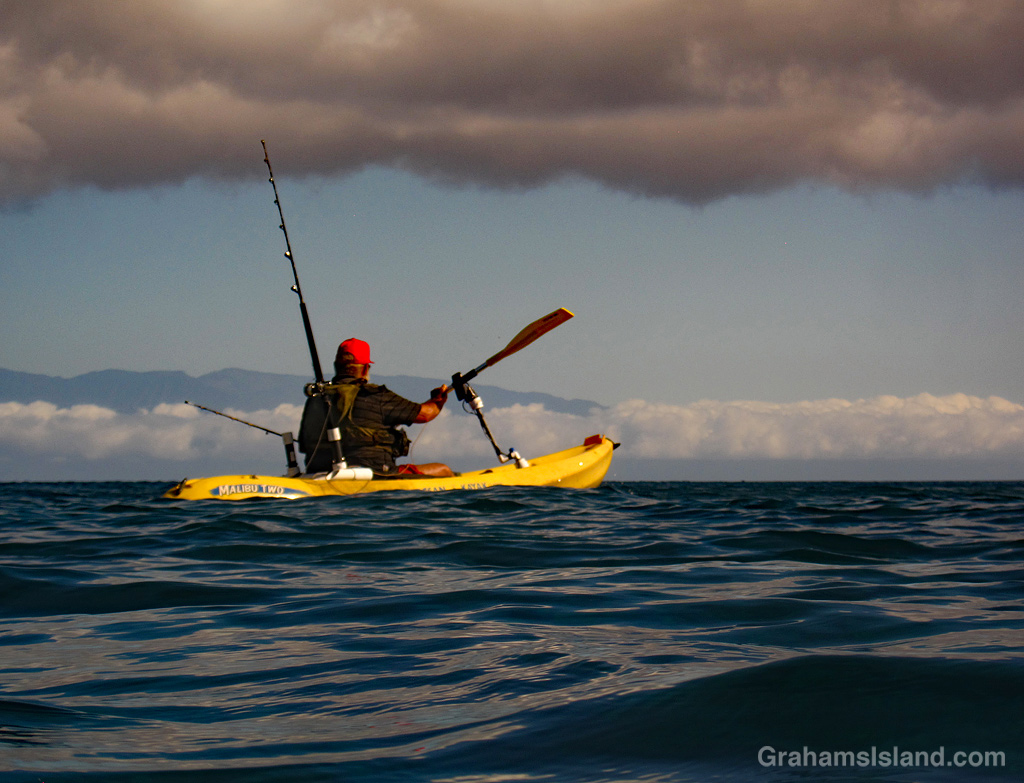
I like the colors in this photo of a kayak fisherman, with his red hat and yellow kayak. He has a fairly typical setup, with two or three rods attached in one way or another. He’ll have some bait in the kayak and probably a few beverages and snacks.
I was surprised to see him passing so close, but figured that he’d seen me and was being careful. In the end, I was glad I stopped to take this photo because just after I started swimming again, a large lure and hook passed in front of me on his unseen trailing line. Had I not stopped I’d probably have been hooked, reeled in, gutted, and barbecued. Not a bad way to go, really, I guess.
I hope this photo doesn’t ruin anyone’s breakfast, but I run it for a couple of reasons. First, a lot of people fish around the island and most of them don’t like eels. Snag an eel on your line and there’s not much to be done. The eel will wrap itself in knots and the only way to be rid of it is to cut the line. The person fishing could try removing the hook and releasing the eel, but even if they were so inclined, the feeling is, ‘why release an eel so that it can tie itself in knots next time you throw a line in?’
And that brings us to the other reason for running the photo, and which also explains another reason no one wants to remove that hook. Look at those teeth! Rows of them, front and back, side to side. Reach for that hook and chances are you’re going to get bitten. This is also why it’s not a good idea to mess with anything in the water. Even little fish that look harmless can have a powerful bite, or sharp spines, or some other nasty surprise.
Last week I posted some octopus photos here. A few days after taking those photos, I had another octopus encounter which I enjoyed a good deal.
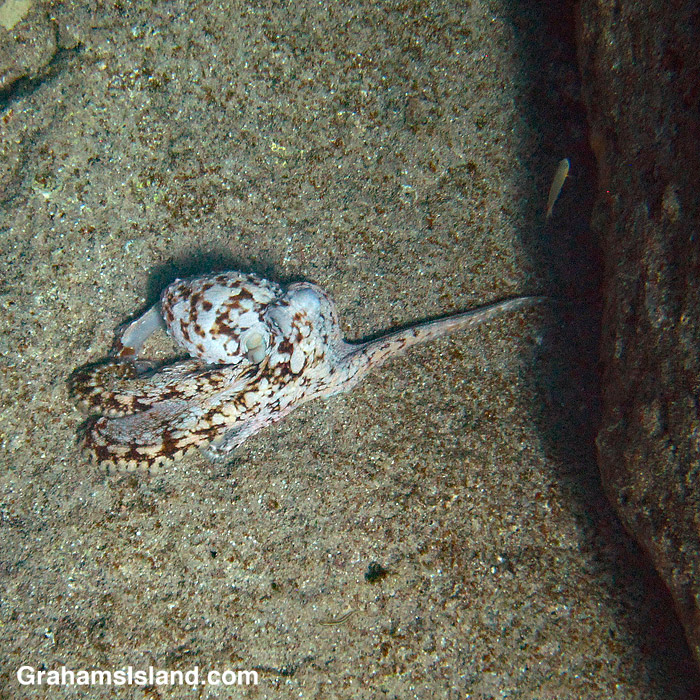
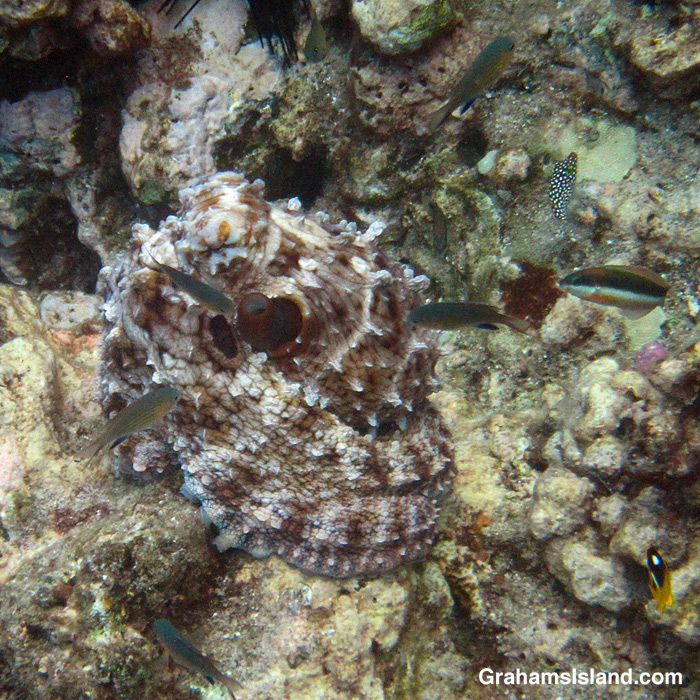
I swam over a rocky ledge and saw an octopus in the middle of a large, flat rock. The rock was pale, but speckled and the octopus was quite white with brown markings. When an octopus gets angry it will flush white, but that wasn’t what was happening with this one. Its paleness was an attempt to blend in.
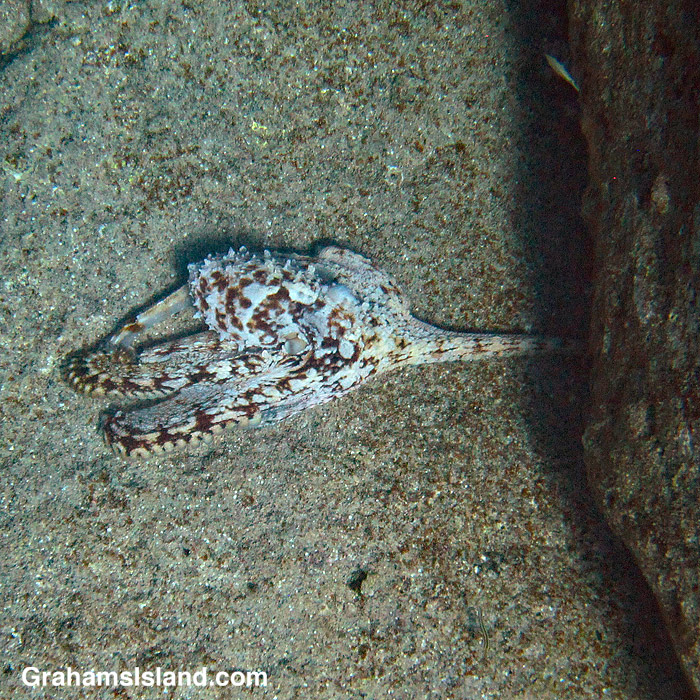
I stopped and the octopus froze. I took a couple of photos. There was another rock a short way away with a dark area where it overlapped the rock the octopus was on. Very slowly, the octopus oozed out a tentacle toward that dark area (top photo). Once the tip reached the shadow it appeared to drop anchor. Then the body of the octopus followed, hauled along on that anchored tentacle. A few moments later, the bulk of the octopus reached the shadows and slipped from view.
It was a slow, deliberate process and I couldn’t help laughing to myself. It appeared as though the octopus hoped that by sliding off in this incremental way I wouldn’t notice its departure. Such a pretty octopus though.
Three spinner dolphins catch the light as they cruise through the water.
A trio of spinner dolphins diving past me.
This is a follow up to yesterday’s post about swimming with dolphins. Within a few months of moving to the Big Island I got to swim with dolphins. A large pod moved into the bay near where I was living and stayed for several hours. Swimming with them was great, but at that time, I didn’t have an underwater camera.
Since then, I’ve mostly seen dolphins from the shore, or just zipping by far enough away that I get a glimpse, but not much more. Several times dolphins have been around just before I get in the water, or just after I got out, or they’ve hung around in the bay on a day I didn’t swim at all.
Last week, several dolphins showed up just after I’d got out, but since they seemed like they might hang around, I got back in and swam out. By the time I got to the place they’d been, I saw them heading south. Four days ago, a small group of dolphins swam by, not far from where I was, without stopping. I got one not-very-good photo.
Three days ago, my wife and I were just preparing to get in when she saw dolphins. They were heading south, but not at speed. Then they seemed to pause. A couple twirled out of the water – spinner dolphins. Perhaps they were going to hang around. We got in the water and headed out.
From the water, it’s harder to spot dolphins unless they’re jumping. When I stopped to look, I couldn’t find them again. When I did, they appeared to be receding. I swam some more, looked up again, and saw dorsal fins. They were heading our way. I ducked my head underwater and got my camera ready. Moments later a group of 10 or more spinners emerged from the hazy water, got rapidly larger, and then passed by on either side of me. They kept going deeper into the bay and I turned to follow. I heard my wife shout and turned in time to see another group go by.
There’s no point chasing dolphins, and it’s not something anyone should do anyway. I’m not a fan of ‘swim with the dolphins’ tours, where they chase them and then dump a bunch of people into the water to get up close and personal. But when they hang around an area, I hang around too in the hope that they’ll come over to check me out. These dolphins did. The next few minutes were a whirlwind of dolphins passing, circling, diving, and occasionally jumping. In close proximity, their size and power was clear, as well as their intelligence and curiosity.
But then, as quickly as they’d arrived, they headed out to sea. The whole encounter was probably no more than 10 minutes, but it’s one I won’t forget, and when I got home I was thrilled that I’d captured several good images.
A spinner dolphin and snorkeler. There were four dolphins making circles around my wife for a short while.A small group of spinner dolphins swims over sand and coral.
This is the final day of Becky’s July Squares challenge theme of ‘Perspective.’ See more responses here.
I was planning on posting images relating to the final days of people who were human sacrifices on the island, a long time ago in case you’re wondering. But I changed my mind after an encounter with a pod of spinner dolphins a couple of days ago. I’ll post more photos tomorrow, but here are a couple to start with.
The top photo shows one of the dolphins coming over to check me out. In the bottom one, a group of dolphins cruises by below me. From my perspective, there are few finer things in life than such an encounter.
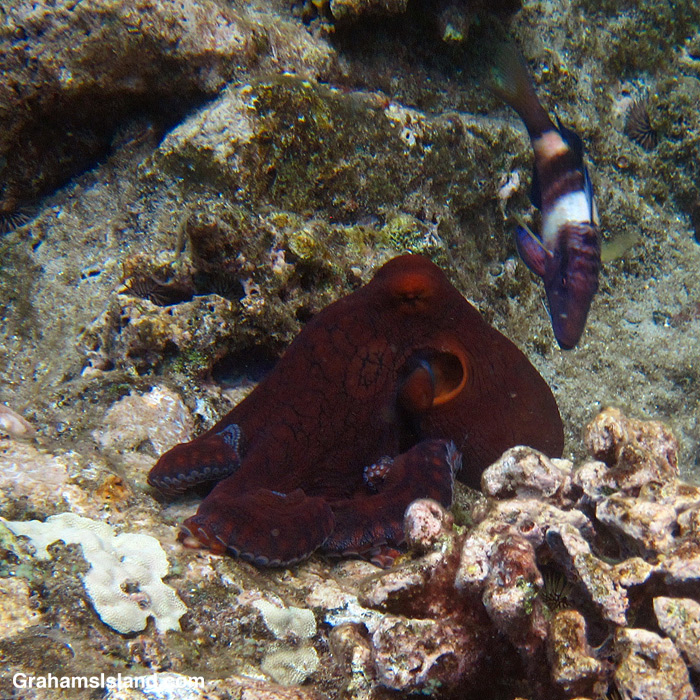
The answer to the headline is that it depends on the moment and the background. I surprised this day octopus when I came around a corner and it instantly changed color. Then it moved and changed color again. I edged away and it moved and changed color again. It changed about five times over the course of a few minutes and each change was like hitting a light switch – one moment this, next moment that.
Their default color is a gray-brown, but I didn’t see that on this occasion. The red of the center photo is a reaction to being surprised and the two mottled patterns are camouflage attempts.
Posted in response to Becky’s July Squares challenge theme of ‘Perspective.’ See more responses here.
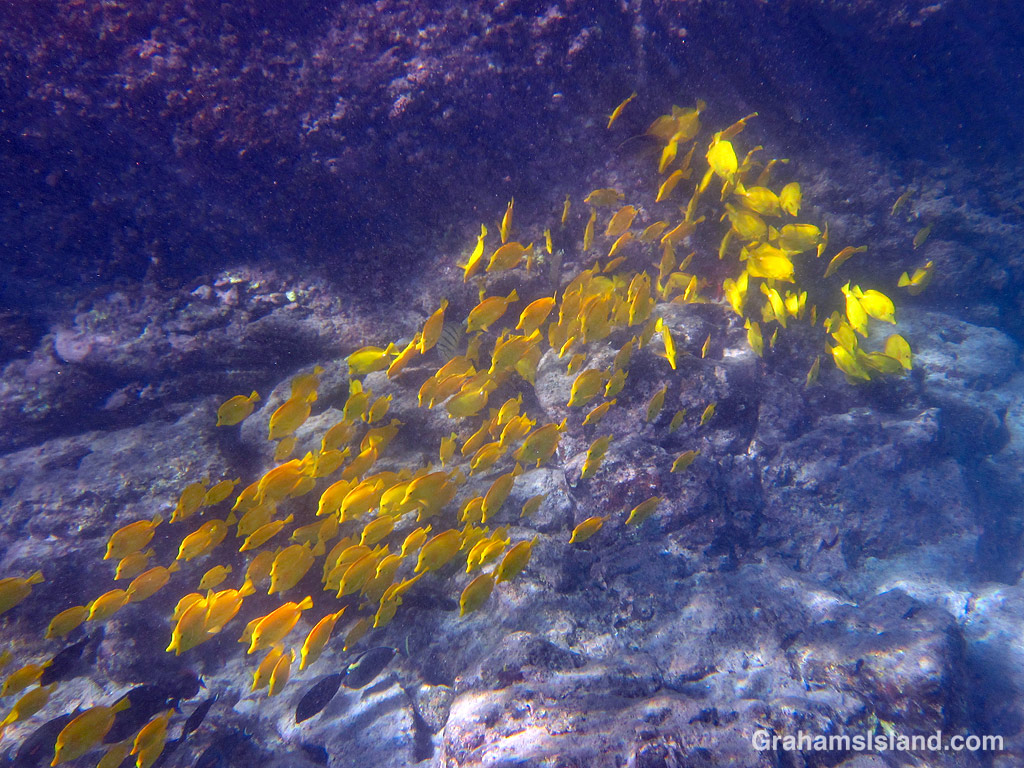
This week’s Sunday Stills challenge theme is ‘Yellow.’ See more offering’s here.
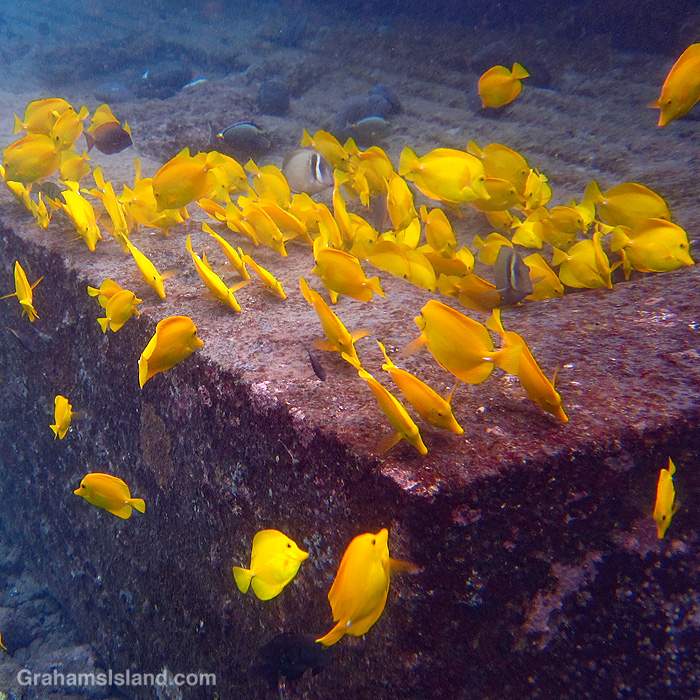
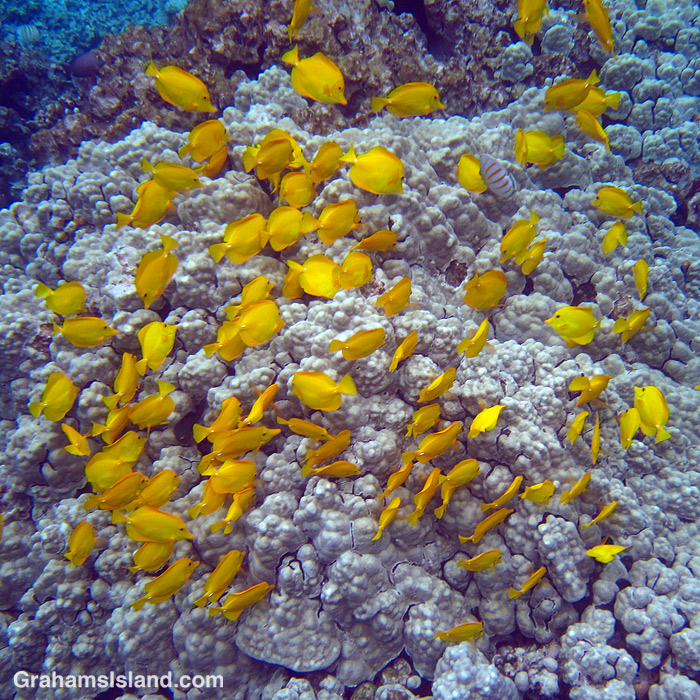
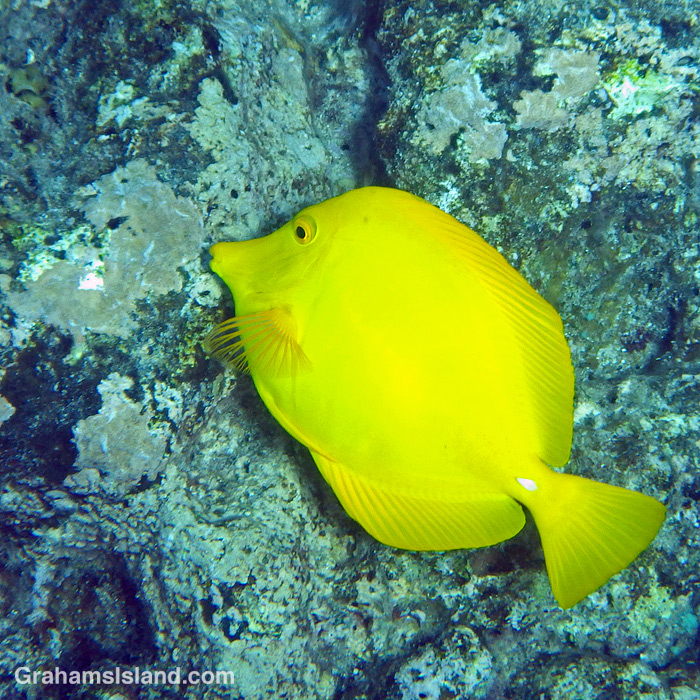
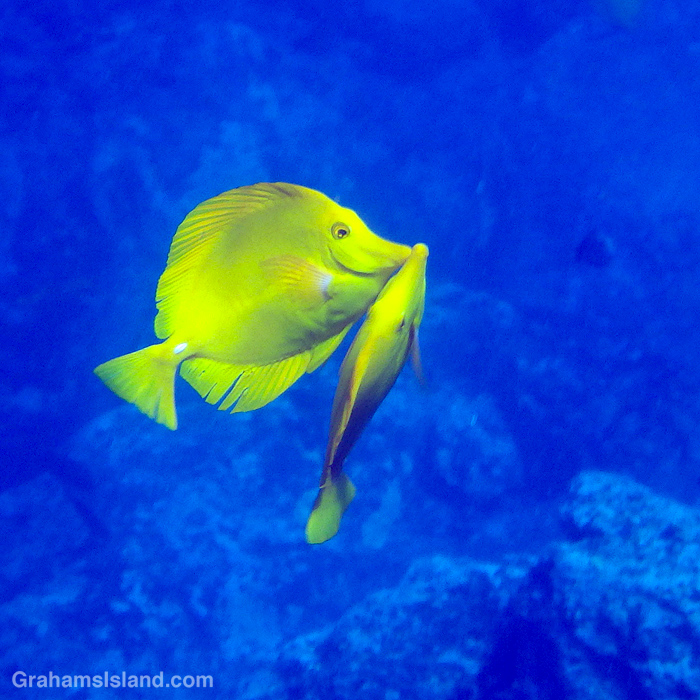
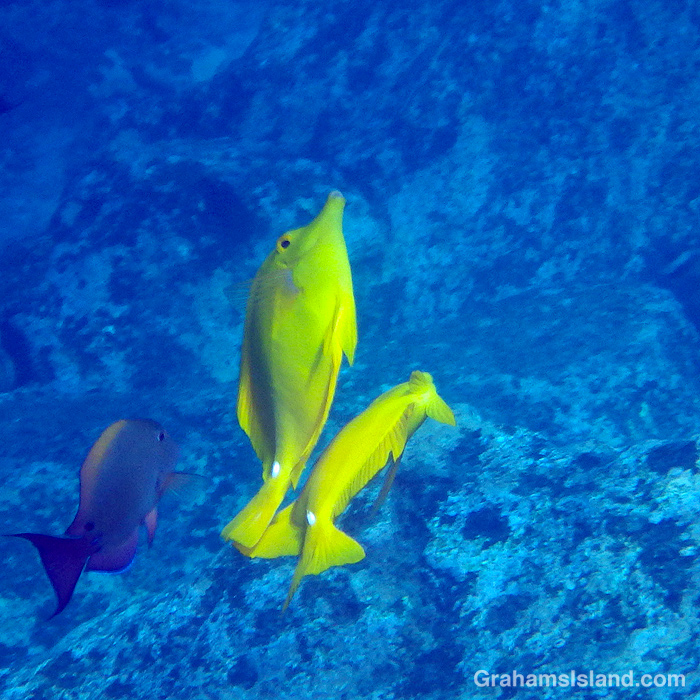
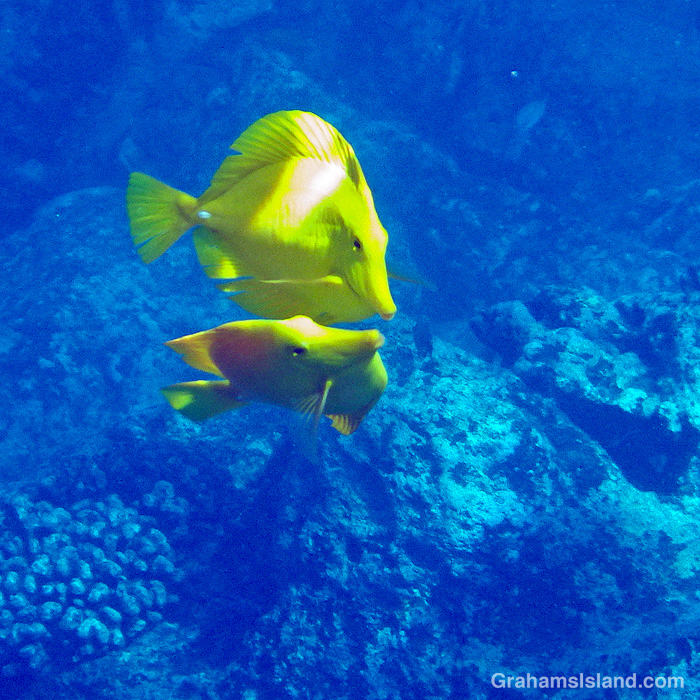
I thought I’d try the WordPress gallery feature for this post, which features yellow tangs, the first fish everyone notices in Hawaii. These bright yellow fish putter about in fairly shallow water, sometimes singly or in pairs, but often in large groups. They feed on algae, and occasionally can be seen cleaning turtles for this purpose. Unlike some fish, juveniles look the same as mature yellow tangs so shoals often contain a variety of sizes. The lower three photos show a pair of yellow tangs engaged in what I think is some kind of mating ritual.
Yellow tang are long-lived fish. They can live to be 20 or 30 years old. They’re also fish that are very popular in the aquarium trade but, since they don’t breed in captivity, all aquarium fish are collected from the wild. Currently, there’s a moratorium on the aquarium fish collection trade here, because of concerns about fish stocks and the sustainability of the practice.
Also posted in response to Becky’s July Squares challenge theme of ‘Perspective.’ See more responses here.
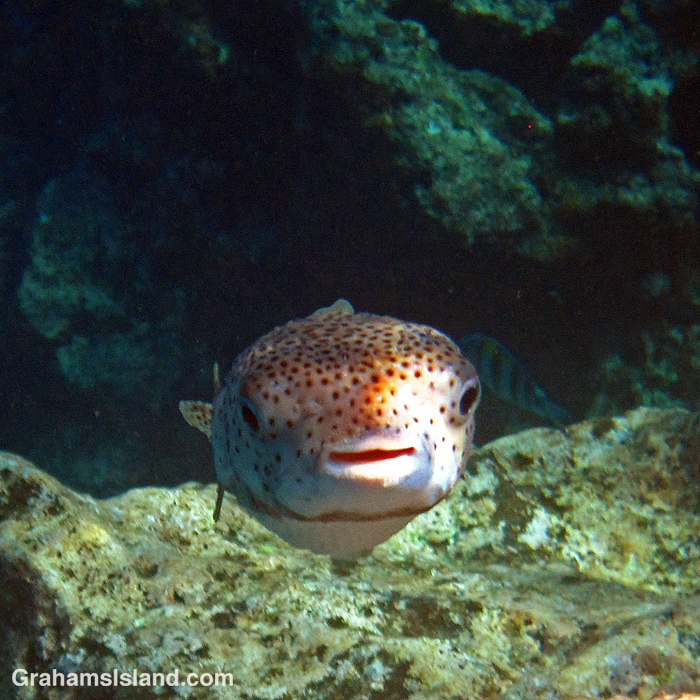
In this case, what’s looking up is a giant porcupinefish and it’s looking at me looking down. It looks friendly, but I would never wave a finger in its direction in case it thought it was a gift and kept it.
Posted in response to Becky’s July Squares challenge theme of ‘Perspective.’ See more responses here.