Category Archives: In The Water

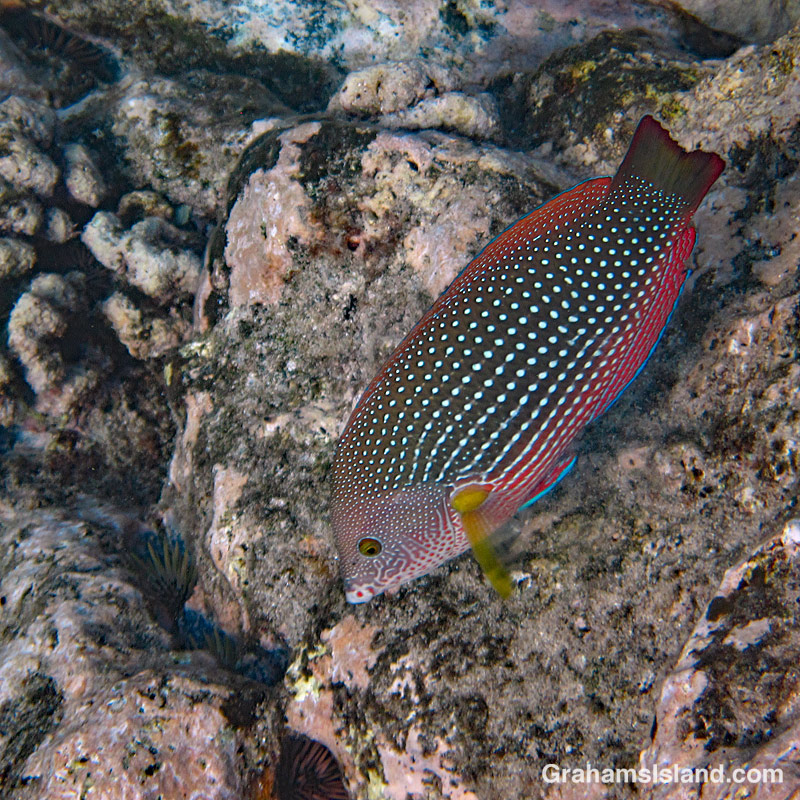
Pearl wrasse

Pearl Wrasse grazing

Pearl WrasseThe pearl wrasse, which is endemic to Hawaii, gets its name from the markings of the female, which look like strings of pearls. The male pearl wrasse is predominantly green with fine blue lines.

I hadn’t seen a pearl wrasse before, or at least not identified one, until this female showed up in a fairly shallow area. She was there for several days before apparently moving on and I haven’t seen her again since.

A striking fish at any time, this one was particularly brilliant when the sun caught her colors.

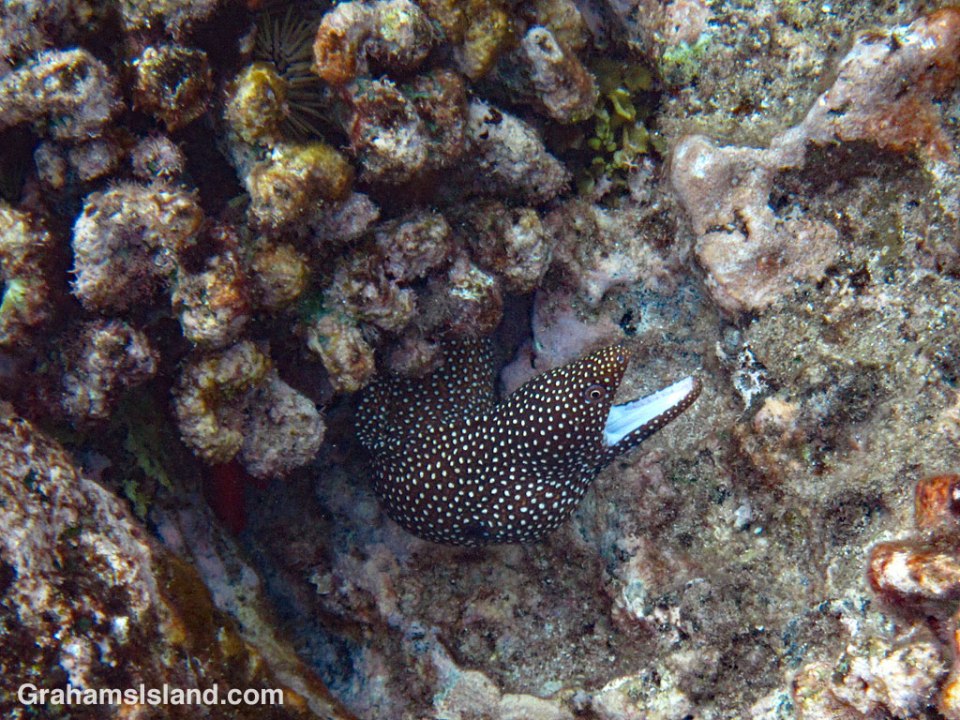
Whitemouth moray eel

Whitemouth Moray Eel

A smaller whitemouth moray eel displays the feature that gives them the name. An eel will typically open and close its mouth in this way, but it’s not an act of aggression. It’s how they breathe, the motion pumping water over the gills.

This pose, with much or most of the eel hidden in a crevasse or coral head, is also typical. It’s how I make most of my sightings. But every so often I’ll see an eel in open water or passing from one hiding spot to the next. It’s usually a fleeting sight as eels can zip along and disappear into the tiniest of cracks.

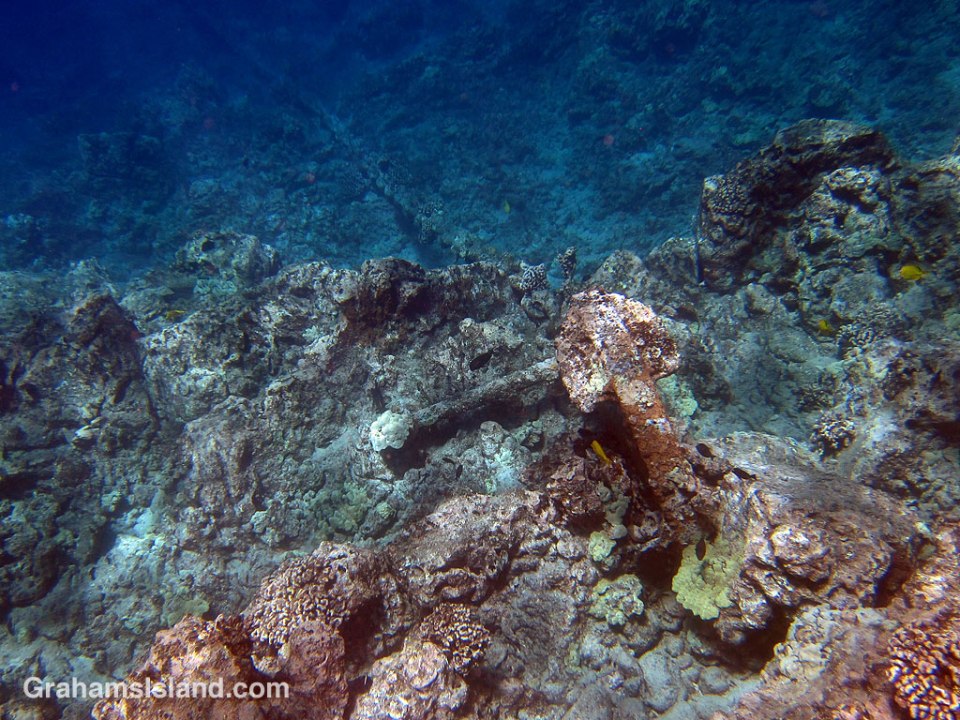
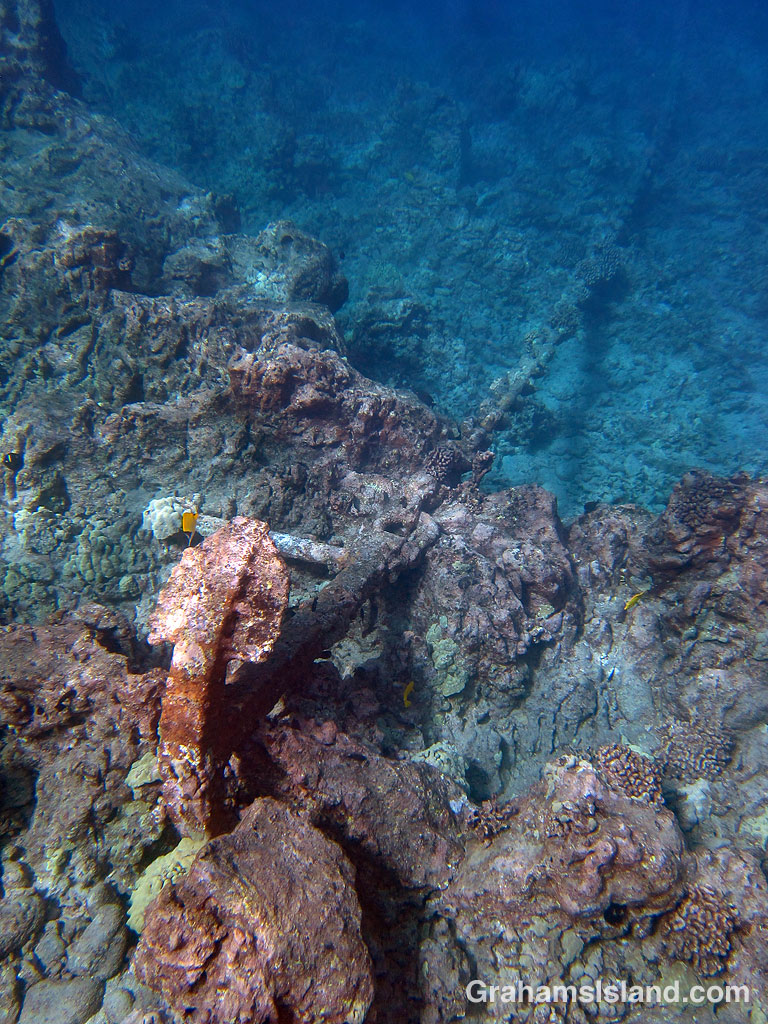
An old abandoned anchor

Sunken Anchor

Sunken Anchor and chainThis week’s Sunday Stills challenge theme is ‘Objects over 100 years old.’ (See more responses here.)

I can’t say for certain that this anchor and chain is more than 100 years old, but it almost certainly is. In the late 1800s and early 1900s, North Kohala was the center of the sugar industry with many plantations and several mills. This anchor likely dates from that time. It’s located in the bay where sugar used to be loaded onto ships.

I suspect the anchor isn’t lost from a ship, since it’s located in shallow water close to shore, with the chain leading out to deeper water – the opposite arrangement of how a ship would normally anchor. Instead, I think the anchor and chain were part of an offshore anchoring system used at the harbor. A ship would drop its anchor from the bow in deep water and attach to the anchoring system from the stern. This would keep the ship fairly stable and make the transfer of cargo, from small boats, easier.

After the sugar industry shut down, a lot of buildings and equipment were abandoned, and in the water, the anchoring system was left to rust.

Dwarf moray eel

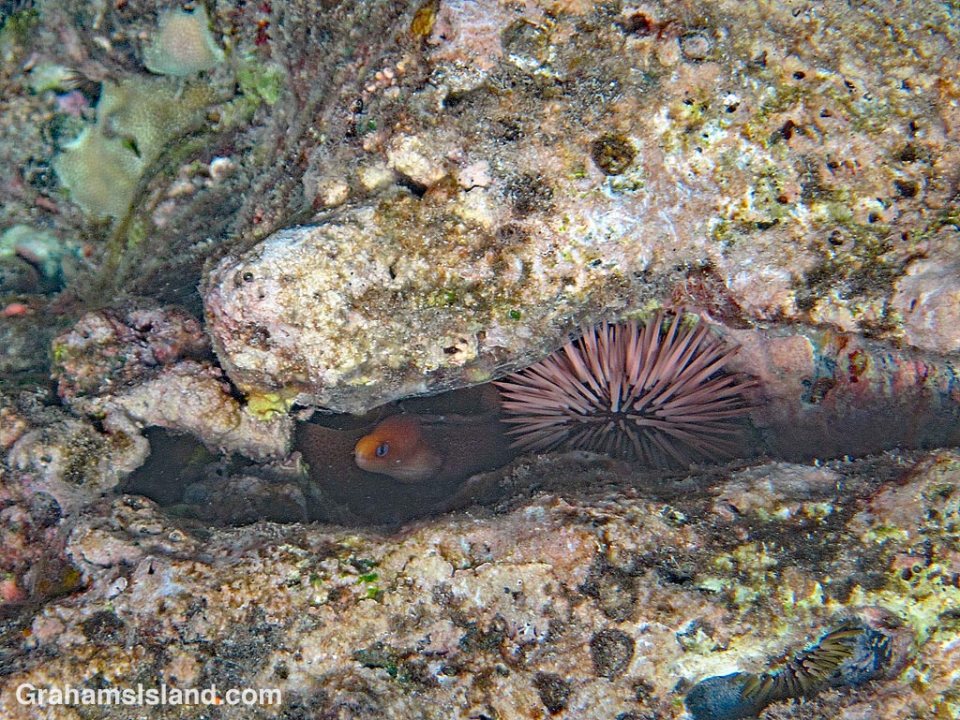
Dwarf Moray eel

I was watching some fish in fairly shallow water when, below them, I noticed this eel tucked away in a groove in the rock. It looked different to anything I’d seen before, but often the young of a species can look very different to the adults. However, a browse through my fish book showed it’s a dwarf moray eel, which doesn’t grow to more than 12 inches long. The clinching feature, which can be seen in this photo, is the dark bar through its eye.

Dwarf morays are fairly common in Hawaii, but because of their size and their reclusive nature they’re not often seen. This was as far as this eel emerged from of its hiding place so I was happy to get this shot.

I think the pinkish pincushion next to it is a rock-boring urchin, which gets its name from the fact that it can bore into solid rock by scraping with its spines and teeth. A second of these urchins can be seen in the little recess below the main one.

Punalu’u turtles

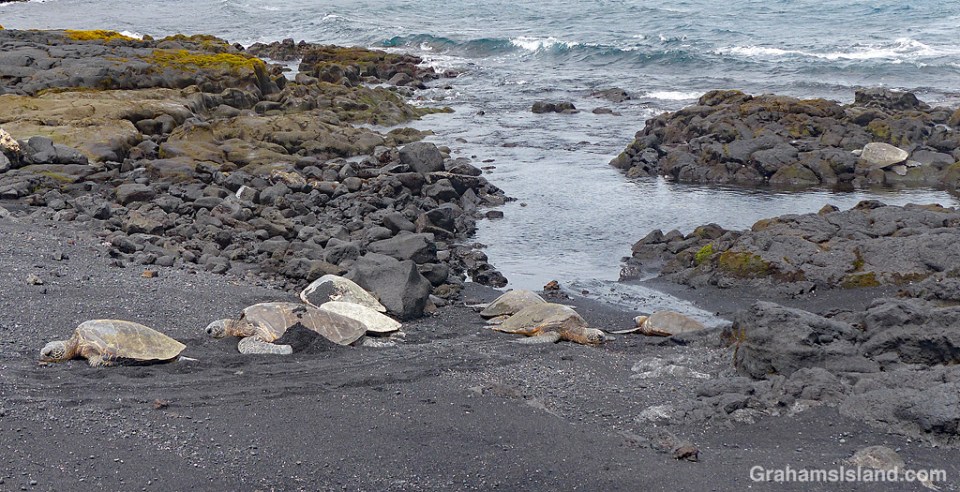
Punaluu turtles resting

Turtles are creatures of the water. The only reason they have to venture ashore is to lay eggs, but in Hawaii, green turtles like to find a beach and spend a lazy day basking in the sunshine. This helps them conserve energy and keeps them safe from sharks.

On the Big Island there are a number of places where turtles are frequently seen on shore. One of them is Punalu’u Beach Park, on the Kau coast, which has a lovely black sand beach ideal for getting a bit of rest. Well, it would be ideal except for that most annoying and obtuse of creatures, the human.

There are apparently large numbers of people who don’t know how to read the numerous signs telling them to keep their distance from the turtles. There are a fair number of people who think the world would be a better place if only there existed a photo of them sitting beside or on top of a turtle.

These days, park staff or volunteers tape off the area where the turtles are resting. This seems to help. The bottom photo was taken from behind the tape with a moderate telephoto lens so it’s not like anyone’s being deprived of getting a good view.

Posted in response to this week’s Sunday Stills challenge on the theme of ‘Lazy Days.’ See more responses here.

Punaluu turtle resting

Monk seals resting

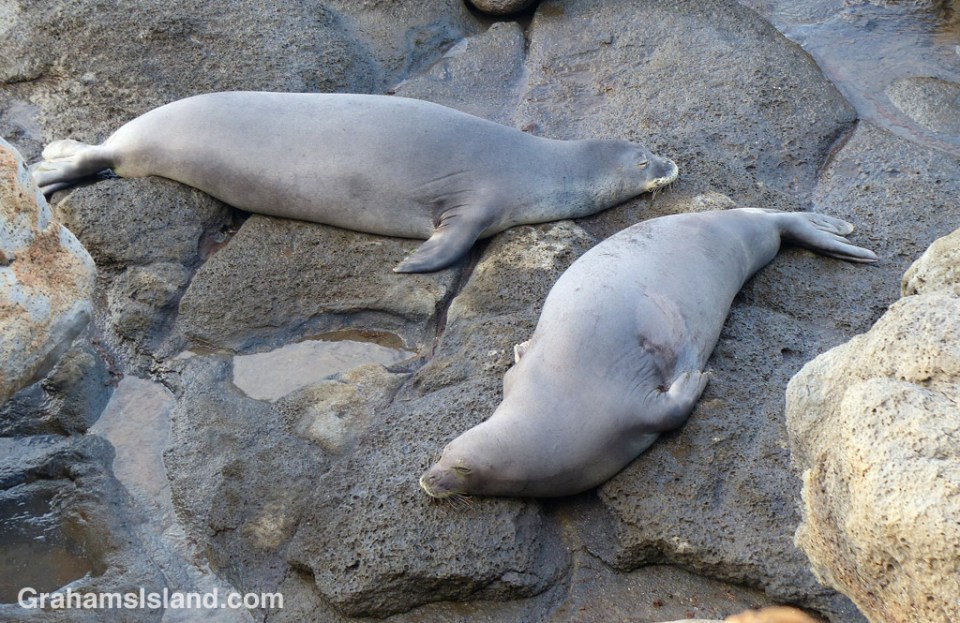
Monk Seals Resting

I’m posting this photo in response to this week’s Sunday Stills challenge on the theme of ‘Friend’ (see more responses here), though it would be equally suitable for next week’s ‘Lazy Days.’

Monk seals are solitary animals, the main exception being the six weeks or so a mother spends with her new pup, teaching it the tricks of the trade, before leaving it to fend for itself. But for a three month period in late 2016, these two monk seals spent a lot of time together.

The top seal is I05, a male, affectionately known as Igor. He’s a Big Island seal and appears to spend his time on the Kohala and Kona coast. The other is B00, a female, affectionately known as Boo. She was born in Kauai and had previously been seen on Molokai and Maui, but now appears to spend much of her time on the Kona coast. Whereas not too much had been known about B00, I05 was regularly seen and was a notorious loner. So his ongoing liaison was quite out of character.

They seemed very relaxed and content in each other’s company, and here are resting ashore, as monk seals do, before heading back into the water to feed.

Threadfin jack juvenile

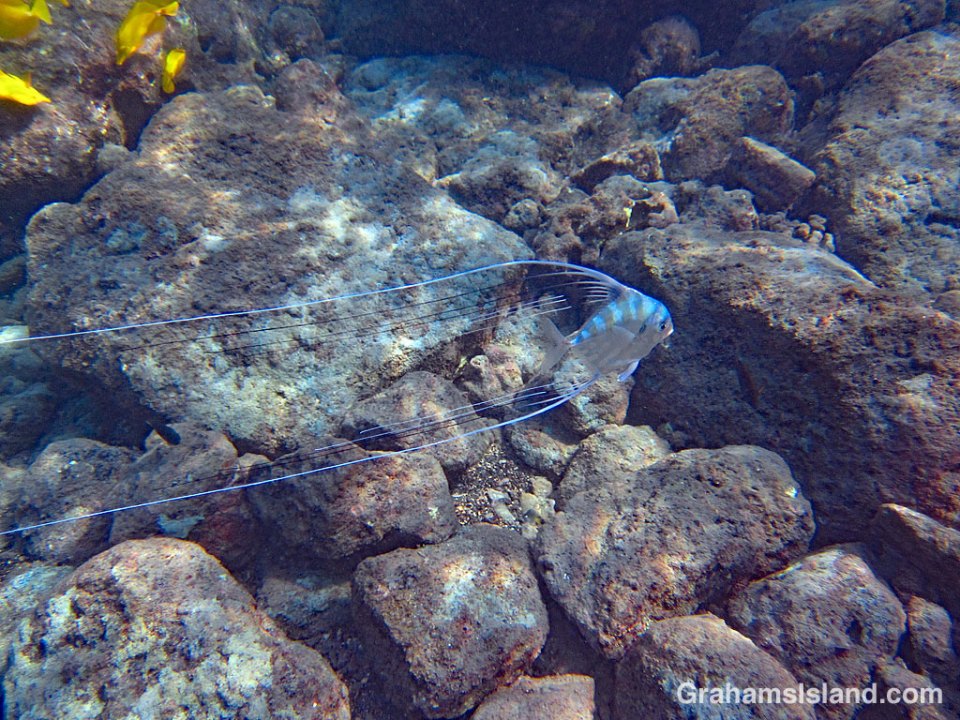
Threadfin Jack juvenile

This is the time of year when juvenile threadfin jacks can sometimes be seen in inland waters. I’ve been on the lookout for them since May, but haven’t seen any. This doesn’t mean they’re not there; so small and shimmery, they’re easy to miss in murky shallow water.

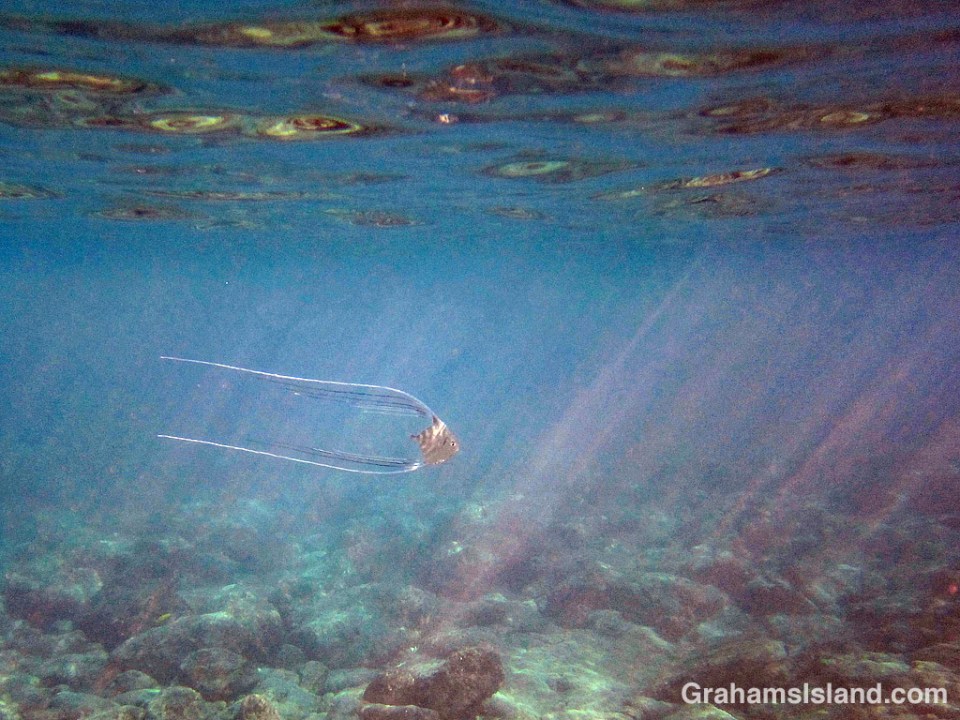
Last week, my vigilance was rewarded. While the water wasn’t too clear, the swell was low so I headed among the rocks near the shore and saw my first threadfin of the year. I took the bottom photo which, while not great, does show the shallow area it tends to inhabit and the sun filtering through that water.

Next day, I went back to the same spot but didn’t see the fish. So I turned and headed out toward deeper water and almost bumped into it coming the other way. I quickly snapped the top photo as it went by, not sure if it was even in the frame, before it disappeared into the shallows.

In the past, these juveniles have stuck around for several weeks, so I’ll hopefully get to see this one a few more times. Ultimately, it will head out to deep water and grow up to be a stocky four-footer living up to 200 feet down.

Threadfin Jack Juvenile in sunlight

Fish farm

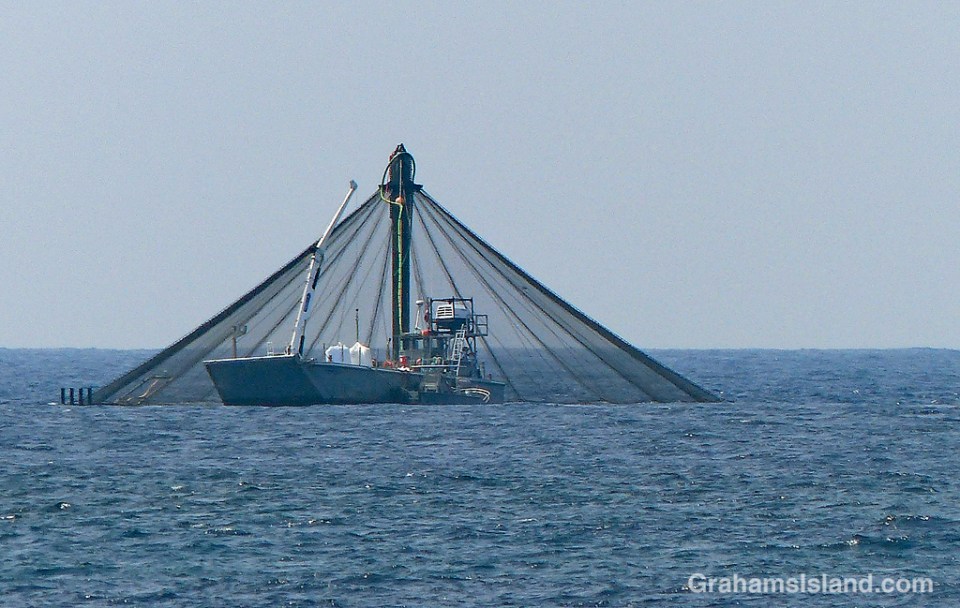
Fish farm net pen and boat

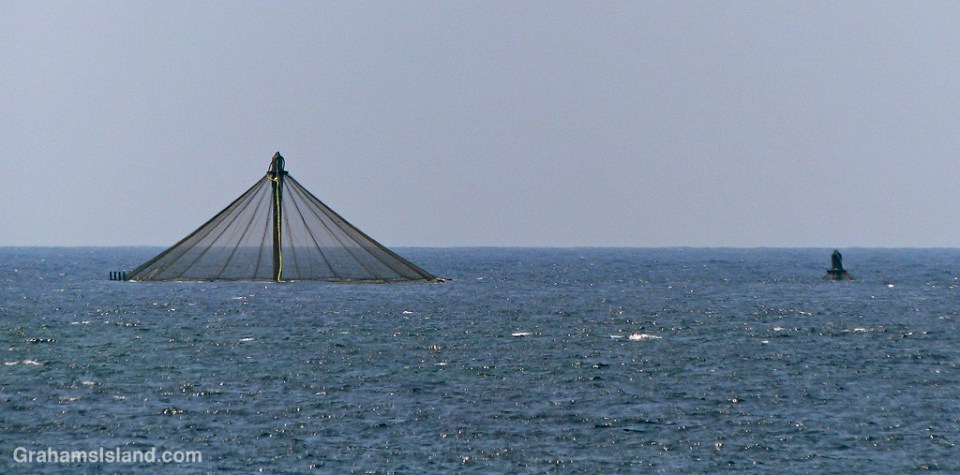
Not far off the Kona coast, near the airport, one or more of these nets can often be seen. They’re the submersible net pens of a fish farm run by Blue Ocean Mariculture. The farm raises Almaco jack which it markets under the name Hawaiian Kanpachi.

In the wild, the fish is prone to ciguatera, a toxin that can cause diarrhea, vomiting, numbness, and other unpleasant symptoms. This is the reason almaco jacks aren’t fished commercially. But the farmed fish are free of this problem. I have mixed feelings about farmed fish, but this farm seems to be well regarded and is approved by Monterey Bay Aquarium’s Seafood Watch.

Part of my ambivalence may be down to the fact that, last year, one of the few resident monk seals living around the island became trapped in a pen and drowned. I’ve since heard that when work is being done on a pen, it should be raised so part is above the surface. That way, if something swims into a pen and can’t get out again, it can at least surface inside the pens to breathe. Whether that happened in this case, I can’t say. The official word is that mariculture projects in Hawaii are under review by the Army Corps of Engineers and NOAA.

Fish farm net pens