Category Archives: Trees

Kou tree

Kou flower and bee

Kou flowersKou (Cordia subcordata) is an indigenous tree that was also brought over by Polynesian settlers. It was highly prized for its wood, which was used to make bowls and other containers.

The flowers are beautiful, too. Less than two inches across, they grow in clumps, which are sometimes hidden by the shiny green leaves. The flowers are followed by small, round green fruits (seen in the photos to the left and below) which harden to a dark brown and contain white seeds.

The flowers on this tree were popular with a variety of insects including a honey bee, above, and a paper wasp (Polistes exclamans), below.

Kou flower and paper wasp

Kou flower and wasp

Kou tree

Long-tailed blue butterfly

Long-tailed Blue Butterfly

I think this is a long-tailed blue butterfly, otherwise known as the bean butterfly. It’s a pest on beans and peas and also wild legumes. My only question about the identification is that the tail, normally seen where the black spots are, is not visible here. But it’s possible that this butterfly has suffered a bit of damage in that area. Some butterflies look so beaten up that it’s a wonder that they’re able to fly at all.

It’s resting on the flowers of a mamane tree.

Royal poinciana

Royal Poinciana flower spray

Royal Poinciana flowersRoyal poinciana (Delonix regia) is also known as the flame tree. As well as producing a stunning array of crimson flowers, it has lacy-looking leaves and produces long, distinctive seed pods.

I noticed this tree, tucked away at the end of a small commercial area in Kawaihae. The top photo shows an array of flowers. The flowers consist of four red petals with a fifth upright petal which is more yellow and white, as in the photo to the right. The photo below shows three of the seed pods which start out green before turning brown. At the bottom is the full tree. It can do well close to the ocean, as this one is, because it’s salt tolerant.

Royal Poinciana seed pods

Royal Poinciana tree

Cannonball tree flowers

Cannonball tree flowers

Cannonball treeI’ve posted a photo of a cannonball tree (Couroupita guianensis) before, here. That one focused on the cannonballs that give the tree its name. On this occasion I was taken by the flowers which can vary in color from pink to deep red. These flowers were on the pink end of the scale. The flowers are also fragrant, especially in the early morning and evening.

The flowers grow directly off the tree trunk and all the way up, but it takes a closer look to really appreciate how beautiful they are.

Abstracts: Rainbow Falls banyans

Abstracts-Rainbow Falls Banyans

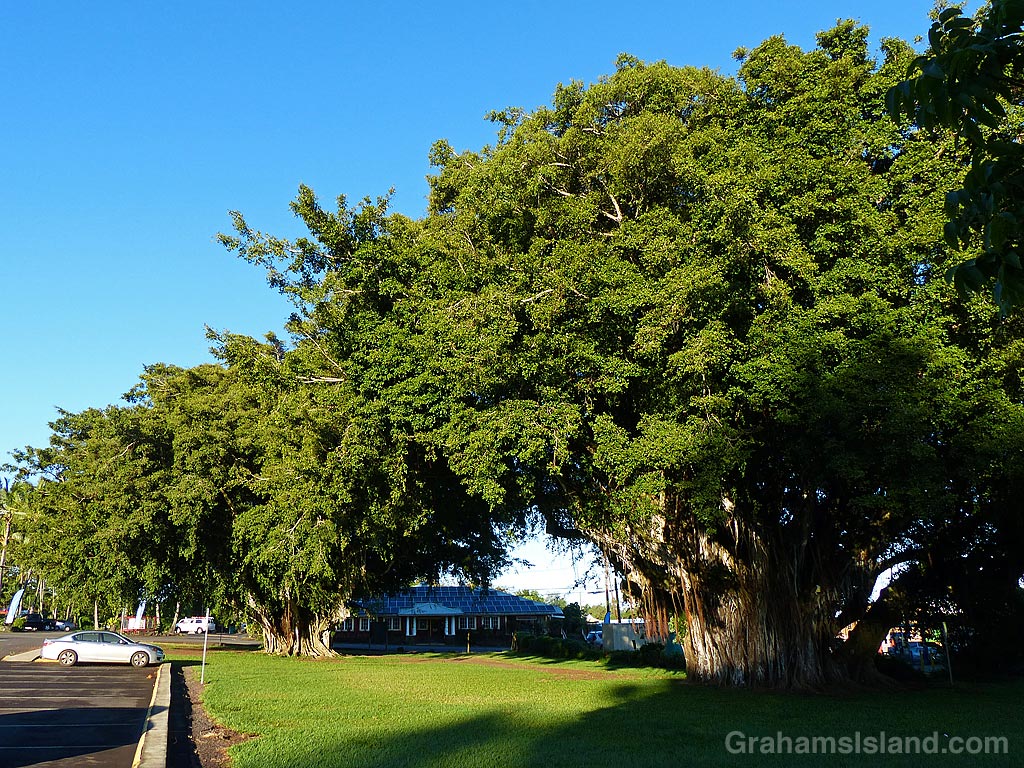
Abstracts-Rainbow Falls BanyanThe main attraction of Wailuku River State Park, in Hilo, is Rainbow Falls. But at the top of the hill are these huge banyan trees.

Banyans are not just a huge sprawl of branches, but a sprawl of roots, too. As epiphytes they begin life growing on other trees, from seeds dispersed there by birds. Over time, they send roots down to the ground, known as prop roots, which help support the mass of branches.

Banyan trees are also known as strangler figs because their roots and branches will ultimately overwhelm the host tree and kill it. Eventually, the dead host will decay and leave a hollow center to the banyan tree that’s left.

By continuing to send down prop roots, banyans grow out as well as up. Very old trees can cover a huge area. For example, the Great Banyan Tree in Kolkata, India is more than 250 years old. Its covers around four acres and has more than 3,500 prop roots. Here in Hawaii, the largest banyan grows in Lahaina on Maui. Planted in 1873, it now has 16 main trunks and covers two thirds of an acre.

The Rainbow Falls trees aren’t that large, but they’re coming along nicely.

Abstracts: Eucalyptus trees

Abstracts-Eucalyptus trees

The Hamakua coast of the Big Island is the site of extensive eucalyptus forests. These tall, fast-growing trees are grown for export to Asia. Harvested trees are trucked to the west side port of Kawaihae and stored there until the next ship comes in.

However, last year, the company running the operation decided not to renew its lease. Since then, the landowners have been casting around for a new business to carry on the work, so far without success. So the trees continue to grow, making a pleasing sight with their dappled trunks catching dappled sunlight.

Is it windy here?

Kauhola Point tree

Northeast trade winds are Hawaii’s air conditioner, moderating what would otherwise be much hotter temperatures. The North Kohala coast is a spot where the winds whistle ashore. They can be very strong, but if you want to know how strong, the surest way is to ask a tree. This one is near the Kauhola Point light.

Posted in response to this week’s Sunday Stills challenge on the theme of ‘Wind.’ See more responses here.