Category Archives: Hawaiian History

Small Asian mongoose

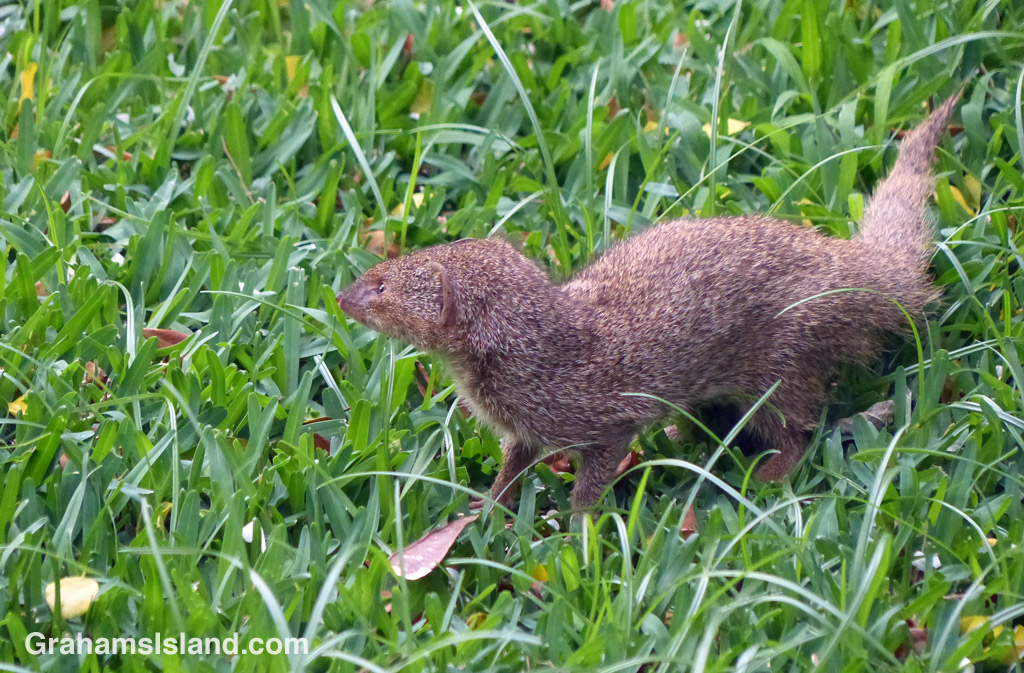
A small Asian mongoose
Here is a great candidate for exhibit A in ‘good intentions gone wrong in Hawaii.’ Back in the late 1800’s, rising rat numbers on the Big Island were causing concern, especially among sugar plantation owners. I mean, nobody wants rats around. They bite. They carry disease. They breed like crazy. They kill native birds and eat their eggs. They’re just generally nasty and a menace.

So the plantation owners brought in the small Asian mongoose (Herpestes javanicus) to control the rat population. What could possibly go wrong? Well, for starters, mongooses are diurnal, operating mostly during the day. Rats are nocturnal, active at night. So apart from the twilight hours, never the twain shall meet. In consequence, mongooses had next to no effect on the rat population. The plan was dead on arrival. Still, no harm done, right?

Not exactly. Since the mongooses weren’t subsisting on a diet of fat, juicy rats, they needed something else to eat. And one of the many things on their menu was native bird eggs. The net result was that, instead of eliminating rats, the mongoose extended the problems they caused to 24 hours a day. The effect on native birds in particular, was especially damaging. Kaua’i has a far greater abundance of birds than the Big Island, in large part because it is still, theoretically, mongoose-free.

In Hawaii, mongooses are the poster animals for the devastation wrought by invasive species because, well, they bite, they carry disease, they breed like crazy, they kill native birds and eat their eggs. In fact, they’re just generally nasty and a menace.

Here on the Big Island, mongooses are most often seen scooting across highways. A generous scattering of squashed corpses attests to those that didn’t make it.

For more information about the small Asian mongoose, go to instanthawaii.com/cgi-bin/hawaii?Animals.mongoose.

Puako Petroglyph Archaeological Preserve

Puako Petroglyphs
Puako Petroglyphs

Petroglyphs can be found at many places around the Big Island. The most extensive display is the Pu’u Loa field at Hawaii Volcanoes National Park, but the Puako Petroglyph Archaeological Preserve also has numerous examples. More than 2,000 petroglyphs, dating back hundreds of years, have been identified. Not all are visible from the area where visitors can go.

Somewhat weirdly, the field is found on the north edge of Mauna Lani resort. This means that in order to see these examples of ancient Hawaiian history and culture, it’s necessary to drive through a swathe of condos and golf courses.

The bulk of the petroglyphs are found at the end of a hot, half-mile trail, bordered by kiawe trees, which are notorious for their long, sturdy, footwear-penetrating thorns. It’s an easy hike and well worth a visit if you have any sort of interest in the history of the island.

Puako Petroglyphs

Keawaiki to Kiholo hike

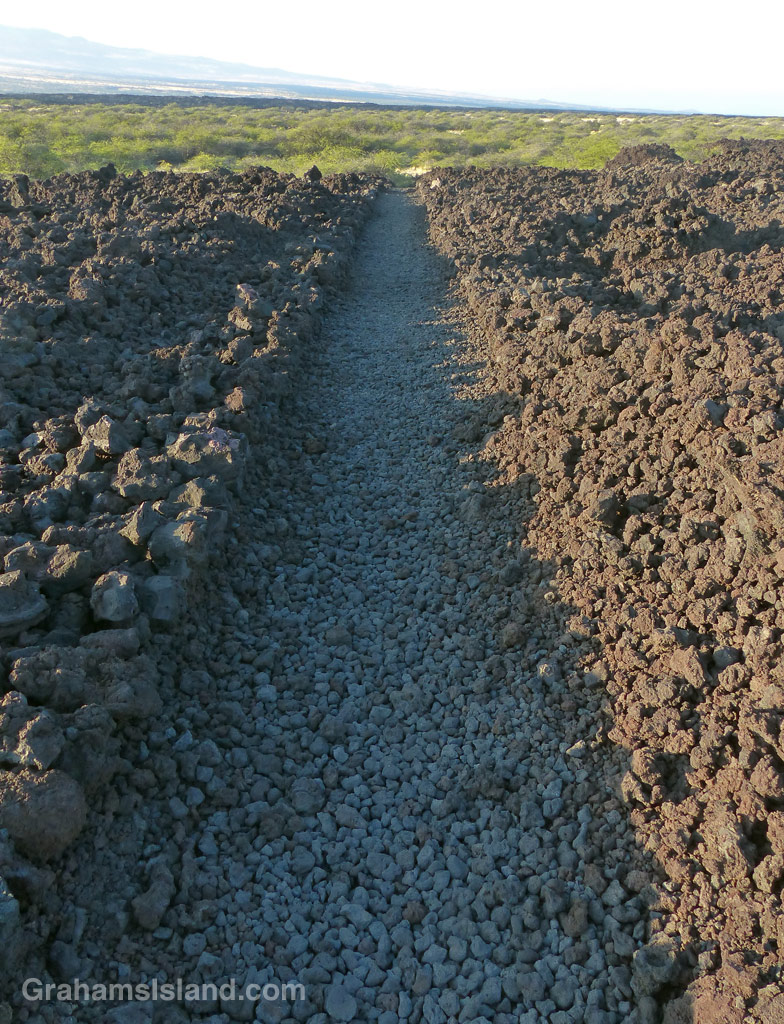
The King's Trail makes a straight shot to the south of Keawaiki.
The King’s Trail makes a straight shot to the south of Keawaiki.
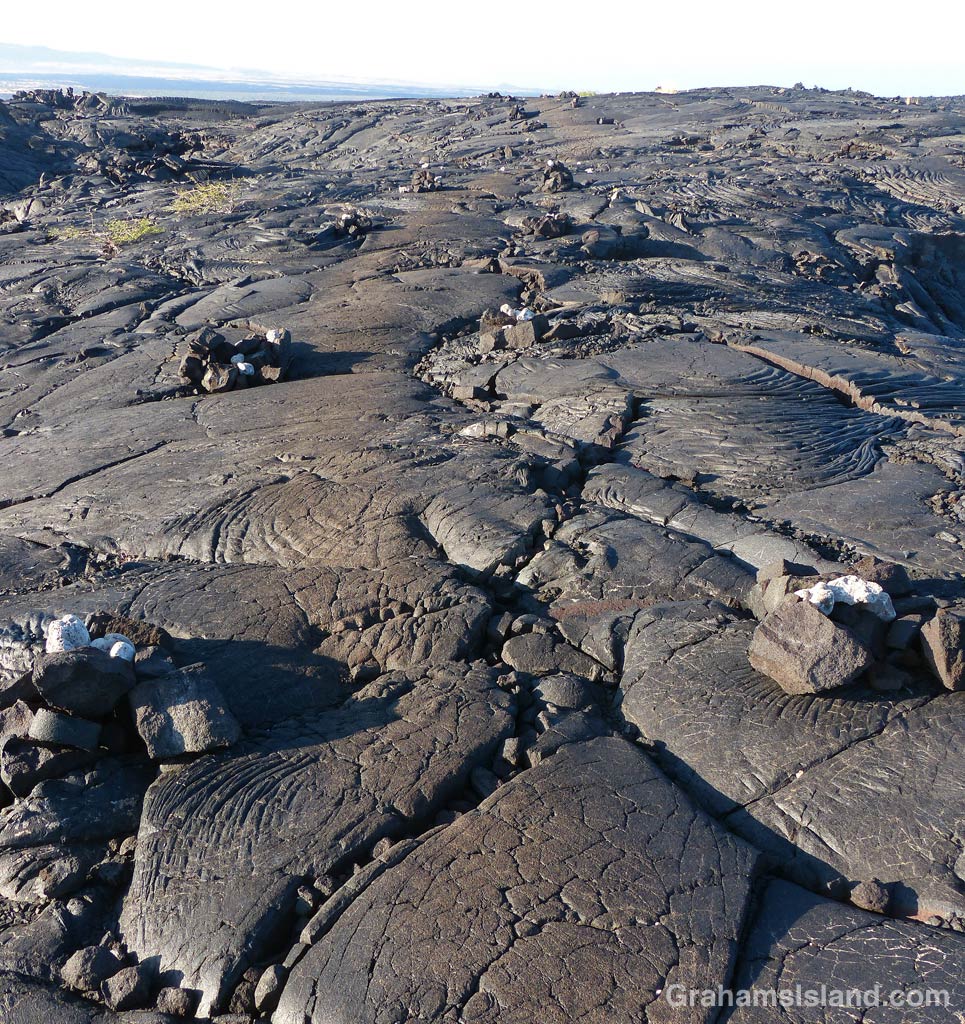
The King's Trail winds over the pahoehoe lava of Mauna Loa's 1859 eruption. The trail is marked by cairns and, in places, the worn surface of the trail stands out from the surrounding lava.
The trail is marked by cairns and, in places, the worn surface stands out from the surrounding lava.
1-6-16-1859-flow-HW
The trail takes a turn.

This hike is the first half of a loop from inland of Keawaiki Bay, south on the old King’s Trail to Kiholo, returning along the coast.

I was on the trail before 8 a.m. because the lava fields become very hot as the day wears on. The trail started out dead straight, with rock wall sides, until it reached a scrubby tree growing in the path. I figured it would pick up again on the other side, but this marked the boundary of the lava flow from Mauna Loa’s 1859 eruption, which destroyed fishponds and a village on the coast near here.

Instead, the trail wound over and around hummocks of pahoehoe lava and the way was marked mostly by cairns. Pahoehoe lava tends to be fairly smooth and rounded and is relatively easy to walk on, but still requires attention. It’s a matter of a moment’s inattention to end up jamming a foot into a crack and turning an ankle or worse. It’s also very easy to spot the next cairn, wander in its direction, then suddenly realize you don’t see any more because the trail has veered off to avoid some hole ahead or take advantage of easier going.

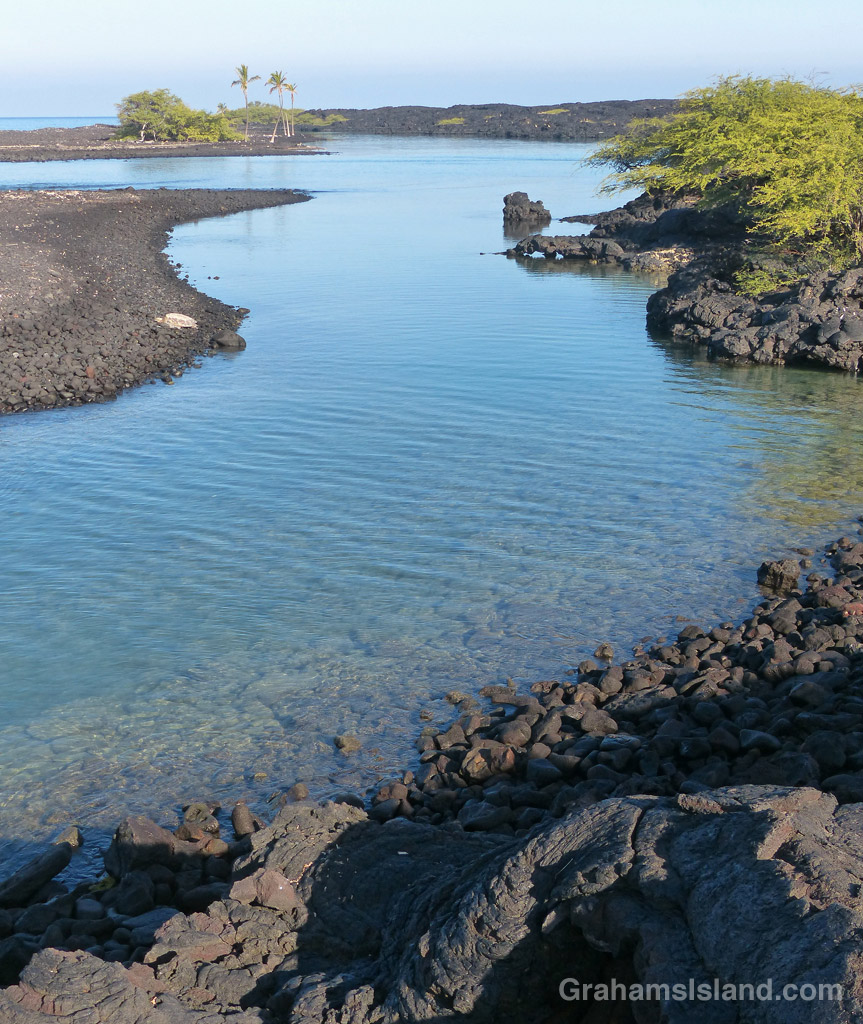
The tranquil waters of Kiholo Bay.

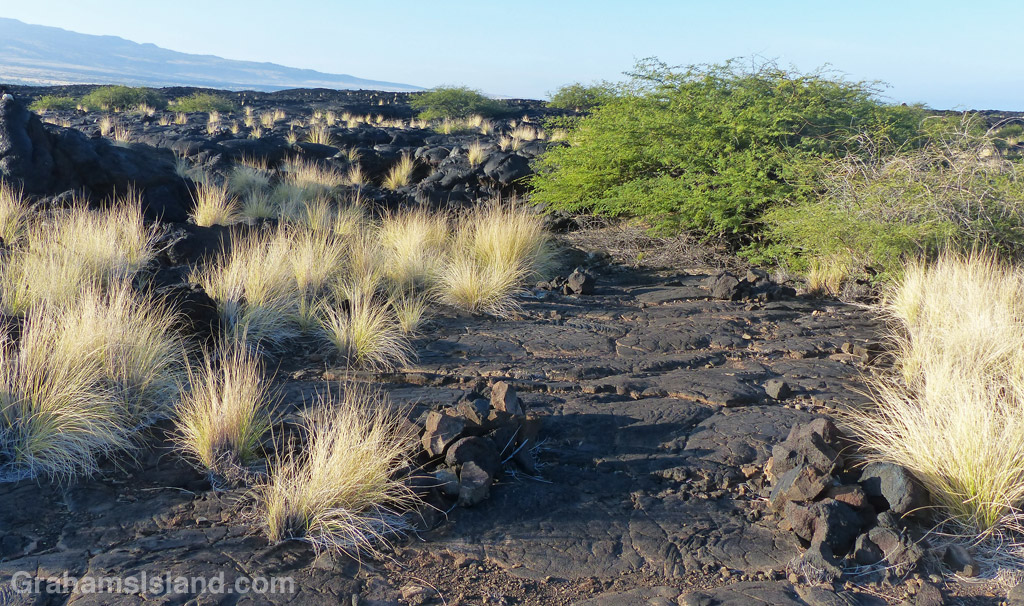
This is a stark landscape, unrelenting lava with occasional shrubs and tufts of fountain grass. But I like the history of the trail, its connection to the early days of Hawaii.

The distance to Kiholo is a little under 3 miles and I was plenty hot by the time I got there. But at Kiholo there’s shade to be found and the opportunity for a swim. I’ve snorkeled at Kiholo before, but it’s not the greatest. Freshwater springs make the water cloudy and cool.

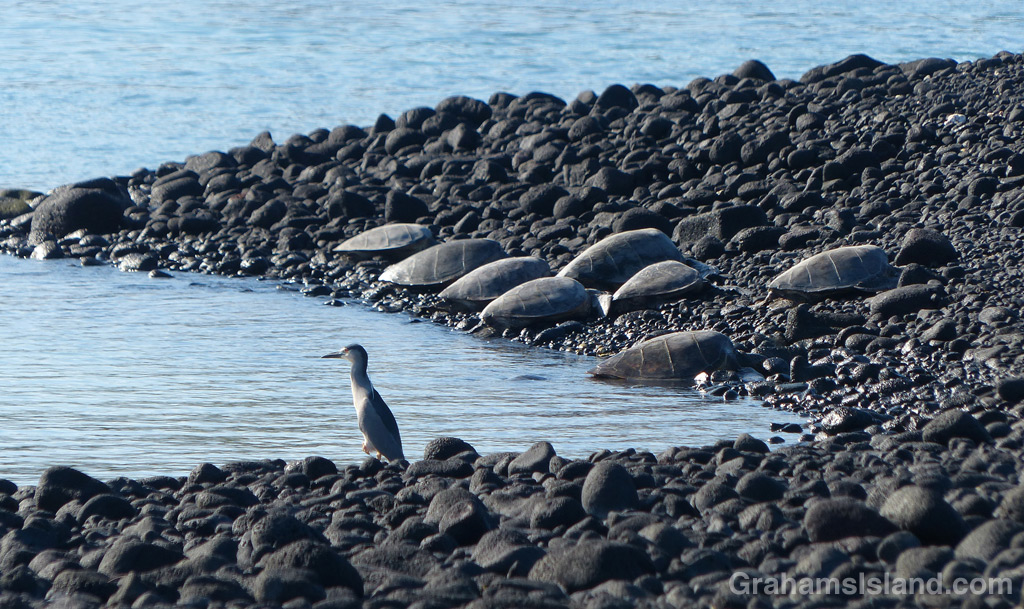
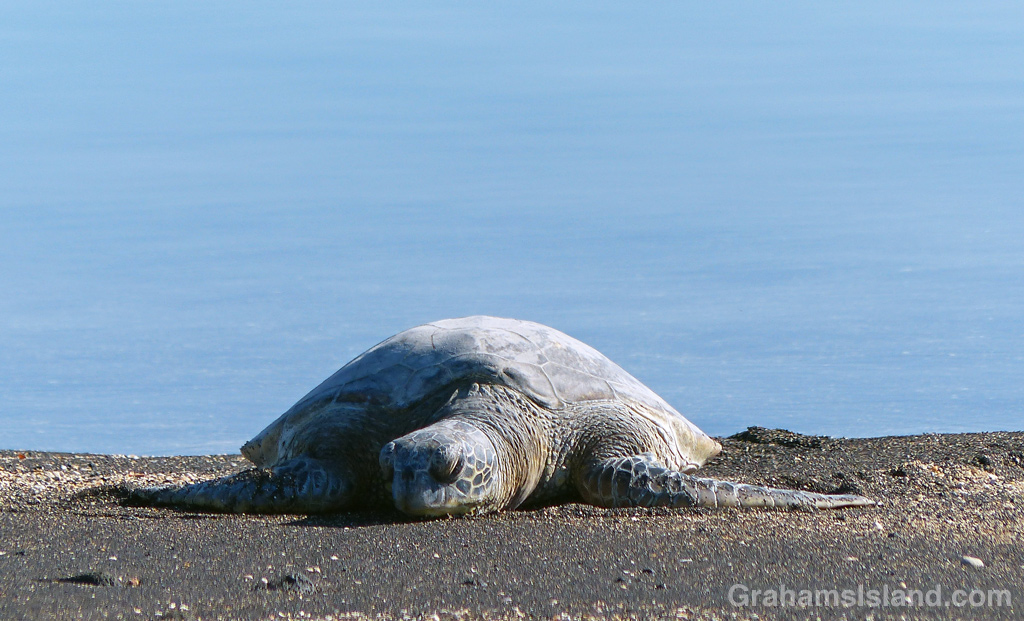
There’s a blue Kiholo Bay Fisheries Management Area sign where the coast trail almost doubles back on the one I’d arrived on. This lightly marked trail winds around a bay rich with wildlife, most notably green sea turtles. Usually they’re hauled out on the spit that forms the outer part of the bay. This day was no exception. A cluster of 8 turtles had lumped ashore near the tip of the spit, watched over by a guardian heron. Others were scattered in ones and twos up the inside of the spit. I hiked down the length of the spit enjoying the welcome sea breeze and taking photos, making sure not to disturb the turtles. Then it was time to head north again. (For the return hike, click here)

For more info about this, and other hikes on the Big Island, go to bigislandhikes.com. (The hike is listed as Kiholo to Keawaiki, starting from the south.)

A heron stands watch while green sea turtles rest on shore at Kiholo Bay,
A heron stands watch while green sea turtles rest on shore at Kiholo Bay.
1-6-16-Green-Turtle-HW
Green sea turtle resting on the shore at Kiholo Bay.