Category Archives: Series

Better Days: ’Aimakapa Fishpond sluice

’Aimakapa Fishpond sluice at Kaloko-Honokohau National Historical Park

’Aimakapa Fishpond is one of two fishponds at Kaloko-Honokohau National Historical Park. The other is Kaloko Fishpond, which is separated from the ocean by a huge rock wall, currently being restored. ’Aimakapa Fishpond’s barrier is made up of sand dunes.

A channel was dug to the ocean to allow water to circulate back and forth and, at the ocean end (seen here), a sluice gate (makaha) installed. The sluice gate helped keep predators out. These days it isn’t used and so the channel has silted up with sand.

Fishponds are different to fish traps. Ponds allow for the rearing of fish from small fry. Traps are shallow walled enclosures, which fish can cross at high tide, but cannot escape from when the tide goes out.

For more information about Kaloko-Honokohau National Historical Park, go to www.nps.gov/kaho/index.htm.

Abstracts: Koi in Lily Lake

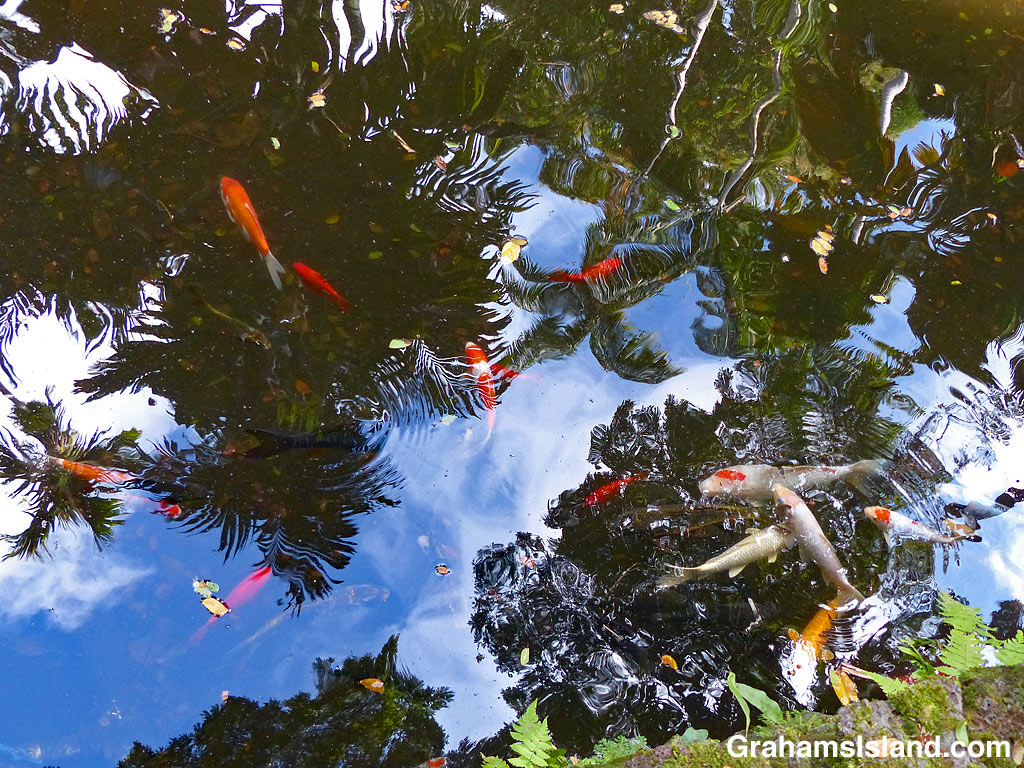
Koi swim in Lily Lake at Hawaii Tropical Botanical Garden

Lily Lake, in the grounds of Hawaii Tropical Botanical Garden, is a tranquil spot which I particularly enjoy for the reflections it provides. On my last visit, the koi in the lake made an appearance and added to the spectacle. As I moved back and forth, on the walkway alongside the lake, the koi followed, clearly hoping I was about to throw a little food their way.

For more information about Hawaii Tropical Botanical Garden, go to htbg.com.

Better Days: Girdled tree

A dead tree stands out on Pu'u Wa'awa'a

This dead tree on the slopes of Pu’u Wa’awa’a did not die of natural causes. The pale strip near the bottom of the trunk is where the tree was girdled.

The tree is, I’m pretty sure, a silk oak. Native to Australia, these trees were introduced to Hawaii around 1880. When in bloom, they present a mass of brilliant orange flowers, but they seed prolifically and also produce an allelopathic substance that inhibits the growth of other plants. Because of this, they can crowd out native plants, of which there are many on Pu’u Wa’awa’a, so trees in areas where they have become too dense or are not wanted, are girdled.

For more information about Pu’u Wa’awa’a and its trails, go to puuwaawaa.org.