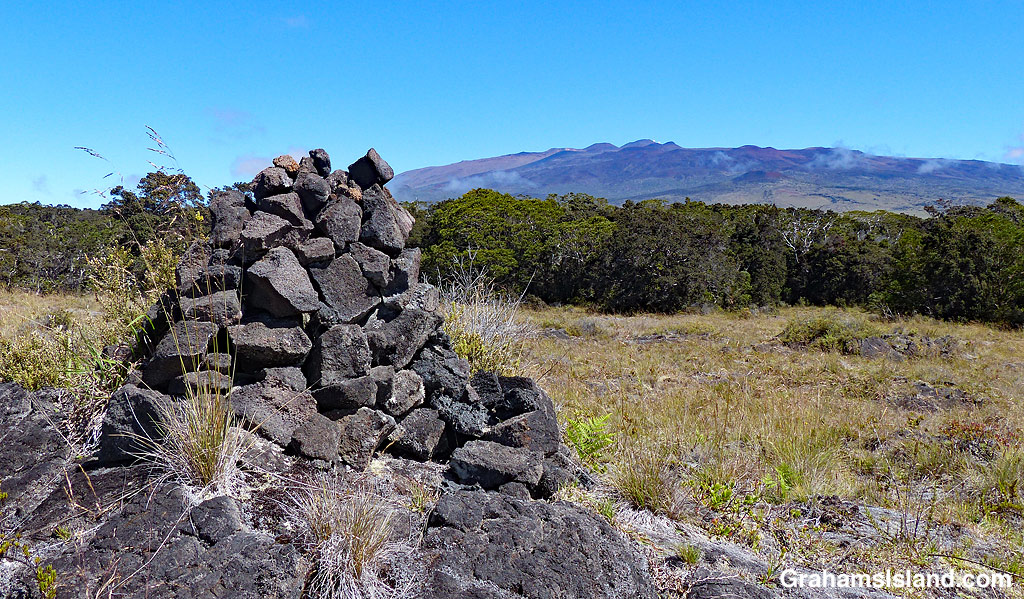
This cairn is one of many that mark the path of the Pu’u O’o Trail, off Saddle Road. At various spots, the trail offers good views of Mauna Kea such as this one.

This cairn is one of many that mark the path of the Pu’u O’o Trail, off Saddle Road. At various spots, the trail offers good views of Mauna Kea such as this one.

A grasshopper (schistocerca nitens) suns itself on the edge of a leaf.
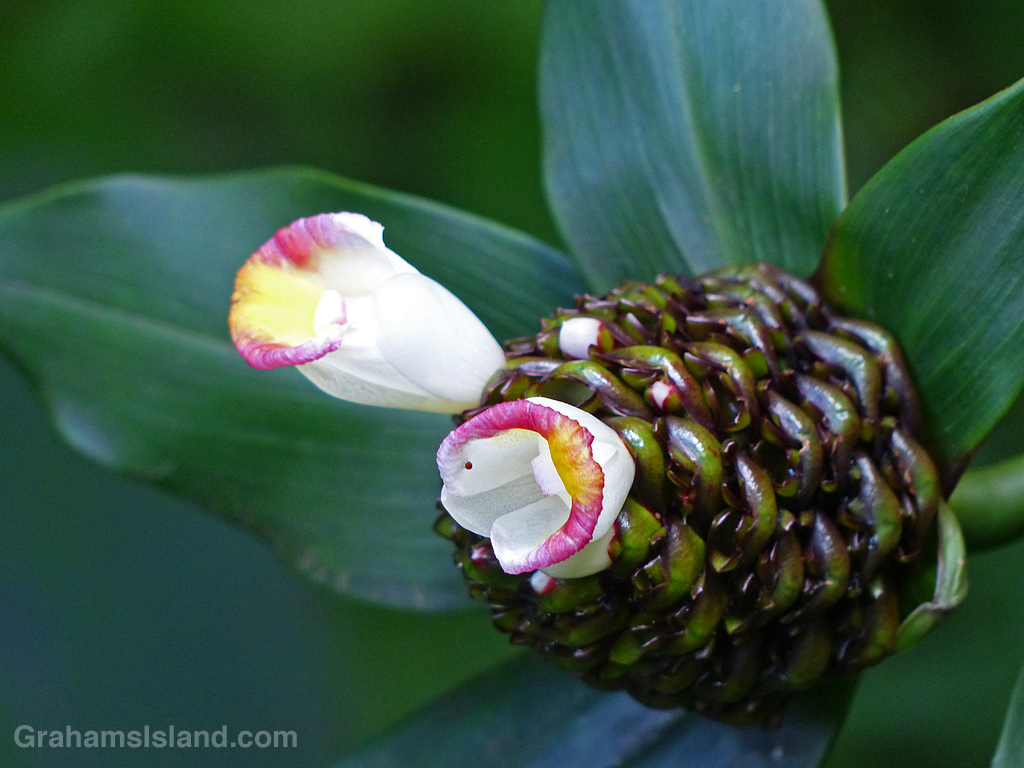
Costus lucanusianus is a native of tropical Africa. It’s also known as spiral ginger or African spiral flag. It’s related to true gingers and the ‘spiral’ in the name comes from the arrangement of the leaves on the stems.
This one was at Hawaii Tropical Botanical Garden. For more information about Hawaii Tropical Botanical Garden, go to htbg.com.

Green Lake was, until June 2 last year, Hawaii’s biggest freshwater lake. This isn’t a dramatic claim since freshwater lakes are in short supply in Hawaii. There are only two freshwater lakes on the Big Island, the other being Lake Waiau, near the summit of Mauna Kea. Green Lake had a surface area of about 2 acres and was no more than 20 feet deep in the center, but it was a popular spot with both locals and tourists who liked to swim and picnic there.
The lava flow from last year’s eruption in lower Puna at first curled around the pu’u, the center of which was Green Lake. But on June 2, the flow breeched the surrounds, boiled away the water and filled it with lava.
The top photo shows that pu’u that contained Green lake, now filled with lava. The bottom photo shows Green Lake in relation to the flow and the area around it. The lava came from the upper left of the photo. It flowed around the pu’u and entered the lake from the southeast. The photo also shows how the flow reached the coast. The area in the top right of the photo used to be Kapoho Bay and its surrounding housing. A white speck is visible on the edge of this flow, which is one of only three houses there that survived the flow’s destructive progress.
At the bottom of the lower photo is untouched land, including a road that runs into, and now terminates, at the flow’s edge.

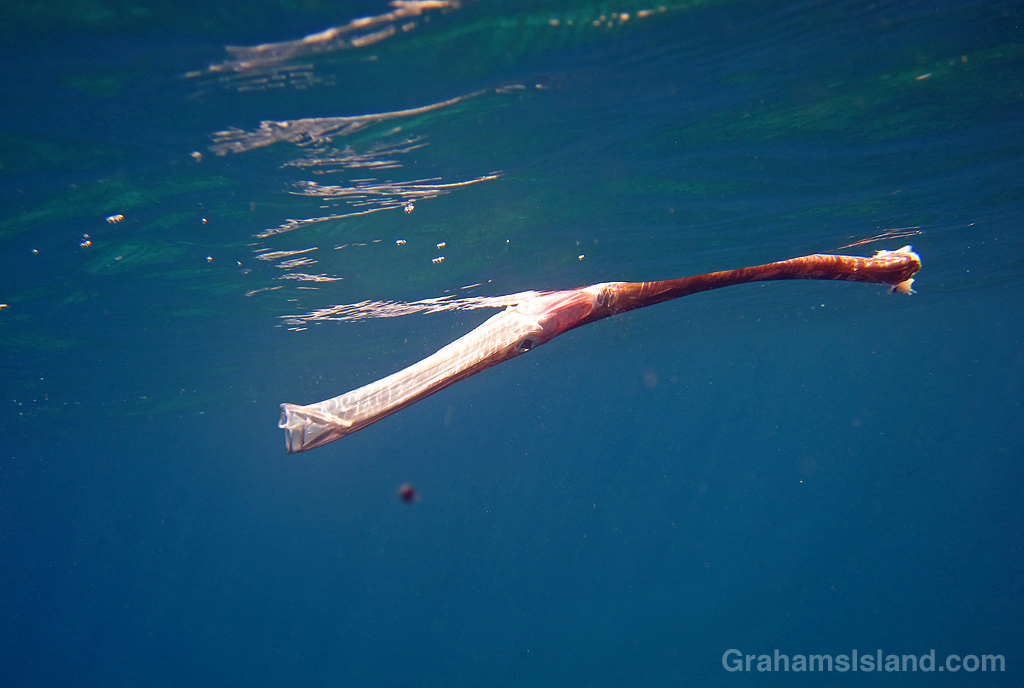
I was swimming one day when I came across this. At first I thought it was a bit of wood, but then I saw the distinctive mouth of the trumpetfish, then the eye. It looked like it was once a good-sized trumpetfish until it encountered something that reduced it to its current state.
I swam around it taking a few photos, until I noticed a large barracuda swimming along with me. I thought, perhaps, it wasn’t a good idea to be near part of a dead fish with an apex predator in the vicinity, so I swam off, leaving the barracuda to make what it wanted of the remains.
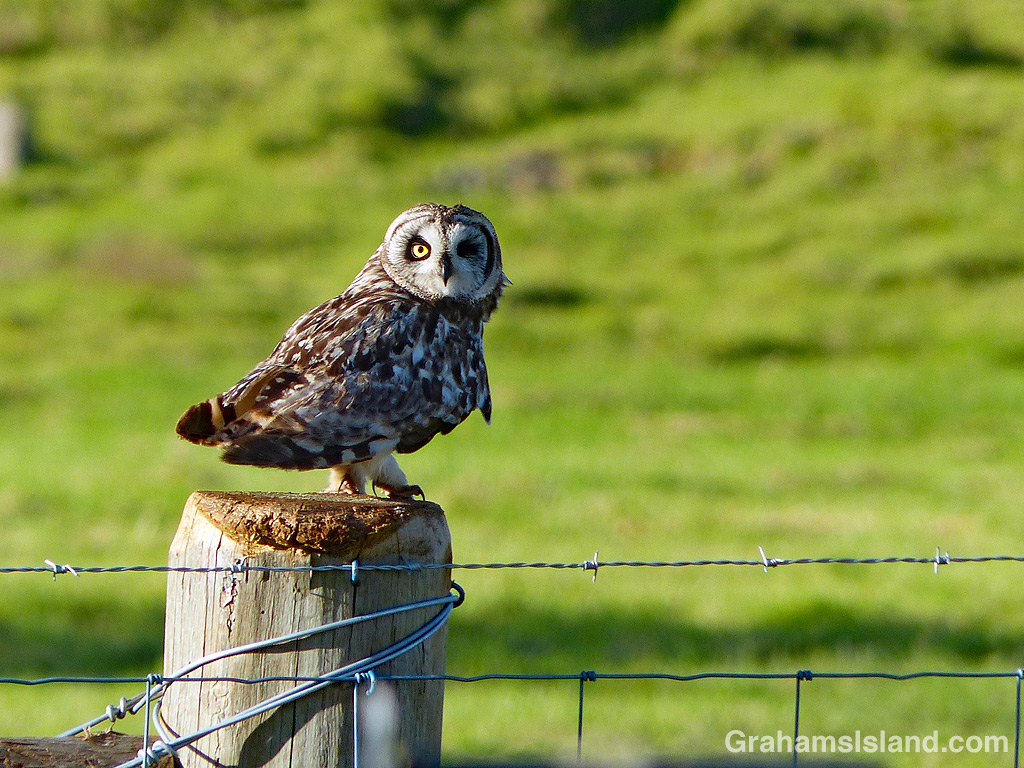
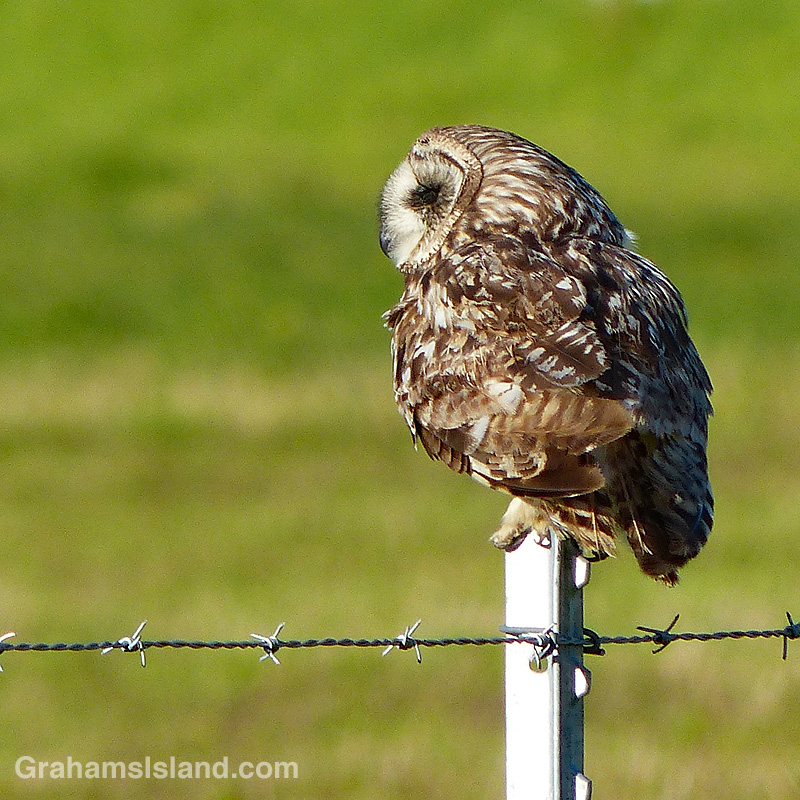
I saw this pueo (Hawaiian short-eared owl) near Waimea and pulled over to take photos. I watched and photographed it for 15 minutes or so and, at the time, I thought there was something unusual about it. Something didn’t seem quite right. But it wasn’t until I got home and looked at the photos that I realized what was up.
The pueo was missing its left eye. The eye socket seemed healed and the pueo didn’t appear to be in pain. Nor did it seem affected in its flying or behavior. In some ways this makes sense. Owls have great eyesight, but it’s their hearing that is truly extraordinary. They can pinpoint prey just by listening. However, in Hawaii, pueos are active during the day so one would think eyesight might be a more important sense than for nocturnal owls.
Either way, I felt a bit sad for the pueo, but I’m also keenly aware that nature isn’t all warm and fuzzy. And I’ve seen several creatures that have been significantly damaged in one way or another that seem to be doing fine despite their handicaps. Perhaps, from a Darwinian point of view, they’re not successful when it comes to finding a mate and breeding, so their genes are not passed on. I don’t know whether this is the case, but it’s certainly possible.
Regardless, I hope for the best for this pueo. Life for them is tough enough as it is without added challenges.
Posted in response to this week’s Sunday Stills challenge on the theme of ‘Unusual.’ (See more offerings here.)
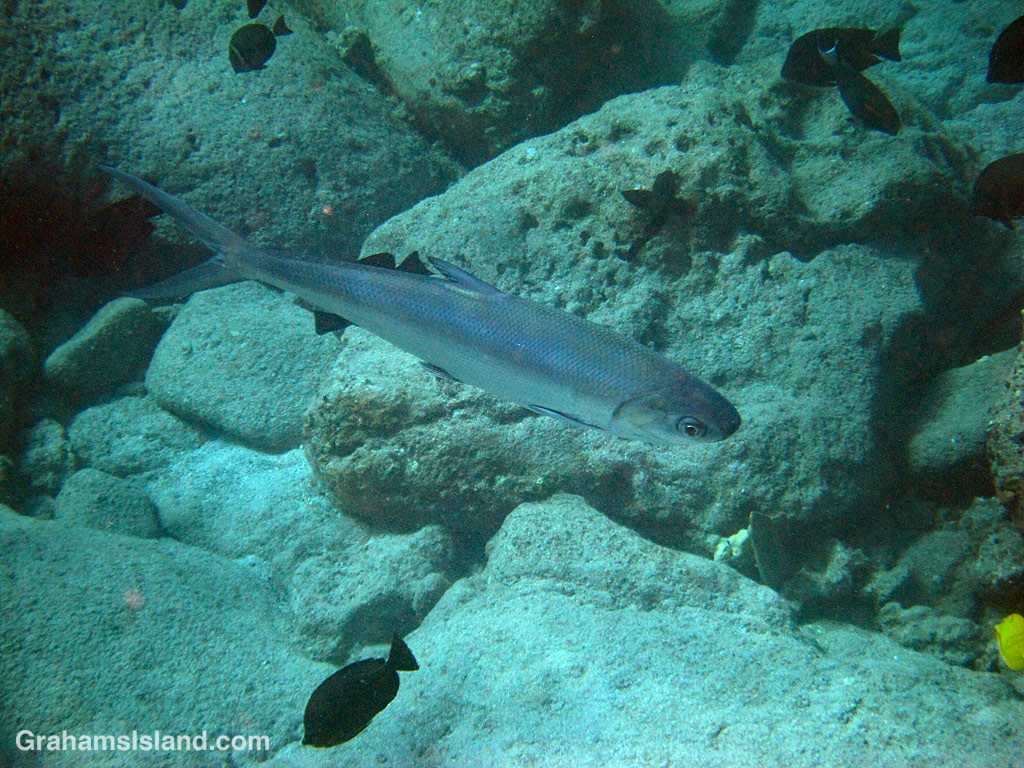

During a recent swim I was somewhat startled by the sudden appearance of these two large fish. I was close to shore when they shot past. At first I thought they were sharks, but quickly realized that wasn’t the case. They were just very big fish.
Their size, and the shape of their tails, made me think of jacks, and initially I identified them as rainbow runners, but later I realized they’re actually milkfish. Milkfish are the sole member of their species and my fish book calls them ‘among the most ancient and primitive of bony fishes.’
The larger of these two, in the top photo, was probably around three-and-a-half feet long. Those smaller, dark fish are around 9 inches long.

This week’s Friendly Friday challenge theme is ‘Shadows.’ See more responses here.
This view was taken near the summit of Mauna Kea. Pu’us – little volcanic cinder cones – dot the landscape here, giving the area an otherworldly look. As the sun sets, the pu’us cast shadows on one another accentuating the slopes and craters.
 Graham's Island