Tag Archives: Butterflyfish

Place of Refuge and Two Step

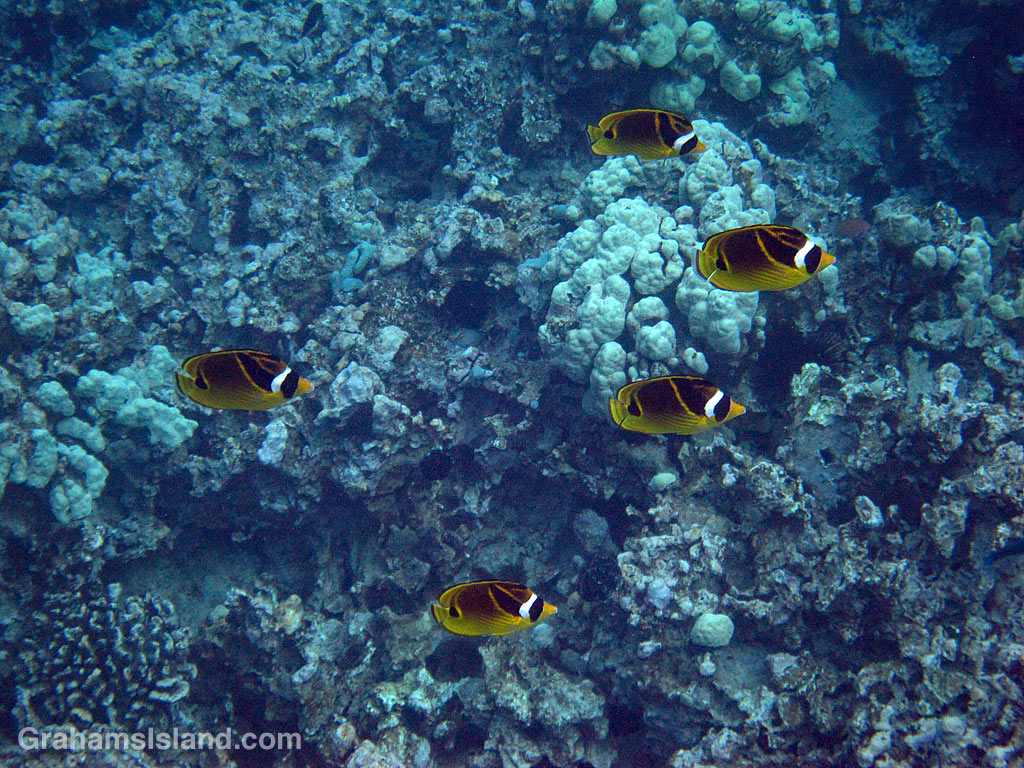
There’s a good variety of fish at Two Step including raccoon butterflyfishes, seen here mingling with goatfishes and yellow tangs.
A barred filefish swims by with a startled look on its face, which is just their usual look.
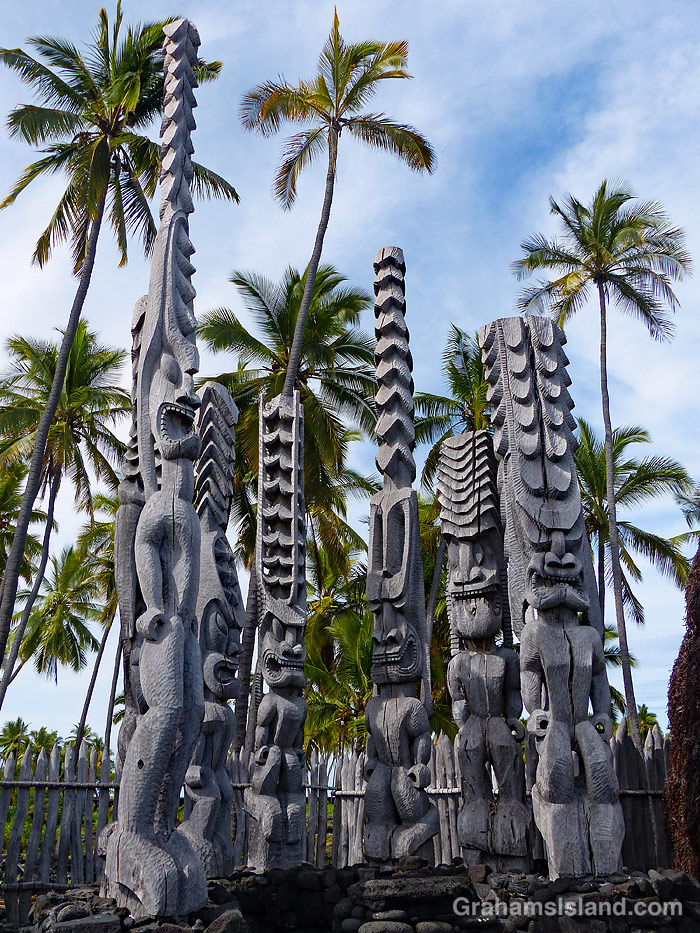
Ki’i at Pu’uhonua o Hōnaunau National Historical Park, better known as Place of Refuge.

This week’s Friendly Friday challenge theme is ‘Anniversaries.’ See more responses here.

Often, on our wedding anniversary, my wife and I go to Hawaii Tropical Bioreserve and Garden (formerly Hawaii Tropical Botanical Garden). This year the garden was shut, and still is, probably until tourists return to the islands. So a different anniversary is my birthday, which is not marked with candles on a cake, since that would be prohibitively expensive, but usually by a trip somewhere and a meal out. This year we went down to snorkel at Two Step and then had a wander around Pu’uhonua o Hōnaunau National Historical Park, otherwise known as Place of Refuge, which is right next door.

Two Step is a very popular snorkeling spot on Honaunau Bay, south of Captain Cook. This is a marine reserve so no fishing is allowed and the fish tend to be more numerous and mellow because of this. It’s a popular spot to see and swim with dolphins, though I haven’t done either of those things there. Currently, it’s not nearly as busy since there are very few tourists on the island and those that are here are diligently following quarantine rules (I’m trying to keep a straight face writing this!).

After our swim we made the short walk to Pu’uhonua o Hōnaunau National Historical Park. The park is on the south side of the bay and, at the moment, is fully open only on Fridays, Saturdays, and Sundays. However, on the other days, pretty much everything else is accessible, it’s just that the parking lot and visitor center are closed. What this means is that there’s basically nobody there so our visit was quiet and uncrowded. The park is an important place in Hawaiian history, and the location is beautiful. What’s not to like?

For more information about Pu’uhonua o Hōnaunau National Historical Park, visit https://www.nps.gov/puho/index.htm.

Palm trees reflect in one of the fishponds at Place of Refuge.

Longnose butterflyfish and bright-eye damselfish

There are two kinds of longnose butterflyfish in Hawaii, the common longnose and the big longnose. Neither name is especially flattering, but I think this is a big longnose butterflyfish. It feeds mostly on small shrimp, which it catches by thrusting its long nose into small crevices and swallowing its prey whole.

The little bright-eye damselfish on the left might have been startled by the butterflyfish, but not threatened. They can be quite aggressive in defending their small territories.

Longnose butterflyfish

The longnose butterflyfish gets its name for fairly obvious reasons, though it could equally be called the yellowsquare butterflyfish, blackspot butterflyfish or pailfin butterflyfish.

There are actually two different kinds of longnose butterflyfish. This one is the common longnose butterflyfish while there is also a big longnose butterflyfish, which is a little larger and has a slightly longer nose. The Hawaiian name for both these fish is lauwiliwili nukunuku ’oi’oi which, according to John Hoover in his book The Ultimate Guide to Hawaiian Reef Fishes, Sea Turtles, Dolphins, Whales, and Seals, is the longest of all Hawaiian fish names. In the Hawaiian name, lauwiliwili means ‘leaf of the wiliwili tree,’ nukunuku means ‘beak,’ and ’oi’oi means ‘best’ or ‘sharp.’

Milletseed butterflyfish

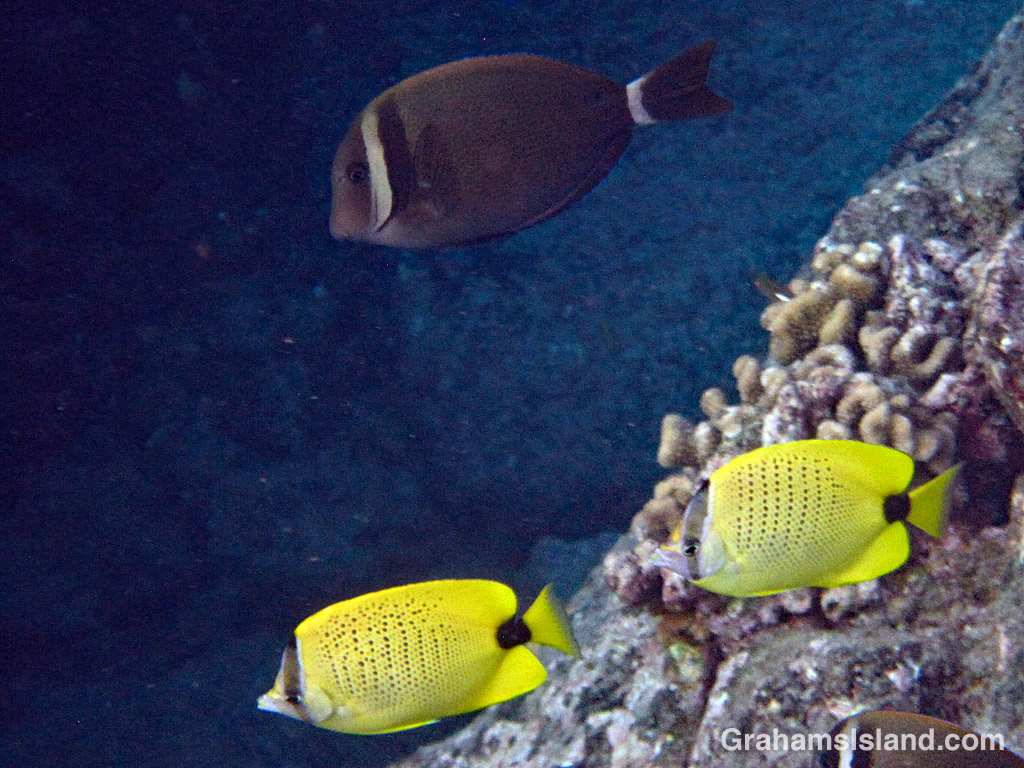
Milletseed butterflyfish and whitebar surgeonfish

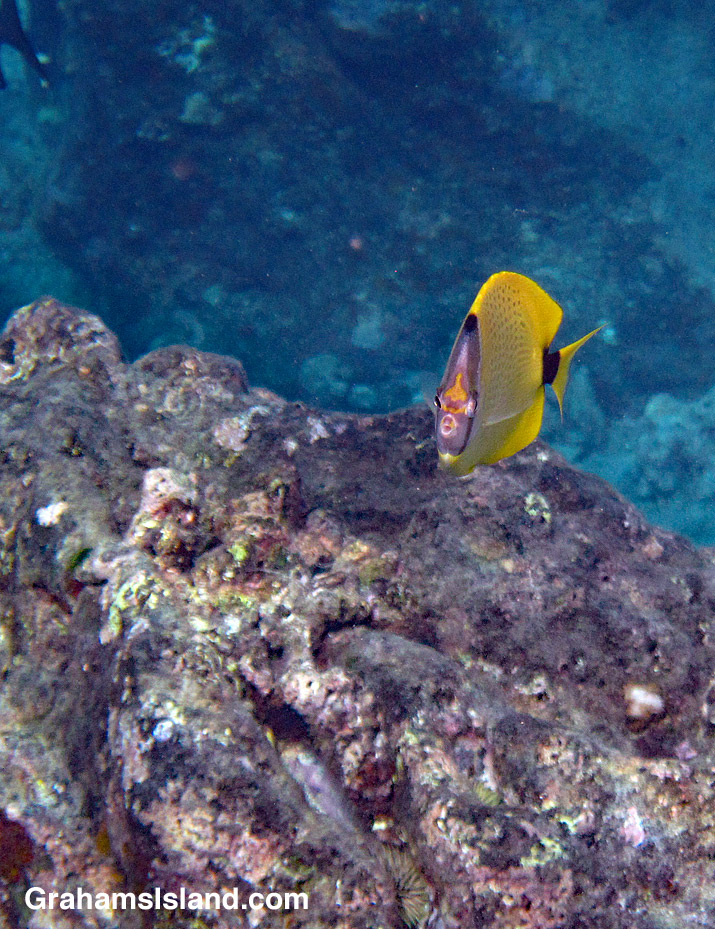
Milletseed butterflyfishMilletseed butterflyfish get their name from their markings, a series of dark dots along their sides. Of course, the markings could be morse code and they could be trying to communicate something to us, if only we’d listen.
I was quite pleased to get a shot of this fish looking my way, for the fish’s expression and for how it shows how slender these fish are. When people approach, most fish, wisely, turn away.

Raccoon butterflyfish in formation

Raccoon Butterflyfish

Raccoon butterflyfish are one of those fishes often seen in small groups. Other fish tend to clump together, but raccoon butterflyfish always seem to be traveling in formation as though they’re taking part in some kind of synchronized swim competition. Perhaps they are, in which case this group would have scored high points.

Cauliflower coral not spawning

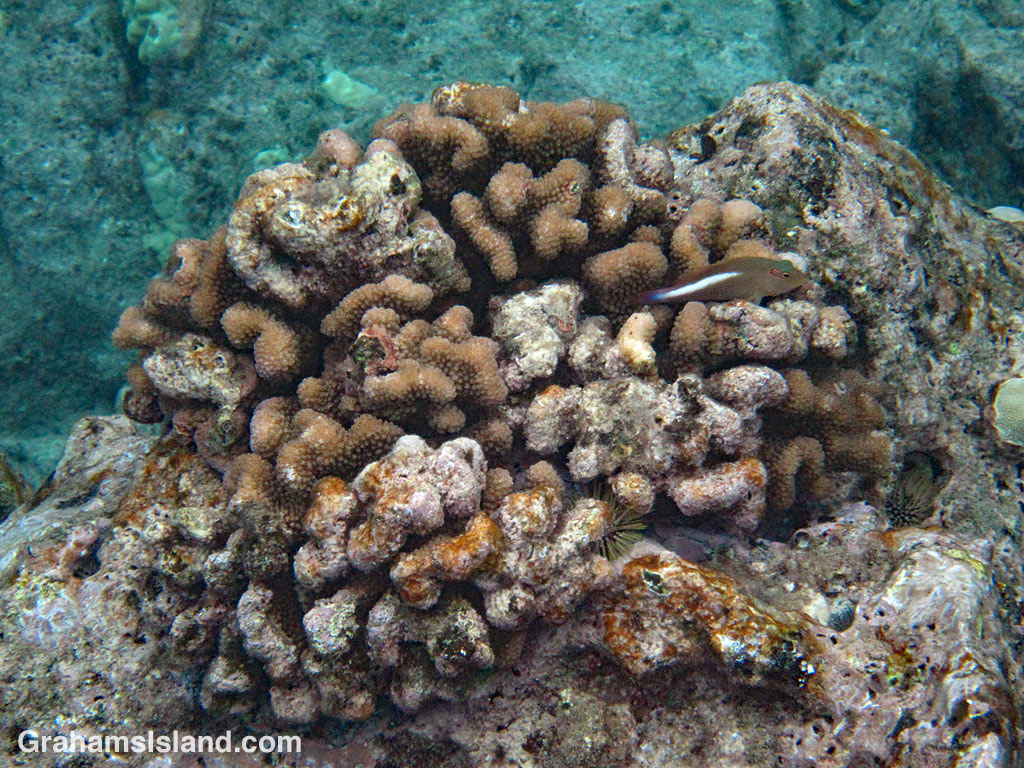
Cauliflower coral and arc-eye hawkfish

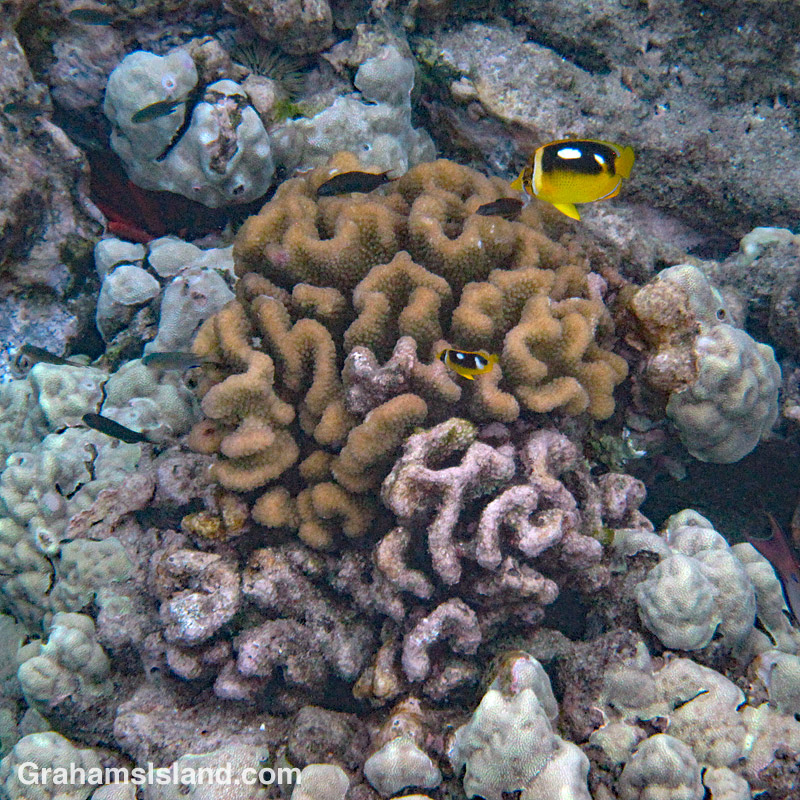
Cauliflower coral

Cauliflower coral was once a mainstay of reefs along the west coast of the Big Island, but has been in decline for a while. Then, in late 2015, high water temperatures caused a huge coral bleaching event, which resulted in a die-off of more than 90% of the area’s cauliflower coral. In some places, nothing was left. Because of this, the reproduction of surviving corals has become of increased importance.

Different corals have different methods of reproduction. Cauliflower coral reproduces in a synchronized spawning event. During this event, the corals release gametes (eggs and sperm) into the water, creating a milky cloud. For many corals, the spawning event takes place at night, but research indicates that cauliflower corals spawn shortly after sunrise, two or three days after the May full moon. At least, that’s what I was told.

Consequently, twice last week, I got up at an early hour in order to be in the water before 7 a.m. in the hope of witnessing a cauliflower coral spawning. Yes, that’s the kind of life-on-the-edge that I lead.

The first priority was to find some live cauliflower coral, easier said than done. There were a few patches in deeper water, but since visibility was not great, it would be almost impossible to tell if and when they spawned. After some finning around, I found a shallow spot with three small clumps and decided to pin my hopes on them. The live coral was part of a larger mass, part of which had died, as can be seen in the photos. Also to be seen in the photos are an arc-eye hawkfish (above), and two four-spot butterflyfish (second photo) among others. Corals are very important to fish stocks because many small fish, and the young of bigger fish, use the coral for protection, a place to hide when threatened.

What’s not to be seen in the photos is any evidence of spawning, because I didn’t see any. It was unlikely that I would. Conditions might not have been right for the coral or my timing could have been off. The May full moon is actually on the 29th so it might be that the spawning will be at the end of the month, not the beginning. I’ll try again then.

Posted in response to this week’s WordPress Photo Challenge ‘Unlikely.’