Tag Archives: Hawaiian Monk Seals

Hawaiian monk seals

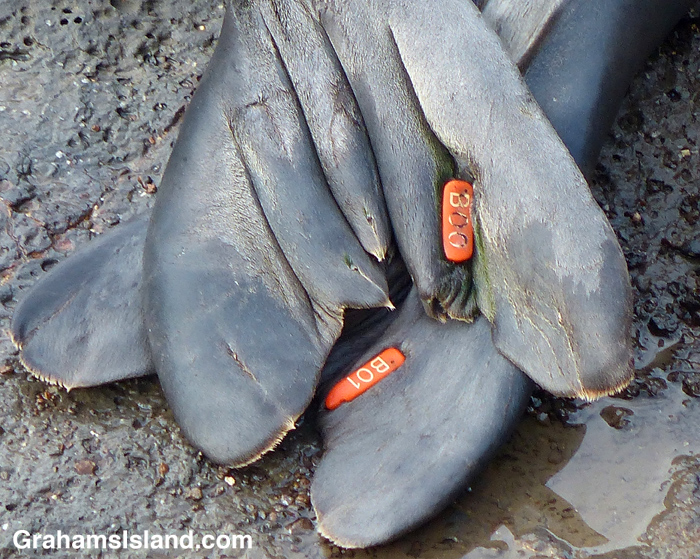
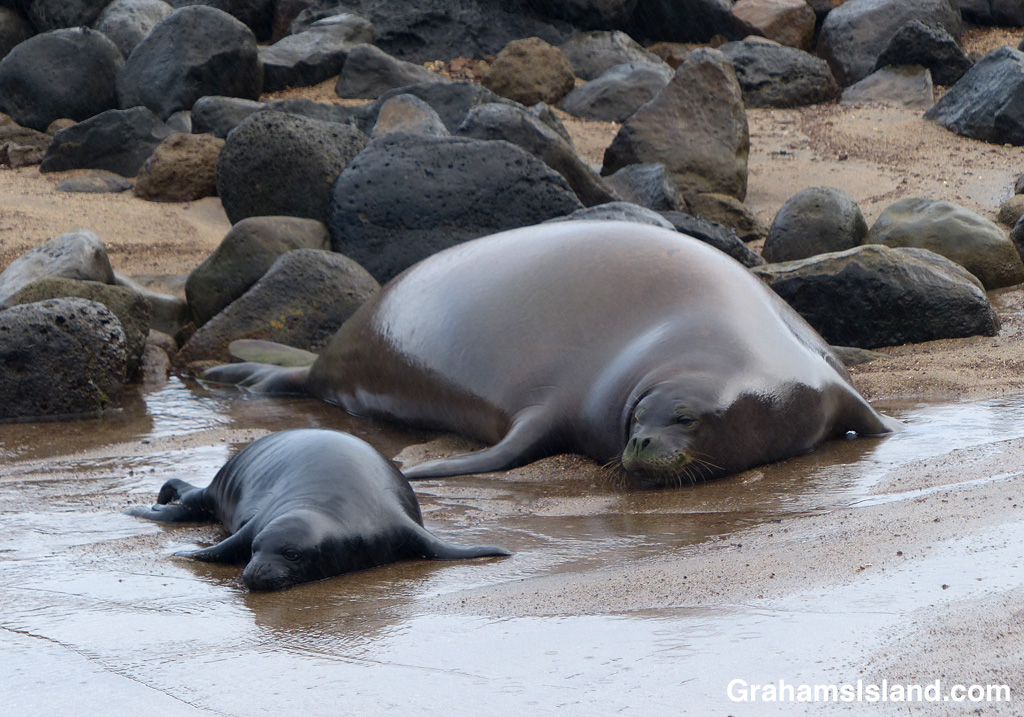
Two Hawaiian monk seals relax in a tide pool on the Big Island.Identifying tags on the tail flippers of a Hawaiian monk seal,
This photo is somewhat unusual, particularly for the Big Island. Outside of mothers with pups, it’s uncommon to see two monk seals together, much less relaxing in the same tide pool. One reason is the scarcity of seals. There are 1,000 or so in the remote northwest islands, but only about 200 around the main Hawaiian islands. Of those 200, there may be as few as 5 living around the Big Island.

One of those is IO5, a 7-year-old male, who I’ve posted about before (here, here, and here). He’s the seal I see most. In this photo, IO5 is in the foreground in what I can only describe as a characteristic pose. He’s resting, which is what monk seals do when they haul out on land.

The other seal was new to me so I was keen to identify it. There are two main means of identification. Many seals have a code bleached onto their sides. Such a mark is good for about a year until the seal molts when it sheds it’s skin. This new seal was not bleached.

The other prime method is red tags attached to the seal’s tail flippers. I moved around, trying to get a good view of the tail, but couldn’t see any tags. (I should mention here that the goal is never to disturb seals when they’re resting, so while they reclined in the tide pool, I was sneaking around on the cliff 30 feet away and another 10 to 20 feet up.) I watched for a while but this seal showed even less inclination to move than IO5. It was so still, I wondered if it was dead, but I did see a couple of twitches.

Over the next few days I saw the new seal three more times. The first time it was in a position where I couldn’t see the tail. The second time, I caught a tantalizing glimpse of red, but that told me nothing more than that the seal had been tagged. (IO5 has also been tagged, but has lost them over the years and now bears only a nubbin of one tag.) The third time I saw the new seal it was out in an open spot where I could get a great view without disturbing it. Again I could see part of the tag, but not enough to identify it. So I hung around for the best part of an hour. I got good photos both sides, of the head and tail, but still only a glimpse of a tag. During that time the seal’s only movement was a twitch of the tail, which covered the bit of tag I could see. The only good news about all this was that the seal looked in excellent shape. I didn’t see any wounds or other marks that might indicate a problem.

Finally, a full week after the first sighting, I went down to the same area again. At first, I didn’t see any seals, but I thought I’d check a low spot on the cliff for another view. About 15 feet away, stretched out on the rock, was the new seal. It was facing me but, eyes closed, remained unaware of my presence. I took a couple of photos, then climbed back up the cliff and around to where I could see the tail flippers. Eureka! The flippers were splayed in such a way that I could clearly see two tags, one in each flipper.

I sent the photos in to the NOAA Fisheries Marine Mammal Response Coordinator and a couple of days later I learned that the new seal is B00 (not sure why the other tag says B01). The seal is a 9-year-old female that was born on Kauai. In recent years she has also been seen on Molokai and Maui. I think is the first sighting for her on the Big Island. She had her first pup this year on Maui, but unfortunately it was stillborn. Perhaps her sojourn on the Big Island with IO5 will presage another pup sometime next year.

For more information about Hawaiian monk seals, go to www.pifsc.noaa.gov/hawaiian_monk_seal/ or www.marinemammalcenter.org/hawaii.
Molted monk seal

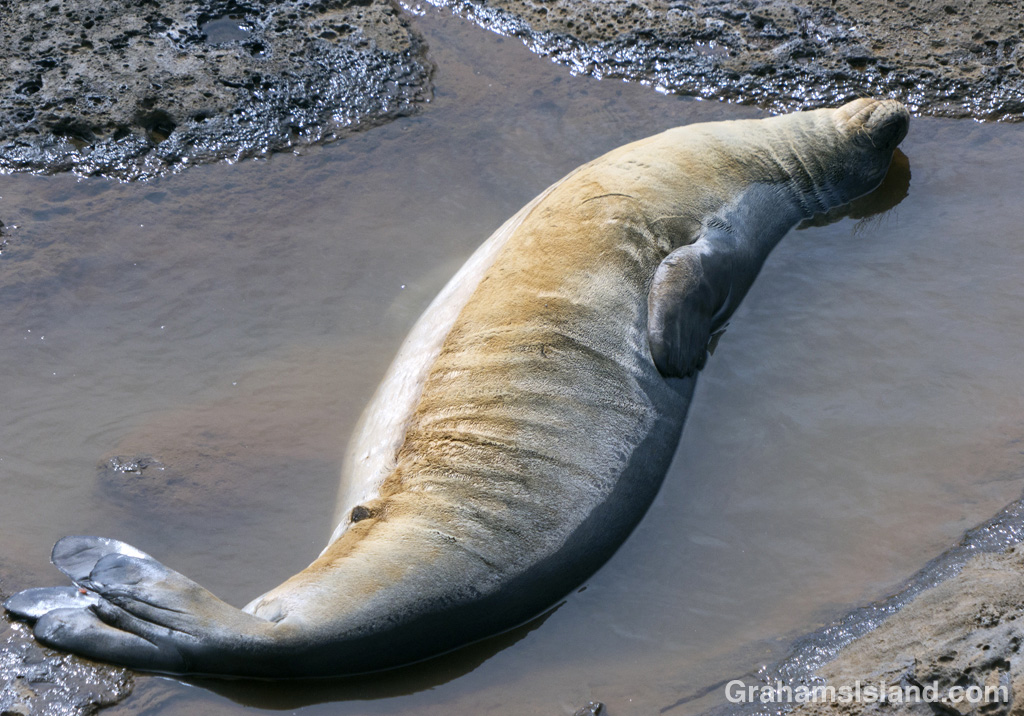
A newly molted Hawiian monk seal rests in a tide poolA newly molted Hawiian monk seal rests in a tide pool
I posted a photo of IO5 back on April 27. Since then, I saw him in mid-May looking about the same. Then a couple of weeks ago I saw him again and in the interim he had clearly molted. The green tinge around his head and flippers was gone and instead he looked clean and tan, silvery where he’d been rolling in the water.

One thing that hadn’t changed from previous sightings was his demeanor and activity on shore. Once again he looked supremely relaxed, stretched out in a tide pool.

Many Hawaiian monk seals look pretty beaten up with scars from encounters with sharks, boats, and goodness only knows what other perils of the sea. IO5 is something of an exception in that, currently, he has barely a mark on him.

For more information about Hawaiian monk seals, go to www.pifsc.noaa.gov/hawaiian_monk_seal/ or www.marinemammalcenter.org/hawaii.

Monk seal calisthenics

A Hawaiian monk seal resting in a tide pool
This is I05 who was the subject one of my first posts on this blog. In that photo he was resting. Here we see him doing calisthenics. Ha, just kidding. This was actually a brief position adjustment between two lengthy spells of resting.

Monk seals, though few in number, often haul out to rest around the island. It’s important not to get too close while they do so. Besides being illegal, disturbing their resting periods can be stressful and adversely affect their health. Also, if they get used to humans being close by, it’s only a matter of time before there’s an encounter where someone gets bitten. This is likely to result in the animal having to be relocated to the uninhabited northwestern islands.

This was the first time I’ve seen I05 in almost 5 months so it was good to see him again and still in such good shape. The green tinge to his skin around his nose and flippers is algae and he will likely molt in the none too distant future. Molting is usually an annual occurrence, during which he’ll shed the top layer of his skin and fur.

I05 is the brother of Waimanu and was the uncle of Elua, the subject of this post. I’m not sure why, but as far as I know I05 was never given a name. I confess that I call him Igor, though I can’t remember why.

For more information about Hawaiian monk seals, go to www.pifsc.noaa.gov/hawaiian_monk_seal/ or www.marinemammalcenter.org/hawaii.
The short, lively life of Elua

Gotta get some rest.
I'm watching out for you.
I’m watching out for you.
Always got to keep an eye on him.
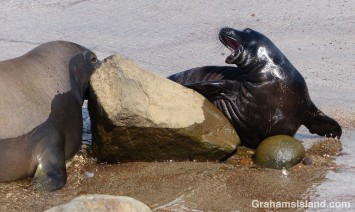
Mom's quick to get Elua's attention.
Mom’s quick to get Elua’s attention.
On the beach.
On the beach.
Tired out again.
Tired out again.
Elua's not shy about making himself heard either.
Elua’s not shy about making himself heard either.

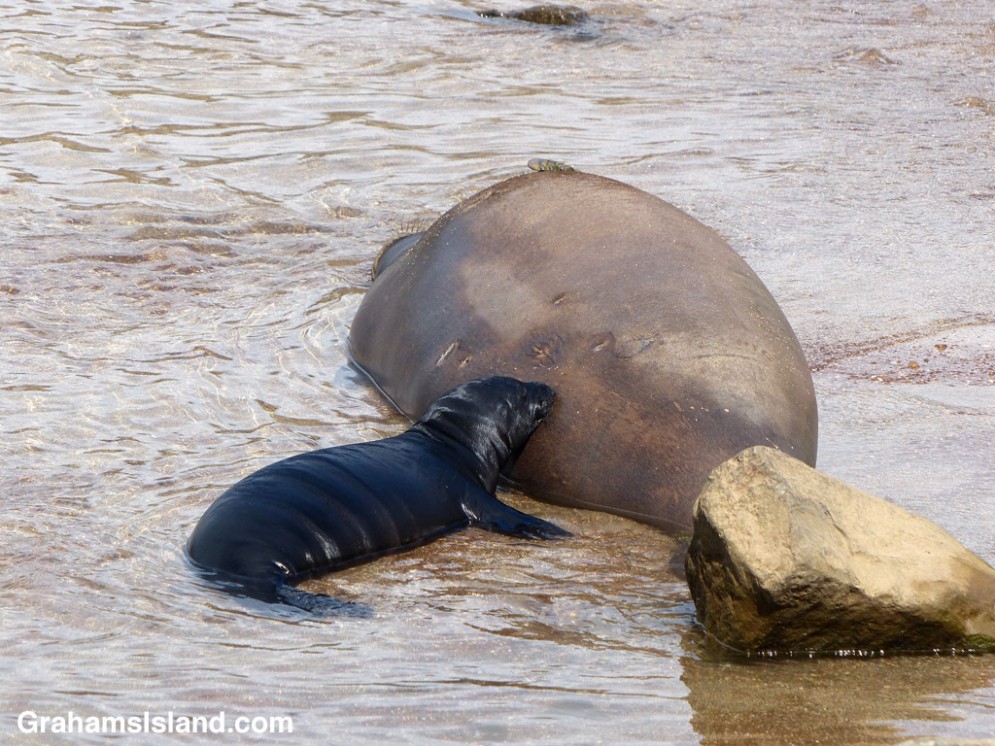
These photos are from November of last year. Not being on social media or especially well connected, it wasn’t until late November that I heard a monk seal pup had been born at Keokea Beach Park. The pup was born November 2 and was named Elua by the local community.

Elua means ‘two’ or ‘twice’ in Hawaiian. He was given the name because his mother, Waimanu (named after the valley where she was born), had given birth to another pup at the same spot two years previously. That pup was named Keokea, after the park. He died in his first year after swallowing a fishhook, a major hazard for monk seals around the islands.

I first stopped by on November 22 and returned on November 25 with a view to joining the volunteers who take shifts to monitor the pup. The idea is that these volunteers provide information about the pup, and monk seals in general, to people visiting the park and try to ensure that the seals aren’t unduly disturbed.

The general consensus was that Elua was doing very well and seemed to be picking things up fast. There was hope the pup would be ready to leave earlier than Keokea had when he was here. Indeed, Elua did seem livelier and more adventuresome, even at this early stage.

On November 26, Thanksgiving Day, Elua was found dead. My understanding is that a necropsy was unable to determine exactly what happened. I heard the cause was ‘blunt trauma’ resulting in edema (abnormal accumulation of fluid) in the lungs. As far as I know, what caused the ‘blunt trauma’ is unknown.

The loss of any pup is serious because there are so few monk seals. They’re a critically endangered species, with a current population of around 1,100. Most live in the northwestern atolls with about 200 around the main Hawaiian islands. In addition, the Hawaiian monk seal has a very low genetic diversity, which makes it potentially very vulnerable to disease and environmental changes.

For more information about Hawaiian monk seals, go to www.pifsc.noaa.gov/hawaiian_monk_seal/ or www.marinemammalcenter.org/hawaii.

Lunch time at last.
Lunch time at last.

Monk seal on the rocks

11-12-15-Igor-SW-700

Hawaiian monk seals are endemic to Hawaii. They’re a critically endangered species, with a current population of only 1,100. Most live in the northwestern atolls with about 200 around the main Hawaiian islands. Many seals can be identified either by a tag in their hind flippers or by a number bleached on sides. This seal is IO5 who has never been bleached, but still has a remnant of a tag to help identify him. Monk seals are most often seen on beaches or sheltered ledges, such as this one, when they haul out to rest.
For more information about Hawaiian monk seals, go to www.pifsc.noaa.gov/hawaiian_monk_seal/ or www.marinemammalcenter.org/hawaii.