Tag Archives: Hawaiian Monk Seals

Monk seals resting

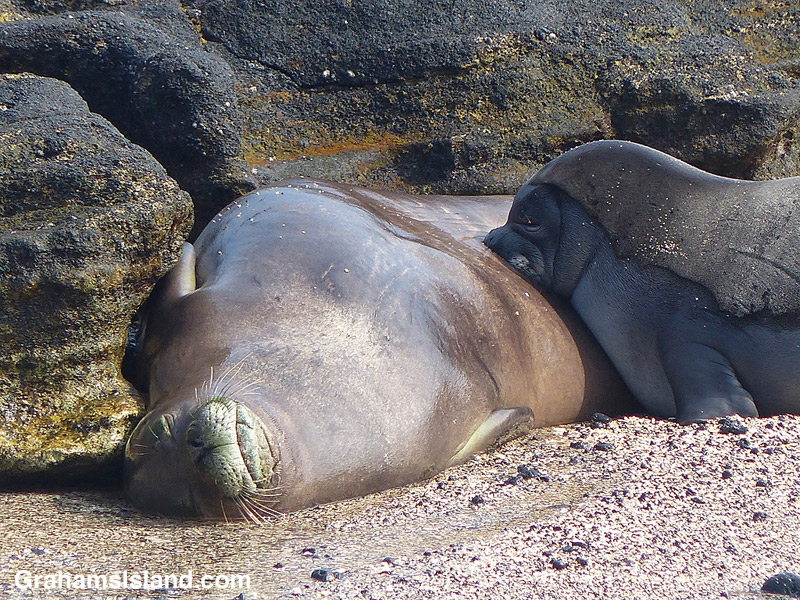
Monk Seals Resting

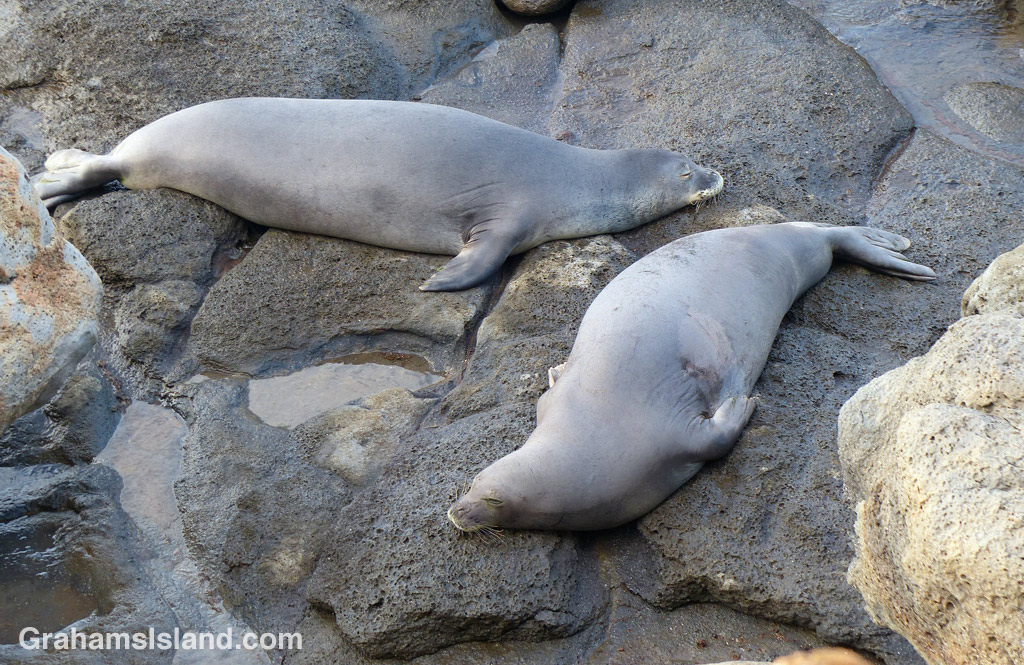
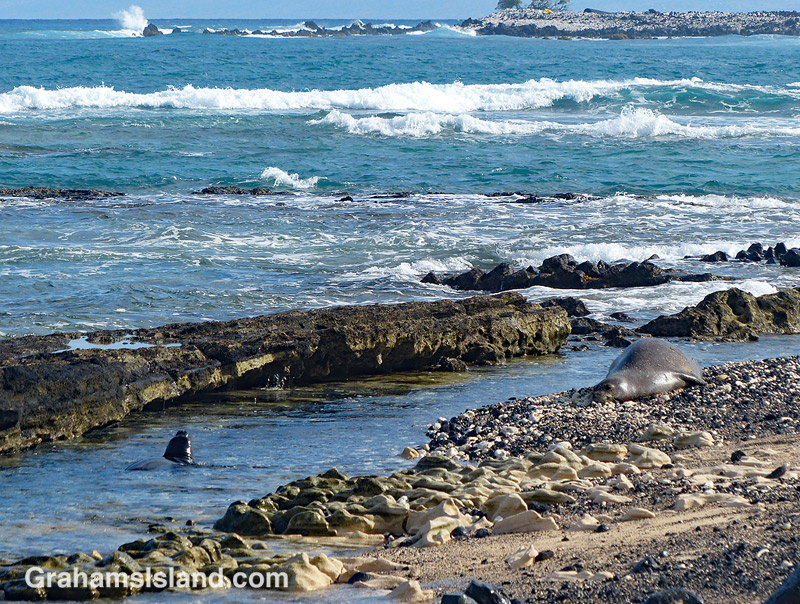
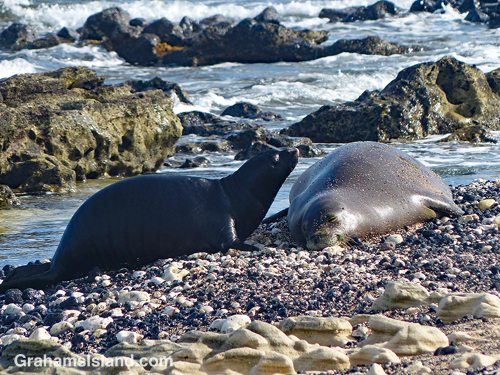
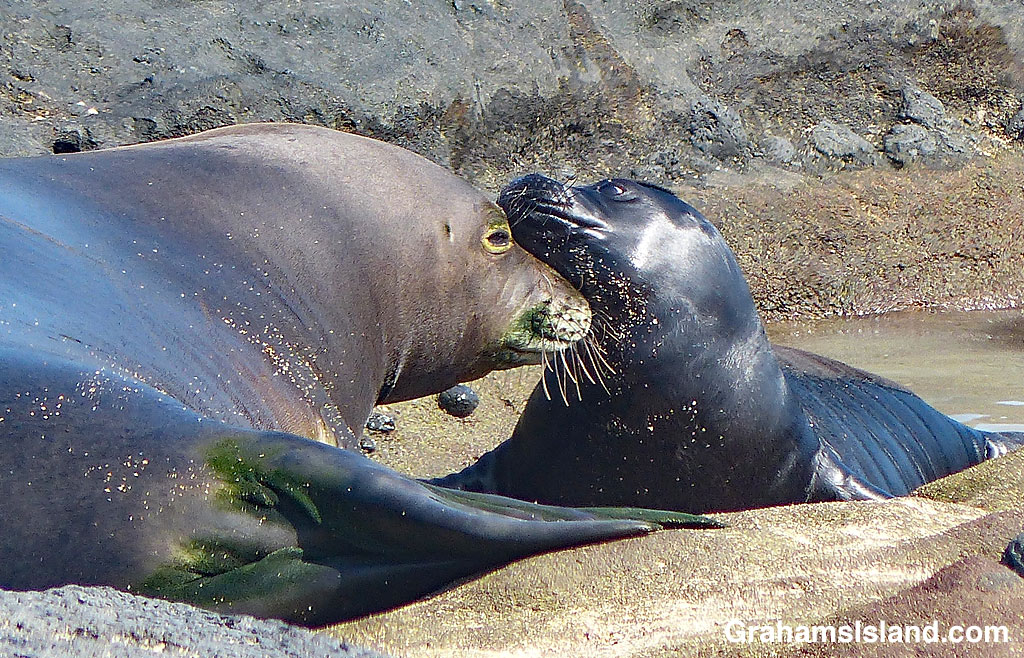
I’m posting this photo in response to this week’s Sunday Stills challenge on the theme of ‘Friend’ (see more responses here), though it would be equally suitable for next week’s ‘Lazy Days.’

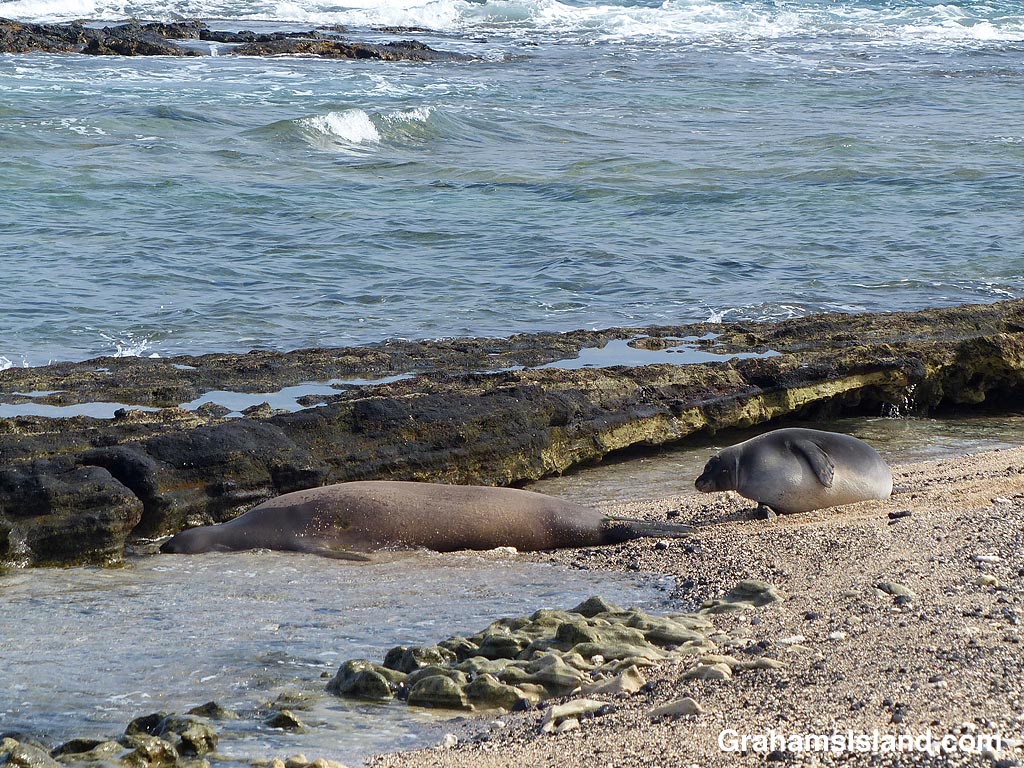
Monk seals are solitary animals, the main exception being the six weeks or so a mother spends with her new pup, teaching it the tricks of the trade, before leaving it to fend for itself. But for a three month period in late 2016, these two monk seals spent a lot of time together.

The top seal is I05, a male, affectionately known as Igor. He’s a Big Island seal and appears to spend his time on the Kohala and Kona coast. The other is B00, a female, affectionately known as Boo. She was born in Kauai and had previously been seen on Molokai and Maui, but now appears to spend much of her time on the Kona coast. Whereas not too much had been known about B00, I05 was regularly seen and was a notorious loner. So his ongoing liaison was quite out of character.

They seemed very relaxed and content in each other’s company, and here are resting ashore, as monk seals do, before heading back into the water to feed.

Monk seal scars

Monk seal scars

Monk seal with scarsThese are older photos, but still interesting to me. I spotted this monk seal one day, not too far from a second seal that is a regular around the Big Island.

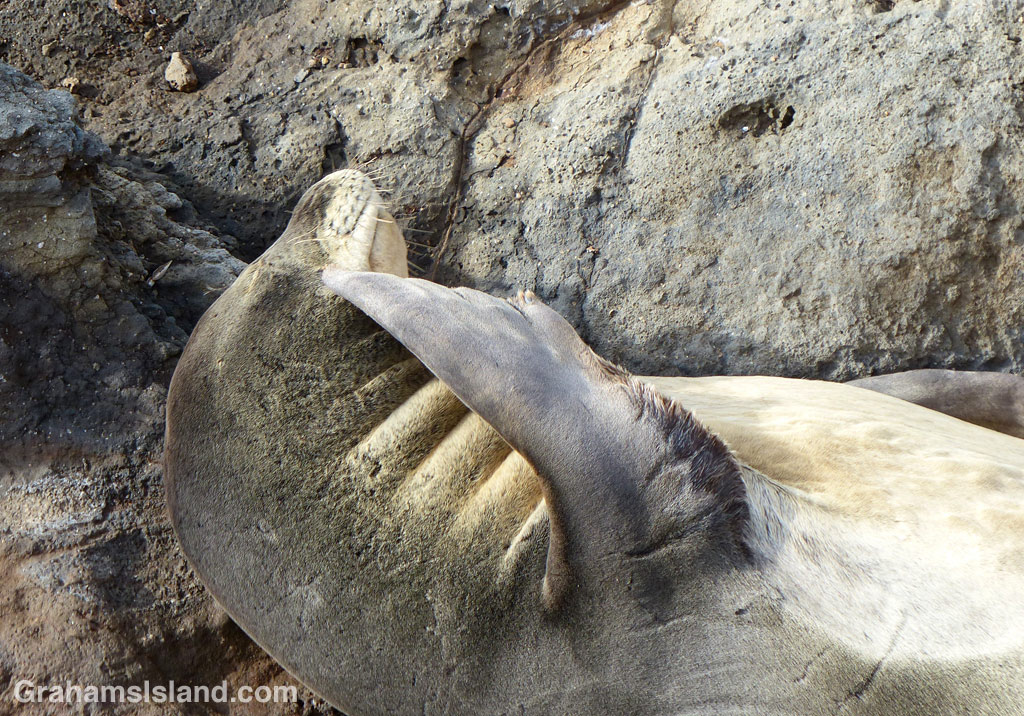
The top photo shows some lighter marking on the side of the seal, below and behind the two dark marks. This lighter marking is bleaching, which is applied to seals when possible, to help researchers monitor the population and keep track of their travels. The bleaching only lasts a year as seals molt annually. In addition to the bleaching, most seals have red tags placed in their rear flippers, to help identify them. It can be a hit and miss method as these photos show. This seal has tags in both flippers, but they were never visible to me.

The other interesting thing is those two dark circles on the seal’s back. They’re made by cookiecutter sharks. Cookiecutter sharks are small dogfish sharks, less than two feet in length. They feed by gouging round plugs, hence the name, out of larger creatures such as monk seals.

Cookiecutter sharks live in the deep ocean during the day, sometimes at depths over two miles. At dusk they rise up toward the surface, before descending to the depths again around daybreak. Another reason not to go swimming at night.

Monk seal pup update

Monk seal and pup

Monk seal pup feedingI visited the Big Island’s newest monk seal pup again, a couple of days ago, and I’m happy to report that mother and pup continue to do well. Since my last post about the pup, it’s clearly been packing on the pounds. Equally obvious is the mother’s loss of weight. Also, since that post, the pup has also been identified as female and given a name, Manu’iwa, which is a reference to the great frigatebird.

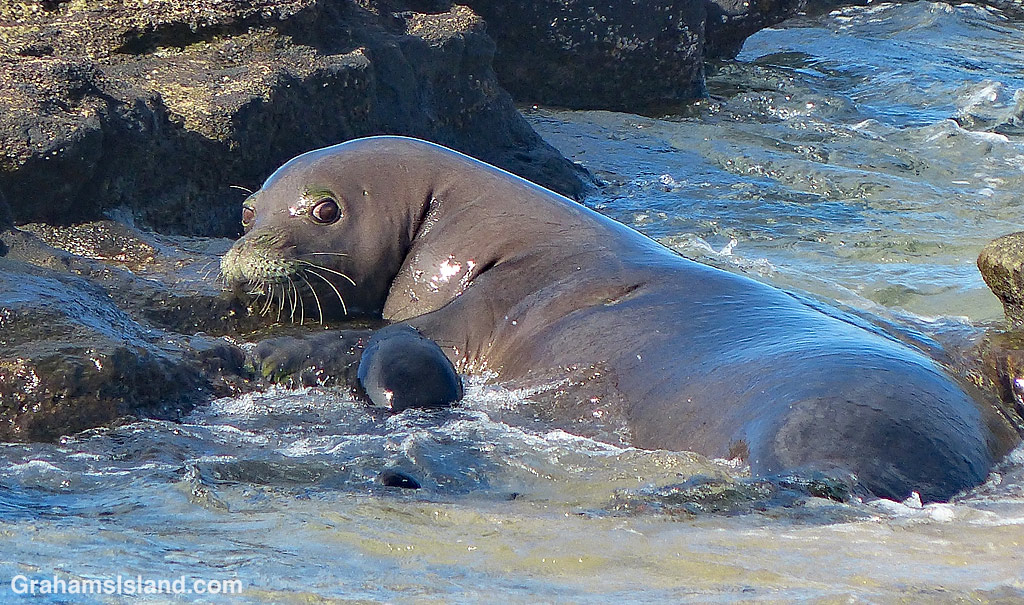
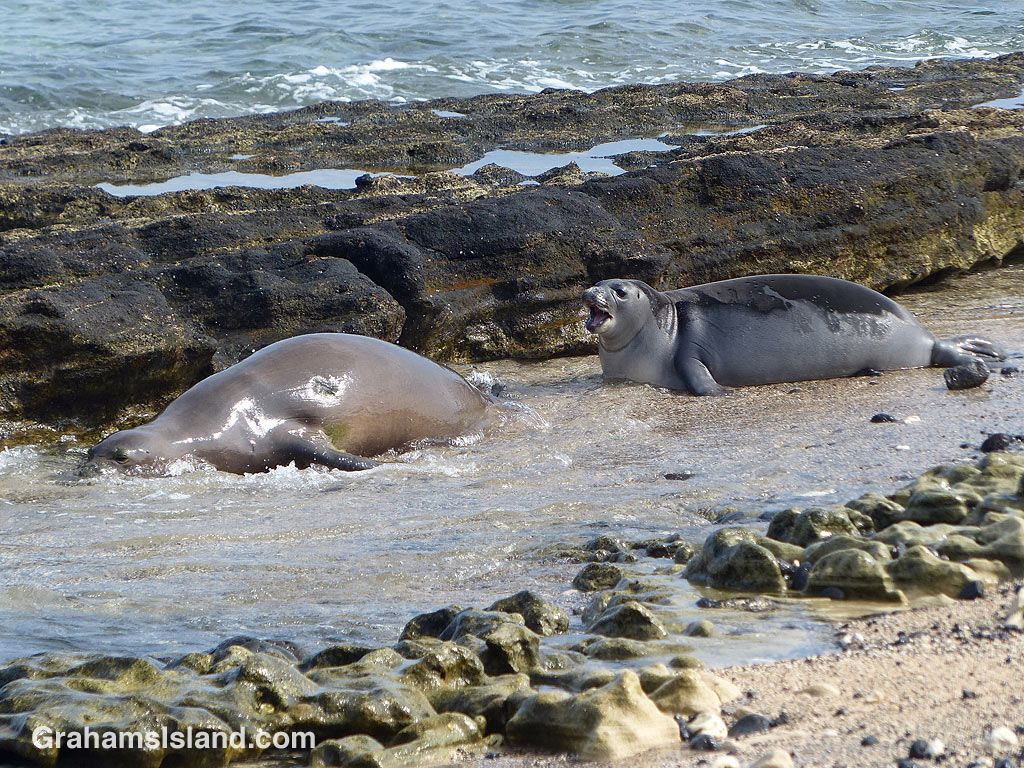
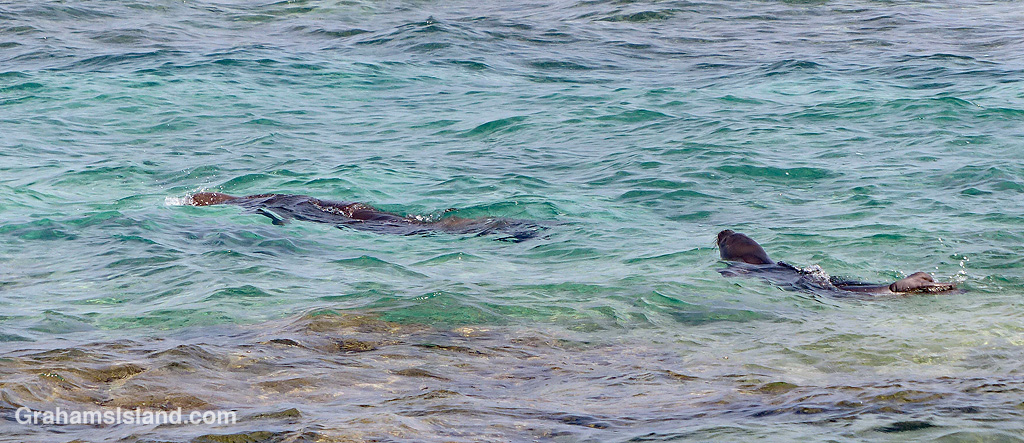
In these photos the pup is exactly 6 weeks old, so sometime very soon the mother will leave the pup to fend for herself. The top photo shows the two of them, the pup having shed her black baby coat for the more usual monk seal look. In the second photo, Manu’iwa has a feed. She was lying in the water which is why her lower half looks smooth while the dry upper part is raised and lighter. Below, mom heads for the water leaving Manu’iwa barking that she’s still hungry. Bottom, mom leads Manu’iwa out into the water for a swim, part of her ongoing education of the pup so that it will be able to fend for itself.

I should mention that these photos, as with those in the previous post, are taken with a telephoto lens. The area where the seals spend their time is cordoned off with volunteers monitoring the area and providing information to visitors. The volunteers work to minimize human interactions with the seals. If the pup gets used to humans it may seek them out and, at some point, is likely to have an interaction that ends badly – not necessarily for the pup, but for the person involved. This could be a bite or something more serious. If the pup, or any seal, has such encounters, it will likely have to be captured and relocated to the northwest Hawaii islands, which are uninhabited. This would be hard on the seal, faced with new territory and greater competition, and also be a blow to the goal of raising the number of monk seals living permanently around the main Hawaii islands.
Monk seal and pup enter the waterMonk seal and pup swimming

Hawaiian monk seal and her new pup

There’s a new monk seal pup on the Big Island and, happily, both mother and pup are doing well. The pup is just over a month old now and its mother will stay with it for another two weeks or so. At that point, she’ll head out to feed, having not eaten since giving birth, and the pup will be left to fend for itself.

I’ve been to see them three times and the pup’s growth has been dramatic as seen in the third and fifth photos. In the top one, the pup is 11 days old and below, exactly a month old.

For more information about Hawaiian monk seals, go to www.pifsc.noaa.gov/hawaiian_
monk_seal/ or www.marinemammalcenter.
org/hawaii
.

Posted in response to this week’s WordPress Photo Challenge to be a visual storyteller.

Waimanu and her pup

A Hawaiian monk seal and her pup.

Waimanu is a monk seal who spends most of her time around the Big Island, one of the few to do so. She has given birth three times here, and recently gave birth to her fouth pup. She won’t leave her pup to feed until it’s ready to fend for itself, usually around six weeks. Because of this, she feeds up, ahead of giving birth, and attains enormous size.

The top photo shows the contrast between the huge mother seal and her small pup. Over the next six weeks, if all goes well, she’ll steadily lose weight while the pup will grow quite quickly. Eventually, the pup will lose it’s black coloration and look similar to its mother, the transformation complete.

A Hawaiian monk seal and her pup.

Waimanu swimming

A Hawaiian monk seal swims in a a bay

Waimanu is one of the few Hawaiian monk seals that live permanently around the Big Island. She has given birth to three pups, each time in the vicinity of Keokea Park in North Kohala. All three pups died, one from swallowing a fish hook when a few months old, the other two while still with their mother on the beach.

We’ll see if she returns to the park again this year for another go.


Relaxed Hawaiian monk seal

A Hawaiian monk seal relaxes on the Big Island.
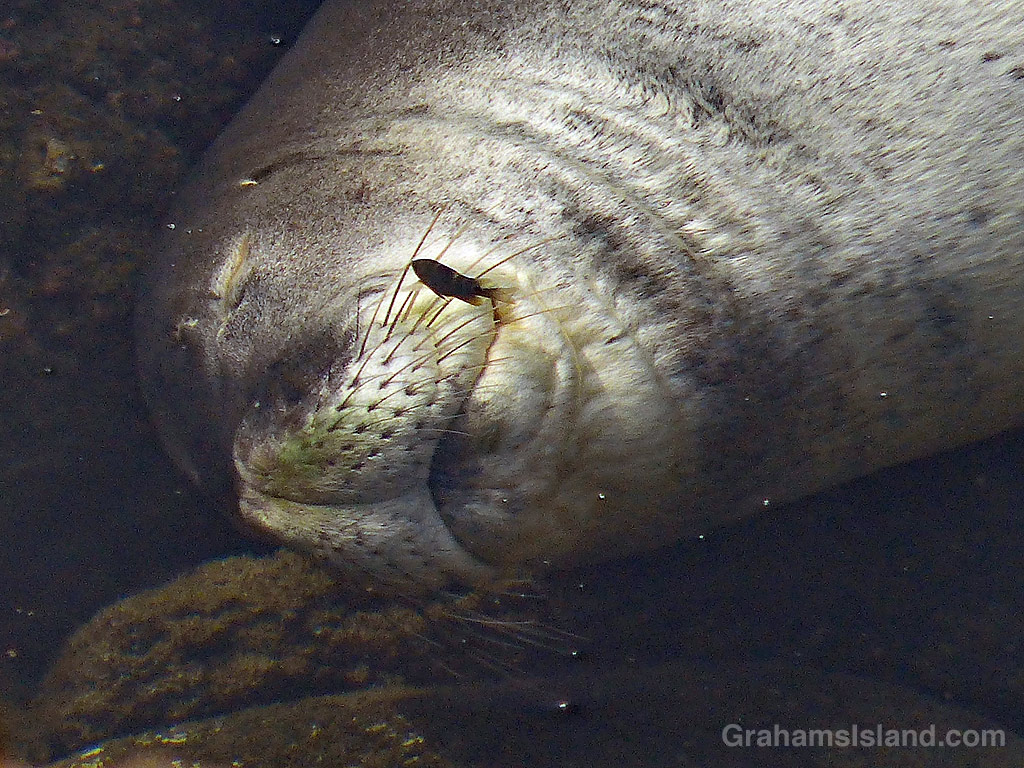
Hawaiian monk seals tend to hunt at night. During the day, they’ll often haul out on a beach or rocky shore to rest, which is when they’re most often seen by people. This seal is a 7-year-old male with the catchy moniker of IO5 (given him by the people who track seals and look out for their welfare). He’s the monk seal I see most often and he has a few distinctive characteristics.

Thus far, he has remained unscarred by encounters with boats or sharks. He usually appears to have an air of being rather pleased with himself, perhaps a certain confidence about what a fine fellow he is. And when he’s on shore, he doesn’t just look like he’s resting, he looks like he has found a deeper, Zen-like calm. Seeing him in such a state always makes me loosen my shoulders, take a deep breath, and relax.

For more information about Hawaiian monk seals, go to www.pifsc.noaa.gov/hawaiian_monk_seal/ or www.marinemammalcenter.org/hawaii.