Tag Archives: Kawaihae

Signs: No parking

A No Parking sign on the Kohala Coast, Hawaii

The coast road between North Kohala and Kawaihae is dotted with these no parking signs. There are virtually no houses along this road, so why the signs? Well, the views are lovely and in the winter, humpback whales frolic just off the coast. Who wouldn’t want to pull over.

Consequently, a 40 mph minimum speed limit is in place along this highway together with these signs. The net result is that people still crawl along taking in the view and pull over to watch whales wherever they please.

Posted in response to Becky’s October Squares challenge theme of ‘Past Squares – Circles and Squares.’ See more responses here.

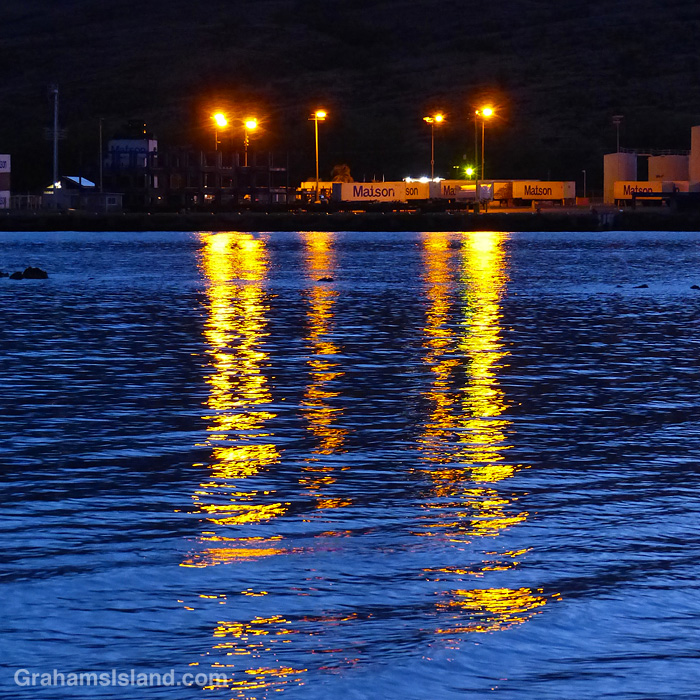
Early morning lights

Early morning lights at the port of Kawaihae, Hawaii

I took these photos one early morning at Kawaihae Harbor. I was experimenting with settings and came up with a couple of different looks of the same scene. Not sure which I like best. Any thoughts?

Posted in response to Becky’s October Squares challenge theme of ‘Past Squares – Light.’ See more responses here.

Later that same day

A view towards Hualalai volcano
A view towards Hualalai volcano, obscured by vog

I took the top photo on my way to work one early morning. It’s a tranquil scene (the reason I go down there) shot from the beach below Pu’ukohala Heiau in Kawaihae. The second photo was shot on my way home in mid-afternoon. It was taken from the same beach in roughly the same place and looking in roughly the same direction.

Astute observers will see past the similarities in the photos and notice something is missing. Hualalai Volcano has disappeared. Now, it’s not unreasonable to think that those puffy white clouds in the second photo have something to do with this, but that’s not really the case. True, they might mask the upper reaches of the volcano, but the whole thing? No, the culprit is the fuzzy band between the clouds and the land – vog!

The latest eruption of Kilauea Volcano, which began on September 29th, is churning out vog, which forms when volcanic gases interact with sunlight, air, moisture, and dust. Two days later, when these photos were taken, it was having a visible effect. I’d noticed the vog drifting up the west side of the island during the morning and by afternoon visibility was greatly reduced. But it’s not just visibility that’s affected. Vog is especially troublesome for people with breathing difficulties, but can also irritate the eyes and skin of just about anyone.

Posted in response to Becky’s October Squares challenge theme of ‘Past Squares – Time.’ See more responses here.

Spencer Beach Park beach

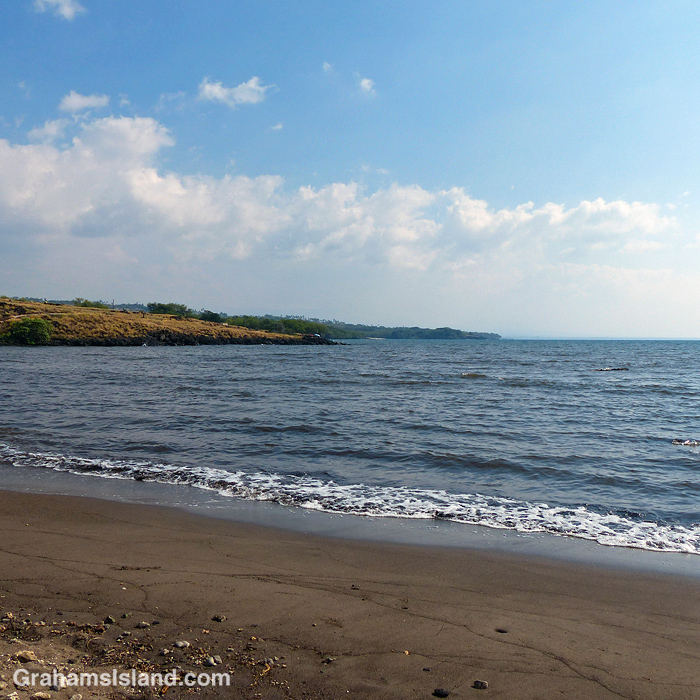
The beach at Spencer Beach Park, Hawaii

A few days ago, I posted about a heron encounter (here) when I didn’t have enough time to walk along the coast before going to work. I took this photo when I did have that time.

This is a view from Spencer Beach Park towards Kawaihae Harbor. The footprints are mine. There were no others. As a start to the day, it doesn’t get much better.

Big buoys

Two buoys and a net pen at Kawaihae Harbor

A while back, I went to take photos of a barge arriving in Kawaihae and saw these buoys on the beach. I don’t know what the net pen was for, but it was quite large, and looked similar to those I’ve seen used for farming fish out in the ocean. I presumed it was ashore here for some repairs

Regardless, the large yellow buoys caught my eye and made a good foreground for the barge being docked.

Fish for breakfast

A juvenile black-crowned night heron catches a fish

I was running early to work recently, so I decided to stop in Kawaihae, as I often do. With more time, I’d have gone for a walk along the coast, but I had only 15 minutes so I plumped for a visit to the south end of the harbor to see if there were any herons around.

I found two there, but one quickly disappeared. The other stood on a rock in shallow water, a popular fishing spot for them. I took a few photos and noticed the heron leaning forward. It had spotted something. An instant later, it plunged into the water and then emerged with a fish on its beak. It returned to the rock and paused. The fish appeared to be impaled on the heron’s beak, but extracting the beak risked losing the fish before it could be eaten.

A moment later, the heron hopped over to the small beach where I was. There, it popped the fish into the air and swallowed it in one slick movement. This whole sequence took less than three minutes. The heron stayed on the beach and I returned to my car and headed off to work, very glad that I’d stopped by.