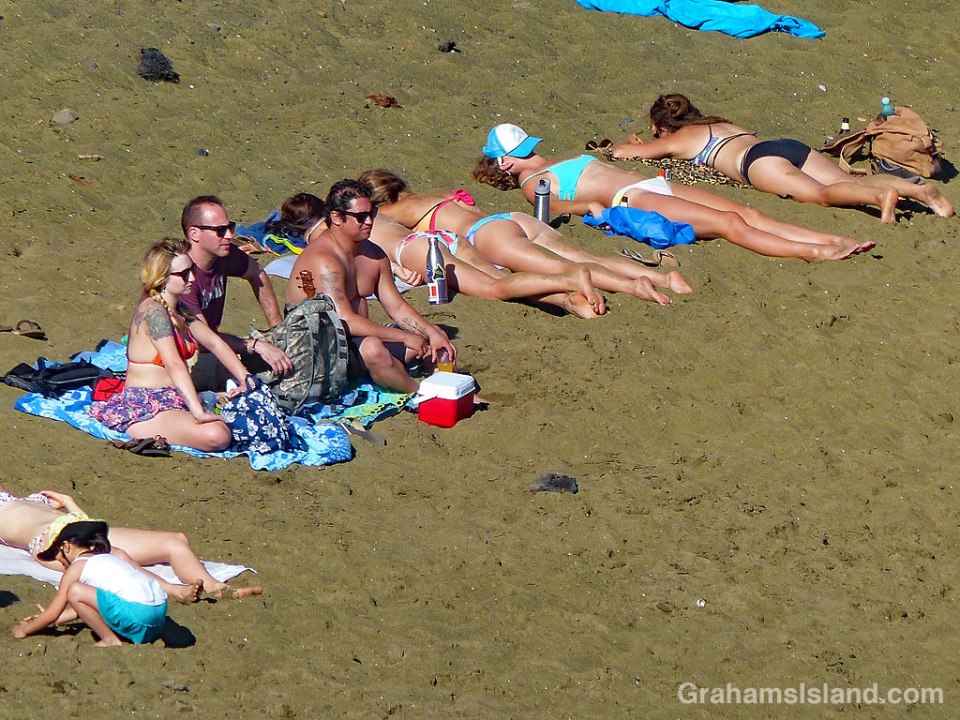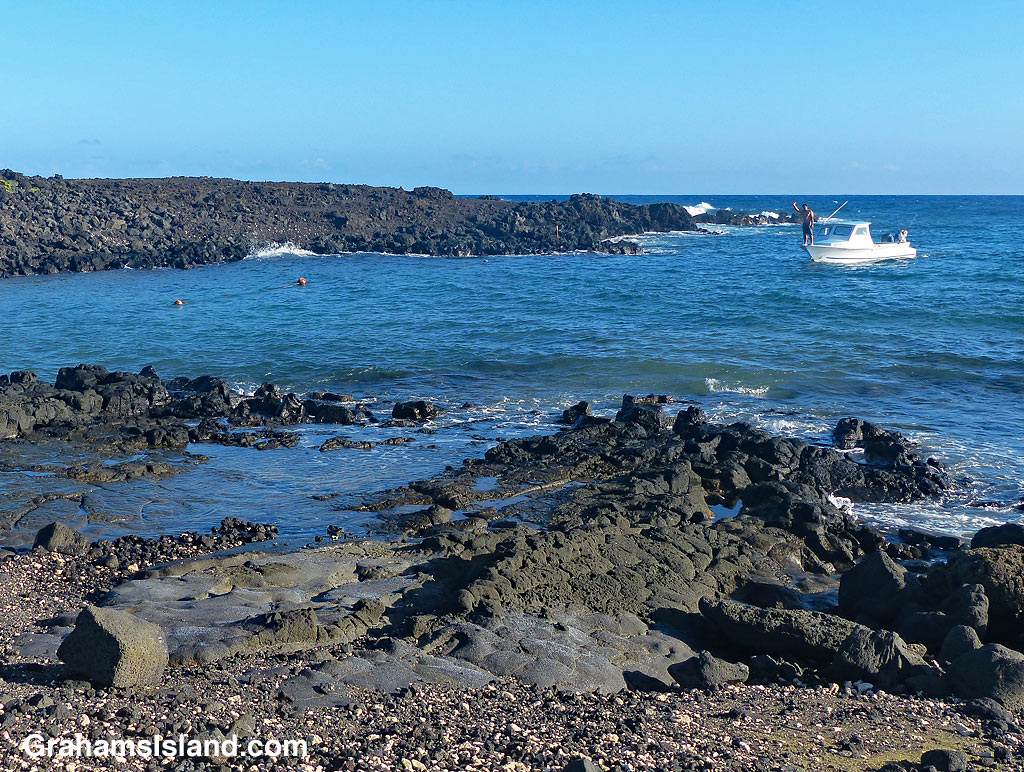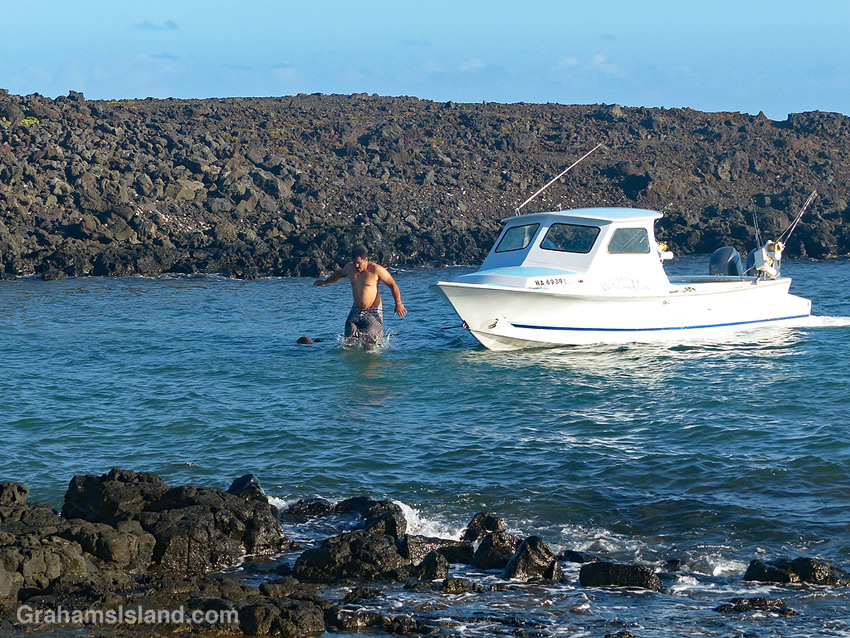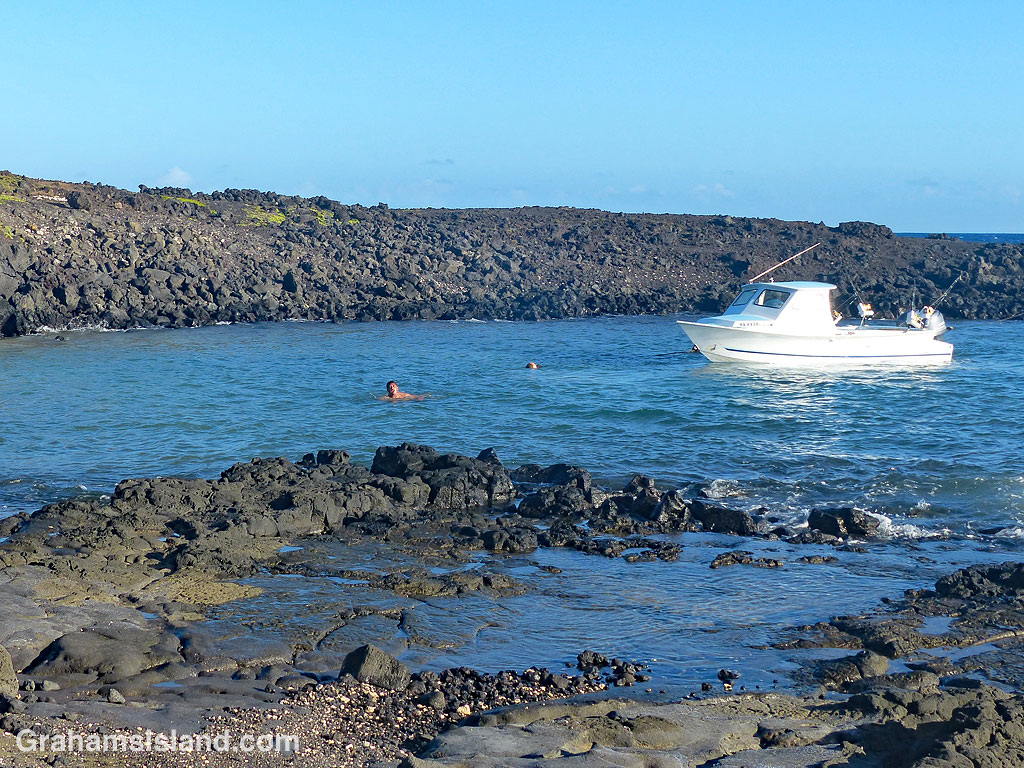
Miloli’i is an old Hawaiian fishing village near the southwest corner of the Big Island. A few miles north is Miloli’i Beach Lots Subdivision, a private community with an undeveloped park. Since the name includes the word ‘beach,’ it will come as no surprise to learn that there’s no beach of any description in the subdivision. There is, however, a reasonable spot to get in the water, at the park, which is accessed by crossing this little plank bridge. If you head straight out from there, in no time at all you’ll find yourself in Taiwan.
Tag Archives: On The Coast
Kauhola Point lighthouse
The Kauhola Point lighthouse is a modern affair, an automated light atop a tall metal pole. It replaced the previous, more traditional-looking lighthouse that was demolished in 2009. In the photo, the old base of that lighthouse can still be seen as several small block shapes toward the tip of the point. Therein lies the story.
The old lighthouse was demolished because erosion was eating away at the land near the base. The passing of time will surely remove even these remnants in the next few years.
In a way, this situation is a microcosm of the whole state. Many people think of the state of Hawaii as the eight main islands at the southeast end of the chain, but it encompasses hundreds of islands stretching away to the northwest for more than 1,500 miles. These small islands were formed over the same hotspot that fuels Kilauea Volcano today, but as the tectonic plate beneath the islands moved northwest, so the islands stopped growing and began to shrink under the forces of erosion. Over time, they too will disappear one by one.
Fa‘afaite Tahitian voyaging canoe
Yesterday saw the return of the Hawaiian voyaging canoe, Hokuleʻa, from its 3-year Mālama Honua Worldwide Voyage. There was a ceremony on Oahu to mark the return featuring Hokuleʻa’s sister canoe, Hikianalia, and several other Polynesian voyaging canoes.
Earlier in the week, one of the canoes, Fa‘afaite, from Tahiti, was waiting for its sister canoe, Okeanos, off the Kohala coast, before carrying on to Oahu. These voyaging canoes use traditional instrument-free navigation on their travels.
For more information about Hokuleʻa and the Polynesian Voyaging Society, go to www.hokulea.com.
Kaloko fishpond
The wall of Kaloko Fishpond, in Kaloko-Honokohau National Historical Park, is currently under repair. According to the park’s website, work on rebuilding the wall began in 1998. This end looks good, but there’s still work to be done at the far end.
For more information about Kaloko-Honokohau National Historical Park, go to www.nps.gov/kaho/index.htm
For more information about Kaloko Fishpond, go to www.keolamagazine.com/ocean/kaloko-fishpond-a-valuable-cultural-resource/
Rock awash
Water sluices over a rock on the North Kohala coast. The dark circles on the rock are helmet urchins, showing they have very good adhesive qualities.
Islet and tropicbird
A fleeting rainbow

This week’s posts are in response to the WordPress photo challenge on the theme of ‘evanescent.’
This slice of rainbow, backed by pink clouds, fits the bill, I think. Fueled by an approaching shower of rain, it shone briefly bright, then quickly faded.
Turtle on the rocks


I’ve been fortunate to see green turtles in the water and on land. On land, they’re most often seen hauling themselves up some sandy beach to bask and rest for a few hours. The effort looks like hard work.
In the water, however, turtles are amazingly graceful. They’re powerful swimmers with great maneuverability. They graze on seaweeds, mostly close to shore. I’ve seen them in shallow waters, white with breaking waves and the worst I’ve witnessed is one or two teetering atop a rock before sliding off again. I’ve never come close to getting a photo of that event.
On this day, there were several turtles feeding in a small bay. A moderate amount of swell ruffled the waters, but every so often a set of two or three much larger waves would barrel in. This was nothing worse than I’d seen turtles handle before, but perhaps these waves were a bit steeper and followed one another a bit quicker. Perhaps, too, these turtles were closer in, bumping among the boulders in the shallowest of waters.
As one big turtle puttered in the shallows, a large wave rushed in and lifted it up and over a rock, dropping it into a water-filled hollow beyond. The turtle scrabbled onto the top of the rock. Here was my photo and my camera was tucked away in its bag on my shoulder. By the time I got the bag unzipped and my camera out, the turtle had enough of its weight across the rock that it slid forward, back into deeper water.
Soon after, another turtle found itself in nearly the same predicament against the same rock. But it wasn’t knocked so far into the hollow and managed to escape much quicker. I did snap a couple of shots, but wasn’t sure if I’d got anything decent.
I hung around, waiting for another big set to come through. When one did, it found the turtle in the photos rattling around amongst the rocks in its quest for food. The onrushing whitewater engulfed the turtle, carrying it in, and when the water receded, the turtle did not.
I started taking photos. The top photo is where the turtle ended up, well up among the rocks. The others show it working like crazy to find a way back to the water. I’ve never seen so much flipper flapping in my life. It was starting to make progress over the first boulder when the next wave arrived, plopping it back where it started. Luckily, that was the end of that big set and over the next few minutes the turtle managed to bump its way over the rocks and into the sea.
Even as I was laughing at this slapstick scene, I hoped the turtle wasn’t injured. I don’t think it was; the waves lifted it over the rocks more than slamming it into them. When it finally slid beneath the water it looked none the worse for wear, though it might have harbored dark thoughts about anyone rude enough to photograph the episode.