
Another post on the theme of ‘Rounded,’ this week’s WordPress photo challenge.
The rounded domes of the two Keck telescopes on Mauna Kea gaze out over the clouds to Maui – and a bit farther afield too.

Another post on the theme of ‘Rounded,’ this week’s WordPress photo challenge.
The rounded domes of the two Keck telescopes on Mauna Kea gaze out over the clouds to Maui – and a bit farther afield too.
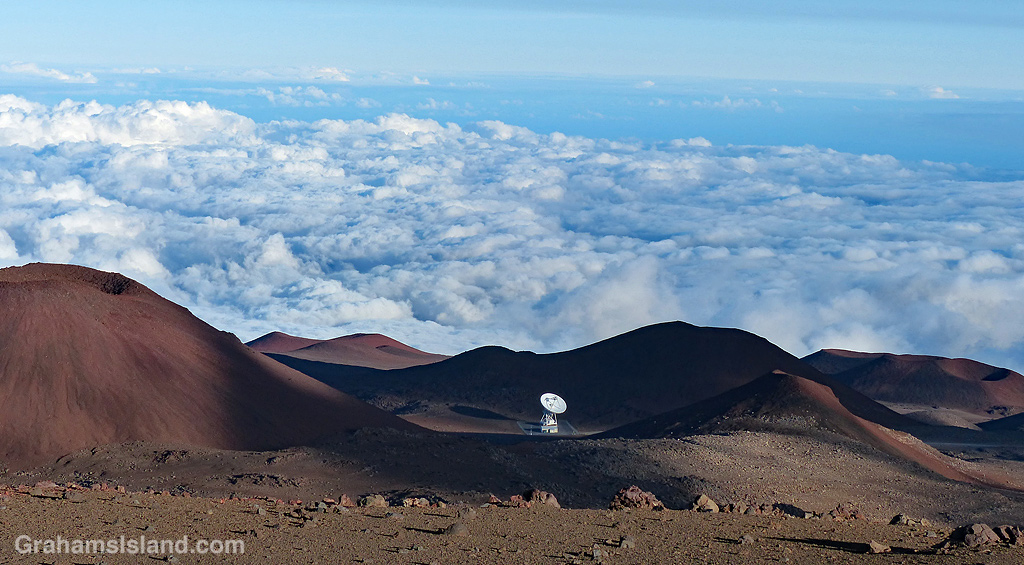 Most of the telescopes on Mauna Kea are clustered together near the summit, but about halfway between the Mauna Kea Visitor Center and the summit is this lonely telescope. It’s one of the ten radio telescopes that make up the Very Long Baseline Array (VLBA), which began operating in 1993. Eight of the other telescopes are scattered around the U.S. mainland with the tenth at St. Croix in the Virgin Islands.
The Mauna Kea telescope, like the others, consists of a dish antenna 82 feet in diameter, and an unmanned control building. These ten telescopes are remotely operated from the Domenici Science Operations Center in Socorro, New Mexico.
For more information about the Very Long Baseline Array, go to https://public.lbo.us/.

Last year, when I went on the Kama‘āina Observatory Experience, I visited a couple of telescopes. One of them was the James Clerk Maxwell Telescope, a single-dish telescope dedicated to detecting submillimetre radiation.
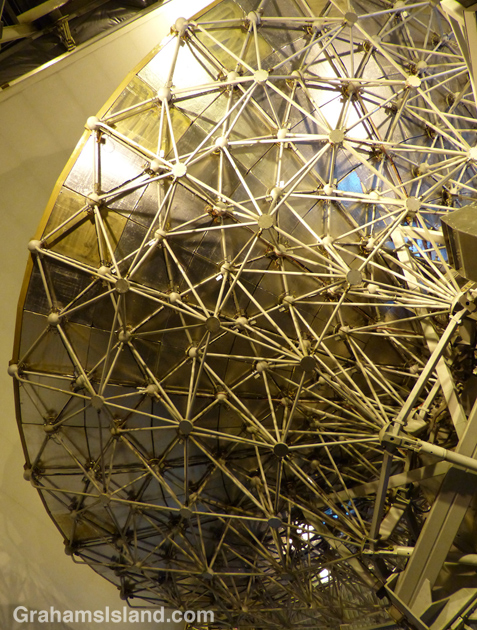
One of the things I liked about that telescope was the structure of the supporting framework. It reminded me of something found at Ikea, but on a giant scale. If I’d been involved in putting it together, at the end of the day, when congratulations were being bandied about, I’d have been the one saying, “Er, I’ve got a rod and three little hexagonal nuts left over. Where do they go?”

Waiting for sunset at the top of Mauna Kea, there are many distractions – shiny telescopes, other sunset watchers, pillowed clouds, and plummeting temperatures. By the time I returned to the car I was ready to turn up the heat, a rare opportunity in Hawaii.
The telescopes are from left: Suburu Telescope, The two telescopes of the W. M. Keck Observatory, and NASA Infrared Telescope Facility.

The small mirror in the Cassegrain cabin of the James Clerk Maxwell Telescope on Mauna Kea, can be rotated to direct information to a variety of instruments. Here, it reflects about the only empty spot in the crowded space.

One of the reasons Mauna Kea is a prime spot for telescopes is that it boasts clear skies for more than 300 days a year. It’s common to see clouds below the summit, but less so to see them passing above the summit like this.
In the foreground is the CalTech Submillimeter Telescope, one of 13 currently operating on the mountain.
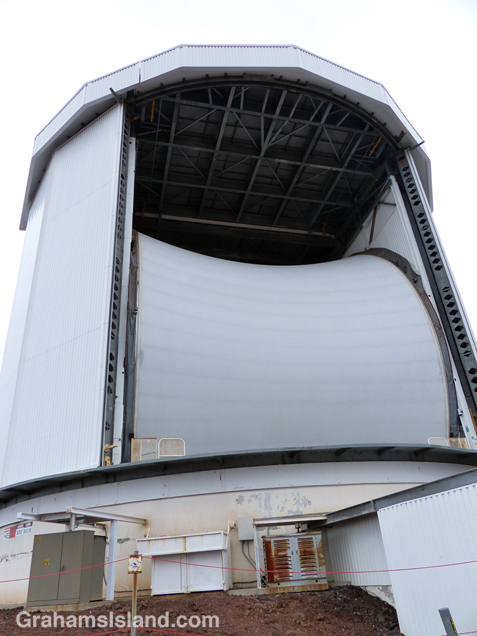
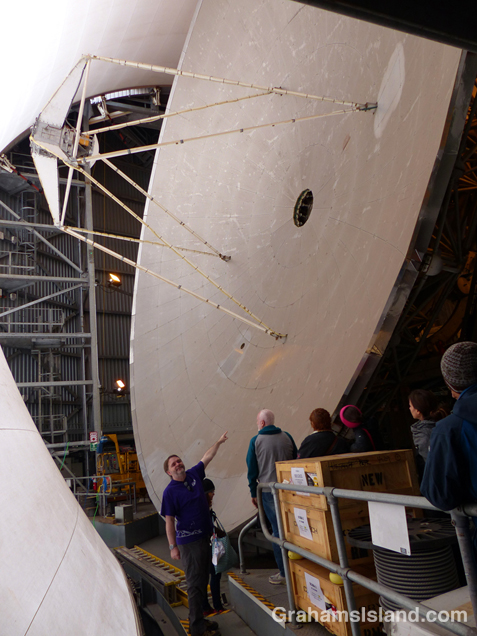
I posted here about a visit to the Canada-France-Hawaii-Telescope on Mauna Kea as part of the Kama‘āina Observatory Experience being offered by the island’s observatories. The other observatory visited during that tour was the James Clerk Maxwell Telescope (JCMT).
The JCMT began operation in 1987 and was funded by the United Kingdom, Canada and the Netherlands. However, the United Kingdom decided to improve how it handled its scientific funding and, as a result, early in 2015, the JCMT’s funding efficiently disappeared into deep space and was never seen again. Subesequently, as one of the guides on the tour said, they basically put the telescope on Craigslist and the East Asian Observatory (EAO) picked up the operation.
The telescope is the largest single-dish telescope in the world dedicated to detecting submillimetre radiation. Other telescopes on Mauna Kea operate at different wavelengths so they are complimentary each other rather than in direct competition. And where other telescopes on Mauna Kea are there because of the 300+ nights of clear skies, the JCMT is there for the lack of moisture in the air, which is critical to its operations.
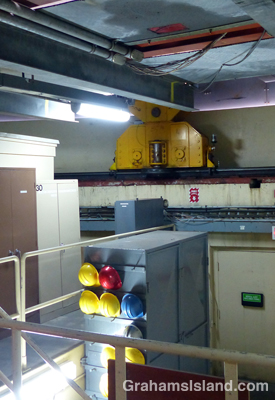
As well as information about the telescope’s operations, the tour included a story about how the steel for telescope’s enclosure had to be sent from England on a small ship after the original freighter broke down. The steel was piled high on deck and was supposed to be headed direct to Hawaii. But the ship’s captain stopped first in Holland to take on a cargo of high explosives! Besides the delay this involved, it also presented problems when the ship arrived at the Panama Canal, for obvious reasons. More delays ensued before the ship disappeared to some port on the Pacific coast to offload the explosives. By the time it arrived in Hawaii, it was so far behind schedule that the penalties accrued for late delivery practically equaled the fee for delivery. However, the ship’s captain, in an apparently canny tactic, waited outside territorial waters and demanded full payment, threatening to dump the steel into the sea if he didn’t get it. This proved to be a bad move! The telescope’s operators took him to court and nailed him for piracy on the high seas. The U.S. Coastguard moved in, took over the ship, and guided it into port of Hilo.
Another story from the telescope’s beginnings concerned the opening ceremony. Several VIPs from the nations operating the telescope turned up, including Prince Philip. When the lever was pulled to start the telescope’s operation, nothing happened. Turned out one of the VIP’s was leaning against an emergency stop button.
For more information on the James Clerk Maxwell Telescope, go to eaobservatory.org/jcmt/about-jcmt/
For more information on the Kama’āina Observatory Experience, go to kamaainaobservatoryexperience.org/
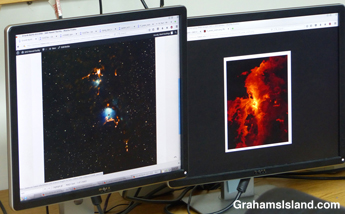
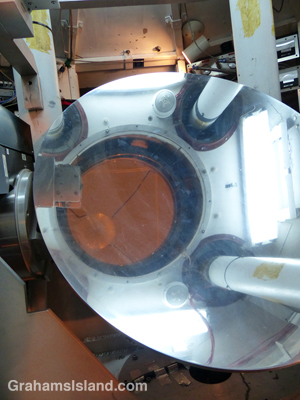


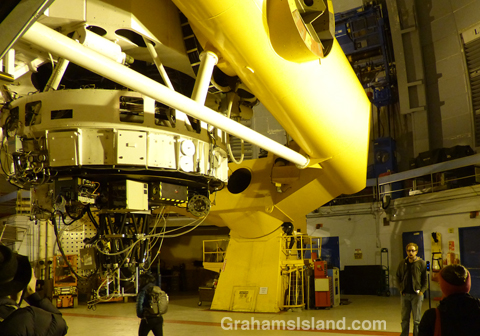
The Kama‘āina Observatory Experience was introduced by President Obama at the White House Astronomy Night in October 2015. The idea is for people who live on the Big Island and elsewhere in the state, to have an opportunity to visit the telescopes and learn a bit about what they do, as well as learn about the natural history and cultural significance of Mauna Kea.
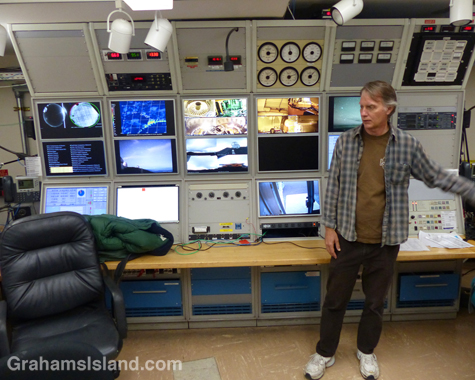
Last weekend, I got the opportunity to take part and the Canada-France-Hawaii-Telescope (CFHT) was the first telescope visited. The telescope dates back to 1979 as is seen in the massive steel arms of the telescope and some of the instrumentation in the control room – love those analog weather instruments in the top row.
The age of the telescope doesn’t mean it’s unsuitable for the modern era. CHFT is a 3.6 meter optical/infrared telescope, but while the mirror and its housing is old school, the supporting instruments are the latest in high tech. And nowadays, like most of the telescopes on the mountain, no one needs to be there overnight; they’re operated remotely.
While a good deal of the information went over my head, and out toward the stars, it was a thoroughly worthwhile experience. I’d recommend it to anyone, but you have to be kama‘āina, a Hawaii resident.
For more information on the Canada-France-Hawaii-Telescope, go to cfht.hawaii.edu/
For more information on the Kama’āina Observatory Experience, go to kamaainaobservatory
experience.org/
 Graham's Island