Tag Archives: Turtles

Abstracts: Yellow-spotted Amazon river turtles

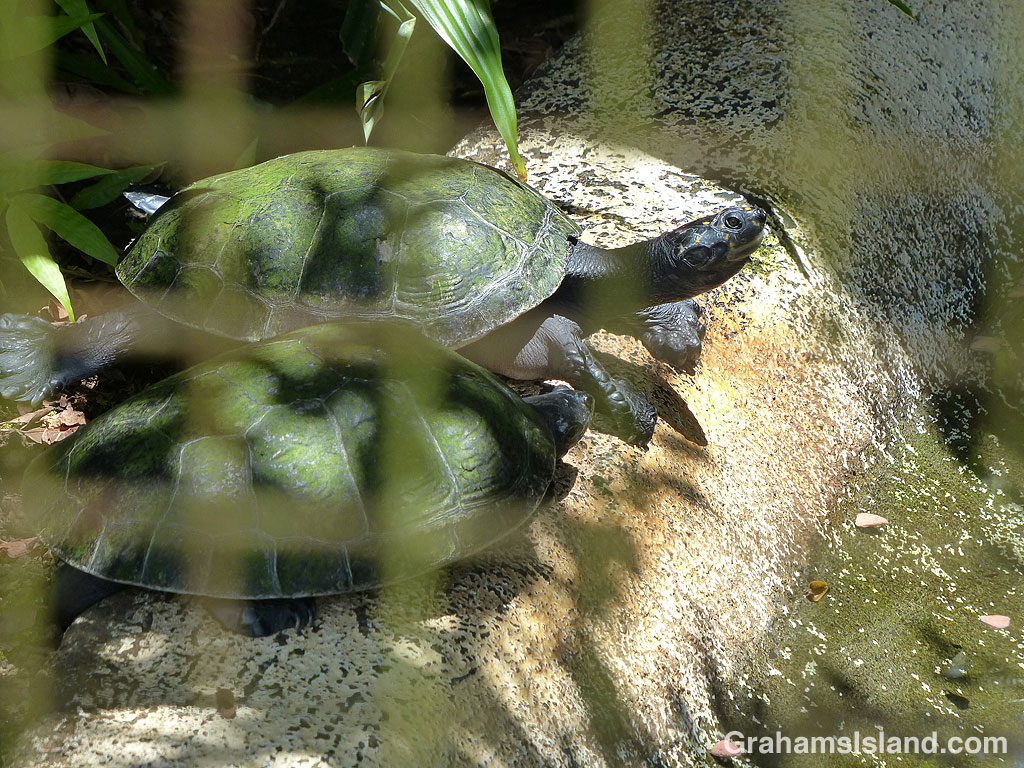
This pair of yellow-spotted Amazon river turtles were waiting for something at Pana‘ewa Rainforest Zoo & Gardens

This pair of yellow-spotted Amazon river turtles were waiting for something at Pana‘ewa Rainforest Zoo & Gardens. Perhaps they were plotting a breakout, figuring out how to cut through the mesh, before making a plod for it.

For more information about Pana‘ewa Rainforest Zoo & Gardens, go to hilozoo.org.

Kiholo turtle collage

A collage of turtles photographed in Kiholo Bay

Since this week’s WordPress photo challenge is ‘collage,’ I thought I’d see just how much I’ve forgotten about Photoshop Elements, or how much I never knew. The answer is a lot, on both counts. Still I had fun figuring a few things out and I like this collage of turtle photos, taken the last time I was at Kiholo.

Kiholo fish pond channel

This channel connects Kiholo fish pond and the ocean

About ¾ of a mile east of the parking area at Kiholo State Park Reserve is this channel or ‘auwai. It connects what remains of Kiholo fish pond with the ocean. King Kamehameha 1 is credited with building the fish pond though he may have actually improved one that was already there. In his day, the pond was much larger than it is today, a lava flow from one of Mauna Loa’s periodic eruptions having filled in a good deal of it.

Turtles and, of course, fish go back and forth through this channel, which also flushes brackish water from the pond. While the pond is on private land, it’s always fun to pause on the little bridge and scan the channel to see if anything is on the move.

For more information about Kiholo fish pond, go to www.nature.org/ourinitiatives/regions/northamerica/unitedstates/hawaii/placesweprotect/kiholo-preserve.xml.

Turtle on the rocks

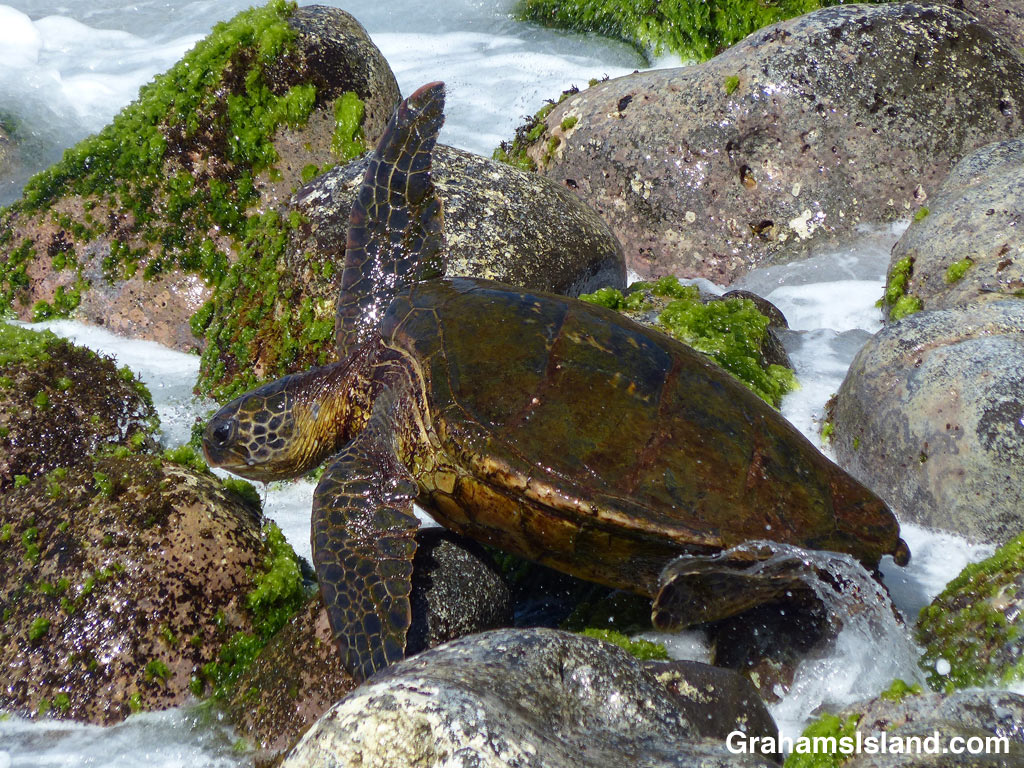
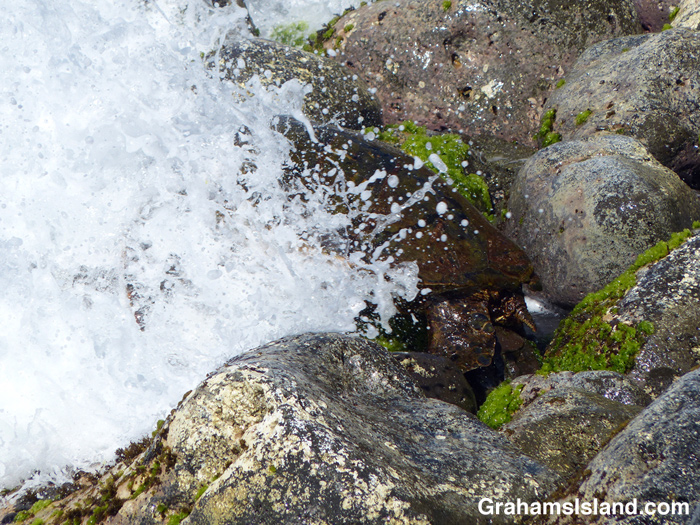
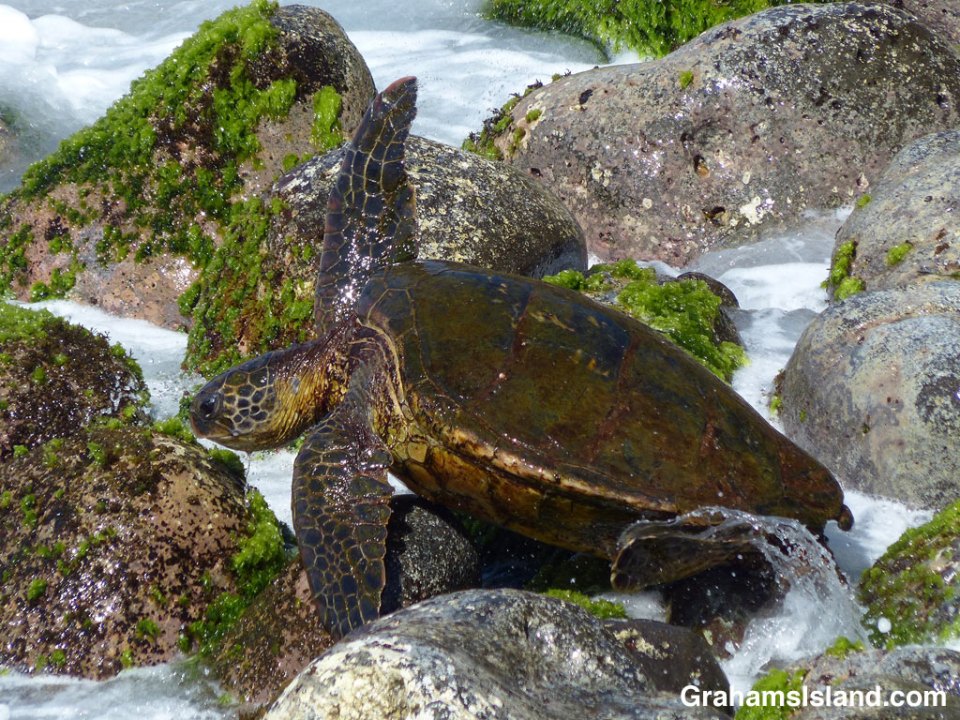
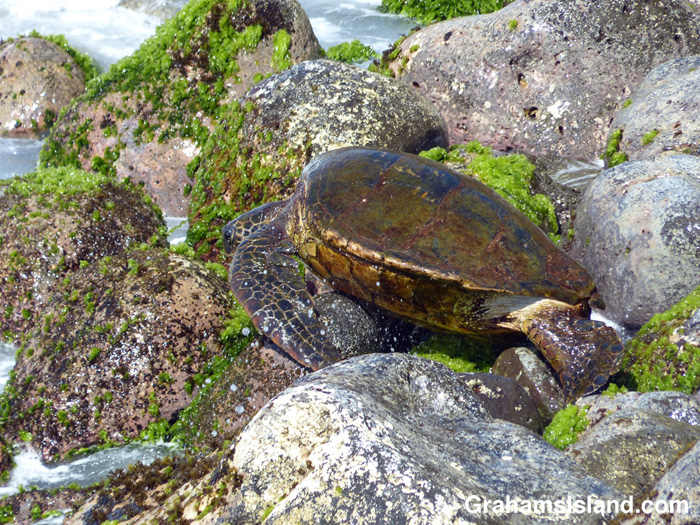
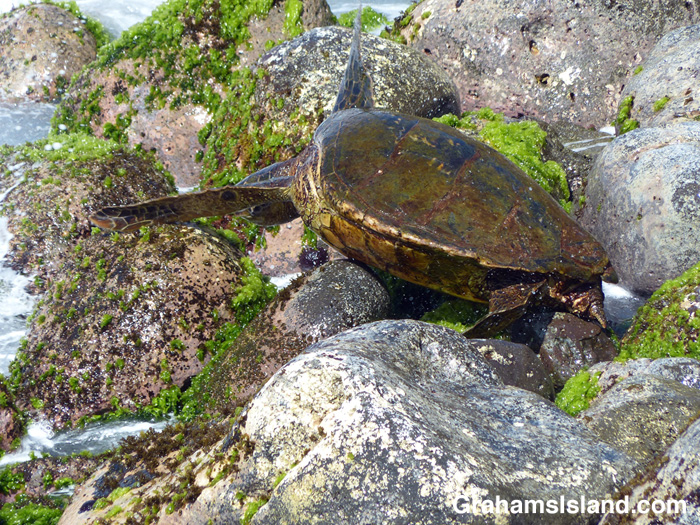
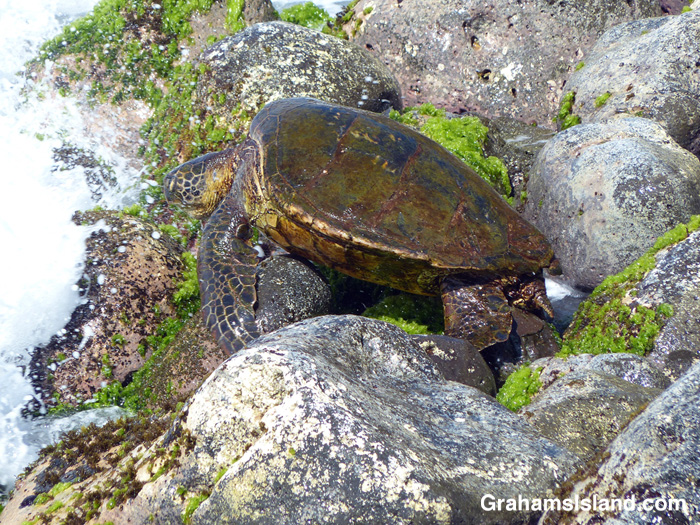
A green turtle is temporarily stranded on a rock.A green turtle is temporarily stranded on a rock.A green turtle is temporarily stranded on a rock.A green turtle is temporarily stranded on a rock.A green turtle, temporarily stranded on a rock, is hit by the next wave.
I’ve been fortunate to see green turtles in the water and on land. On land, they’re most often seen hauling themselves up some sandy beach to bask and rest for a few hours. The effort looks like hard work.

In the water, however, turtles are amazingly graceful. They’re powerful swimmers with great maneuverability. They graze on seaweeds, mostly close to shore. I’ve seen them in shallow waters, white with breaking waves and the worst I’ve witnessed is one or two teetering atop a rock before sliding off again. I’ve never come close to getting a photo of that event.

On this day, there were several turtles feeding in a small bay. A moderate amount of swell ruffled the waters, but every so often a set of two or three much larger waves would barrel in. This was nothing worse than I’d seen turtles handle before, but perhaps these waves were a bit steeper and followed one another a bit quicker. Perhaps, too, these turtles were closer in, bumping among the boulders in the shallowest of waters.

As one big turtle puttered in the shallows, a large wave rushed in and lifted it up and over a rock, dropping it into a water-filled hollow beyond. The turtle scrabbled onto the top of the rock. Here was my photo and my camera was tucked away in its bag on my shoulder. By the time I got the bag unzipped and my camera out, the turtle had enough of its weight across the rock that it slid forward, back into deeper water.

Soon after, another turtle found itself in nearly the same predicament against the same rock. But it wasn’t knocked so far into the hollow and managed to escape much quicker. I did snap a couple of shots, but wasn’t sure if I’d got anything decent.

I hung around, waiting for another big set to come through. When one did, it found the turtle in the photos rattling around amongst the rocks in its quest for food. The onrushing whitewater engulfed the turtle, carrying it in, and when the water receded, the turtle did not.

I started taking photos. The top photo is where the turtle ended up, well up among the rocks. The others show it working like crazy to find a way back to the water. I’ve never seen so much flipper flapping in my life. It was starting to make progress over the first boulder when the next wave arrived, plopping it back where it started. Luckily, that was the end of that big set and over the next few minutes the turtle managed to bump its way over the rocks and into the sea.

Even as I was laughing at this slapstick scene, I hoped the turtle wasn’t injured. I don’t think it was; the waves lifted it over the rocks more than slamming it into them. When it finally slid beneath the water it looked none the worse for wear, though it might have harbored dark thoughts about anyone rude enough to photograph the episode.

Abstracts: Impressionist photo of Hawaiian sea turtles

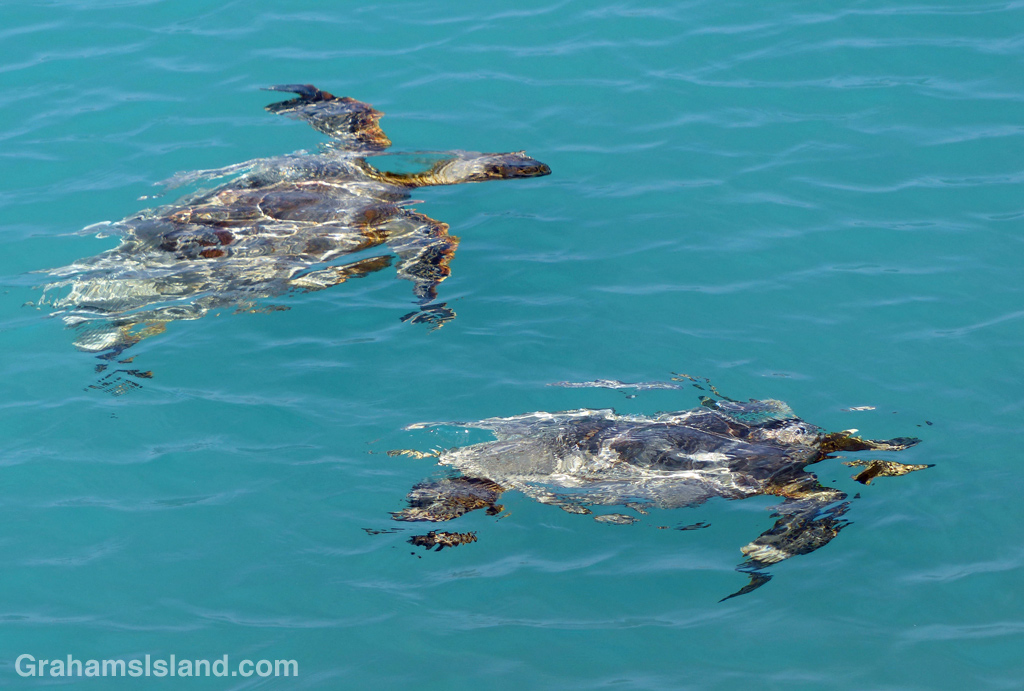
two Hawaiian sea turtles look like an impressionist painting as they swim underwater
Kiholo Bay is a popular spot for Hawaiian green sea turtles. On a recent hike I saw several of them on land and in the water. A light breeze rippled the water and when the turtles swam just below the surface, their appearance was in constant flux. It was a nice surprise to find I’d captured this impressionistic effect.

Brant goose

A brant goose at Kaloko-Honokohau National Historical Park, north of KonaA brant goose and green turtle at Kaloko-Honokohau National Historical Park, north of Kona
Brant geese are rare visitors to Hawaii so it was nice to see this one puttering in the shallows at Kaloko-Honokohau National Historical Park, north of Kona. The rock it’s about to bump into is a Hawaiian green sea turtle. There were probably about a dozen of them there, either resting on the sand or bumping along the reef close to shore.

Mongoose and dead turtle

A mongoose about to feast on a dead green turtle on the Big Island.
I pondered about posting this photo. I’d emailed a contact at a marine animal facility with the news that I’d found a dead turtle with a broken shell washed up among some rocks. I asked if anyone would be interested in that information, thinking some marine biologist might want to check the remains to determine the cause of death, that sort of thing.

He asked me to send a photo, which I did. Then I got a response in which he said not to send more. He’d been expecting a ‘happy turtle photo.’ I suspect he’d missed the bit about it being dead with its shell broken in two.

This is a less graphic photo taken a day later, by which time mongooses had discovered the remains. My appearance distracted them, but not enough for them to flee. The mongoose is the poster animal for catastrophic invasive species, but in this case, it’s performing something of a service in cleaning up the remains. Probably other creatures, such as crabs, also gathered for the feast.

I don’t know what happened to the turtle. Possibly it was attacked by a tiger shark or it could have died for some other reason. I doubt the ocean caught it by surprise and swept it to its death. Turtles are very good swimmers.