


This is the second part of a three-part description of a hike along the Puna Coast Trail in Hawaii Volcanoes National Park (See part 1 here).
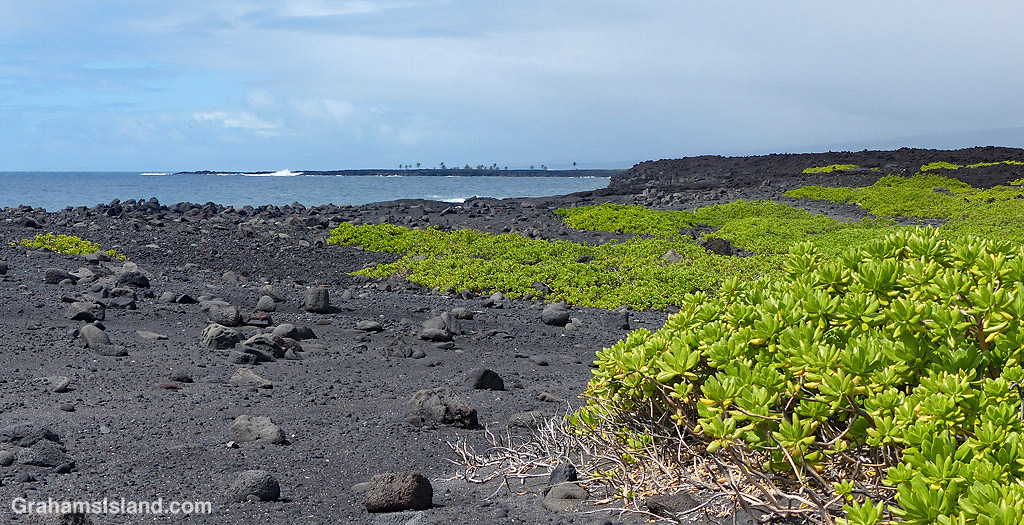
As the trail reaches the coast, it passes over an older flow that has a fair amount of vegetation on it. The third photo shows the trail cutting through a swathe of naupaka, sourbush, and assorted grasses.
This area was, despite the threat of volcanic activity, well occupied by early Hawaiian people. Along the trail are several reminders of that including the structures below. The photo, below middle, shows the amazing abilities of plants to grow in even the most daunting locations. The roots are somewhere deep in the lava, from which the trunk of this noni snakes upward. The large, nobbly fruit can be seen on this plant. This fruit, when ripe, has a pungent aroma which supposedly smells like vomit!
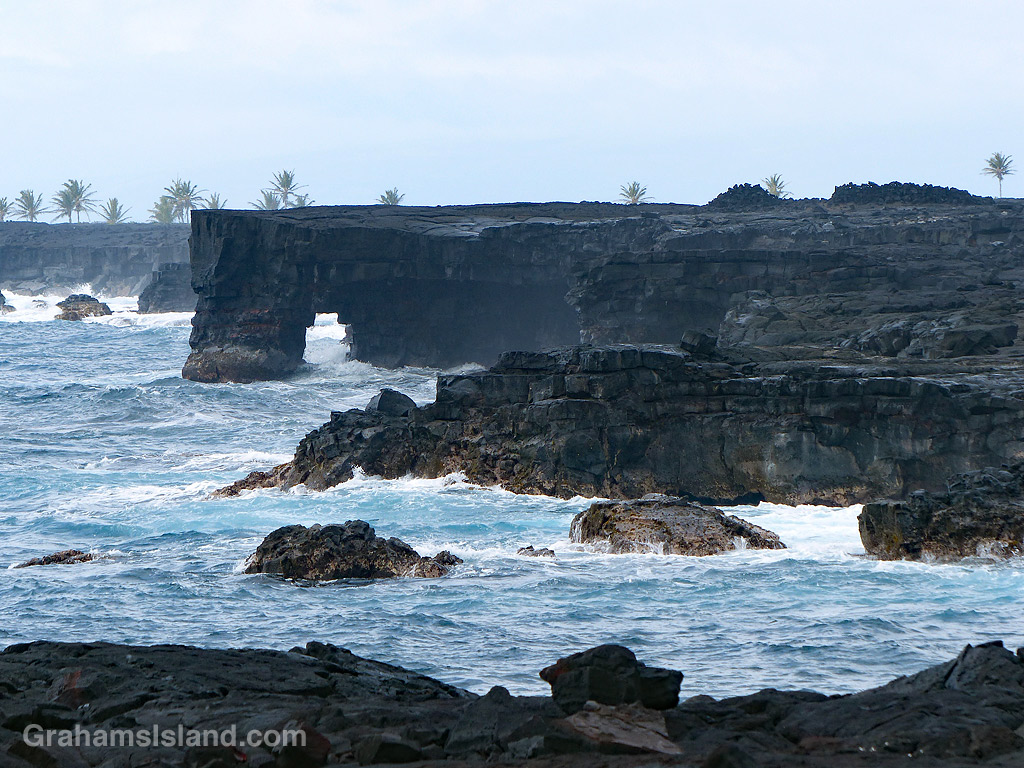
The bottom photo shows an area of rocks and black sand on the coast, backed by an extensive field of naupaka. Beyond that, the trail passes close to a pair of sea arches seen in the top photo and the one at top right. This is a rugged coastline and, when the weather is rough, huge waves can crash up and over the lava. It’s also an unstable coast with rocks and sections of cliff liable to tumble into the ocean.
In the background of the top and bottom photos are the palm trees of ʻĀpua Point, which will be the focus of the third and final post about this trail, tomorrow.
For more information about Hawaii Volcanoes National Park, go to nps.gov/havo/. For more information about the Puna Coast Trail, go to bigislandhikes.com/puna-coast-trail.


 Graham's Island
What a stark and dramatic landscape. The second-to-last photo certainly gives an impression of previously molten lava that cooled and solidified?
LikeLiked by 1 person
I’m always amazed how plants are able to grow in this environment and begin the slow process of reclaiming the lava fields.
LikeLiked by 1 person
It is remarkable. I guess the lava is rich in minerals to which some of the plants are adapted.
LikeLiked by 1 person
It is rich in minerals, but I think on of the keys is the plant’s ability to send roots to places where there’s water. I was in a lava tube once and it was amazing to see ohia roots dangling from the ceiling. They take in water from the condensation in the tube and that’s what enables the tree to grow.
LikeLiked by 1 person
What an interesting adaptation!
LikeLiked by 1 person
If only I had such a stunning area in which to walk, Graham! Lucky you and beautiful photos!
LikeLiked by 1 person
Well, can’t walk there right now, but it turned out to be even more interesting than I thought it would be.
LikeLiked by 1 person
Pingback: Puna Coast Trail: Apua Point | Graham's Island