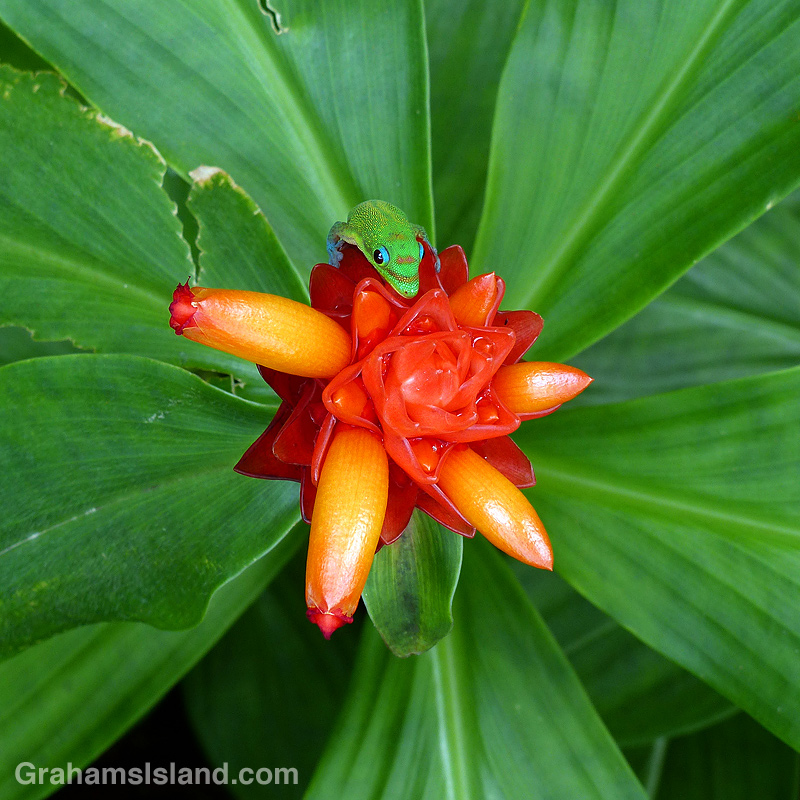
Renanthera imschootiana orchids are from southeast Asia. This one was at Hawaii Tropical Botanical Garden.
For more information about Hawaii Tropical Botanical Garden, go to htbg.com.
Renanthera imschootiana orchids are from southeast Asia. This one was at Hawaii Tropical Botanical Garden.
For more information about Hawaii Tropical Botanical Garden, go to htbg.com.
I found this triumvirate in some shallow water. I saw the white-spotted sea cucumber and blue-black sea urchin first, then noticed the stocky hawkfish. As they do, the hawkfish held its ground for a while, before deciding that was enough of being observed.


The lesser grass blue butterfly (Zizina otis) was first seen in Hawaii on Oahu in 2008 (for an article, or most of an article, about the find, click here). They’re now well established on the Big Island as well.
Lesser grass blues are very small, with a wingspan no more than ¾-inch. With wings folded up they’re the size of a small fingernail. They also fly close to the ground, within a foot or two.
Lately, I’ve been seeing them in large numbers on these blue heliotrope (Heliotropium amplexicaule) flowers. When I say ‘seeing them,’ what I mean is that when I walk past a patch of these flowers, a host of lesser grass blues will flutter up from the flowers, dance around in a tizzy for a few moments, and then settle back down again. When they do this, it’s like blue confetti being thrown (a few inches) into the air.
I’ve tried to capture this image with my camera, but haven’t been able to (and I’ve taken LOTS of photos). The butterflies are so small, I’m tall, and the effect is fleeting. But the top photo gives an idea of what’s going on, with three lesser grass blues homing in on the small blue heliotrope flowers while a fourth has already found a spot.
It wasn’t until I processed the photos at home that I noticed the spider in the second photo. I don’t know what it made of all the butterfly activity. I hope they weren’t its prey.

Kona airport is officially called the Ellison Onizuka Kona International Airport at Keahole.
Ellison Onizuka was an astronaut from Kealakekua, Hawaii, who died in the destruction of the Space Shuttle Challenger. Kona is the district and Keahole the place name for the actual location (Keahole Point) of the airport. And International? Well that’s largely due to the aircraft in these photos.
Japan Airlines (JAL) began flying to Kona from Tokyo in 1996, but suspended service in 2010. With no international flights coming in, the feds shut up shop, and that’s the way it stayed until the end of 2016. At that point, Hawaiian Airlines began service to Tokyo three times a week and a new Federal Inspection Service facility opened at the airport to accommodate the needs of the government. But the icing on the cake occurred in September of last year when JAL resumed daily flights to Kona. And in December of this year, Air Canada will begin seasonal nonstop flights from Vancouver. Très internationale!
These photos are of the outgoing JAL flight preparing to take off on the return journey to Japan. I took the top photo because it made me think of a shark cruising by.


I came across this pair of nene, the Hawaiian goose, on one of my walks. They didn’t seem too bothered by my arrival in the vicinity and continued to graze.
And in a shameless bit of self-promotion, the second image is my Photo of the Week for this week (7-23-18 to 7-30-18). Check out my shop for more details here.

Lantana is such a colorful flower – pink and purple, yellow and orange (and invasive here, but let’s not talk about that). Curiously, it doesn’t seem all that popular with bugs, at least by my observations. But at certain times I see butterflies very interested and on this occasion, several bees were going from bloom to bloom.
Posted in response to this week’s Sunday Stills challenge on the theme of ‘Macro-Photography of Anything.’ See more responses here.

Mo’okini Heiau is located just off one of my regular walks. The old signs for the heiau and the Kamehameha birth site fell from their original spot, tacked on a fence, some years ago. Since then, the signs have been wedged into a barbed wire fence, from which they regularly fell into the grass.
When I noticed this, I’d root the signs out and wedge them back in the fence. I believe other people also did this. At some point, one of the signs split in two, so there were three pieces to try and arrange in some way that they wouldn’t immediately fall down again.
I kept thinking I should bring some wire and a drill and try and put the signs back together again, maybe attach them to a fence post, but I only remembered this good intention when I was picking the signs out of the grass.
The grounds of the heiau are maintained by staff presumably contracted by the county or state. However, the area in the vicinity of the signs never got much attention except when, a couple of years ago, a sign prohibiting animals (on the left of the photo) suddenly appeared. I have a fondness for that sign because the chance of anyone enforcing that regulation is right up there with me winning three different lotteries on the same day (and Hawaii doesn’t have lotteries).
So imagine my surprise the other day when I reached this point in my walk and saw this spiffy new sign. Two new boards attached to a brightly painted pole securely set in a rock. I was giddy with shock and excitement (yes, I don’t get out much). If an alien spaceship had landed I wouldn’t have been more surprised. Note too the red and yellow paint on the chain across the trail to the heiau, and the well-supported post that fell down about a year ago.
Folks, forget the volcano. You want to see something truly amazing on the Big Island, come up to North Kohala and check out these signs while they’re still standing.

Kaumana Caves State Park is a small park west of Hilo. Besides the usual park facilities, the main attraction is the caves. The caves are actually a lava tube, created by a flow from Mauna Loa in 1881. They’re accessed through the large opening where a section of the tube collapsed, so the two caves are at opposite ends of this opening.
My understanding is that the caves go on for quite a way, but one is not supposed to go much beyond the entrances because it is, officially, private property after that. It’s also very dark and claustrophobic, so that was enough for me.
The photos show – Above: A view from mouth of the southern cave; Middle: The staircase down to the caves; Below: Foliage that’s grown in the open portion of the tube. The cave entrances are the dark areas at the edge of these photos.