Author Archives: Graham

Unknown's avatar

About Graham

I take photos when I'm out and about, recording life on the Big Island of Hawaii.

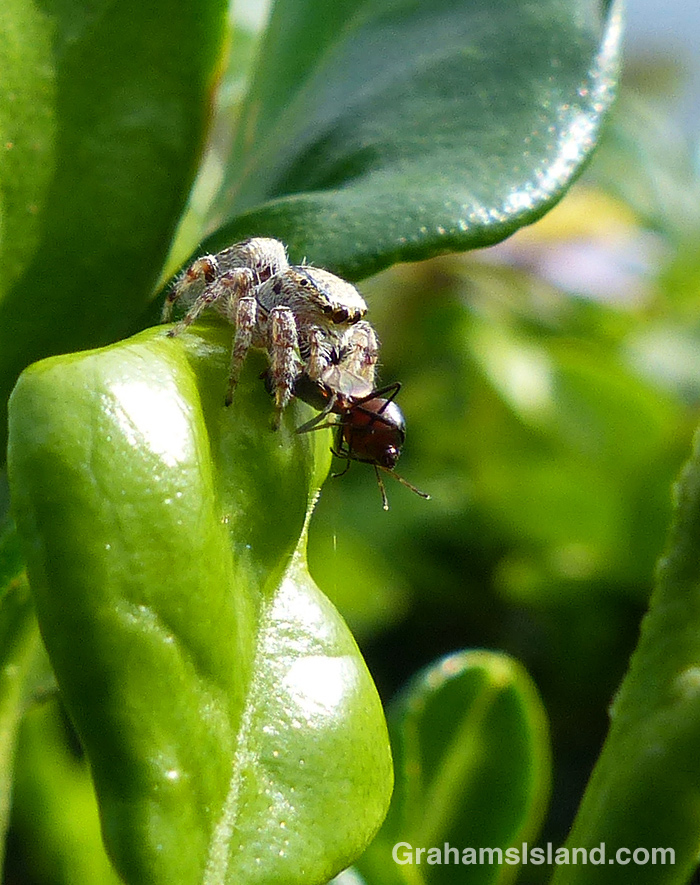
A jumping spider snags a meal

A jumping spider catches a parasitic wasp.
I was watching some butterflies recently when my eye was caught by something tiny (we’re talking a quarter-inch long here) bouncing across the dirt in front of me. I peered down and snapped a couple of photos before it disappeared. I’d seen enough to recognize it as a spider and the photos, while not great, were good enough to enable me to identify it as a striped lynx spider, a kind of jumping spider.

Not long after that, I was again watching butterflies and other bugs inhabiting a mock orange hedge, when I saw this little creature. Again, no more than a quarter inch long, it’s movement caught my eye against the glossy green of the mock orange leaves. A different kind of jumping spider, it hung around, enabling me to get this photo, because it had latched on to what I think is a parasitic wasp. Jumping spider don’t make webs, they pounce on their prey.

Jumping spiders are in the family Salticidae, but there are numerous species within the family and I haven’t yet been able to identify which this is. A characteristic of these jumping spiders is the pair of large eyes in front. This gives them very good eyesight, useful in identifying prey.

Another thing I’ve found out is that they’re everywhere around here. Now that I’m aware of them, and looking out for them, I see them often where I had never noticed them before. Mine eyes have been opened to the glories of the jumping spider – or something like that.

Game bird guzzler

A game bird guzzler collects water for wild birds
On a recent hike, I came across this contraption. What I liked most about it was its name – Game Bird Guzzler. It’s basically a device for providing a source of water for game birds. The way it works is that when rain hits the roof of this structure, it’s collected in a gutter and piped into the back into the tank. This water is then fed, through the white pipe, into the small basin at the front. There’s a flap in the basin so that when a game bird such as a turkey takes a drink, its head will push the flap and release more water into the basin.

When I was there, I didn’t see any turkeys or other game birds, but my approach prompted great activity and squawking as a good number of assorted finches and African silverbills took to the surrounding trees. They sat there, refusing to return to the water but not leaving either. The area surrounding the guzzler was alive with bird calls in an area otherwise not noticeably populated.

Eventually I gave up waiting for a bird to take a drink and moved on. No doubt, within a few minutes the guzzler was again crowded with small birds.

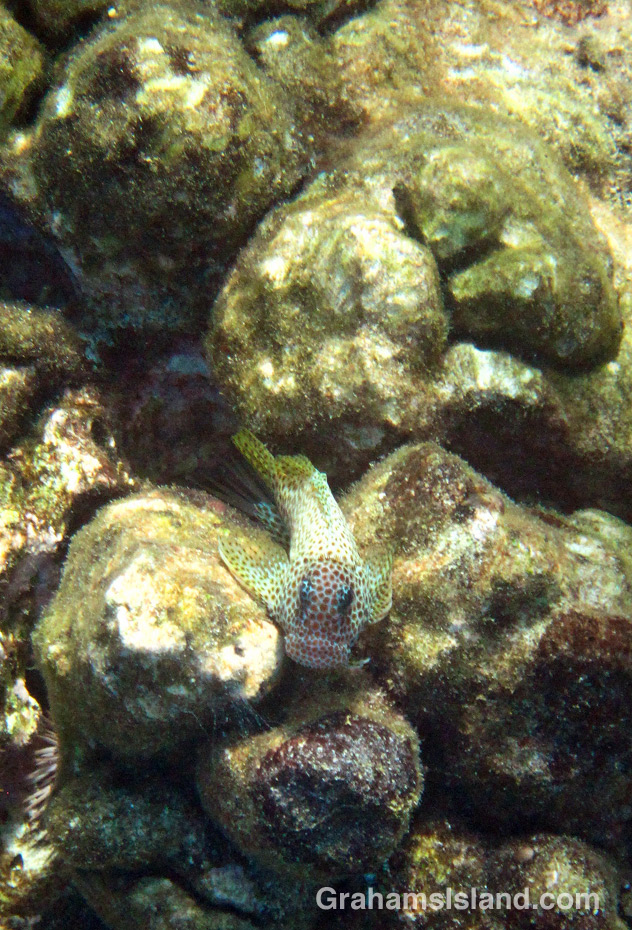
Spotted coral blenny

A spotted coral blenny rests on a piece of coral.
I like blennies. They have the kind of goofy expression I see when I look in a mirror. The spotted coral blenny is considered large for the species, growing to 6 inches long. This one was engaged in typical blenny behavior, sitting motionless on a piece of coral.

In my attempts to identify what I see in the water, I use John P. Hoover’s book The Ultimate Guide to Hawaiian Reef Fishes, Sea Turtles, Dolphins, Whales, and Seals. His website is hawaiisfishes.com.

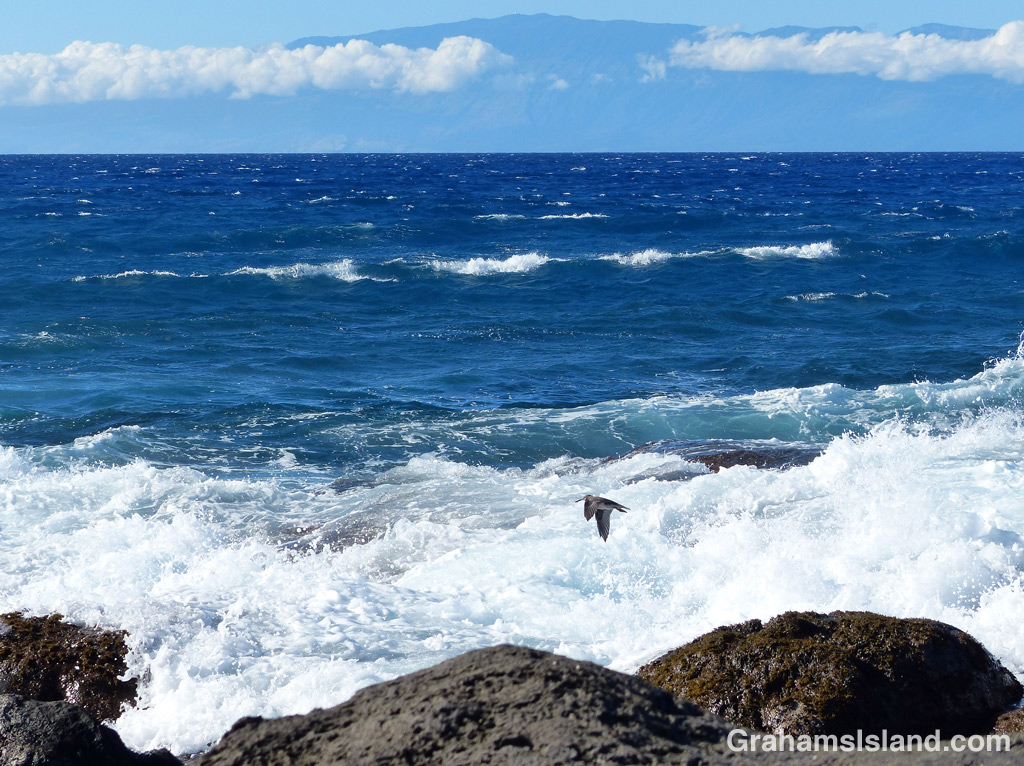
A view of Maui and a wandering tattler

A wandering tattler flies along the Kohala coast
A wandering tattler flies along the Kohala coast on a bright breezy day. What’s notable about this photo is that it was taken in the afternoon and Maui is visible. The reason for that can be seen in the waves. They’re coming from the west to northwest. Waves were from the northeast are driven by the usual northeasterly trades, and those winds would have pushed cloud cover across Maui by this time of day.

A passion vine butterfly lays her eggs

A passion vine butterfly lays an egg.
I watched this passion vine butterfly flitting around on a hedge, laying eggs atop the leaves of, you guessed it, a passion vine growing in the hedge. Typically, she deposits a single egg on each leaf, but this butterfly laid two on this one.

The butterfly is selective about which leaves to use. She chooses ones that have no eggs on them yet, since this will reduce the competition for her offspring. On the leaf she’s using in the photo are some yellow spots. I thought these might be where eggs had been laid previously, but some passion vines produce these colored bumps to make it look like eggs are already there and thus discourage the butterfly.

Not that laying eggs on unoccupied leaves guarantees survival. I saw a number of small parasitic wasps checking out the yellow bumps on several leaves. I have no doubt they do the same with the real eggs. I also saw a very small passion vine butterfly caterpillar snacking on what looked suspiciously like a newly-laid egg. And there’s always the possibility that someone will come along and trim the hedge. Not sure what the vine or the butterfly can do about that.