This week’s Friendly Friday challenge theme is ‘Balconies.’ See more responses here.
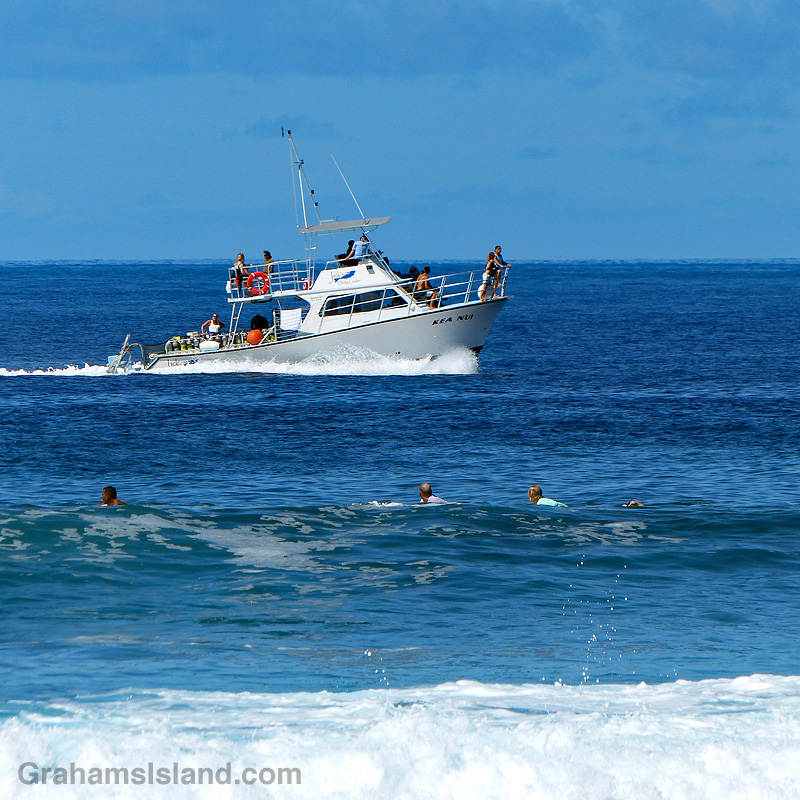
Not having any photos of balconies in the traditional sense, I thought I’d pop for a photo taken yesterday when I was down in Kailua Kona. Here, a powerboat heading north passes some surfers waiting for a wave.
The boat is taking people out to a dive, and like many of these kinds of boats this one has a couple of balconies (though they’re not called that in nautical language) where passengers can relax en route to the dive site.
The Ka’awaloa Trail starts near the top of Napoʻopoʻo Road, on the edge of Captain Cook – the town that is, not the person. The trail goes down to the water near the Captain Cook Monument on Kealakekua Bay.
As you can see, there are a lot of warnings on the sign. It could be greatly shortened to, “Abandon hope all ye who set foot on this trail.” But there are a couple of things to know about this sign. One is that most people won’t read it. I mean, who needs to waste time reading a dumb sign. The second is that quite a few people will end up in difficulty on the way back up, because the trail really is steep, hot, and exposed. Locals often take extra water with them to help out those in need, but if you don’t meet one of them on the trail, you’re on your own. An iced tea stand two-thirds of the way up could make a killing.
I also like that someone has taken the time to obliterate the word ‘vehicles’ in the ‘No vehicles’ admonishment. A car would never make it and even a trail bike might have a tough time. Perhaps it was just the principle of the thing that someone objected to.
Canoe racing is part of a resurgence in traditional Hawaiian culture and activities. Before contact with western civilization, canoe racing was widely popular. But missionaries, who were among the early western arrivals on the islands, didn’t like the races and the gambling on them (along with pretty much every other enjoyable activity). Finally, Queen Ka’ahumanu, influenced by the missionaries, banned canoe racing.
In 1875, King David Kalakaua reinstated the sport, leading to renewed participation in the activity. These days, canoe racers come from all walks of life and take part in the sport for the exercise as well as the racing. Many of the boats, based on traditional designs, are made from fiberglass, but most canoe racing clubs have at least one canoe made from koa wood as it would have been in the old days.
In these photos, a group of local women train in a double-hulled canoe, zipping into Kawaihae Harbor ahead of one of the inter-island barges.
Posted in response to this week’s Sunday Stills challenge on the theme of ‘Sports or Hobbies.’ See more offerings here.
This week’s Friendly Friday challenge theme is ‘blue.’ See more responses here.
Here in Hawaii, blue sky and blue water dominate, especially along the coast. Fishermen are at the forefront of those who get to see these things the most, or they would be if they were around. This scene is typical: blue sky, blue water, a fishing pole, but no fisherman. No doubt resting somewhere in the scant shade provided by the trees.
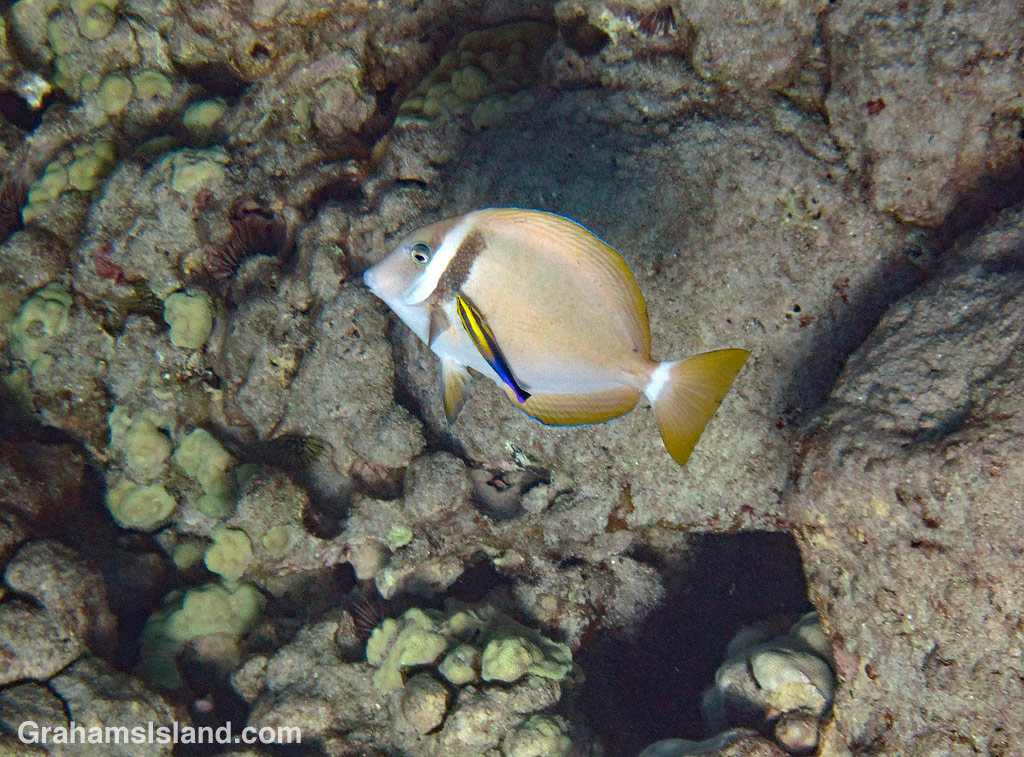
A cleaner wrasse performs its service on a whitebar surgeonfish. Cleaner wrasse establish stations where other fish can visit to be cleaned of mucus and parasites.
When I’m snorkeling, I enjoy visiting these stations to see what’s going on and which fish are availing themselves of the services offered. Some of these fish are predators who, in other circumstances, might be expected to make a meal of a cleaner wrasse. But because of the beneficial service they offer, cleaner wrasse get a free pass with predators.
I have a tendency, when out snorkeling, to revisit places where I’ve seen something interesting. So if I’ve seen a frogfish, a shark, or gargantuan blenny in a particular place, I go back there to see if it’s still there. Bear in mind that these are creatures that extremely mobile and move around a good deal.
And yet, there’s method in this madness. Many fish are territorial and so do occupy a very limited area which they defend with great vigor. Others might be more transient, but tend to feed in certain areas.
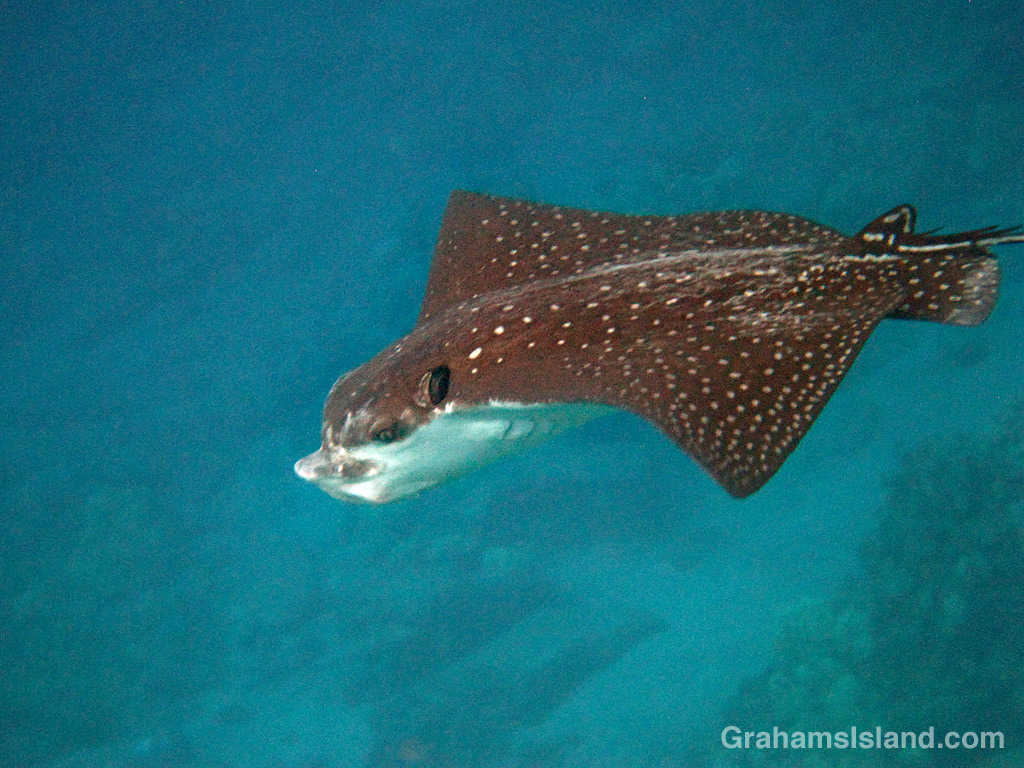
Spotted eagle rays fall into this latter category. They can cover large distances, but tend to feed on sandy bottoms, shoveling the sand with their bills to uncover the marine invertebrates that they feed on.
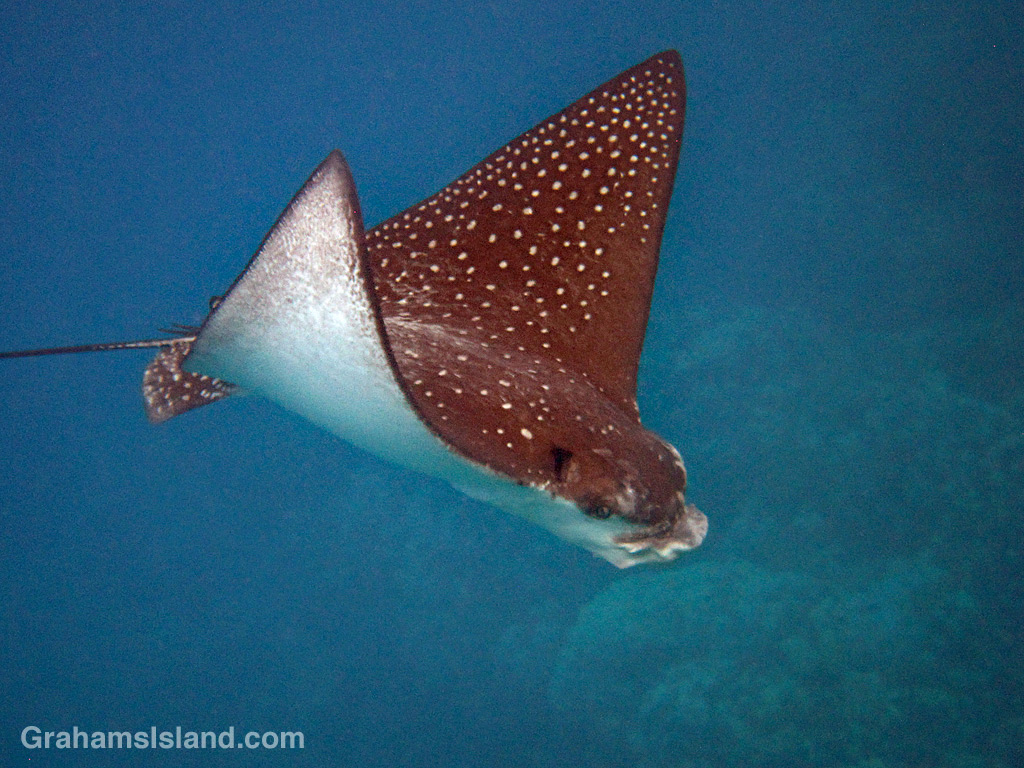
This eagle ray was dong just that, cruising low over the sand, pausing occasionally dig for potential prey. But after a long spell of this activity, it rose in the water, cruised around, and made a close pass, clearly checking me out. It did this a couple of times before heading back down and in toward the shore in search of food.
I don’t think there was any reason for this behavior other than a curiosity to see what this ungainly creature was that was following it. And it’s not alone in this behavior. Manta rays also do this along with dolphins, sharks, and a fair number of smaller fish. They’re curious about us; we’re curious about them. This is what makes getting in the water fun.
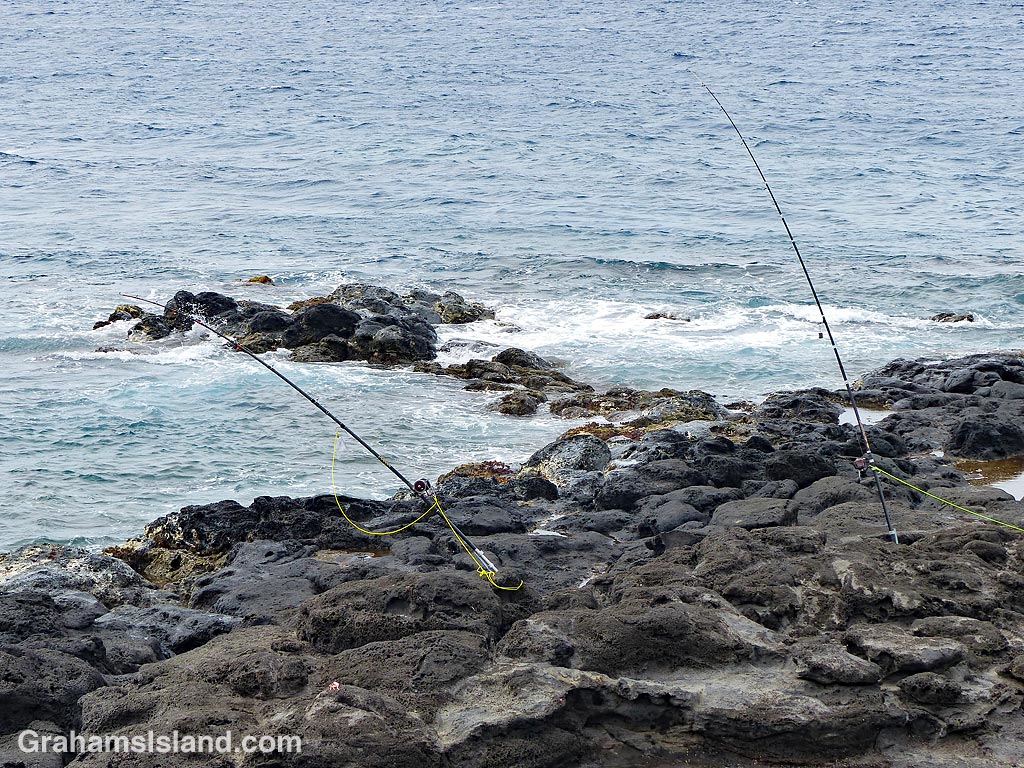
These fishing poles were two of many set up along the North Kohala coast for a fishing tournament. Typically, fishing poles are set into a piece of pipe lodged or cemented into the rocks. They’re anchored on something solid so that they can’t be yanked out – the yellow lines in these photos. Often a bell is attached to a pole so that when something strikes the fisherman is alerted, since they’re not usually tending the poles, but hanging out nearby, often nursing a beer.
A small catamaran cruises through the waters off the Kona coast, its triangular sails harnessing the wind to keep it moving on course and away from rocks inshore.
Posted in response to this week’s Sunday Stills challenge on the theme of ‘Triangles.’ See more responses here.





 Graham's Island