The current Friendly Friday challenge theme is ‘Close ups and Macros.’ See more responses here. Here’s a selection of some little creatures up close and personal.
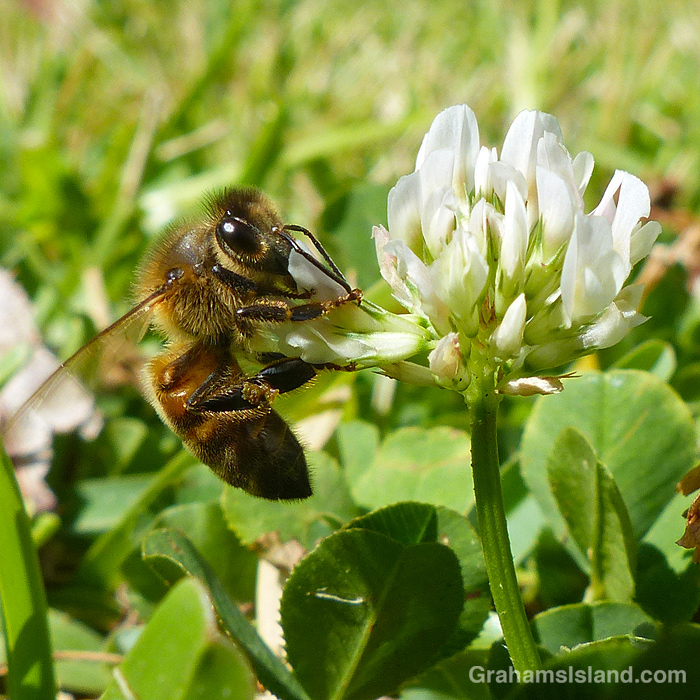
A bee on a clover flower.
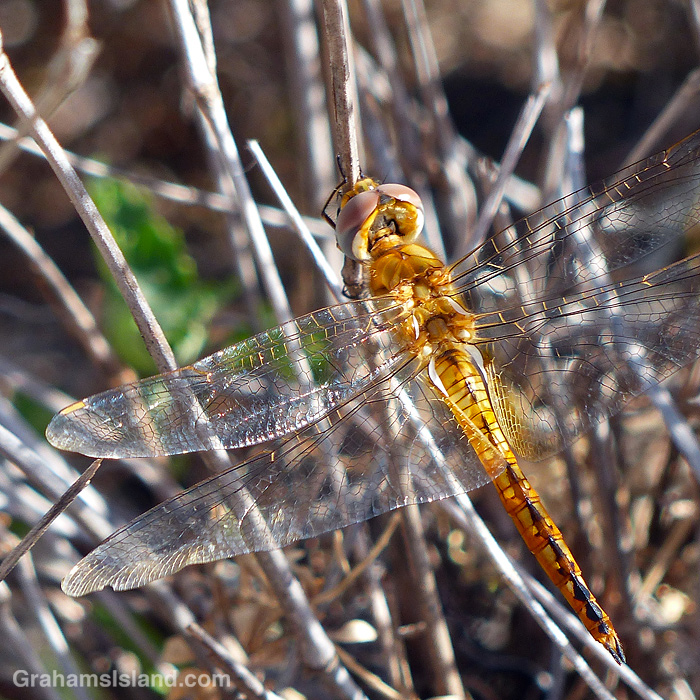
A wandering glider dragonfly rests on a stalk.
A female Hawaiian garden spider on her web.
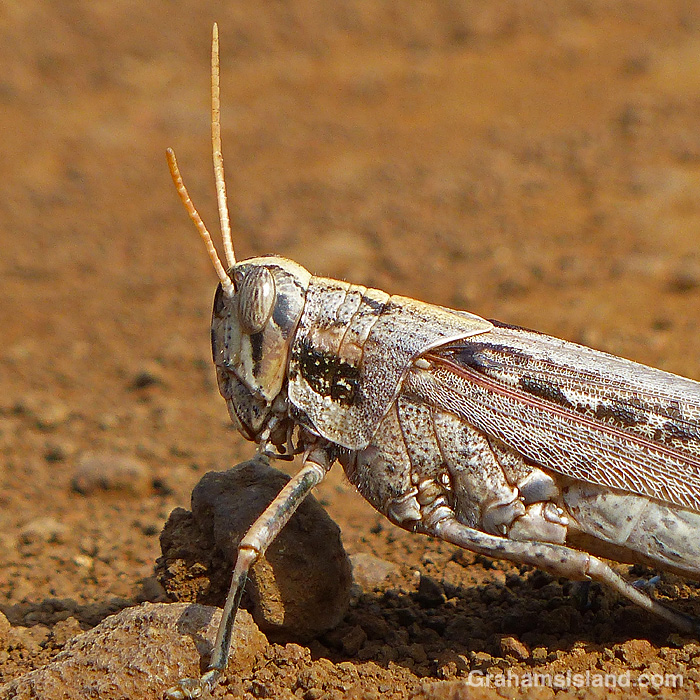
A grasshopper (Schistocerca nitens) sunning itself.
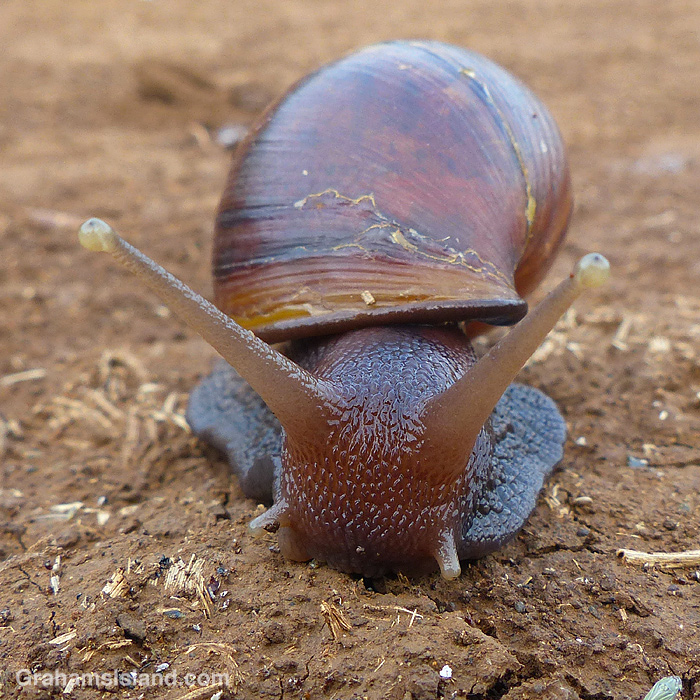
Run for your life, it’s a giant African land snail!
I often see fiery skipper butterflies on what I know as ice plants. I thought the different color flowers were just variations within the plant but, while they’re members of the same family (Aizoaceae), they’re different plants. At the top is an Aptenia haeckeliana with its yellow flower. To the left is an Aptenia cordifolia with a magenta flower.
It’s a different butterfly on the two flowers, but both are fiery skippers.
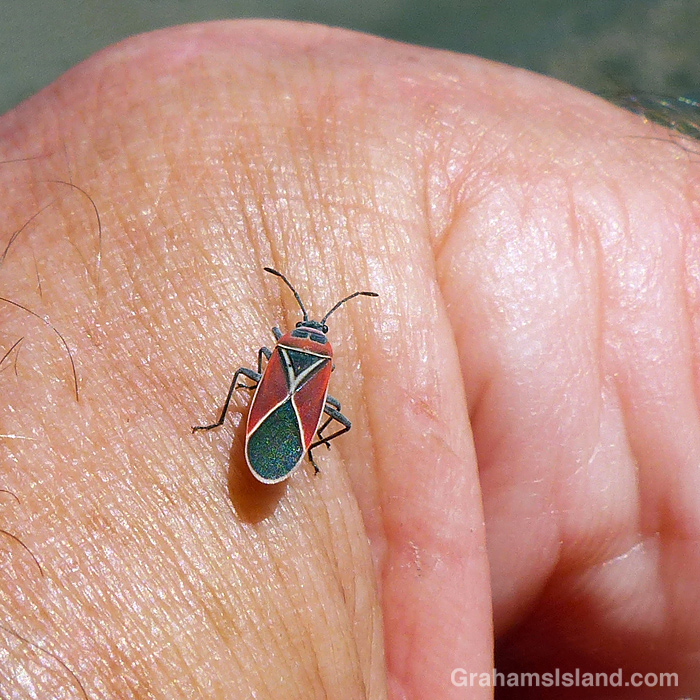
I was doing some cleanup work outside, when I noticed this bug on my hand. I headed in to where my camera was and the bug stayed in place the whole way. I got the camera organized and took a few photos before it finally flew off.
I knew I’d seen one of these before, but couldn’t remember where or what it was. A quick search revealed that this is a whitecrossed seed bug (Neacoryphus bicrucis), a resident of fields and meadows.
My previous sighting had occurred after a hike on Mauna Loa. It was on a water bottle I’d left in the cooler in my truck while I hiked. I suspect that one had inadvertently taken a day trip with me and was probably stunned to find itself at 11,000 feet, surrounded by barren lava!
A while back I posted a photo (here) of one of the heavily-laden tangerine trees in the yard. I noted that in my eight years living here I’d never seen a flower on the tree despite its prolific production of fruit.
However, last week, when I was up on a ladder harvesting the last of the current crop of fruit, I finally saw the flowers in the top photo. Then, when I’d knocked the last of the fruit down, I saw (bottom photo) one tangerine had a bit of branch still attached which bore, not only a flower, but also a leaf bearing a cluster of butterfly eggs.
I still don’t know how I’ve missed seeing these flowers before. They’re small, but not minuscule, and they have a lovely scent. While I wouldn’t expect to see flowers on higher branches, the lowest branches are at eye level and below. And I still haven’t seen bees and butterflies around the trees, though the eggs clearly show they do visit.
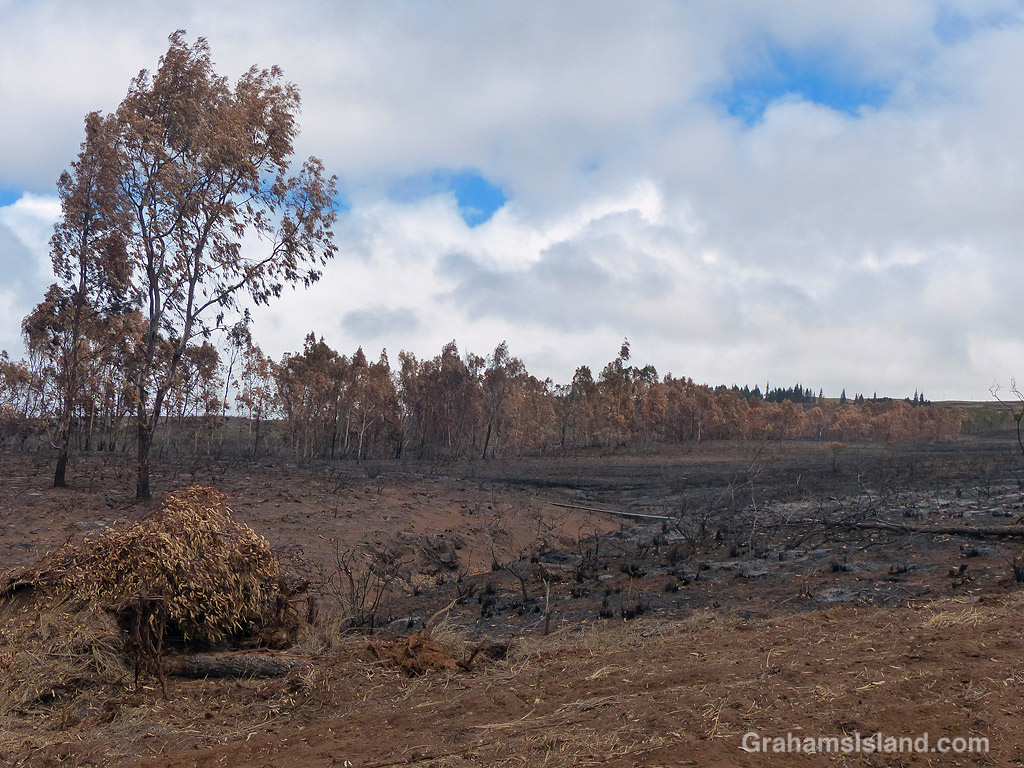
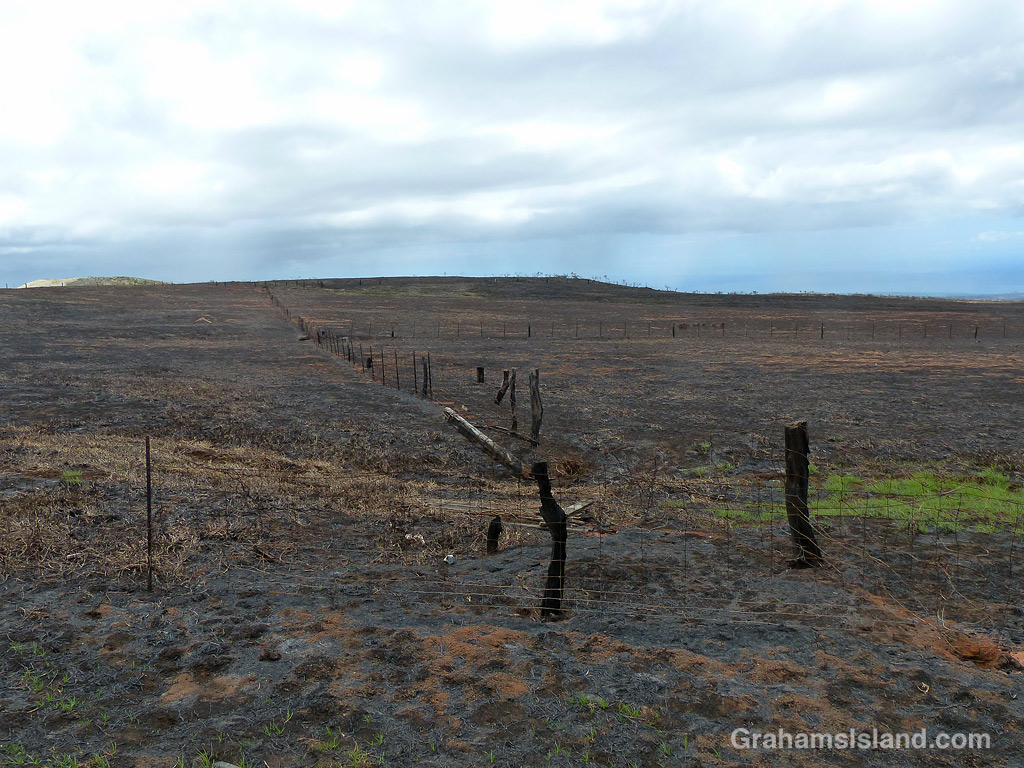
Burned pasture and trees with a bulldozed fire break in the foreground.
An object burned by the fire.
Earlier this month, I posted here about the largest brush fire in Big Island history, which burned more than 40,000 acres of land. A couple of days ago. I drove Old Saddle Road and got a look at the aftermath.
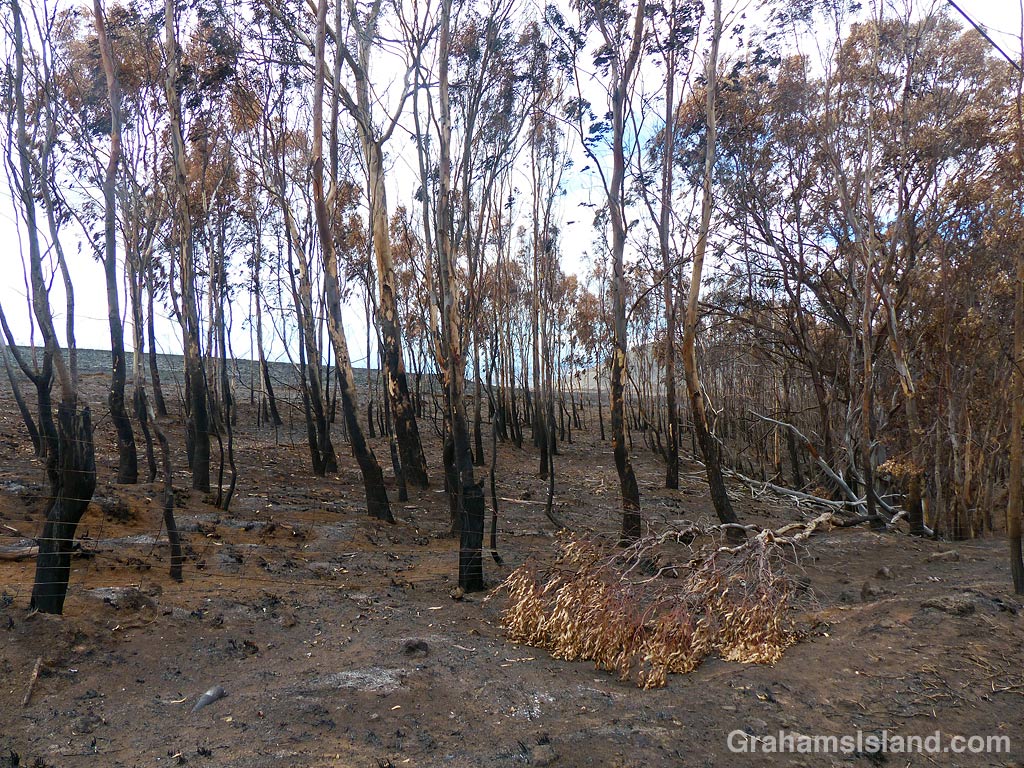
The fire burned mostly through dry pasture and scrub land leaving a black and brown landscape. Clumps of charred trees broke up otherwise uniform stretches of blackened grassland. Lines of fencing could be seen, but where before posts held up the wire, in many places the wire now supported the dangling remains of posts. Thoroughfares of dusty brown dirt cut through the landscape where fire breaks had been bulldozed. Strips of green alongside the highway were the only remnants of the area’s usual color.
The fire has been out for a couple of weeks now, but when the wind blows, brown clouds of dust are driven before it. It will be a few months before anything resembling normalcy returns, though new green shoots could be seen here and there, a testimony to the resilience of nature.
Trees charred by the fire.
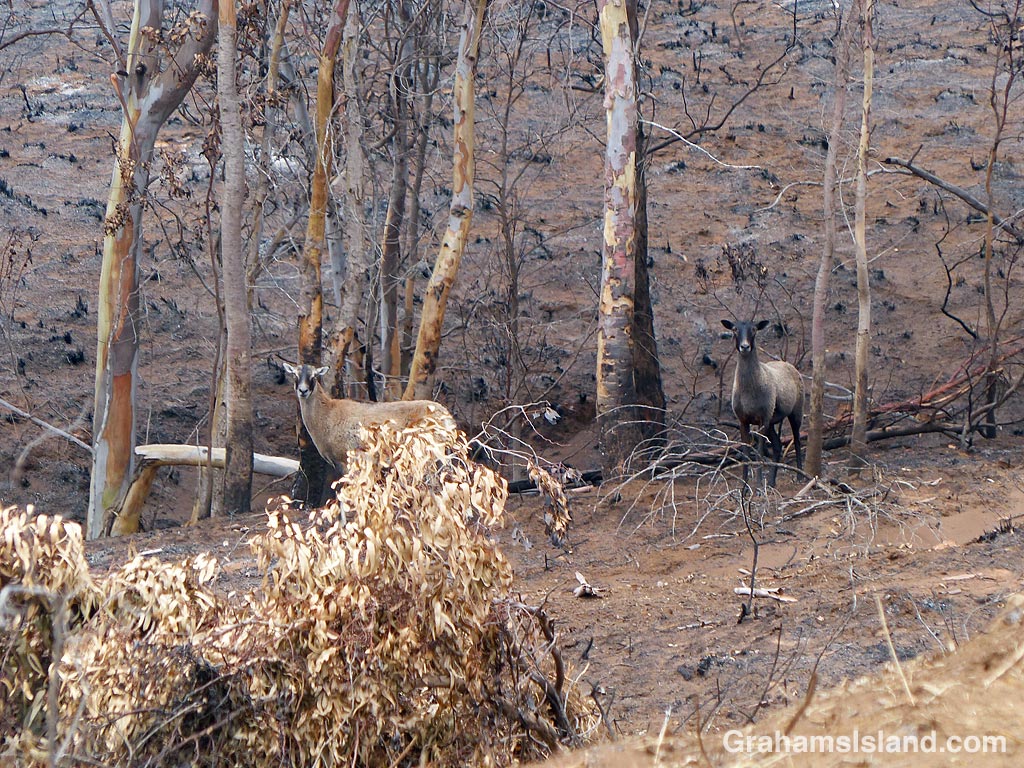
This is the same area after the fire and before.Two sheep in a fire scarred landscape.
As I walked around taking photos I heard some noises. I thought it was trees creaking, but when I got back to the car, I heard the sounds again and spotted these two sheep, now well camouflaged in the new landscape. They looked well enough, though there was nothing to eat or drink for some distance. But they’re free to roam through the gaps in the fencing and no doubt will find something. All the cattle and horses that normally occupy the fields were missing. Many were rounded up ahead of the flames, though some perished.
It was a sobering scene, the more so because, while this was the islands largest brush fire, it was tiny in comparison to the blazes that have become a regular feature of summer on the mainland.








 Graham's Island