
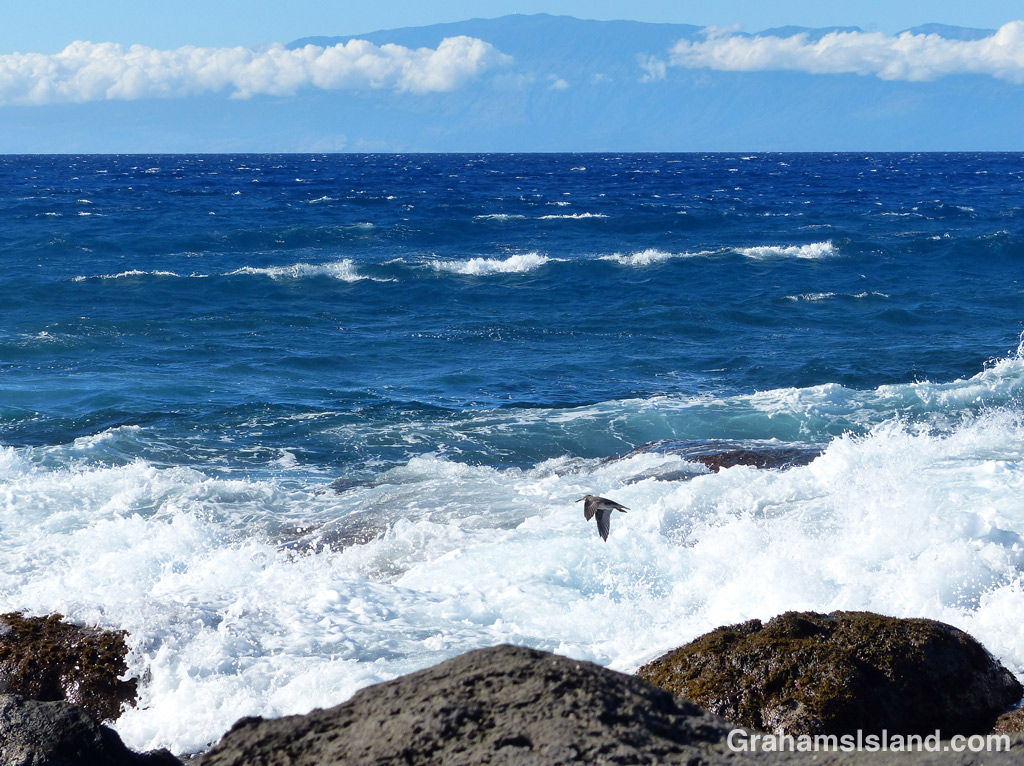
A wandering tattler flies along the Kohala coast on a bright breezy day. What’s notable about this photo is that it was taken in the afternoon and Maui is visible. The reason for that can be seen in the waves. They’re coming from the west to northwest. Waves were from the northeast are driven by the usual northeasterly trades, and those winds would have pushed cloud cover across Maui by this time of day.
Category Archives: Birds
Brant goose


Brant geese are rare visitors to Hawaii so it was nice to see this one puttering in the shallows at Kaloko-Honokohau National Historical Park, north of Kona. The rock it’s about to bump into is a Hawaiian green sea turtle. There were probably about a dozen of them there, either resting on the sand or bumping along the reef close to shore.
Cattle egret on a cow
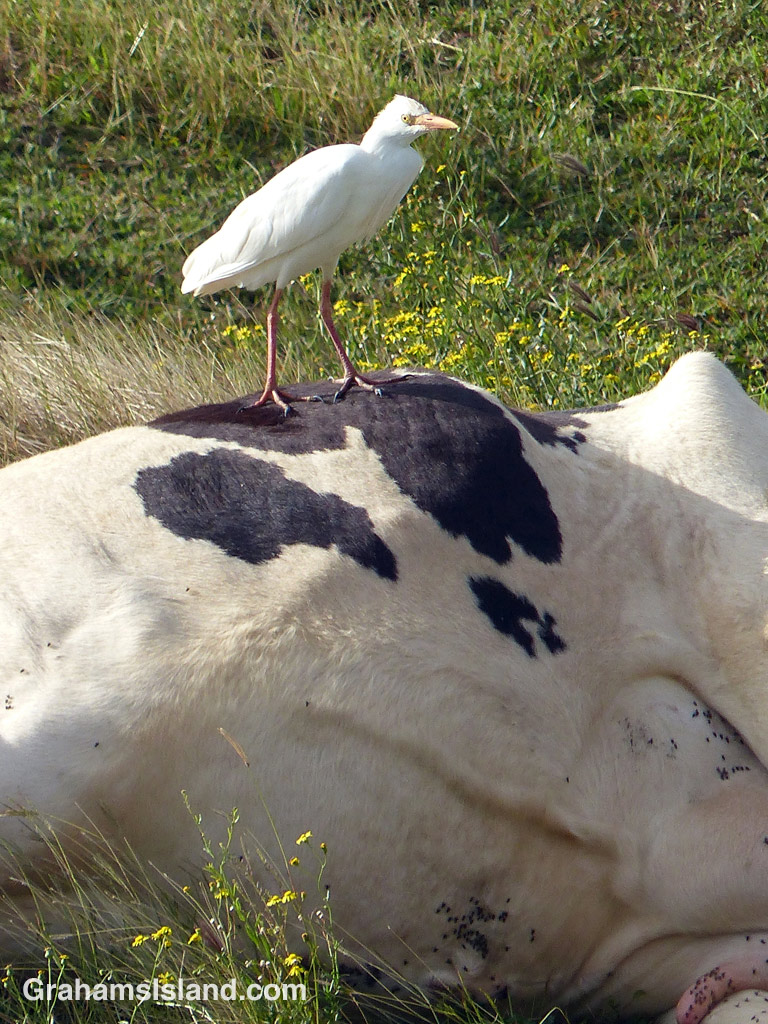
Something about the gleam in this egret’s eye made me think about an old Far Side cartoon where two fishermen are in a boat and one has hooked a cow in the water. The other fisherman says, “It’s gonna be fresh burgers tonight!” Mind you, I think the cow might have had a thing or two to say about that.
Nutmeg mannikin

Nutmeg mannikins are often seen in flocks and are flighty birds. By this, I mean they’re the kind of bird that constantly flits around and gets farther away in the process. They feed on grass seeds, climbing up the stems and stripping the seeds off the ends.
In Hawaii, when cane grass (Pennisetum purpureum) goes to seed it’s a popular feast for a variety of birds. Here, one of a small group of nutmeg mannikins, busily plucks seeds off this stem before moving on for more.
Nene calling
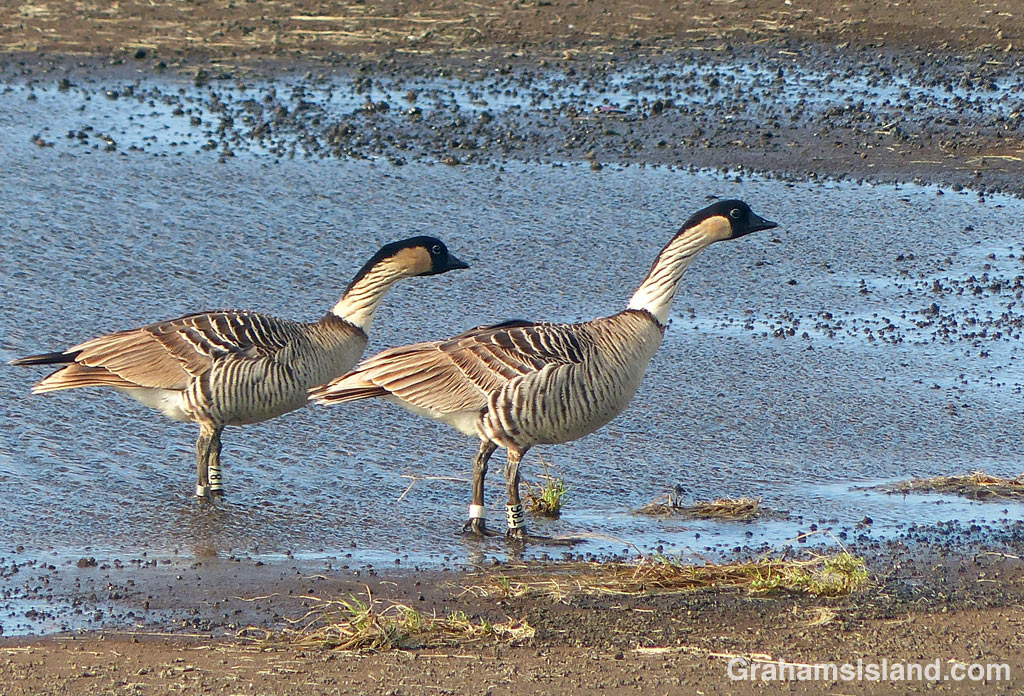
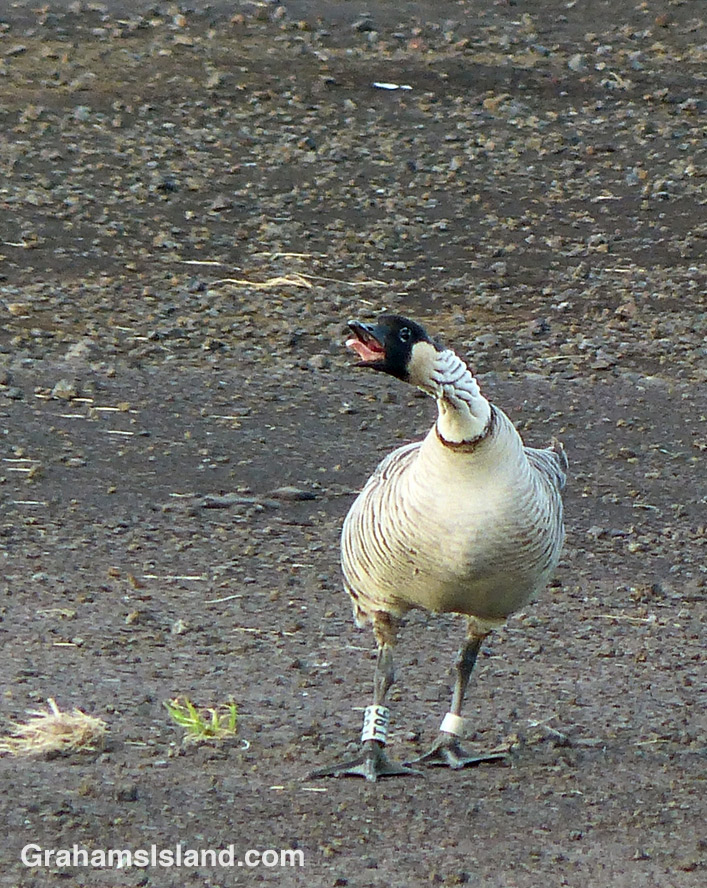
When it rains, large puddles form off to the side of the runway at Upolu Airport. These puddles are popular with a variety of birds, including these two nene, which were in fine voice.
The nene, or Hawaiian goose, is the official state bird and endemic to the islands. It’s also an endangered species and people are encouraged to report sightings to help track the birds. Here on the Big Island, nene sightings are reported to Hawaii’s Division of Forestry and Wildlife. The person I contacted there, Raymond B. McGuire, gave me this information about the birds:
“All of the nene that have the gray bands (like these) are part of a Governor’s Proclamation to move nene from Kaua’i (where they were nesting in a golf course near the airport) to the Big Island and Maui. In total, the Big Island received 598 nene in a 5-year period (2011-2016), this more than doubled the resident population prior to the project. The bands not only tell us where the nene came from, but also the sex. There should be two bands on the nene. One is metal with a U.S. Fish and Wildlife Service number (really tiny and hard to see) and the other is made of colored plastic and much easier to read the ID numbers (though the gray bands are not always easy to see on a gray legged bird). These gray-banded birds were banded by sex: males will have their plastic bands on the right and females will have the plastic bands on the left. These two particular nene, T86 and T87 were brought to the Big Island in 2014 and according to my records T86 is a male, and T87 is a female. They were brought as a breeding pair with 4 offspring. The translocated birds have been exploring the island more than the local birds have been. Although most of the introduced nene have been mixing with local nene and frequenting already established nene areas, we also now have nene frequenting areas that historically have not seen them or used to see them very infrequently, such as in Pahala, Punalu’u, Hawi (including Upolu), Waimea, and Kukuihaele!”
For more information about Nene and other native Hawaiian birds, go to state.hi.us/dlnr/consrvhi/forestbirds/.
Black-crowned night heron in flight

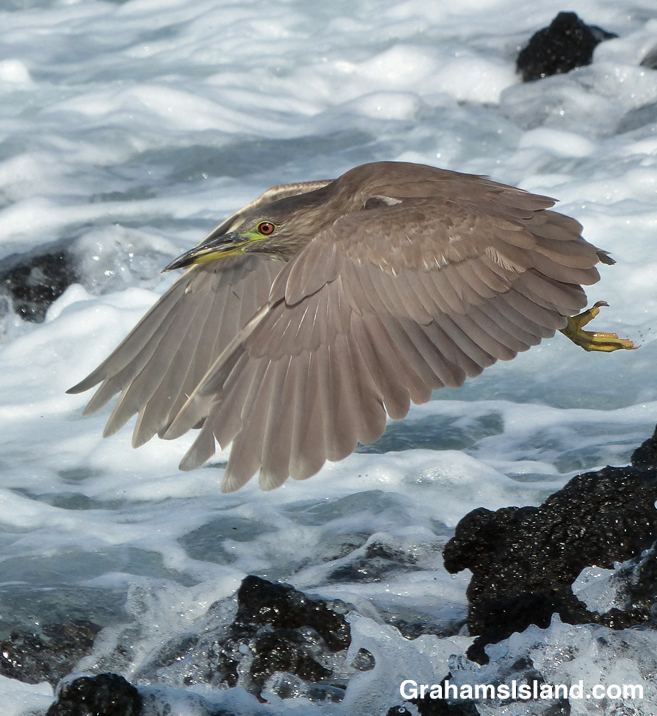
I find the flight of birds very graceful. This juvenile black-crowned night heron was mostly statuesque while fishing in the shallows, but every so often it took flight to relocate, gliding over turbulent waters.
Squirrel’s tail
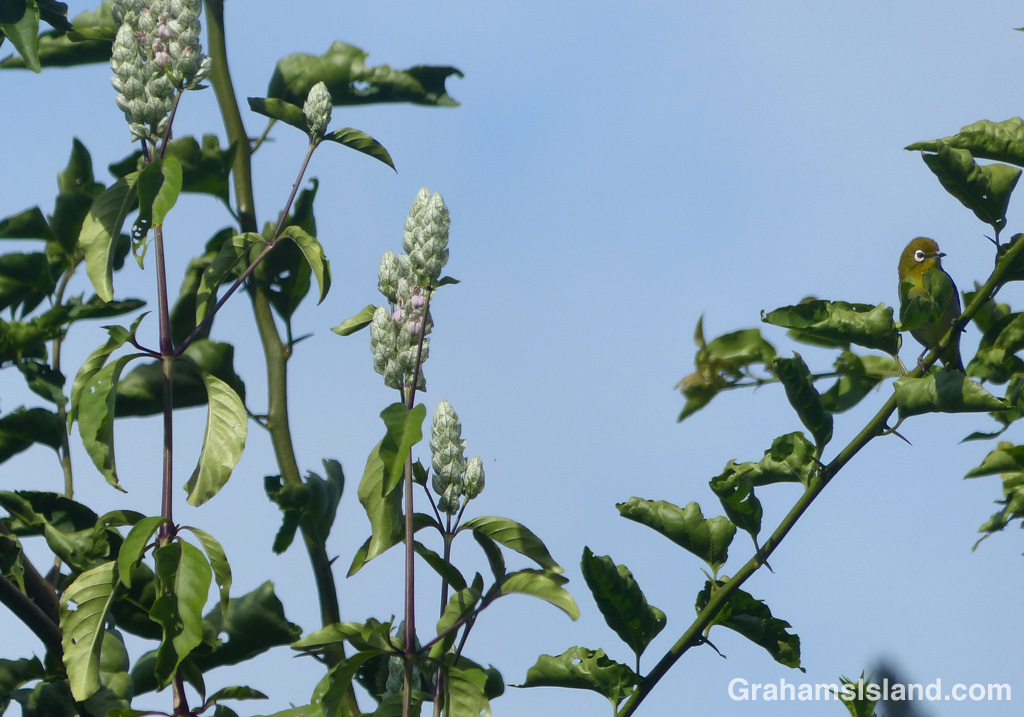
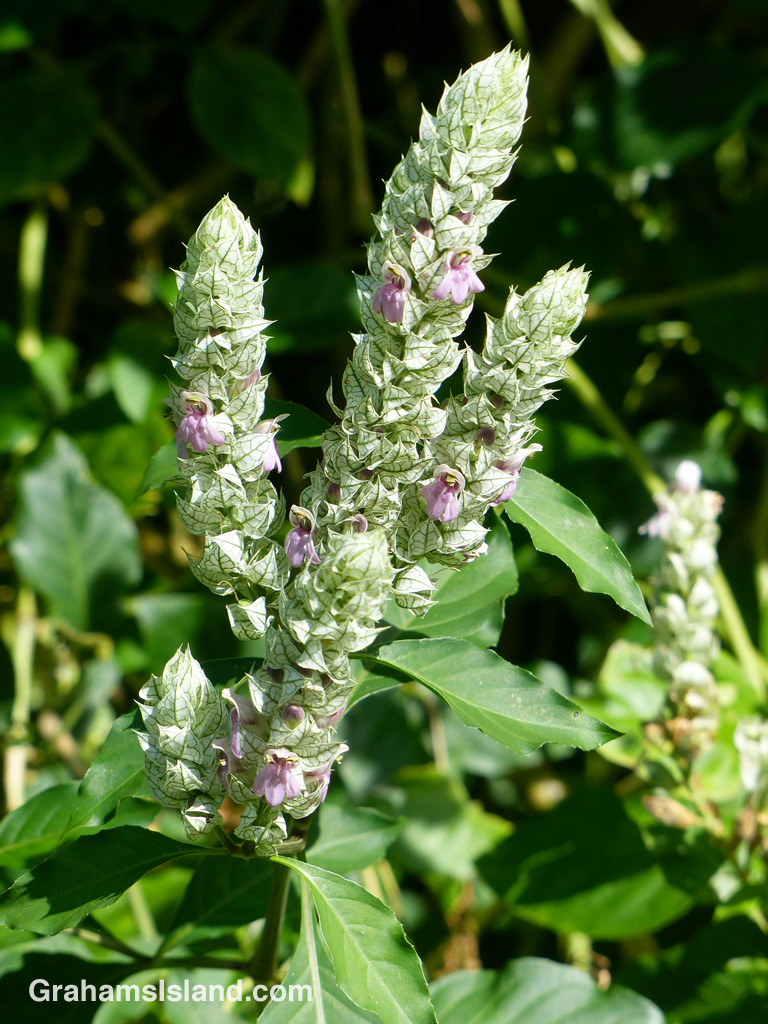
Squirrel’s tail (Justicia betonica) is a fairly common plant on the Big Island. It can grow into a quite large shrub with pink flowers on distinctive stalks. This one offered a handy perch for a Japanese white-eye.
Ruddy turnstones

Ruddy turnstones get their name from their red legs and their feeding habit of turning over rocks in search of invertebrates. This group was mostly resting and grooming near the water’s edge. In the foreground is a Pacific golden plover.
 Graham's Island