Category Archives: Photo Challenges

Is it windy here?

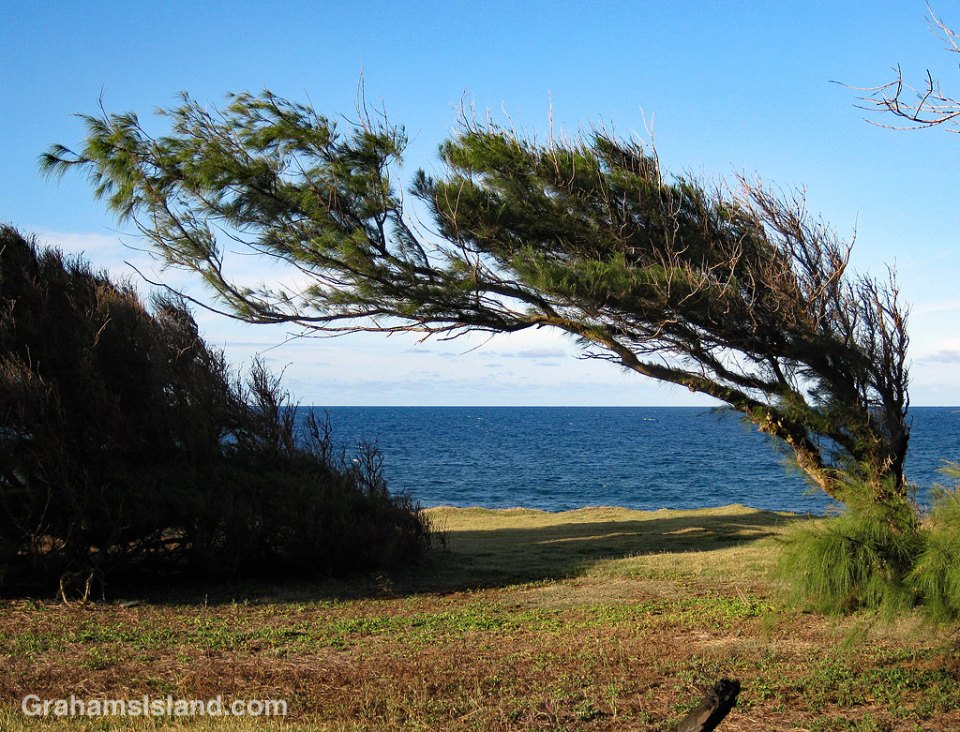
Kauhola Point tree

Northeast trade winds are Hawaii’s air conditioner, moderating what would otherwise be much hotter temperatures. The North Kohala coast is a spot where the winds whistle ashore. They can be very strong, but if you want to know how strong, the surest way is to ask a tree. This one is near the Kauhola Point light.

Posted in response to this week’s Sunday Stills challenge on the theme of ‘Wind.’ See more responses here.

Two Step

Two Step

There are seasons in Hawaii. Summer is hotter, and wetter on the dry side of the Big Island. But let’s be honest, there are many people who live through freezing winters and boiling summers, sun-free winters and sun-seared summers. They believe Hawaii has summer year-round, and not just any summer, but a pleasant summer where it’s warm and sunny but not inhospitably so.

For those people, and in response to this week’s Sunday Stills challenge on the theme of ‘Summer,’ I give you a typical summer shot of people getting ready to go snorkeling, or just exiting the water. The photo was taken at Two Step, next door to Pu’uhonua o Hōnaunau National Historical Park — in February. Bwahahahahahaha.

For more information about Pu’uhonua o Hōnaunau National Historical Park, visit https://www.nps.gov/puho/index.htm.

See more Sunday Stills responses here.

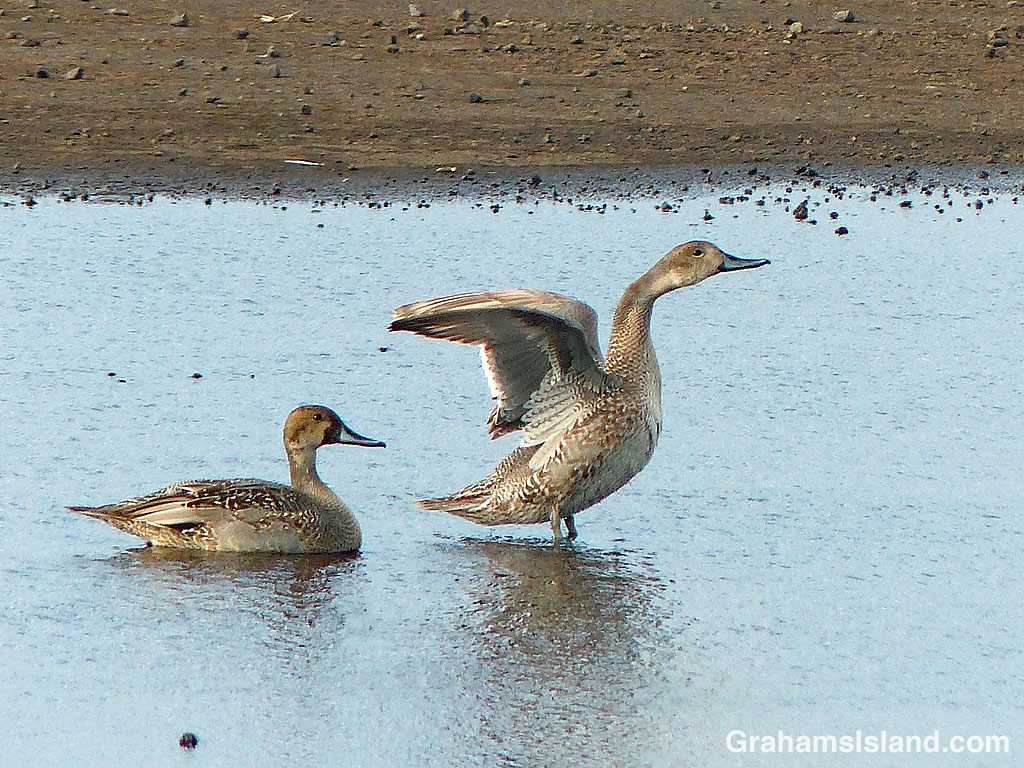
Northern pintails

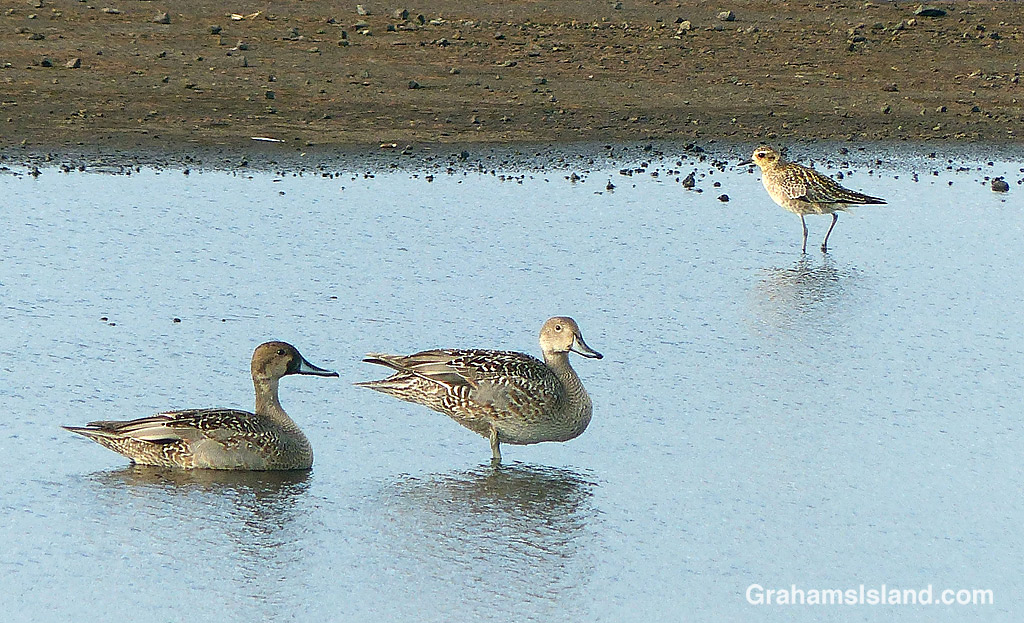
A pair of northern pintails take a dip in a puddle at Upolu Airport. Northern pintails migrate to Hawaii in the winter, in large numbers in former times, but fewer these days.

These are both drakes just starting to molt out of eclipse or juvenile plumage. Alas, they didn’t stick around the area long enough for me to see them in their splendid adult plumage.

Thanks to posters on birdforum.net for the identification and information.

Posted in response to this week’s Sunday Stills challenge on the theme of ‘Tourist.’ See more responses here.

King Kamehameha statues

King Kamehameha statue KapaauKing Kamehameha statue Honolulu

These two photos are of statues of King Kamehameha I, the king who first united the Hawaiian Islands under one leader. On top, draped in leis from last Monday’s Kamehameha Day celebrations, is the statue at Kapaau, here on the Big Island. Below is the statue in Honolulu. It sits in front of the Aliʻiōlani Hale, which housed the government of the Kingdom of Hawaiʻi and the Republic of Hawaiʻi, and is currently home to the Hawaiʻi State Supreme Court.

Back in 1878, a statue of the King was commissioned for display in Honolulu. The commission was given to American artist Thomas Ridgeway Gould, and in 1880 his plaster model was sent to Paris to be cast, before being shipped to Hawaii. Alas, it never made it. The ship transporting the statue caught fire and sank off of the Falkland Islands.

Fortunately, the statue was insured, so a replacement was ordered. While this process was underway, the original statue turned up! Salvaged by fishermen, it was sold to a British ship captain who recognized it. He, in turn, sold it to the Hawaiian government, which now found itself in possession of identical twin statues. But the statues weren’t identical. The replacement statue was pristine and resplendent with gold detailing. The original was missing a hand and had a broken spear, and had suffered a good deal of fire damage.

The government decided to erect the replacement statue in Honolulu and the original was restored and sent to Kapaau, near Kamehameha’s birthplace. However, the original was corroded from its time in the sea so, in the early 1900s, local residents began to paint the statue, both to prevent further corrosion and to make it more lifelike.

By the end of the century, the statue was in bad shape and in 1996 conservator Glenn Wharton was hired to assess its condition. In his book, The Painted King: Art, Activism, and Authenticity in Hawaii, he recalls being startled by what he found, ‘A larger-than-life brass figure painted over in brown, black, and yellow with “white toenails and fingernails and penetrating black eyes with small white brush strokes for highlights. . . . It looked more like a piece of folk art than a nineteenth-century heroic monument.”’

For the next few years Wharton led a community discussion about how to save the statue, including the tricky question of whether it should be restored to its original bronze and gold finish or continue the painted alternative the community had grown up with. In the end the community voted to keep the painted finish and in 2001 the statue was restored in this way and rededicated.

A third statue of King Kamehameha I was commissioned after statehood in 1959, for installation in the U.S. Statuary Hall in Washington DC. However, this statue wasn’t cast from the original molds, but from molds taken of the Honolulu statue.

Posted in response to this week’s Sunday Stills challenge on the theme of ‘Twin.’ See more responses here.

Jacaranda flowers

Jacaranda flowers cluster

Jacaranda flowersA final response to the last edition of the WordPress photo challenge with a theme of ‘All time favorites.’

I headed back to Pu’u Wa’awa’a last week, because this is the time of year when several kinds of trees are in bloom. One of those trees is the jacaranda, which blooms from April to June, and produces masses of blue to lavender flowers. Jacarandas prefer cooler elevations so the lower areas of Pu’u Wa’awa’a are right in their zone.

I wasn’t disappointed. Several trees were covered with these delicate flowers, which somewhat made up for the fact that the entire hill was shrouded in thick vog, exacerbated by the ongoing eruption down in Puna.

Jacaranda flowers and bee

Smithsonian Submillimeter Array

Smithsonian Submillimeter array

Smithsonian Submillimeter array dishesSmithsonian Submillimeter array dishes with textAnother response to the last edition of the WordPress photo challenge with a theme of ‘All time favorites.’

I post this for two reasons. The first is that recently I had an exchange on this blog with the wife of the Director of the Submillimeter Array (SMA). The second is that Mauna Kea is a favorite place of mine to visit.

So here are a couple of photos of the SMA taken a few years back. The dishes are mounted on those little round pads in the photos, and they can be moved to different pads to produce different configurations. In my ignorance of most things scientific, I marvel at the idea of moving a dish a few meters makes a big difference in observations of things way the heck out there in space. That’s not an official measurement there.

The top photo shows seven of the eight dishes that make up the array.
The other photos, of three dishes and what immediately popped into my head when I saw them, show why I never made it as a scientist.

For more information about the Submillimeter Array, go to https://www.cfa.harvard.edu/sma/.

The eyes have it

Sheep with older lamb

Another response to the last edition of the WordPress photo challenge with a theme of ‘All time favorites.’

After a recent hike, I was returning to my truck and saw a small flock of sheep ahead on the track. These two caught my attention. The smaller one on the right was, I assume, the other’s lamb. Just before I took this photo, I saw it going for milk with that pneumatic drill approach that lambs have.

Before and after that, the ewe stood still, unwaveringly fixing me with those intense eyes. Then the two of them ran off to follow the rest of the flock that had already moved on.