Category Archives: Photo Challenges

Touching octopuses

For Valentine’s Day I offer this photo of two day octopuses. It comes with a little story.

One day, while I was snorkeling, I noticed a stocky hawkfish about to plop onto a bit of coral. Before it could settle, a blue goatfish butted it away, getting my attention. I wondered if its presence might mean there was an eel or octopus around since they sometimes hunt together. Almost immediately, just beyond the goatfish, I noticed a day octopus glued to the side of a rock.

I took a couple of photos but knew they wouldn’t be very good; the octopus just looked like another lump of rock. So I began the usual dance I do with an octopus. I edge away, as though I’m leaving, keeping an eye on the octopus out of the corner of my eye. I know the octopus is watching me. Often, when I’ve gone a ways, the octopus will rise up onto whatever rock it’s hiding behind. If I’m quick, I can turn and get a photo before the octopus slides back down again. It’s like we’re connected by a line: I go away, the octopus rises. I return, the octopus sinks.

I swam behind a large chunk of rock, then peeked around the side. Still there, still hidden. A bit farther, another peek. Still there, still hidden. And again. And then I looked away momentarily and when I looked back, the octopus was gone. I think they, like many other creatures, watch a person’s eyes and if the person looks away, off they shoot.

It was a matter of a moment so I knew it couldn’t have gone far. I looked around, examining the rocks. Nothing. They can squeeze into tiny spaces so it was always possible I wouldn’t see it even if it was close by. Then, as I turned around, I caught a glimpse of movement and saw the octopus zip behind a bit of rock. Except then I immediately saw a second octopus follow the first.

I swam around the rock and saw the two of them, each in its own separate crack, a few feet apart. Again I took a couple of photos and then moved away. This time I went farther and waited, watching from a fair distance. Eventually, the octopus on the right of the photo emerged and moved toward the other one. I edged closer and began taking photos. It was then that that octopus slowly eased a tentacle toward the other one, sliding over the rock until it reached up and over the front of the other octopus. It was such a sweet and tender gesture, as though the octopus sought reassurance in making physical contact with its companion.

I took the photo and swam off, leaving them in peace.

Pu’uhonua o Hōnaunau National Historical Park

The final post on this week’s theme of the WordPress photo challenge, ‘Tour Guide.’

These photos are from Pu’uhonua o Hōnaunau National Historical Park, otherwise known as Place of Refuge. This National Park showcases important Hawaiian history with it’s royal grounds where the Hawaiian royalty lived, Hale o Keawe where the bones of 23 ali’i were housed, and for the Pu’uhonua where anyone who had broken kapu (sacred laws) could seek shelter and ultimately forgiveness.

Here are views from the ocean side (above), of a hālau (right) which houses canoes, and of a ki’i (below) representing an Hawaiian god.

For more information about Pu’uhonua o Hōnaunau National Historical Park, visit https://www.nps.gov/puho/index.htm.

White plumeria

This week’s posts are on the theme of the WordPress photo challenge, ‘Tour Guide.’

Tropical foliage and flowers are another Hawaii must-see. Those tender house plants back home grow like weeds here. The east side of the Big Island, with its copious rainfall, is lush and green with sprays of tropical color as different plants come into bloom.

Plumerias are a quintessential tropical plant, much used here in the making of leis.

Convict tang shoal

This week’s posts are on the theme of the WordPress photo challenge, ‘Tour Guide.’

Getting in the water is a top activity here. Whether it’s surfing or swimming, diving or snorkeling, the water is relatively warm and reasonably clear. And there’s lots to see in the water. Here, a shoal of convict tang are joined by a couple of yellow tang, a whitespotted surgeonfish, a ringtail surgeonfish, and an orangespine unicornfish.

Palila


This week’s posts are on the theme of the WordPress photo challenge, ‘Tour Guide.’

A myriad of unique species evolved on these isolated islands. Many have disappeared, victims of other species introduced willfully or accidentally, decimated by new-to-them diseases, or simply displaced by the relentless encroachment of humans.

Of those that still survive, many are under great threat. However, there are success stories. Nēnē, the state bird, have come back from almost nothing and are doing well. Some ‘amakihi appear to have developed resistance to avian malaria, and ‘alalā, the Hawaiian crow, have recently been reintroduced into the wild in small numbers in an attempt to reestablish a wild population.

The palila is another endemic species that is rebounding with a little help. It is the only one of 16 finch-billed honeycreepers still in existence. It used to live on the islands of O’ahu, Kaua’i and Hawai’i. Today it exists only on Hawai’i, the Big Island. Even here, it’s habitat, which once covered the māmane forests of Mauna Kea, Hualali and Mauna Loa, has been reduced to a small area on the southwestern slopes of Mauna Kea.

The palila is a specialist feeder and this is one of the reasons it’s in trouble. It feeds mostly on immature seeds of the māmane, but māmanes have been badly affected by agricultural expansion and by grazing by wild sheep and goats.

The Palila Forest Discovery Trail is an area that has been fenced off and is protected from these threats. I’d been up there several times (four-wheel drive required) but had never caught so much as a glimpse of a palila. One of the reasons for their elusiveness is that palilas follow their food. Māmane flowers at different times depending on the elevation, so palila move up and down the hillside as the flowers bloom and the seeds reach the state they prefer.

Last time I was up there, however, my luck changed. I was taking photos of a moth when something flashed by just above me. I looked round and sitting on a nearby branch was a palila (I’m not a birder, but they’re quite distinctive.).

I quickly snapped a few photos, desperate to get some kind of record of this elusive bird before it disappeared. I needn’t have worried. It seemed unconcerned by my presence and was soon joined by several others. What was most striking was their feeding habit. A palila would pluck a green seed pod and take it to another branch. Once it was settled, the reason for its it stocky bill became apparent. It absolutely hammered at the pod, pinning it to the branch and banging away with its beak to access the seeds. The image of a workman smashing concrete with a pneumatic drill popped into my mind.

For half an hour or so I got to watch them at work. They seemed much like other birds I see — lively, healthy, a thriving group. But looking around, it was a sobering thought to realize I could see all their habitat, containing all that is left of an entire species.

For more information about palila and the Palila Forest Discovery Trail, go to dlnr.hawaii.gov/restoremaunakea/palila-forest-discovery-trail/.

For more information about birding on the Big Island, go to http://hawaiibirdingtrails.hawaii.gov/.

Gold dust day gecko on a bird of paradise

This week’s posts are on the theme of the WordPress photo challenge, ‘Tour Guide.’

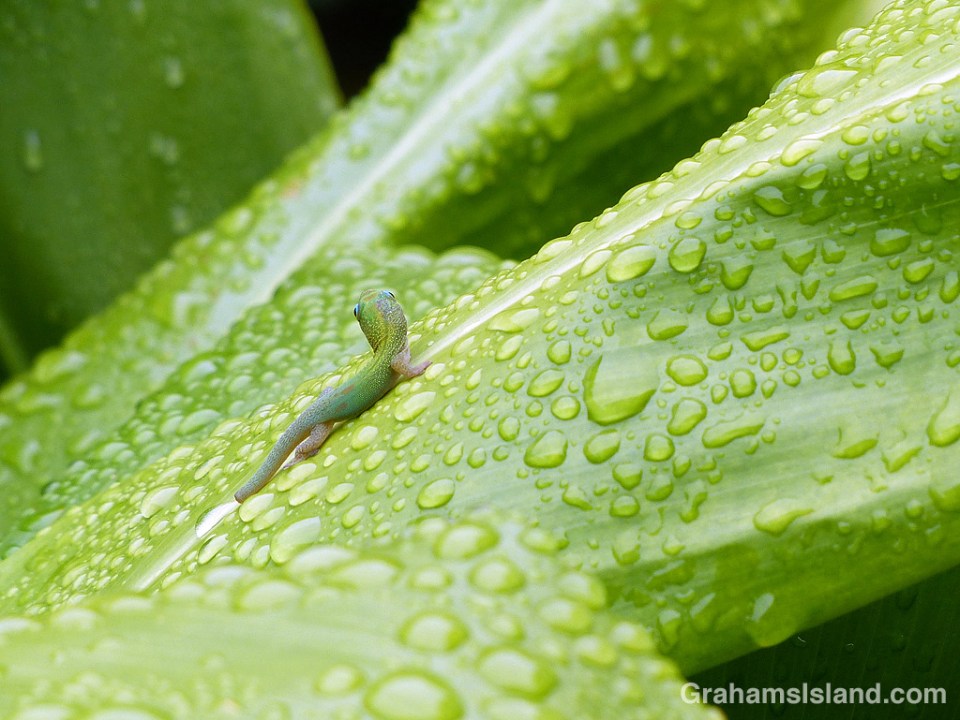
Today’s photo features a couple of tropical standbys, a gold dust day gecko getting ready to take a drink from a bird of paradise flower. The flower is a riot of color and the gecko, also very colorful, is bold and cheerful. Most visitors are likely to encounter at least one, glued to a wall or ceiling, watching them with a somewhat bemused expression.

Green Sand Beach

This week’s WordPress photo challenge is ‘Tour Guide’ which I’m happy to use as my theme for this week’s posts. Since this is Hawaii, a good place to start is at the beach. This one is Papakōlea Beach, better known as Green Sand Beach. It’s about 3 miles northwest of South Point, the most southerly point in the United States.

The beach lies in a bay formed when the ocean eroded one side of an old cinder cone, Pu’u Mahana. The green color of the sand is a result of olivine in the lava. Since it’s heavier than other things in the lava, it stays on the beach. Swimming is possible in the shelter of this deep bay, but be careful. This coast is notorious for dangerous surf and strong currents.

It’s 2 1/2 miles to the beach from the parking area. There’s a very rough four-wheel drive road, which you can drive, or locals will ferry you out for a fee. The other alternative is to hike out along the coast, which is what I did.

You’re not likely to have the beach to yourself, but you will have a share of a beautiful, remote beach, a view all the way to Tahiti (you might have to stand on a rock), and the opportunity to broil on the distinctive green sand.