Camp Tarawa

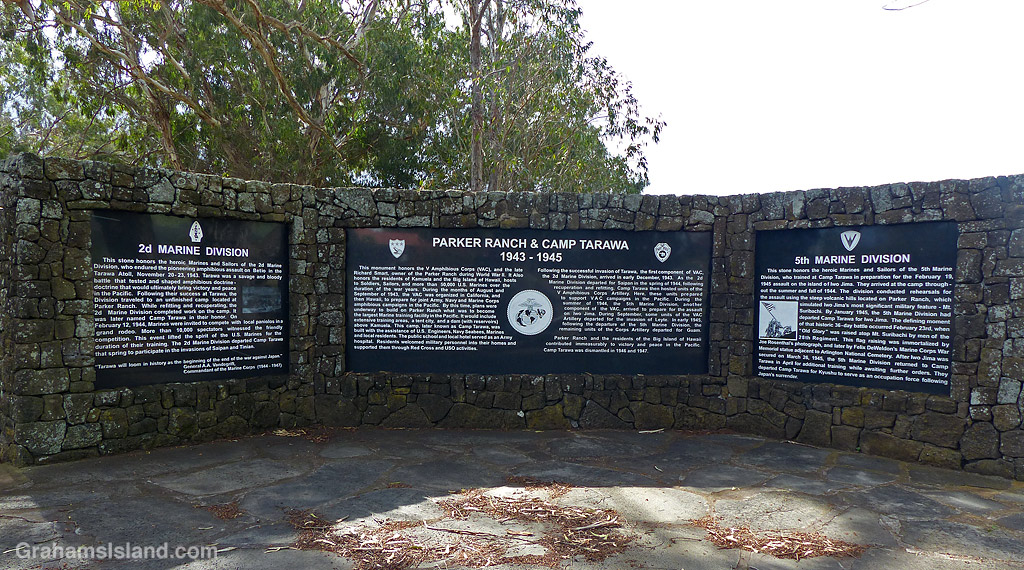
Signs at the entrance to the former Camp Tarawa in Waimea, Hawaii

Waimea was the site of Camp Tarawa from 1943 to 1945. The camp was built by the 2nd Marine Division which had just fought the battle of Tarawa, hence the name of the camp. Those marines then trained there for their next campaigns before moving on in spring of 1944.

They were replaced by the 5th Marine Division, who used the area to train for the attack on Iwo Jima. After that campaign, those marines returned to the camp for further training, but the war ended before they were called into action again.

The camp was closed in November 1945 and returned to Parker Ranch, which had leased the land to the U.S. government for a nominal fee, with the proviso that it be returned to them in its original condition. This meant that few buildings from that time remain, but the land between Waimea and the South Kohala coast was littered with unexploded ordinance and shrapnel, some of which remains to this day.
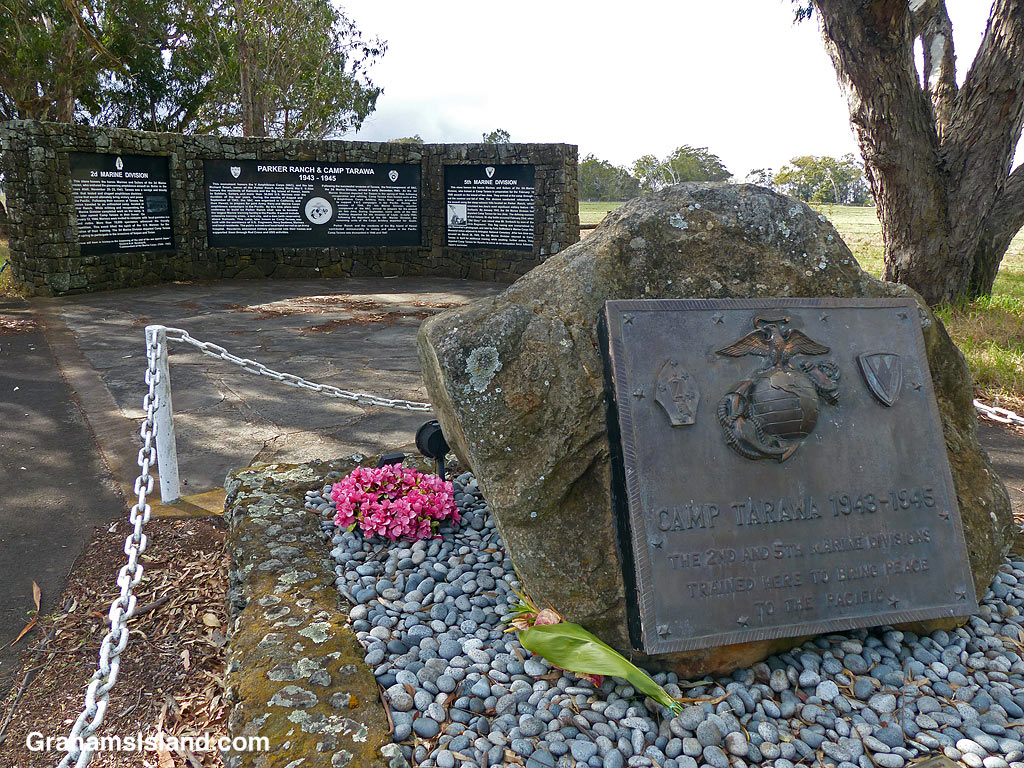
Signs at the entrance to the former Camp Tarawa in Waimea, Hawaii

Milkfish at Lahuipua’a Fishpond gate

Milkfish congregate at Lahuipua'a fishpond gate at Mauna Lani Hawaii
A sign next to Lahuipua'a Fishpond at Mauna Lani, Hawaii

Fishponds were places where the early Hawaiians used to raise fish for consumption. Lahuipua’a Fishpond at Mauna Lani is a very large pond which holds many Milkfish. Awa is their Hawaiian name.

These Milkfish were congregated at the entrance gate, no doubt hoping for someone to open it and let them out. The gates can be used for either purpose, but the idea of the ponds is that small fish can enter, but as they get bigger, they can’t get out. The fish in the top photo are far too big to escape through the grill.

There is another way out, as the sign in the second photo notes. Jacks and barracudas sometimes manage to get into the pools and will feed on the juvenile fishes. There are supposedly a couple of very large barracudas in this pool that have so far evaded capture and they’re probably living well off the inhabitants there.

In the pink

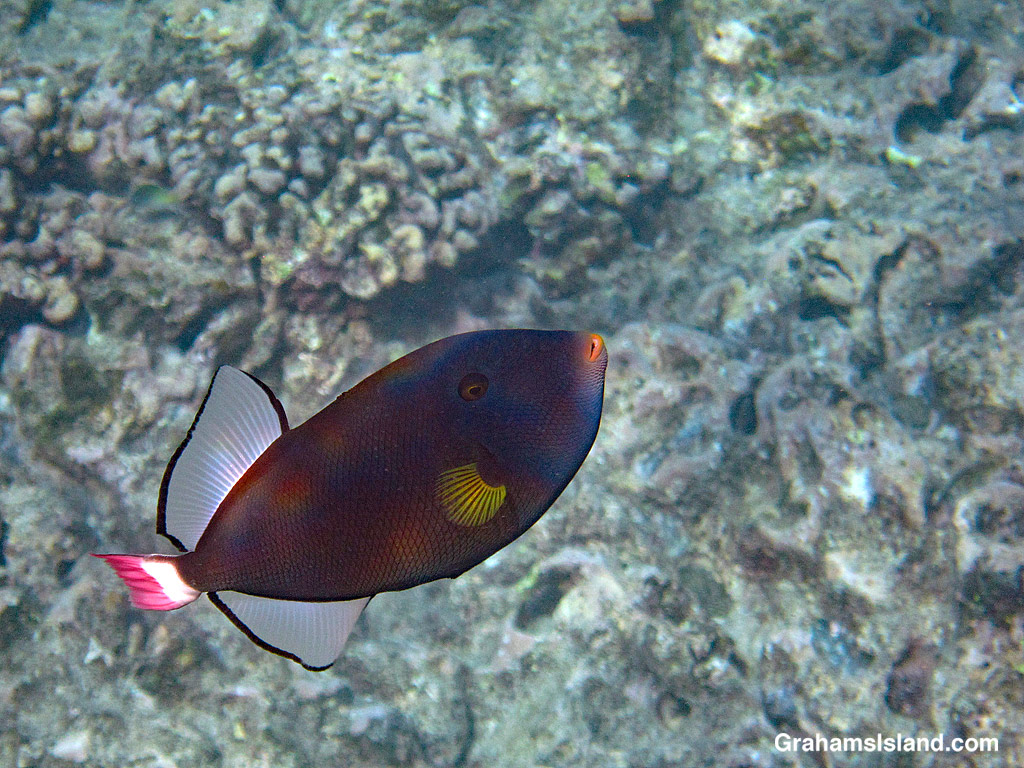
A Pinktail Triggerfish in the waters off Hawaii

This week’s Sunday Stills Monthly Color Challenge is ‘Pink.’ See more responses here.

The top photo is an appropriately named Pinktail Triggerfish. Below, we have a Gold Dust Day Gecko cleaning the windows, a pink hibiscus fronting an orange tree, and an Hawaiian Stilt with an itch.

A’ama Crab on a rock

An A'ama Crab by a pool in Hawaii

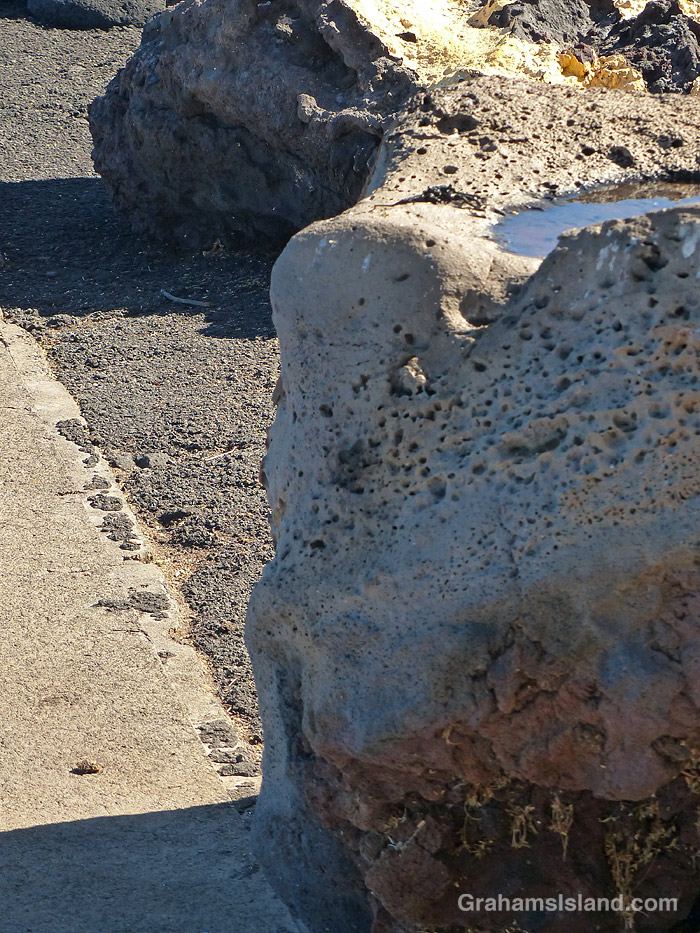
The top photo looks like a regular shot of an a’ama crab on the edge of a tide pool with the ocean blurred in the background. But the second photo shows that the ‘tide pool’ is actually a depression in a large rock, one of several placed along the edge of a parking lot, to stop people driving into the ocean (yes, they would, in case you’re wondering.).

For some reason, this encounter reminded me of the incredible climbing ability of these crabs even though I often see them skittering up or down vertical walls, in rolling surf, when I get in the water.

Assassin Bug nymph

An Assassin Bug nymph in Hawaii

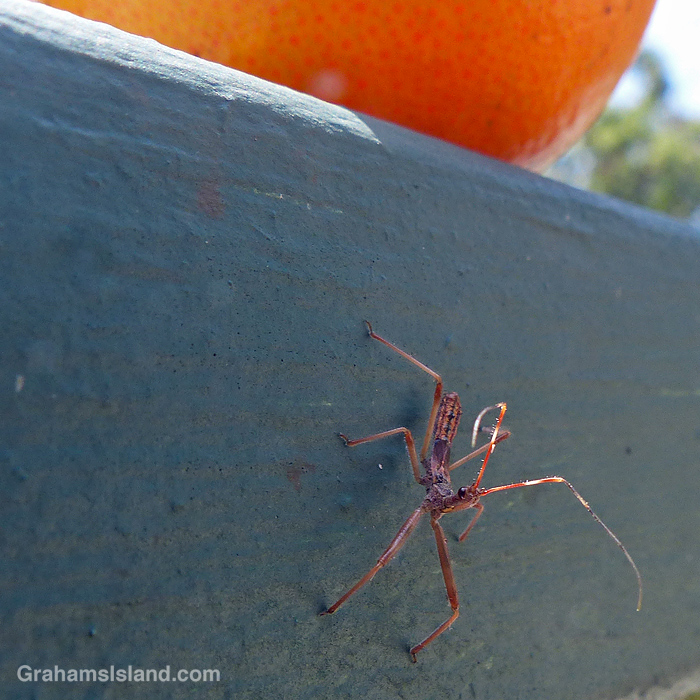
I was juicing tangerines in the kitchen when I noticed this little bug atop the pile of fruit. I took the tangerine it was on outside and tried to free it onto the rail there. The bug stuck to the fruit, scampering around as I rotated it. Eventually, it dismounted and I went inside to get my camera.

When I started taking photos, the bug accommodated me by approaching the lens. It quickly got too close so I moved to a different spot. The same thing happened. Every time I moved, the bug followed me until we both tired of the game and I left it in peace and it did the same to me.

At first, I thought it was a baby Praying Mantis because of the curve of its body, but a bit of research revealed that this is an Assassin Bug nymph. Assassin Bugs can deliver a painful bite, so maybe it was after me to take me out!

This one was only about half-an-inch long, as indicated by the average-size tangerine on the rail above and the fact the bug is standing on the thin side of a 2×4.