This week’s Friendly Friday challenge theme is ‘Color Harmonies.’ See more responses here.
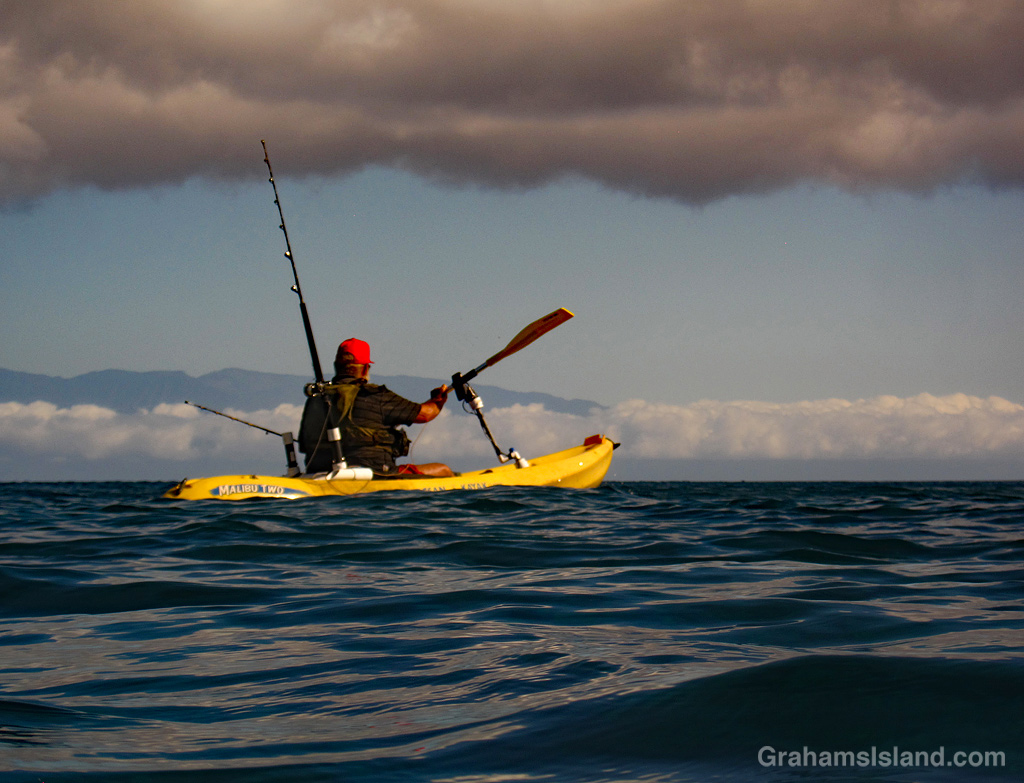
I like the colors in this photo of a kayak fisherman, with his red hat and yellow kayak. He has a fairly typical setup, with two or three rods attached in one way or another. He’ll have some bait in the kayak and probably a few beverages and snacks.
I was surprised to see him passing so close, but figured that he’d seen me and was being careful. In the end, I was glad I stopped to take this photo because just after I started swimming again, a large lure and hook passed in front of me on his unseen trailing line. Had I not stopped I’d probably have been hooked, reeled in, gutted, and barbecued. Not a bad way to go, really, I guess.
Recently, I stopped to take photos along Kohala Mountain Road. I was leaning against a gate when I glanced to the right and saw this rather large bull lying down in the enclosure. I took some photos, looked over again, and saw the bull stand up. It stared at me. I glanced down at the gate, wondering just how stout it was.
I finished my photo taking, snapped a couple of the bull, and retreated to my car. There’s no doubt in my mind that, should the bull feel like it, neither the fencing, nor the gate would keep it contained. Probably my car wouldn’t fare that well either.
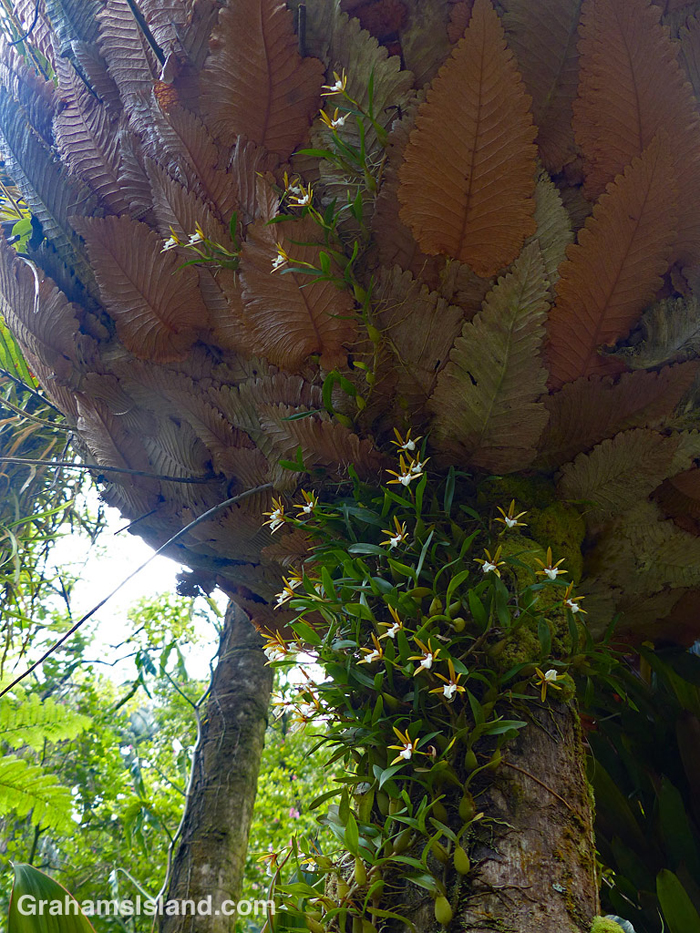
This drynaria rigidula ‘Whitei’ basket fern was growing on a tree trunk at Hawai’i Tropical Botanical Garden (which has since change its name). I like basket ferns, which look like upturned umbrellas. This fern was complemented by a dinema polybulbon orchid, a delicate and fragrant epiphytic orchid that was winding it’s way up into the fern.
For more information about Hawai’i Tropical Bioreserve & Garden (formerly Hawai’i Tropical Botanical Garden), go to htbg.com.
I hope this photo doesn’t ruin anyone’s breakfast, but I run it for a couple of reasons. First, a lot of people fish around the island and most of them don’t like eels. Snag an eel on your line and there’s not much to be done. The eel will wrap itself in knots and the only way to be rid of it is to cut the line. The person fishing could try removing the hook and releasing the eel, but even if they were so inclined, the feeling is, ‘why release an eel so that it can tie itself in knots next time you throw a line in?’
And that brings us to the other reason for running the photo, and which also explains another reason no one wants to remove that hook. Look at those teeth! Rows of them, front and back, side to side. Reach for that hook and chances are you’re going to get bitten. This is also why it’s not a good idea to mess with anything in the water. Even little fish that look harmless can have a powerful bite, or sharp spines, or some other nasty surprise.
This week’s Sunday Stills challenge theme is ‘Mountains and Valleys.’ See more offerings here.
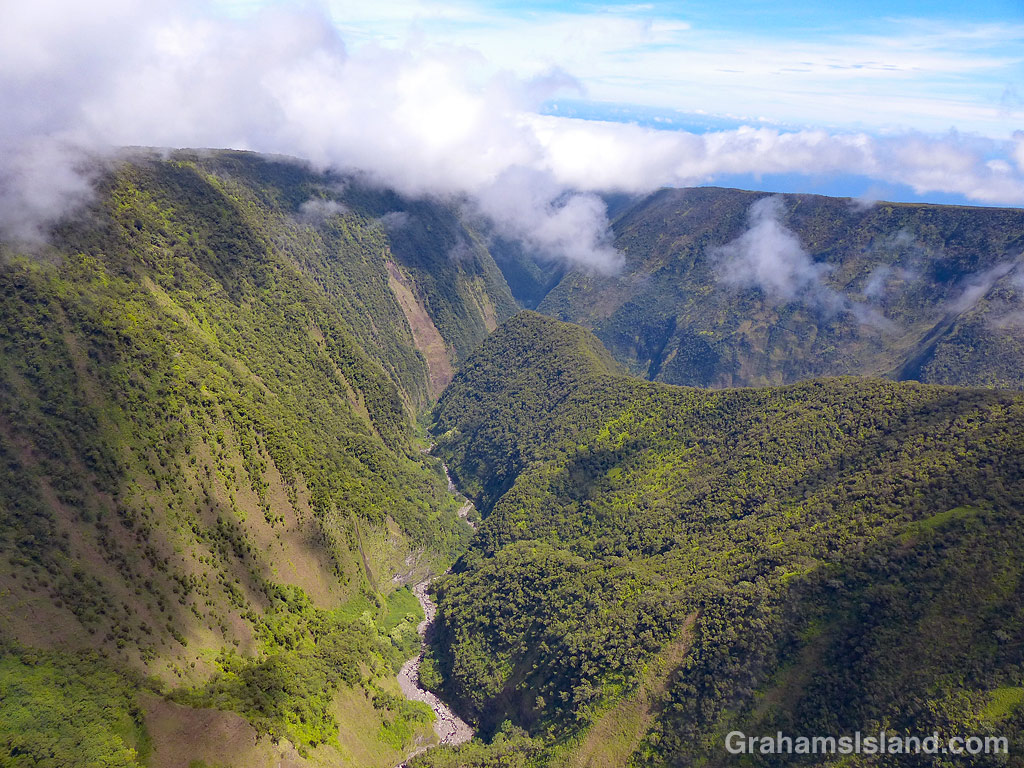
Kohala Volcano is the oldest volcano on the Big Island and has long been extinct, having last erupted around 120,000 years ago. Since then, the various processes of erosion, from rainfall to landslides, have carved deep valleys into the volcano. Waipio, the easternmost of these valleys, is accessible by vehicle (4-wheel drive only), horseback, or on foot. It has permanent inhabitants so access within the valley is restricted.
The other valleys are most easily seen from the air, along the Kohala coast. The top photo shows Waimanu Valley. This can be accessed by foot from Waipio, after a long and arduous hike, and permits are available for camping there. Waimanu River can be seen on the far side of the valley and is one last obstacle to be crossed to reach the camp site, which is in the strip of land between the river and the ocean. The steep sides are typical of these valleys and another consideration to keep in mind when thinking about hiking here.
The middle photo shows a fairly typical view directly into one of the valleys from the ocean. Again, notice the steep valley sides and the abundance of foliage, evidence that this is the wet side of the island.
The bottom photo shows valleys cutting through the mountain farther inland. There’s little or no water running in this view. A few valleys have spring-fed streams, but most depend on rain for water flow. However, when it does rain, it can rain long and hard. Flash floods are common. It’s not a shock when campers in Waimanu Valley are cut off and unable to make the return hike.
I’ll do another post about the water courses for next week’s Sunday Stills challenge.
I see this stand of yuccas on the drive into Waimea and watch for it to bloom. When it does, late afternoons are the best time for photographs so I try to remember to stop on the way back from hiking off Saddle Road or at Hawaii Volcanoes National Park. In this instance, it was the latter, and I was passing by around 6 pm.
Look closely at the top photo and the telescopes of Mauna Kea can be seen in the distant background, which is a bit unusual for this time of day, morning being their time to shine.