What the tide washed in

Beach debris Big Island

These are scenes from the coast of the Big Island, a few miles northeast of South Point, the island’s southernmost tip. This stretch of coast is notorious for the amount of marine debris on its shores.

In late January of this year, a mass of rope washed up at Kamilo Point, just a few miles from where these photos were taken. The rope mass was estimated to weigh around 40 tons. Kamilo Point is nicknamed ‘Plastic Beach’ because weather conditions and ocean currents bring huge amounts of debris ashore there. At least some of this junk is believed to have come from the ‘North Pacific Garbage Patch’ and before that, Asia.

In early March, volunteers gathered 11.6 tons of debris from this same stretch of coast.

The debris in these photos is mild be comparison, but still unsightly, and dangerous for everything from seabirds to Hawaiian monk seals, turtles, and humpback whales. That said, the blue plastic soaking tub (below) on the ocean’s edge, looked awfully inviting.

Beach debris near South Point

Awkward landing

Grasshopper and thorn

I always tend to think of animals and birds as being supremely graceful, swooping through the air, leaping from tree to tree, twisting and turning at high speed. So, while I don’t wish them any harm, I get a secret pleasure when I see one of nature’s creatures looking a bit clumsy. I’ve seen turtles bumping into rocks, birds landing with an ungainly stumble, geckos leaping and missing their target.

I saw this grasshopper jumping from one branch to another but, alas, it did not quite stick the landing. Mind you, if I was a grasshopper and tried the same stunt, I’d probably impale myself on that nasty-looking thorn.

Here’s looking at you

Giant Porcupinefish

Giant Porcupinefish with Blackfin Chromis and Goldring surgeonfishI was swimming one day when I realized I was being watched. Peeking up from a crevasse in the reef, was this giant porcupinefish. These fish do seem to be quite curious and this is a look I’ve seen before. The difference here was that the water was quite shallow, so the fish was not as deep as they usually are. If I got too close, the fish would dip deeper into the crevasse. If I moved away, it would pop up again.

Porcupinefish are not to be messed with. They have strong beaks (fused teeth), which they use to break mollusc and crustacean shells, and which have been known to sever fingers, too. In addition, like pufferfish, they can inflate themselves with water into a large, round ball when threatened. Unlike pufferfish, porcupinefish have sharp spines which normally lie flat, but which become erect when inflated. Finally, they’re extremely poisonous.

The other fish, in the second photo, are a goldring surgeonfish and, above it, a small blackfin chromis.

Ironman 70.3

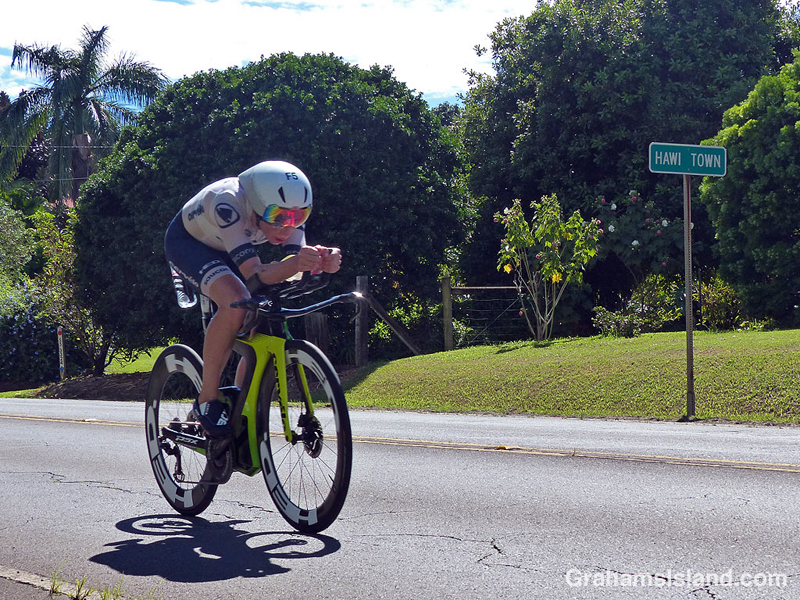
Going the other way at Ironman 70.3Approaching the turn at Ironman 70.3Last Saturday was the Ironman 70.3 race on the island. Unlike the Ironman world championship, held here in October, the 70.3 series covers half the distance. That means there’s a 1.2 mile swim, a 56 mile bike ride, and a 13.1 mile run. However, as with the longer race, Hawi is the turnaround point on the bike leg, so I ambled down to take a look.

Top: Racers heading in opposite directions shortly before/after the turnaround.
Middle: Slowing to make the turn.
Below: Bottles and trash can only be dropped in certain areas, where volunteers quickly pick them up for disposal or recycling.

I figure that if they’re doing a half distance race, it can’t be longer before they offer other shorter versions. I’m waiting until they get down to a one sixty-fourth Ironman and then I’m racing. Still a little worried about the run though.

Passing cyclists at Ironman 70.3

Jacaranda flowers

Jacaranda flowers cluster

Jacaranda flowersA final response to the last edition of the WordPress photo challenge with a theme of ‘All time favorites.’

I headed back to Pu’u Wa’awa’a last week, because this is the time of year when several kinds of trees are in bloom. One of those trees is the jacaranda, which blooms from April to June, and produces masses of blue to lavender flowers. Jacarandas prefer cooler elevations so the lower areas of Pu’u Wa’awa’a are right in their zone.

I wasn’t disappointed. Several trees were covered with these delicate flowers, which somewhat made up for the fact that the entire hill was shrouded in thick vog, exacerbated by the ongoing eruption down in Puna.

Jacaranda flowers and bee

Smithsonian Submillimeter Array

Smithsonian Submillimeter array

Smithsonian Submillimeter array dishesSmithsonian Submillimeter array dishes with textAnother response to the last edition of the WordPress photo challenge with a theme of ‘All time favorites.’

I post this for two reasons. The first is that recently I had an exchange on this blog with the wife of the Director of the Submillimeter Array (SMA). The second is that Mauna Kea is a favorite place of mine to visit.

So here are a couple of photos of the SMA taken a few years back. The dishes are mounted on those little round pads in the photos, and they can be moved to different pads to produce different configurations. In my ignorance of most things scientific, I marvel at the idea of moving a dish a few meters makes a big difference in observations of things way the heck out there in space. That’s not an official measurement there.

The top photo shows seven of the eight dishes that make up the array.
The other photos, of three dishes and what immediately popped into my head when I saw them, show why I never made it as a scientist.

For more information about the Submillimeter Array, go to https://www.cfa.harvard.edu/sma/.