
A tugboat enters Kawaihae Harbor in the early morning. The crewman, bathed in sun and casting a long shadow, waits to begin the process of maneuvering the tug’s barge alongside the jetty.
In response to WPC ‘A face in the crowd.’

A tugboat enters Kawaihae Harbor in the early morning. The crewman, bathed in sun and casting a long shadow, waits to begin the process of maneuvering the tug’s barge alongside the jetty.
In response to WPC ‘A face in the crowd.’

This Erckel’s francolin appears indistinct in its cover of waving grasses, though if it makes its piercing call, that cover will immediately be blown.
In response to WPC ‘A face in the crowd.’

When I’m out walking I often pass fields of cattle. In general they either stare dolefully or run off when I look at them. Recently though, I was walking alongside one field and, at my appearance, the cattle ran to one side of the field, formed a group and then thundered down the hill toward me. When they got close, they did a U-turn and shot back up the hill.
Next day they did the same thing, but this time instead of the U-turn they stopped just across the hedge from me and stared. All the running about had stirred up the cattle egrets that invariably accompany them and that’s when I took this photo. I particularly like the devilish horns of the one animal peering out from the crowd.
I moved on and the cattle followed. We repeated this a couple of times before they decided they’d had enough.
On the third day, my appearance provoked only dull stares. Obviously the thrill of my presence had gone.

This last week or so my attention’s been drawn to the Chinese hibiscus flowers around here. Always a showy flower, they’re currently at the peak of their bloom. When the sun shines on them, they look perfectly stunning.


A blackspot sergeant heads for cover behind an old pier piling.

This is one of Hawaii’s emergency alert sirens. There are different styles, but I like how this one, at Kawaihae, emerges from the palm trees. The sirens are intended to warn of impending tsunamis and, these days, nuclear attack.
These sirens did not go off during the recent false missile attack fiasco. That issue concerned messages sent to residents’ phones and to radio and TV. In the aftermath of that incident, I read in a news report that “According to state officials, the watch officer had been a cause for concern to his colleagues for more than a decade and had twice before mistaken drills for real alerts. It was unclear how he had managed to remain in such a sensitive post for so long.” Not in this household. Our ‘joke’ is that a person has to kill three people here before it’s considered serious enough to be fired from a government job. I guess causing widespread panic and embarrassing the state worldwide must be roughly the equivalent.

As a patch of mud dries, the surface cracks apart and the edges of these patches curl up, giving them something of a floral appearance.
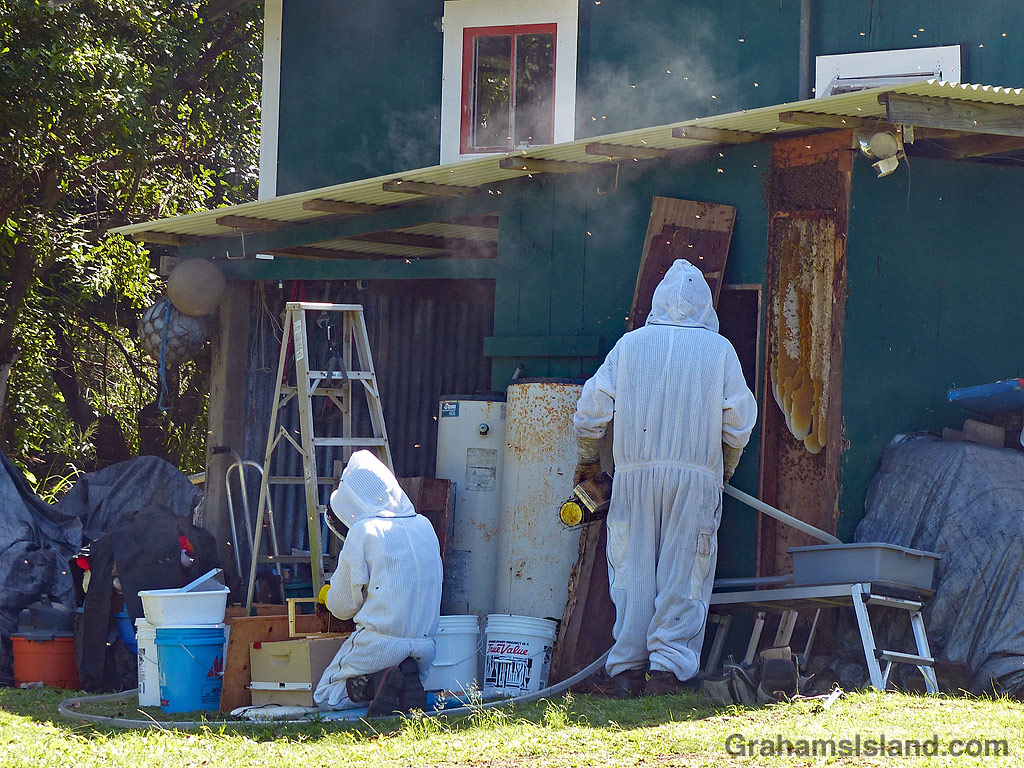

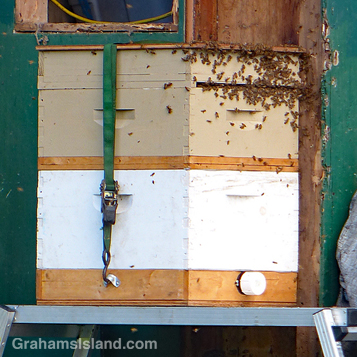
Recently, when I moved my truck to mow the lawn, I noticed this scene at a neighbor’s house. I was impressed by the number of bees and the huge, hanging combs filled with sweet honey. When I got out of the truck, I thought I’d get a few photos.
The bee wrangler called out to me that there were a lot of angry bees about. I said I wasn’t going to come closer and asked if it was OK to take photos. He said that was fine, but the bees might come and find me where I was. Since I was a good 70 or 80 feet away, I wasn’t too worried. I snapped a few photos, then heard a buzzing noise, and felt something on my arm. Sure enough it was a bee.
I imagined this bee sending back a message along the lines of, ‘Hey, here’s another one of those creatures, but this one doesn’t have protective clothing. Let’s get him.’ I pictured the rest of the colony heading my way in a matter of moments, so I blew the bee off my arm and hotfooted it back home. Before I went inside I made sure I hadn’t accidentally ended up with the queen bee lodged somewhere in my clothing. No need to have my day turn into a starring role in a horror movie.
After the lawn was mowed, the bee wranglers were still on the scene so I left the truck where it was. A couple of hours later I thought it would be safe to retrieve it. As I reached the house, the bee wranglers were just leaving. We chatted a bit about what they’d been doing. They’d cleaned out the bees’ home in the wall and put a new hive next to it. Presumably they’d found the queen and installed her in her new digs. The idea is to have the bees relocate to the new hive and, when they’re settled in, move it to a new location, probably on one of the farms around here.
They warned me, however, that there were still some disgruntled bees flying around. As if on cue, I heard buzzing. Something landed on my head and started burrowing into my hair. The bee wrangler had just handed my his card and I used that to try and extract the bee. The buzzing intensified, but I couldn’t dislodge it. Finally, it popped loose and I took off for my truck. I jumped inside, making sure the door shut properly and the windows were closed, and drove home.
I avoided walking past that house for a while until, two days later, the hive was gone and it was safe to venture out again.
For more information about Ho’ola Beekeepers, go to savehealthrive.com.

