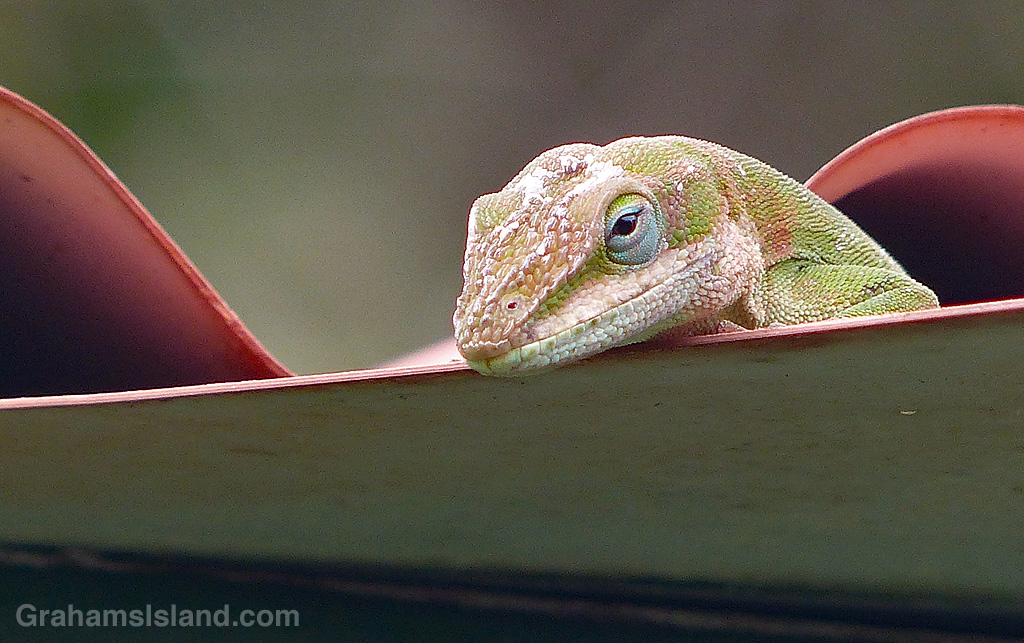
Green anole shedding

A green anole tears at his shedding skin before eating it

This green anole is the dominant male at the south end of the house. I see him often, but was surprised recently to find him in this condition. He was shedding, which I think is an annual event. He pulled at the paper-like skin with his mouth, and when it came free, he promptly ate it. Sometimes it can take a while to complete the process, but when I saw him again half an hour later, he was all done.

Doritaenopsis hybrid orchid

A Doritaenopsis hybrid orchid at Hawaii Tropical Botanical Garden
As with most of my orchid photos, I include the words ‘I think’ when it comes to talking about what it is. I think this is a Doritaenopsis hybrid. Doritaenopsis orchids are a cross of Phaleanopsis and Doritis orchids, in this case Champion Lightning and Chianxen Magpie. This one was at Hawaii Tropical Botanical Garden.

For more information about Hawaii Tropical Botanical Garden, go to htbg.com.

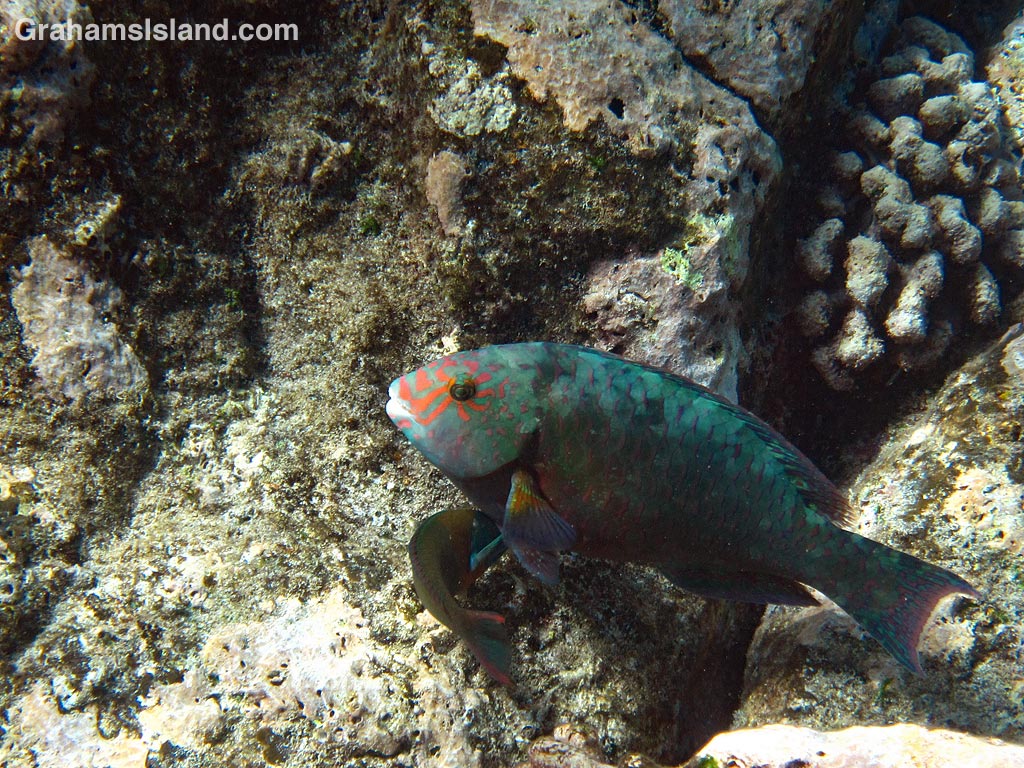
Hawaiian cleaner wrasse services a bullethead parrotfish

A Hawaiian cleaner wrasse cleans a bullethead parrotfishA Hawaiian cleaner wrasse cleans a bullethead parrotfish

Hawaiian cleaner wrasse are small blue and yellow fish that clean the mucus, dead tissue and parasites off other fish. They establish permanent stations on the reef, and fish that need cleaning swim up and hover around until it’s their turn.

A fish can get nipped during a cleaning, but they also seem to enjoy the process and the sensation of the cleaner wrasse dragging its fins over a client’s body – a one-stop clean and massage. This bullethead parrotfish seemed positively ecstatic during its clean, several times sporting a look of bliss on its face.

Maybe next time I’m in the water, I’ll dive down and give it a go.

Chocolate ball ginger

Chocolate ball ginger (Zingiber macradenium) is a beehive ginger, so-called because of their shape and composition.
Chocolate ball ginger (Zingiber macradenium) is a beehive ginger, so-called because of their shape and composition. Their form means the many little cups are great collectors of water. They probably make great drinking spots for geckos, birds and other small creatures. Probably also a great environment for breeding mosquitoes.

For more information about Hawaii Tropical Botanical Garden, go to htbg.com.

Runaway cow

An escaped cow runs along the side of a road.
I like cows, but they can be nervous creatures. Escapees from the local dairy farm are quite common and not a big deal (unless I stop to consider the very large bulls sharing the same fields these cows escape from so easily). The cows rarely get into trouble, in part because they have to travel more than a mile before reaching the main road.

On this day, I was walking down the dirt road to the coast when this cow galloped around a corner, a quarter-mile distant, headed in my direction. She’d clearly been panicked by something and I knew that when she saw me, she might panic again.

The road widened just ahead so I eased up to that spot and hugged the fence line, hoping the cow would carry on past without becoming alarmed. She loped along, up on the bank on the far side of the road. Then, about 100 yards from me, she stopped, ears up, eyes staring. Clearly, I’d been spotted. I didn’t look her way, turning around and pretending I hadn’t noticed. The last thing I wanted was for her to head back the way she came with me walking along behind, stoking her fears.

Luckily, her existing anxiousness got the better of her and she thundered past along the bank, which is when I took this photo. What generally happens is that, eventually, someone from the farm sees the cow or cows on the road and rounds them up. The cows are inevitably relieved to be back in their pasture and all is well – until the next time.