Māmane

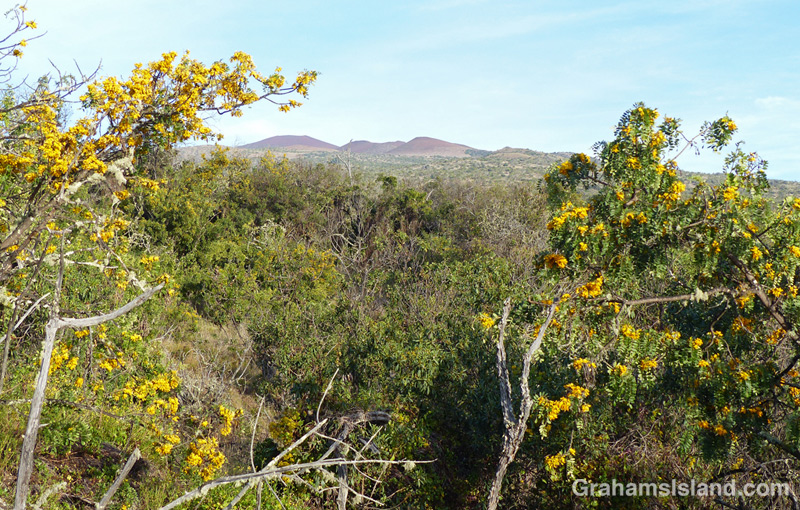
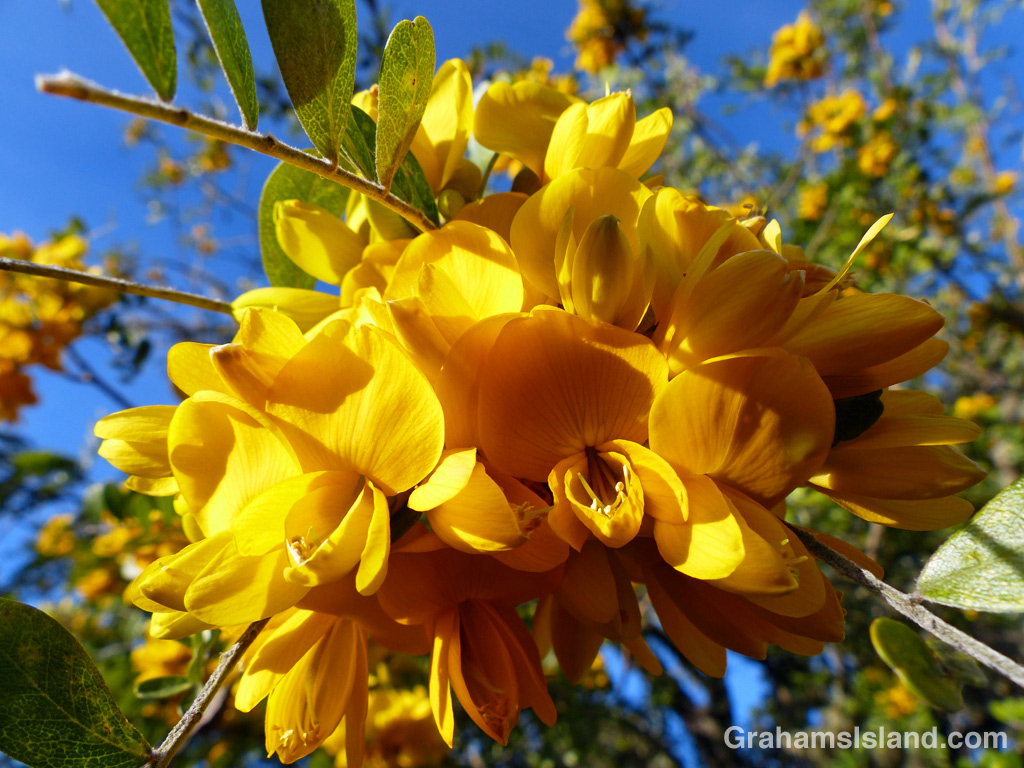
The flowers of the mamane tree in Hawaii.Mamane trees on the slopes of Mauna Kea.
Māmane (Sophora chrysophylla) is an endemic Hawaiian tree which grows in the dry forest on the sides of Mauna Kea. These māmane are in the recently-opened Palila Forest Discovery Trail at an elevation of around 7,000 feet.

Māmane is an important plant for several endemic Hawaiian birds including the endangered palila, which is found only in this area. Palila depend on māmane trees for 90% of their food, the most important item being immature māmane seeds. These seeds are poisonous to other wildlife, but not palila.

Palila Forest Discovery Trail is part of an ongoing effort to reestablish the high-elevation dry forest on Mauna Kea, which has been greatly impacted by non-native goats, sheep, and cattle.

For more information about Palila Forest Discovery Trail, go to dlnr.hawaii.gov/restoremaunakea/palila-forest-discovery-trail/.

Gold dust day gecko catches lunch

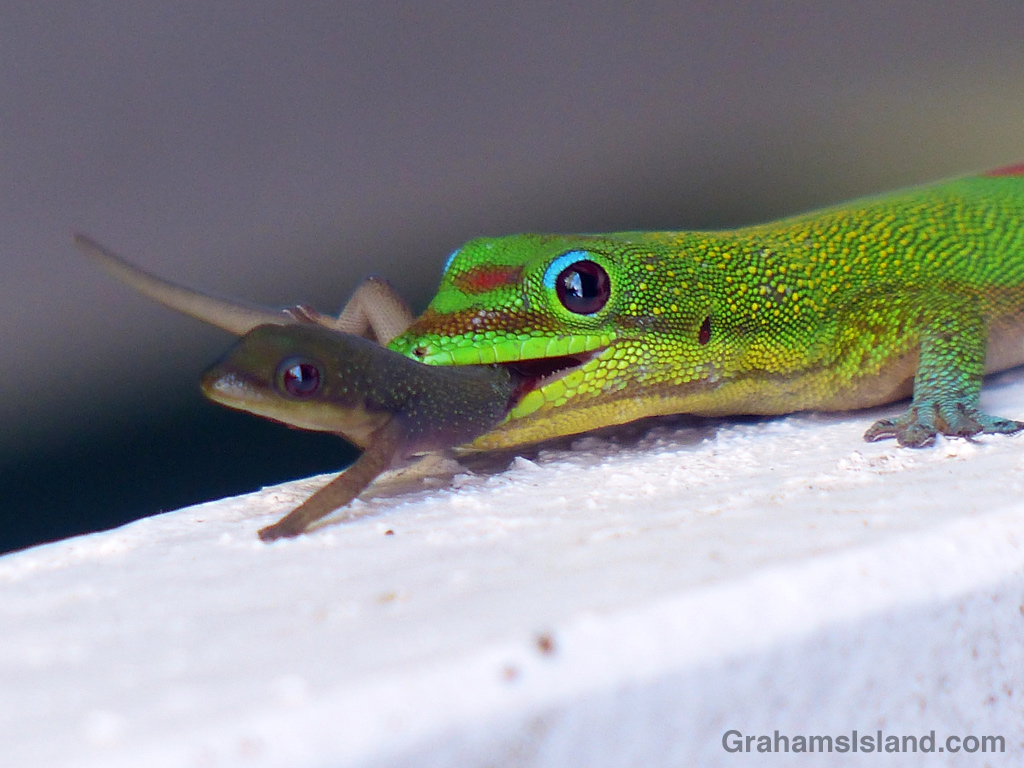
A gold dust day gecko catches a young gecko.
Gold dust day geckos are exceptionally cute and endearing, but it is a fact (and not an alternative one either) that they will eat the young of their own species if they get the chance. This particular gecko is getting ready to do just that.

Undulated moray eel

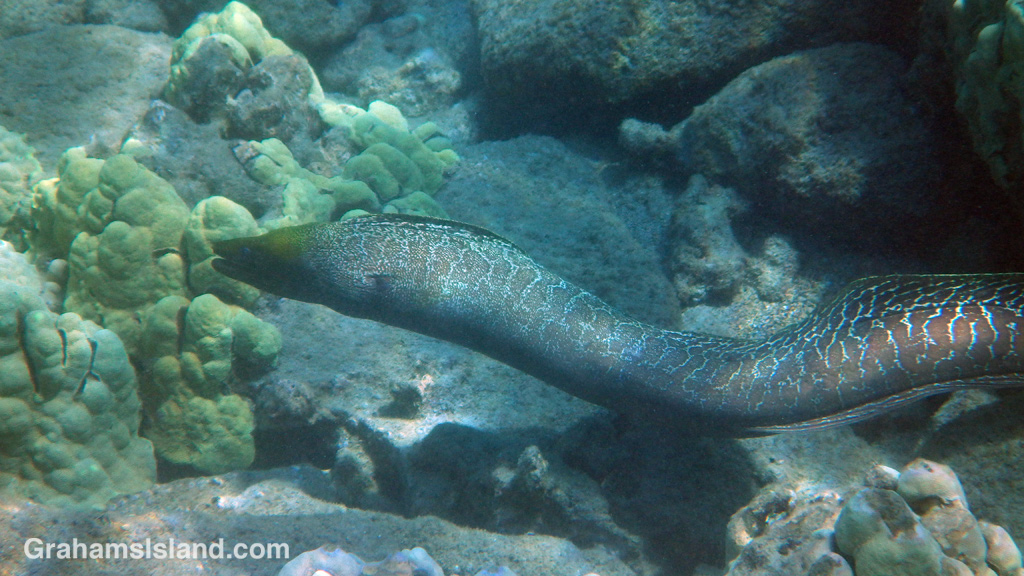
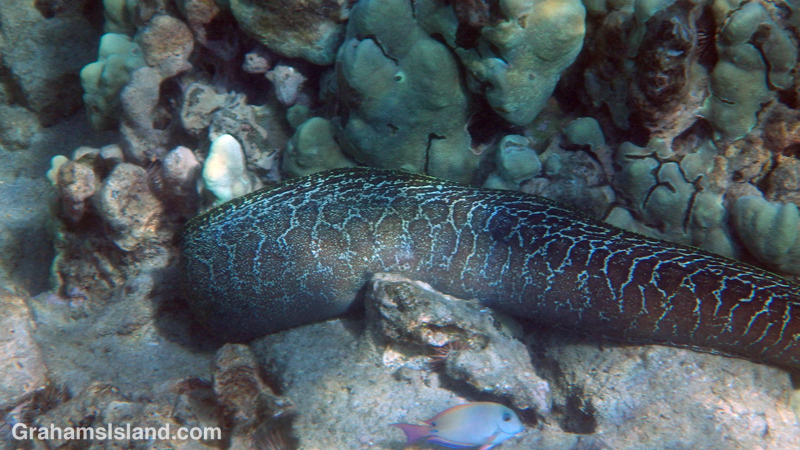
A large undulated moray eel cruising in shallow water off the Big Island.A large undulated moray eel disappears into a crack in the coral
I saw this large undulated moray eel cruising in shallow water until it disappeared into, what appeared to me to be a tiny crack in the coral. John P. Hoover says of the undulated moray eel, “One of the commonest Indo­-Pacific morays, it is also one of the nastiest; do not attempt to play with it or feed it.” Words to live by.

In my attempts to identify what I see in the water, I use John P. Hoover’s book The Ultimate Guide to Hawaiian Reef Fishes, Sea Turtles, Dolphins, Whales, and Seals. His website is hawaiisfishes.com.

Nene calling

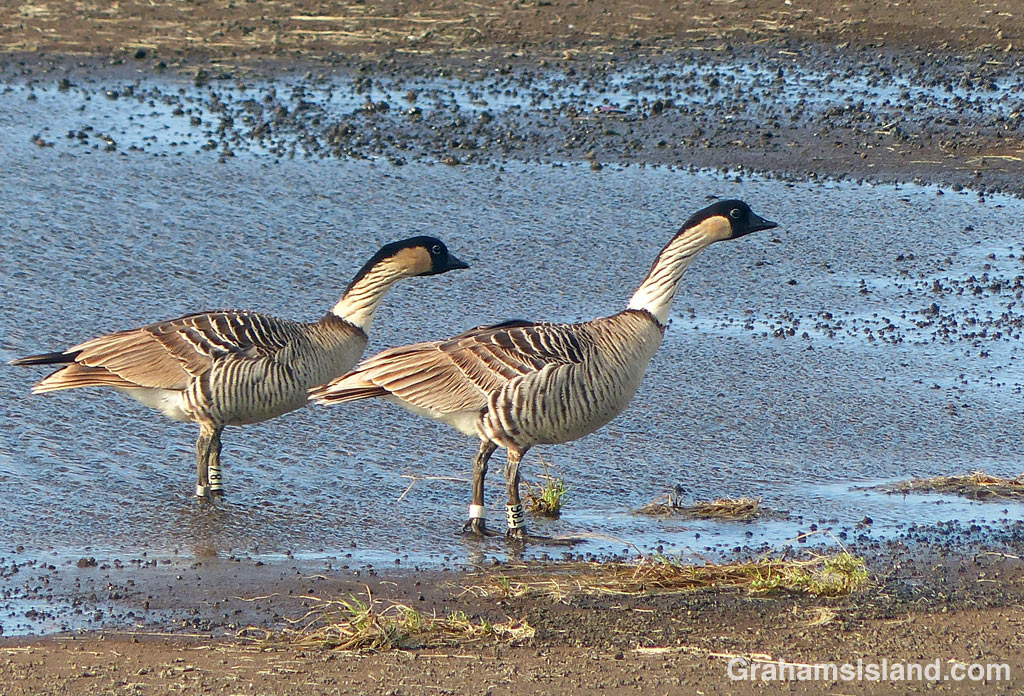
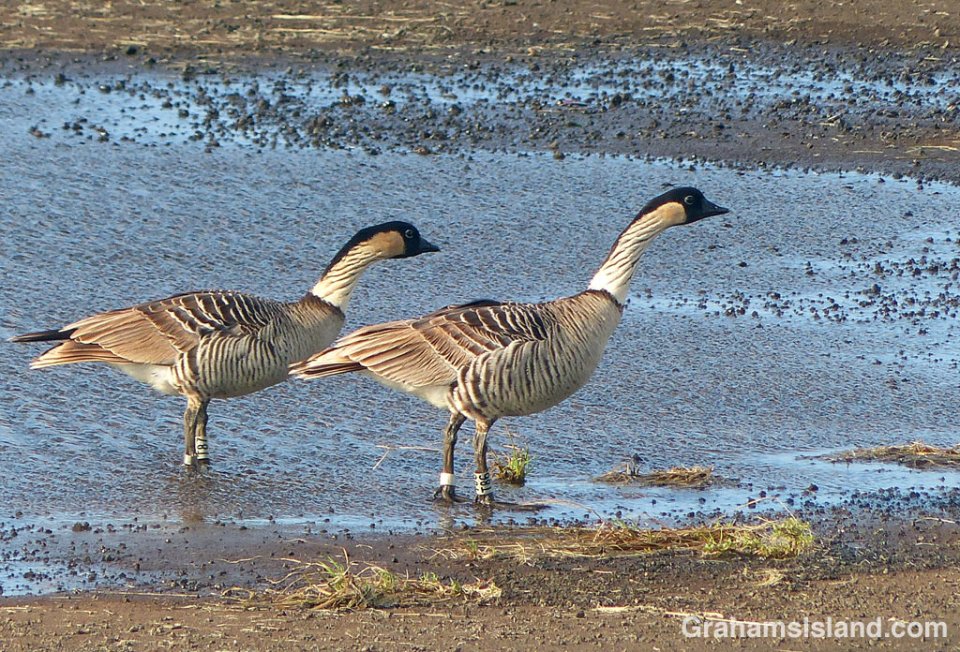
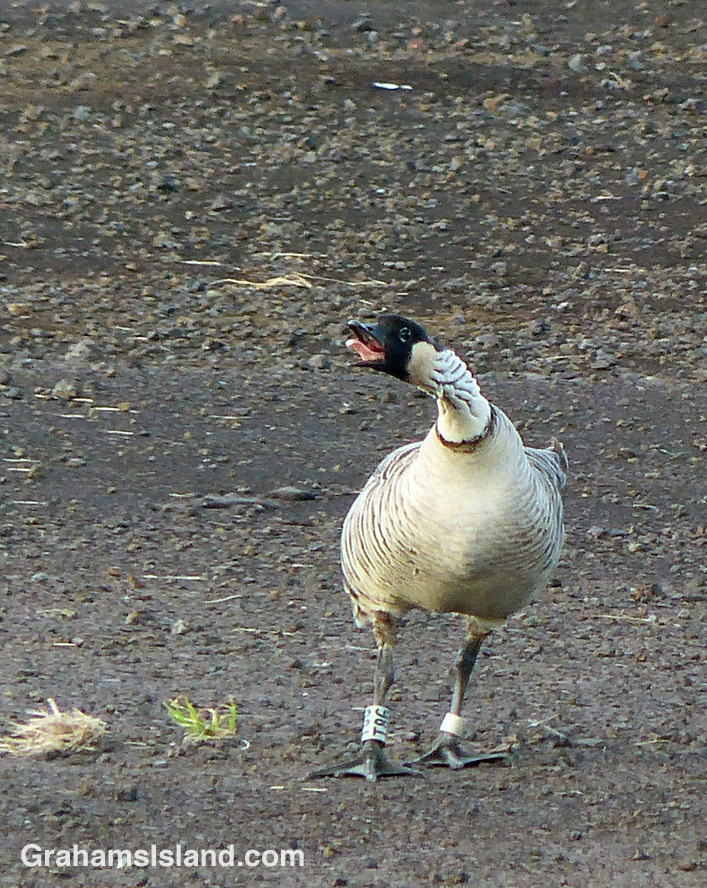
A pair of nene on the Big Island of HawaiiA nene calls on the Big Island of Hawaii
When it rains, large puddles form off to the side of the runway at Upolu Airport. These puddles are popular with a variety of birds, including these two nene, which were in fine voice.

The nene, or Hawaiian goose, is the official state bird and endemic to the islands. It’s also an endangered species and people are encouraged to report sightings to help track the birds. Here on the Big Island, nene sightings are reported to Hawaii’s Division of Forestry and Wildlife. The person I contacted there, Raymond B. McGuire, gave me this information about the birds:

“All of the nene that have the gray bands (like these) are part of a Governor’s Proclamation to move nene from Kaua’i (where they were nesting in a golf course near the airport) to the Big Island and Maui. In total, the Big Island received 598 nene in a 5-year period (2011-2016), this more than doubled the resident population prior to the project. The bands not only tell us where the nene came from, but also the sex. There should be two bands on the nene. One is metal with a U.S. Fish and Wildlife Service number (really tiny and hard to see) and the other is made of colored plastic and much easier to read the ID numbers (though the gray bands are not always easy to see on a gray legged bird). These gray-banded birds were banded by sex: males will have their plastic bands on the right and females will have the plastic bands on the left. These two particular nene, T86 and T87 were brought to the Big Island in 2014 and according to my records T86 is a male, and T87 is a female. They were brought as a breeding pair with 4 offspring. The translocated birds have been exploring the island more than the local birds have been. Although most of the introduced nene have been mixing with local nene and frequenting already established nene areas, we also now have nene frequenting areas that historically have not seen them or used to see them very infrequently, such as in Pahala, Punalu’u, Hawi (including Upolu), Waimea, and Kukuihaele!”

For more information about Nene and other native Hawaiian birds, go to state.hi.us/dlnr/consrvhi/forestbirds/.

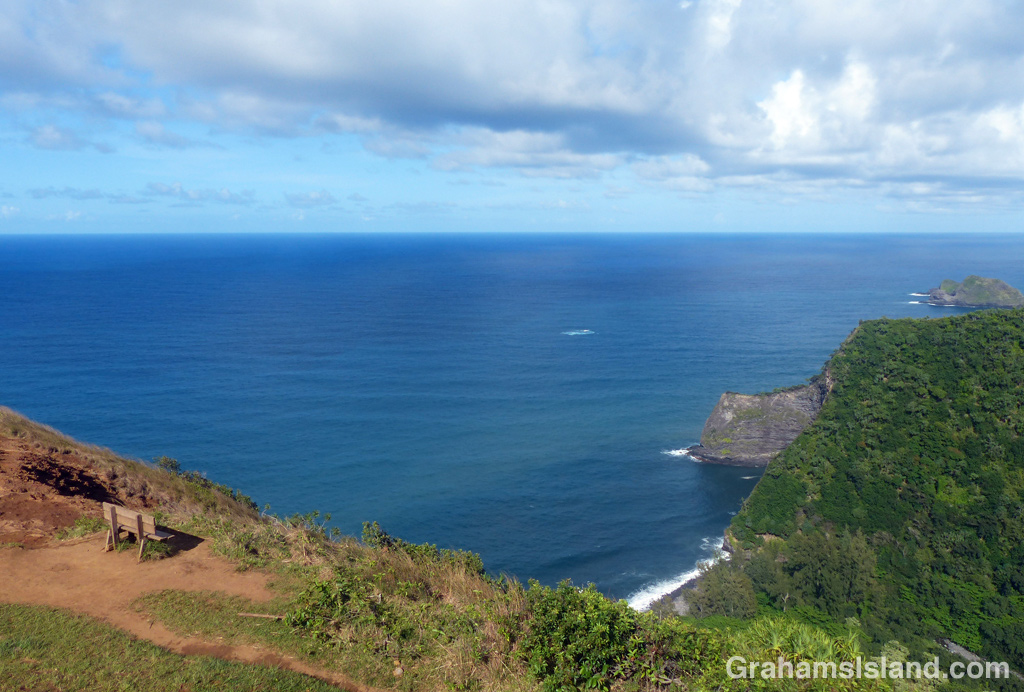
The bench overlooking Honokane Nui Valley

The bench overlooking Honokane Nui Valley on the Big Island.
At the end of the highway in North Kohala is the Pololū Valley overlook. This is where most people park their cars (if they can find a space), snap a photo or three, and then climb back in and attempt to turn around and head back.

Quite a few people head down the steep, third-of-a-mile trail to the valley and beach below. Some walk the half-mile-long beach. Very few continue up the trail on the other side. There are good reasons for this. The trail is somewhat hidden. If it’s been raining, it can be even muddier and more treacherous than the trail down to the valley. If conditions are right, it can be alive with bugs. But for those that do press on for another a mile or so, this is the spot they will reach.

Overlooking Honokane Nui Valley, this bench is the perfect spot to experience some welcome solitude. Chances are it will be unoccupied. Chances are no one else will even pass by. I like to sit on the bench (rickety though it is currently) and enjoy the ocean stretching away on one side and the tropical jungle climbing the side of the Kohala Mountains on the other.

For more information about the trail go to bigislandhikes.com/pololu-valley/.