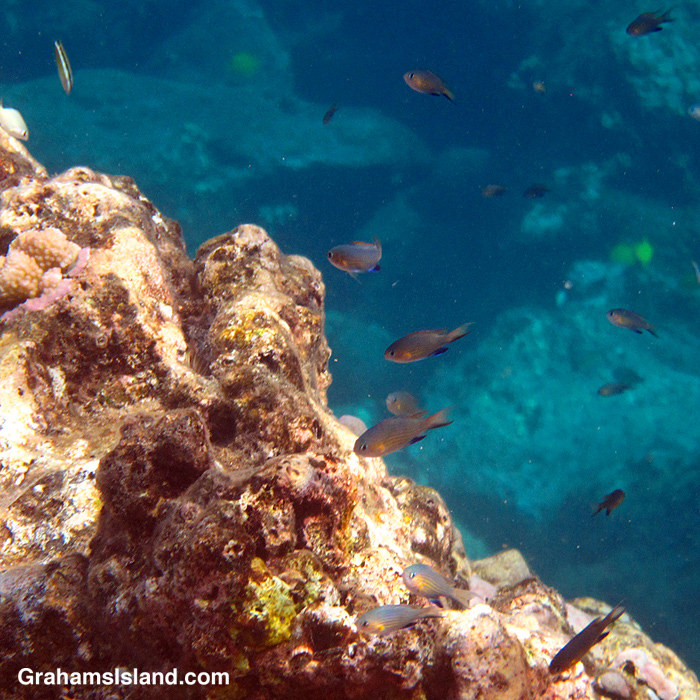
Blackfin Chromis are small damselfishes that gather around coral heads in fairly shallow water. They disappear into the coral and crevices if approached. The black anal fin and black lower edge of the tail are an easy way to identify this fish.
The idea of The Numbers Game is to enter a number into your computer’s search bar and then post a selection of the photos that turn up. I typed in a few numbers and up popped photos I’d forgotten about, so I thought this would be a fun way to feature some photos that ran a while ago, but warranted another airing.
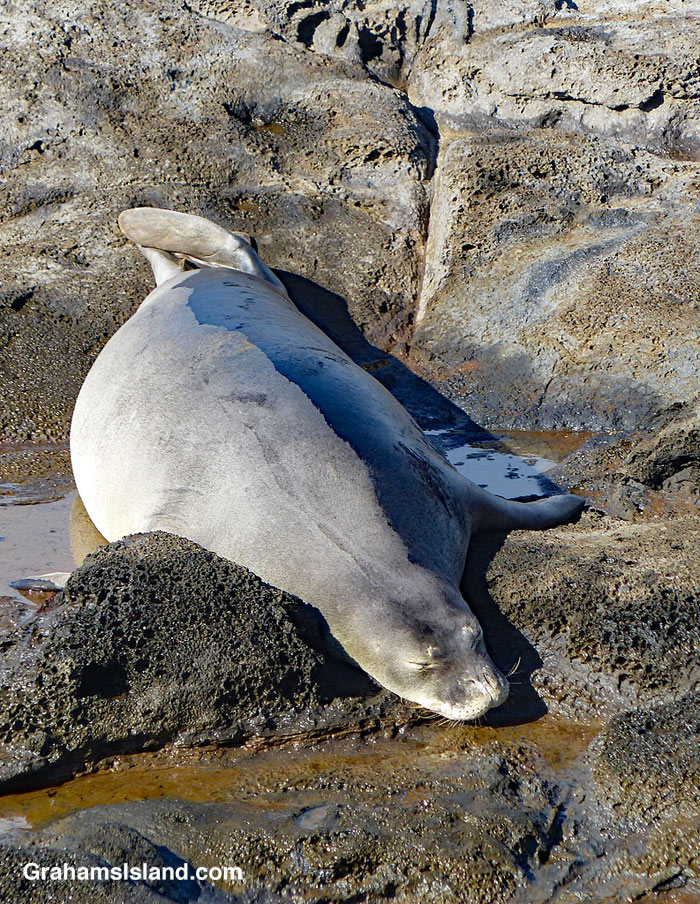
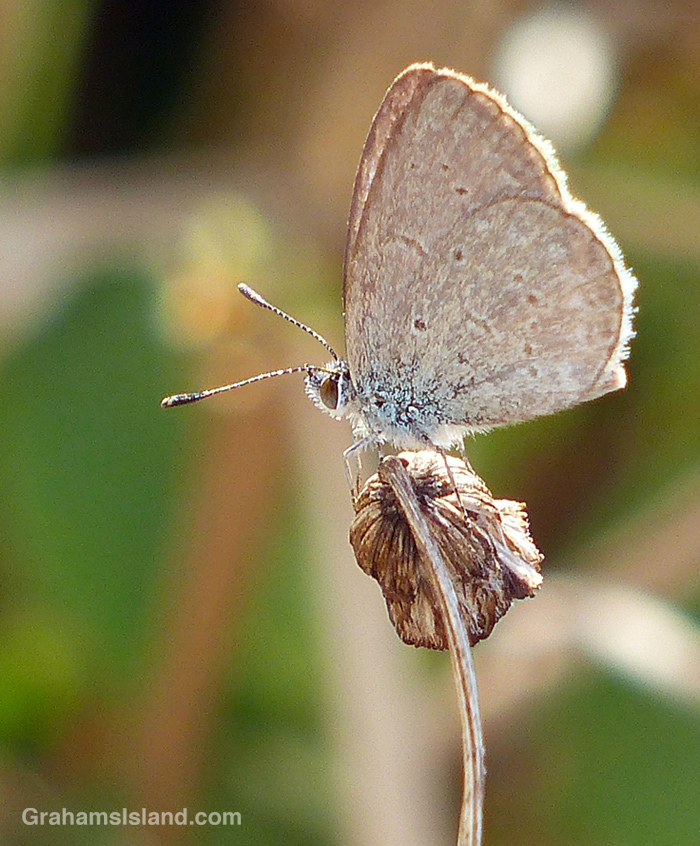
Hawaiian Monk Seal resting.Lesser Grass-blue Butterfly.
This week’s number is 126. Ironically, for this first response, it turned out that three of these photos haven’t run before, but have been languishing in my archives.
When I get to the end of a swim, I keep looking around because, as the water shallows, it’s possible to see a wide variety of fish and marine invertebrates.
Recently, I was about 10 feet from my exit point when I saw the Devil Scorpionfish in the photos. That’s right, there’s a fish in the top photo and it’s not the Bright-eye Damselfish on the left. The second photo gives a better view, where the fins stand out a bit and a flash of orange can just be seen on the left pectoral fin. A Devil Scorpionfish will flash these orange fins, probably as a warning to predators, since it has venomous spines.
Don’t feel bad if you can’t find the fish in the top photo. I wouldn’t have spotted it if it had been stationary, but in the shallow water, I noticed a small movement and quickly realized what I was looking at. I’ve seen a Devil Scorpionfish in this area before so this might be the territory of this same fish.
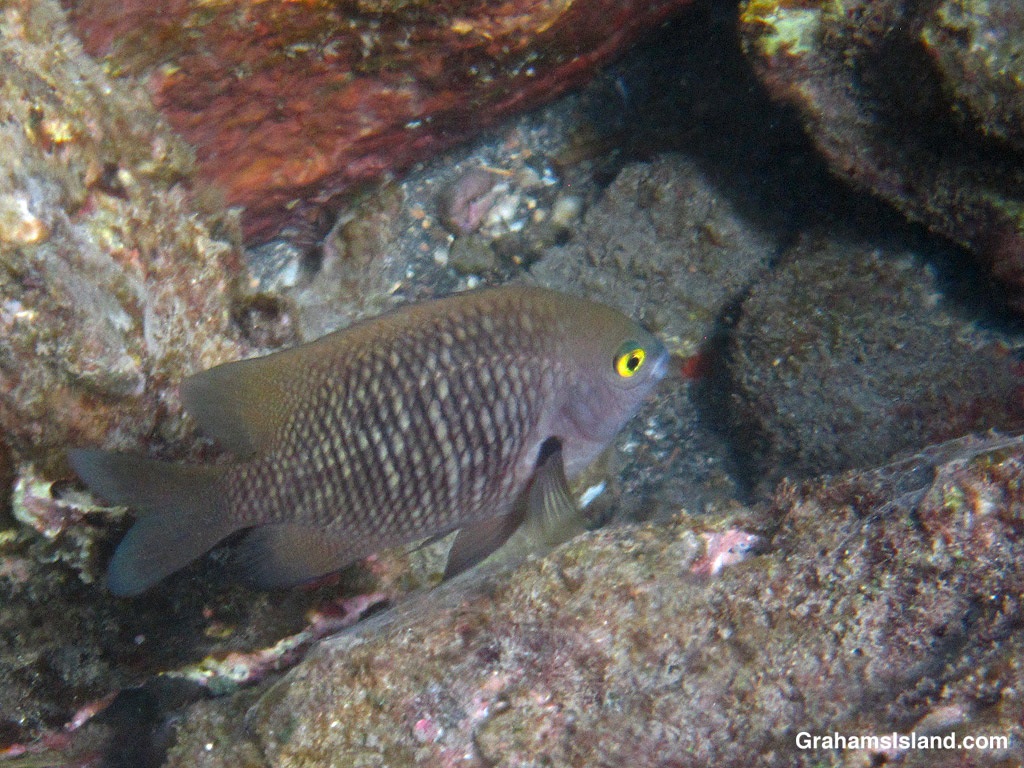
This endemic damselfish is mostly black or brown with a mottled distribution of light and dark scales, but it’s easily identified by its yellow eyes. It eats filamentous algae and is said to ‘farm’ the algae in its territory, which it defends vigorously against other algae-eaters after its crop.
While this isn’t the greatest photo, I liked how the very small inhabitants of this rocky area were all looking at me at the same time. At the top is a juvenile wrasse, probably a Saddle Wrasse, though the Bird Wrasse is somewhat similar. The middle two are Bright-eye Damselfishes, and at the bottom is an Hawaiian Whitespotted Toby, the giant of the group at about 3 inches long.
Most of the fish in this photo, with five vertical black bars, are Indo-Pacific Sergeants. But there are a few fish where the bars fade away and these are endemic Hawaiian Sergeants. The two species sometimes interbreed, so some of these fish might be hybrid sergeants. Regardless, they’re a familiar sight in the water, usually swimming in large groups and feeding high in the water.




 Graham's Island