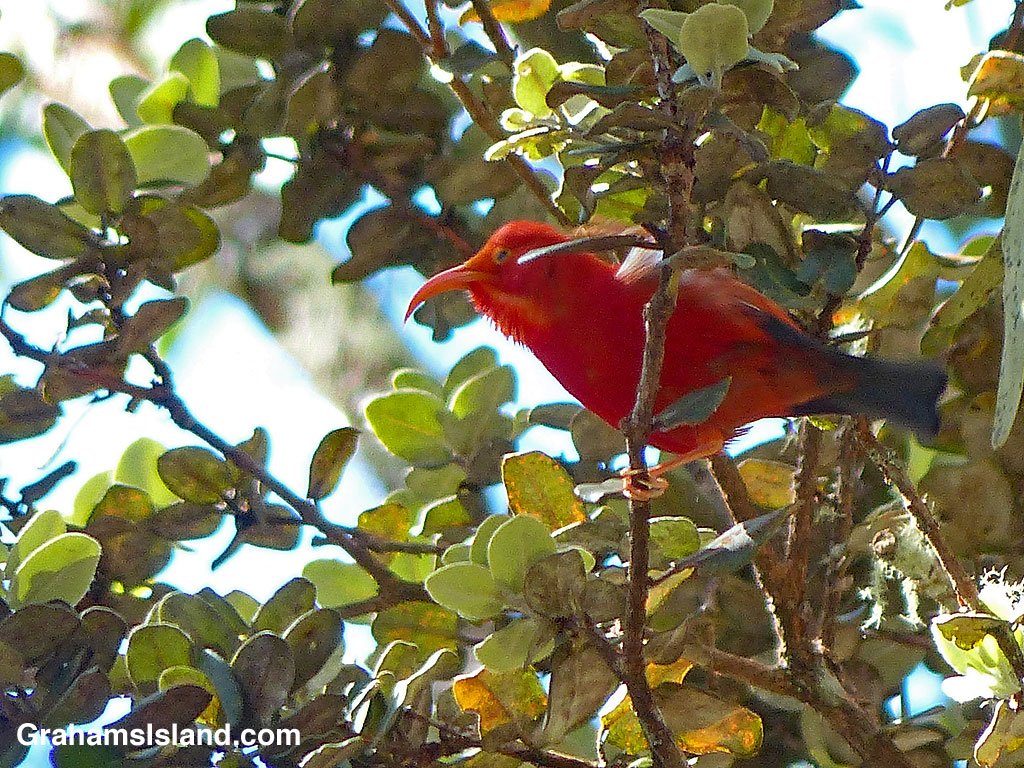
I saw this I’iwi (Drepanis coccinea) on a trail off of Saddle Road, between Mauna Kea and Mauna Loa. These bright red birds are native Hawaiian honeycreepers and in the old days, the feathers of the birds were collected to make cloaks for Hawaiian royalty.
The curved bill is suited for feeding on native lobelias, but a decline in those plants has seen the I’iwi adapt to feeding on other native plants including ʻōhiʻa lehua, māmane, and ohelo.
While the numbers of I’iwi are still fairly good, particularly on the Big Island and Maui, they have suffered, like other birds, from loss of habitat. In addition, They are susceptible to avian malaria, spread by mosquitoes. Consequently, I’iwi are doing better at higher elevations, such as where this photo was taken at around 6,000 feet.
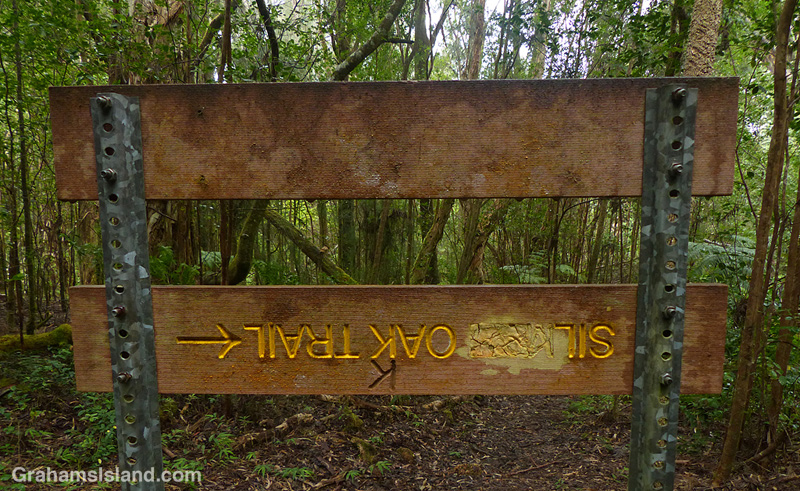
I was hiking in Kalopa Native Forest State Park when I came across the trail sign above. Nothing too remarkable about that, but I happened to notice the back side of the sign (middle), which showed that getting the sign right took a bit of practice.
On a subsequent visit, I noticed that the back of sign at the other end of the trail (bottom) had also seen a rejected first effort.
This week’s Friendly Friday challenge theme is ‘Whereabouts.’ See more responses here. ‘Whereabouts’ means ‘the place or general locality where a person or thing is.’
My whereabouts are the Big Island, Hawaii, which is also the place where Captain James Cook, of the British Royal Navy, lost his life on February 14, 1779. He was killed by native Hawaiians with whom he was involved in a dispute over the loss of a cutter from one of his ships. I won’t go into a detailed history here, but more information about Captain Cook can be found at www.captaincooksociety.com/.
Captain Cook’s whereabouts were often uncertain, in that he was an explorer who visited unknown or little known places around the world. Not only did he sail to far flung places, but he made excellent, detailed maps and charts of the places he visited, which made him highly thought of in the British Admiralty, and which made it easier for future travelers to know their whereabouts.
Between 1768 and 1779 Cook made three voyages around the world. The first two focused on the search for the theorized southern super-continent of Terra Australis. The third was intended to find the Northwest Passage across the northern part of North America.
It was on this third voyage that Cook became the first European to officially visit Hawaii (as opposed to other European commercial ships that were believed to have been there before). He sailed on to the north to attempt (unsuccessfully) to fulfill his commission before returning to Hawaii.
This time he anchored in Kealakekua Bay on the Big Island (official name, Hawaii Island). He was well received, in part because his arrival coincided with a Hawaiian festival for the god Lono. After a month, Cook left to resume his voyage, but when one of his ships lost a mast, he returned to Kealakekua Bay.
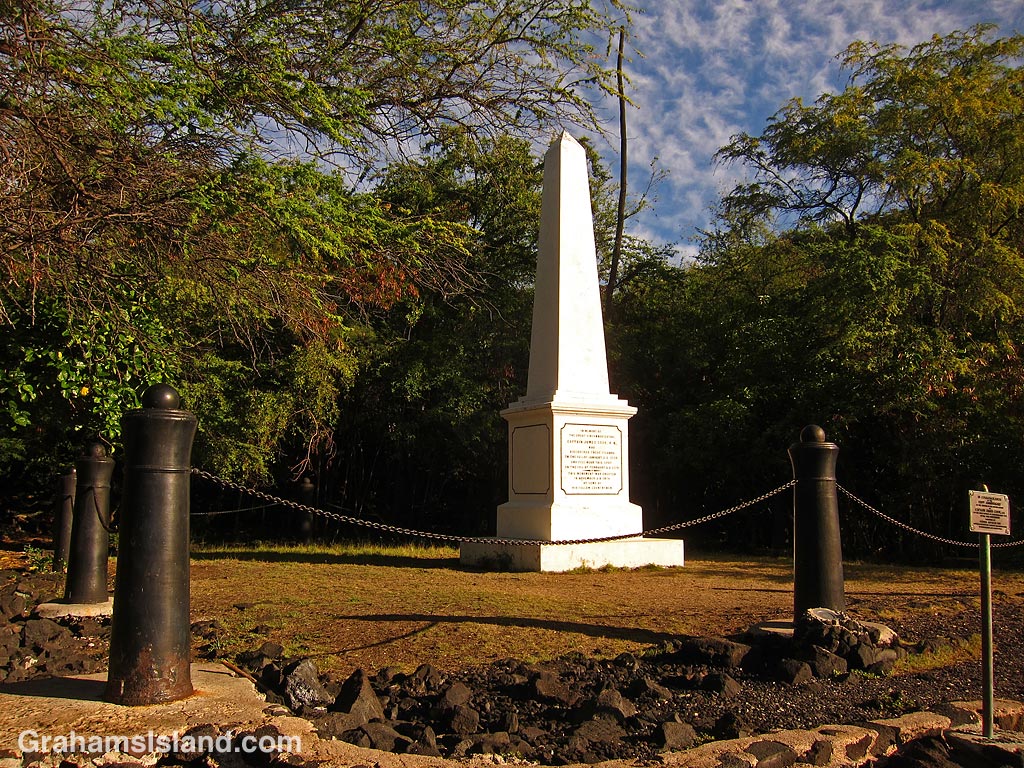
Unfortunately, by then the festival for Lono was over and his return was not greeted with the same enthusiasm. Soured relations led to several incidents culminating the theft of a ship’s cutter and the incident that led to Cook’s death. However, the killing of Cook did not diminish his standing in the eyes of the Hawaiians. In 1874, the Captain Cook monument was put in place and, in 1877, the land on which it stands was deeded to Britain by Princess Likelike as a sign of respect.
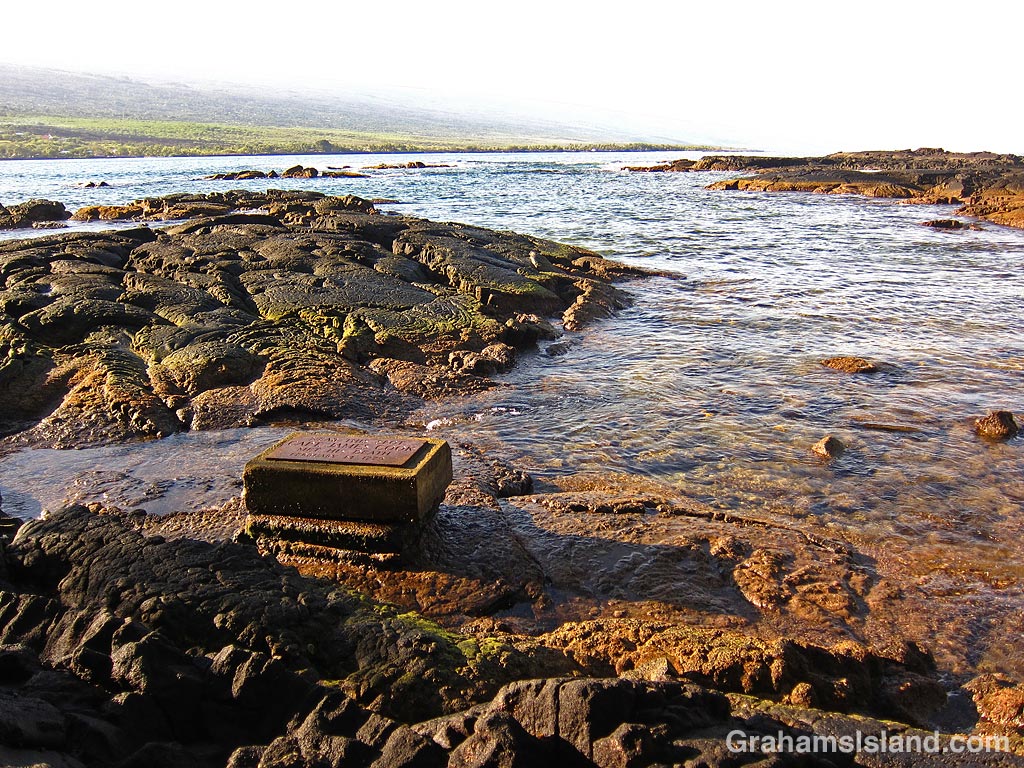
The top photo shows the monument, surrounded by a chain supported by twelve cannons from HMS Fantome. The second photo shows the inscription on the monument. I particularly like the bit about how he discovered these islands, islands which were occupied by a substantial population governed by an established royal line. The third photo is the plaque marking the spot where Captain Cook is believed to have been killed. Below is the location of that plaque in relation to Kealakekua Bay, which is the water beyond the rocks in this photo.
Most people going to Green Sands Beach, near South Point, hike in or pay for a local to transport them in one of a variety of dubious-looking trucks. Once there, people head down to the beach to swim or broil on the green sand.
Beyond the place where the trucks stop is a pu’u and a hike over this hill and down the other side takes one to this bench, which overlooks the bay, though not the beach itself. It’s a quiet spot unless the wind is howling, which it often is, but the view is lovely and it makes a great resting spot before either carrying on along the coast, or returning whence one came.
I recently went hiking in the Kalōpā State Recreation Area, not far from Honoka’a, on the northern end of the island. I’d been there before, but only to check it out, so this was an opportunity to explore the trails more thoroughly. One of the treasures of this area is that it features plants that were on the island before even the native Hawaiians arrived.
The recreation area is about 100 acres, and it neighbors the 500 acre Kalōpā Forest Reserve. At an elevation of around 2,000 feet, and on the wet side of the island, it’s cool and damp. There are a variety of trails that intersect and criss cross, which allows hikers options from short loops of less than a mile, to a 6+mile hike around the perimeter.
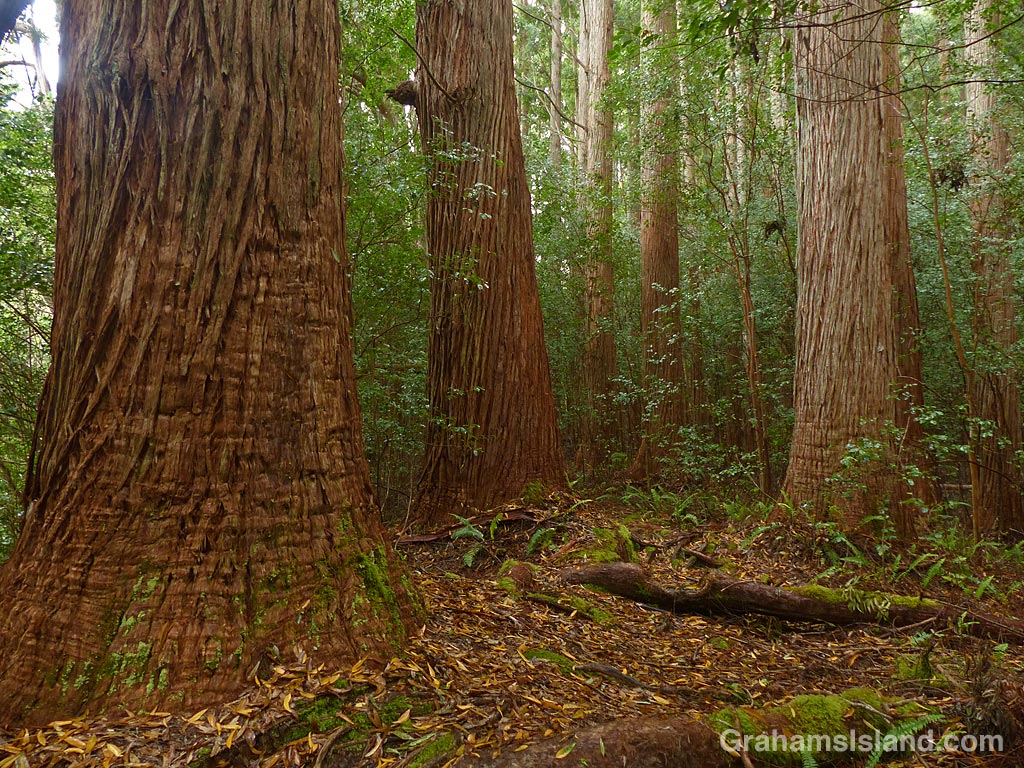
I took one of the longer routes and it reminded me greatly of hikes I’d taken back in the Pacific Northwest where I used to live. Light rain, water dripping from the overhead canopy, ferns bordering the trail, and tall trees stretching up into a grey sky. These were all features of those hikes. Only the species were different. Eucalyptus, ohia, and kopiko instead of firs and cedars.
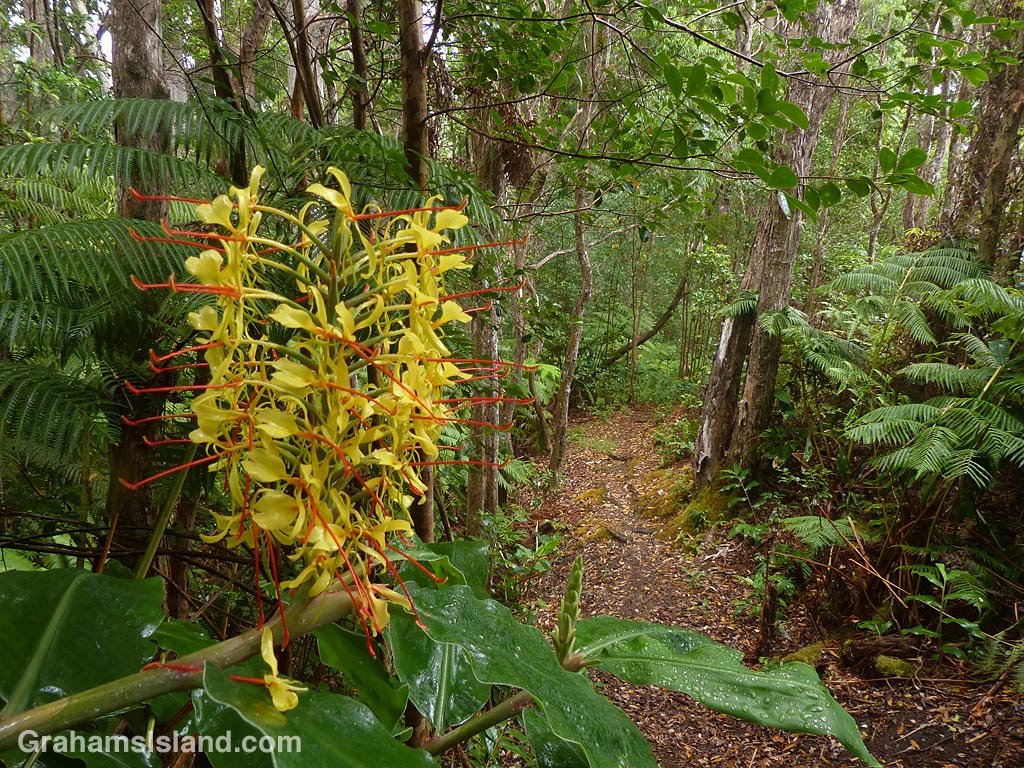
The photos show – Top: towering trees line the trail alongside Kalōpā Gulch. Above: A view down into Kalōpā Gulch. Flash floods often race down this gully so it’s a good idea to watch your step. Third photo: Strangler figs envelope native trees and take over resulting in weird, twisted shapes. Below: The old Jeep Road, bordered by invasive kahili ginger, cuts through the center of the area. It’s hard to imagine anyone driving this trail.
The Ka’awaloa Trail starts near the top of Napoʻopoʻo Road, on the edge of Captain Cook – the town that is, not the person. The trail goes down to the water near the Captain Cook Monument on Kealakekua Bay.
As you can see, there are a lot of warnings on the sign. It could be greatly shortened to, “Abandon hope all ye who set foot on this trail.” But there are a couple of things to know about this sign. One is that most people won’t read it. I mean, who needs to waste time reading a dumb sign. The second is that quite a few people will end up in difficulty on the way back up, because the trail really is steep, hot, and exposed. Locals often take extra water with them to help out those in need, but if you don’t meet one of them on the trail, you’re on your own. An iced tea stand two-thirds of the way up could make a killing.
I also like that someone has taken the time to obliterate the word ‘vehicles’ in the ‘No vehicles’ admonishment. A car would never make it and even a trail bike might have a tough time. Perhaps it was just the principle of the thing that someone objected to.
A red-billed leiothrix perched on a branch in a kipuka on the Pu’u O’o trail off Saddle Road. A kipuka is an area of land that has been surrounded by a lava flow. Kipukas often contain older trees and other plants that are a haven for native and non-native birds and other creatures.
This leiothrix had an exceptionally red bill because it was carrying a bit of ripe thimbleberry, presumably to young birds in a nest nearby.
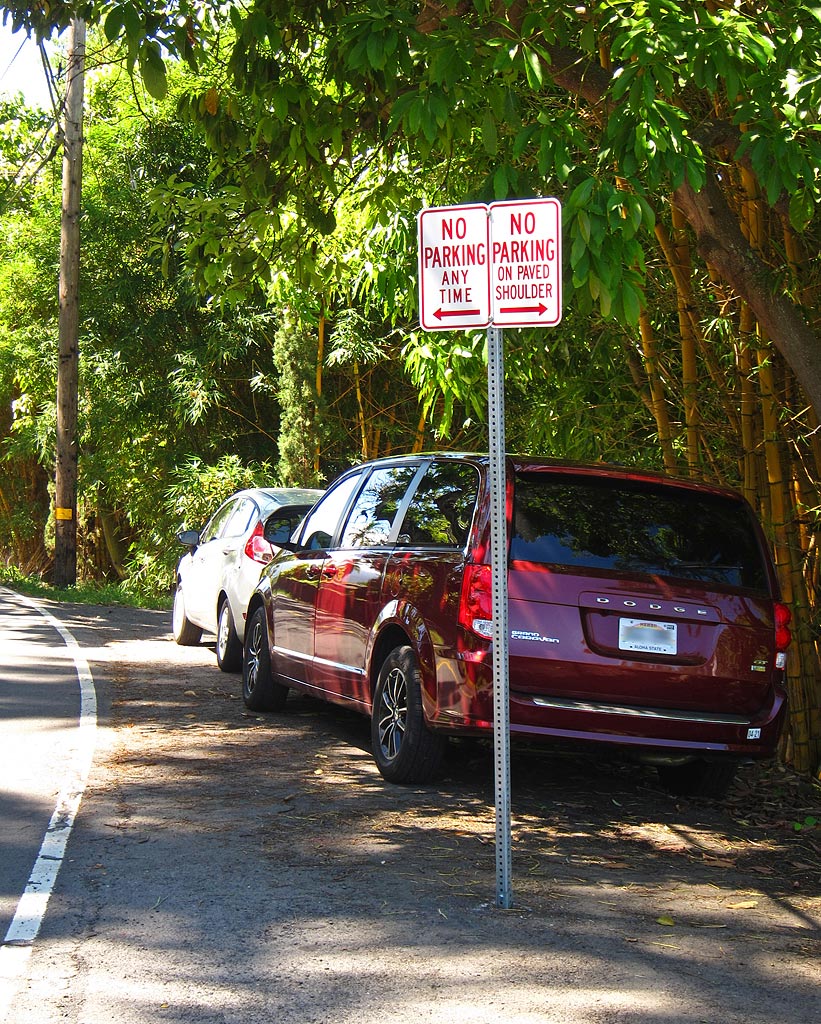
I was going to title this, ‘Unclear on the concept,’ but decided not to comment in that way. It’s possible the two drivers didn’t see the sign, or saw it and didn’t care. Either way, they have a reasonable chance of getting away with it. This isn’t a heavily policed area, and even if a cop goes by, there’s a fair chance they’d simply ignore the transgression. The most likely case for something happening is if one of the people who lives in the vicinity complains.
The sign is at the top of a busy trail down to the Captain Cook Monument. A redesign of the road junction nearby created new parking opportunities and this has resulted in a surge in people using the trail. With more use, word gets out and soon the trail will be overused, the shoreline around the monument littered with trash, and the waters and coral in the bay damaged and degraded.
Not that this is the fault of these two drivers, but since they’re clearly breaking the law, let’s blame them for everything anyway.