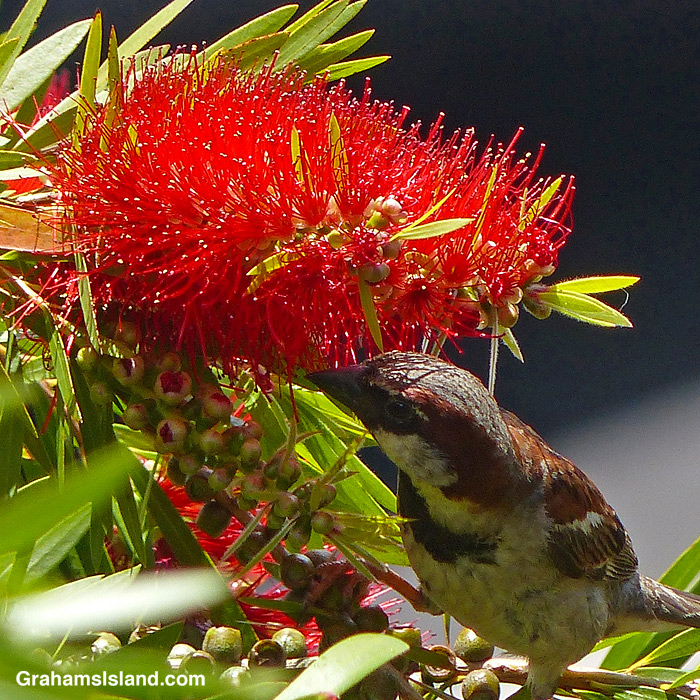
I was surprised to see this House Sparrow feeding on this bottlebrush flower. I usually see them snapping up fallen food at outdoor restaurants or squabbling over bird seed thrown out by sympathizers.

I was surprised to see this House Sparrow feeding on this bottlebrush flower. I usually see them snapping up fallen food at outdoor restaurants or squabbling over bird seed thrown out by sympathizers.

A Lesser Grass Blue Butterfly (Zizina otis) feeds on a Blue Heliotrope (Heliotropium amplexicaule) flower.
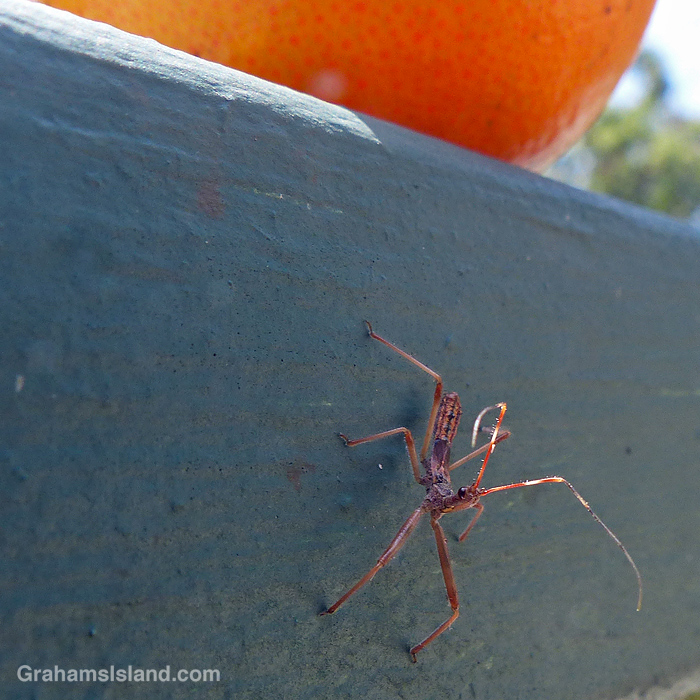
I was juicing tangerines in the kitchen when I noticed this little bug atop the pile of fruit. I took the tangerine it was on outside and tried to free it onto the rail there. The bug stuck to the fruit, scampering around as I rotated it. Eventually, it dismounted and I went inside to get my camera.
When I started taking photos, the bug accommodated me by approaching the lens. It quickly got too close so I moved to a different spot. The same thing happened. Every time I moved, the bug followed me until we both tired of the game and I left it in peace and it did the same to me.
At first, I thought it was a baby Praying Mantis because of the curve of its body, but a bit of research revealed that this is an Assassin Bug nymph. Assassin Bugs can deliver a painful bite, so maybe it was after me to take me out!
This one was only about half-an-inch long, as indicated by the average-size tangerine on the rail above and the fact the bug is standing on the thin side of a 2×4.
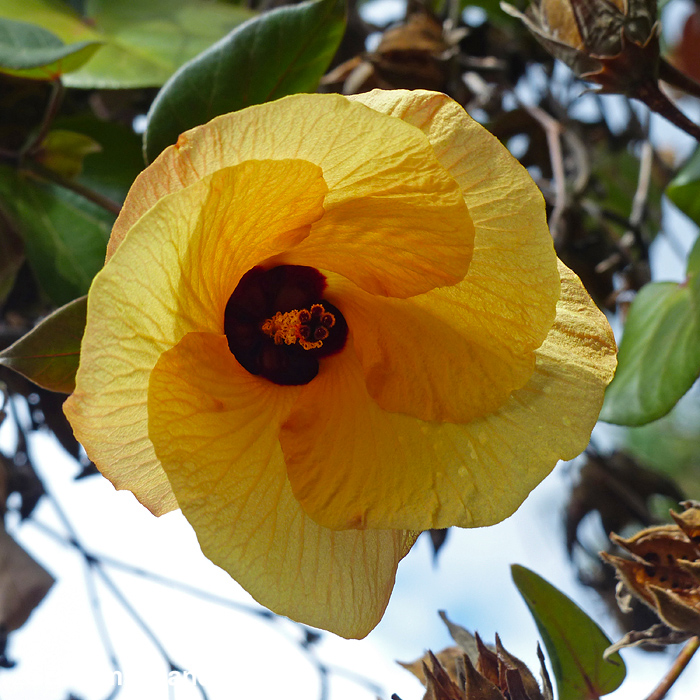


I saw this Milo (Thespesia populnea) flower during a walk on the South Kohala coast and liked the different views it afforded. Milo is a canoe plant, brought to Hawaii by Polynesian settlers. It’s similar to another canoe plant, Hau (Hibiscus tiliaceus), but Milo is more of a tree and has different shaped leaves, pointed as opposed to heart-shaped.

This bee was burrowing in to get what was on offer from a clover flower.

An Ashy Grey Lady Beetle climbs the buds of a Plumeria tree.

I spotted this shiny creature on the trunk of a mango tree, but wasn’t sure what it was. So I searched online using the striking details – iridescent green, red on legs, Hawaii – and the first result was a post on whatsthatbug.com. It was headlined, ‘Emerald Cockroach Wasp from Hawaii turns Roaches into Zombies!!!’ (link here). That got my attention! Within that posting was a link to a longer post with more details (here).
In brief, the female Emerald Cockroach Wasp (Ampulex compressa) stings a cockroach to temporarily disable its front legs. It does this to buy time to deliver a second sting to a precise spot in the cockroach’s brain that controls the roach’s escape reflex. The roach isn’t paralyzed, but it just stays where it is, that is until the wasp takes it by the antenna and leads its zombie prey back to her burrow. There she lays an egg on the roach, before walling up the burrow’s entrance. Back inside, the roach just waits while the egg hatches and the larva eats its way inside the roach and devours the roach’s organs. Four weeks later, a new wasp emerges from the roach and the burrow.
I was astonished to learn about this, in particular how, for the second sting, the wasp locates the exact spot in the roach’s brain using sensors on the stinger.
The source of the whatsthatbug.com description comes from Carl Zimmer who has a great article here. More information about this remarkable wasp can be found here, here, and here. And finally, a must see video of the wasp in action, including leading the cockroach to its lair, can be seen here.

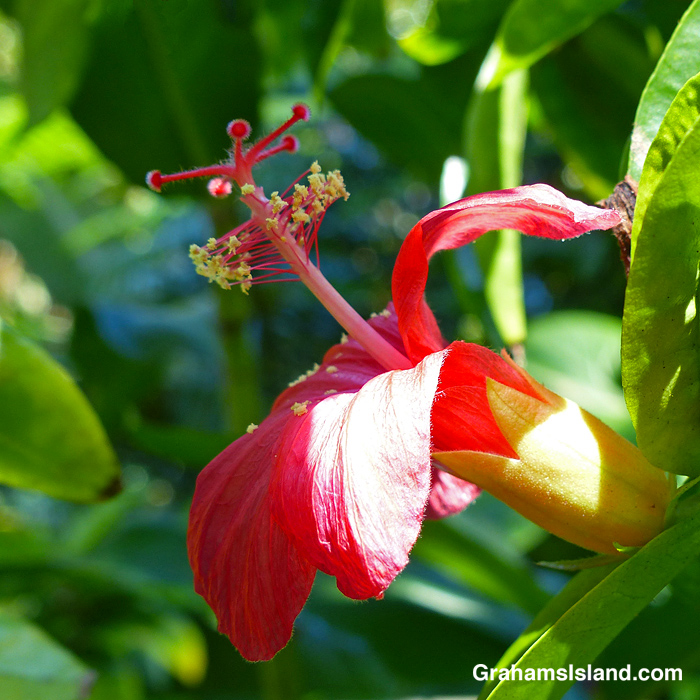
Hibiscus Clayi is endemic to Hawaii, but is listed as endangered. In the wild, it’s found only in a part of eastern Kauaʻi, but this one was growing at Hawai’i Tropical Bioreserve & Garden. For more information about Hawai’i Tropical Bioreserve & Garden, go to htbg.com.

