
The idea of The Numbers Game is to enter a number into the search bar of your computer and then post a selection of the photos that turn up. This week’s number is 149. Captions are on the photos. You can see more responses here.





The idea of The Numbers Game is to enter a number into the search bar of your computer and then post a selection of the photos that turn up. This week’s number is 149. Captions are on the photos. You can see more responses here.

The small Indian mongoose is the poster child for bad ideas in Hawaii. Introduced back in the days of the sugar plantations, the idea was for them to get rid of the rats running rampant in the cane fields. Alas, rats are nocturnal, mongooses diurnal, so their paths only crossed on the shift change. Instead, the mongooses appreciated the absence of predators in Hawaii and the abundance of ground-nesting birds and were major reasons for the extinction of many native bird species.
They are most frequently seen running across roads, like big sausages with little legs. Closer up, there’s an intensity about them, as seen in this photo. I’ve had a couple of close encounters and have no wish to get into an altercation with one. I’d probably win, but would likely bear the scars of victory!

Mongoose are everywhere including at the beach. This one was scurrying across the sand at Pelekane Beach, Kawaihae.
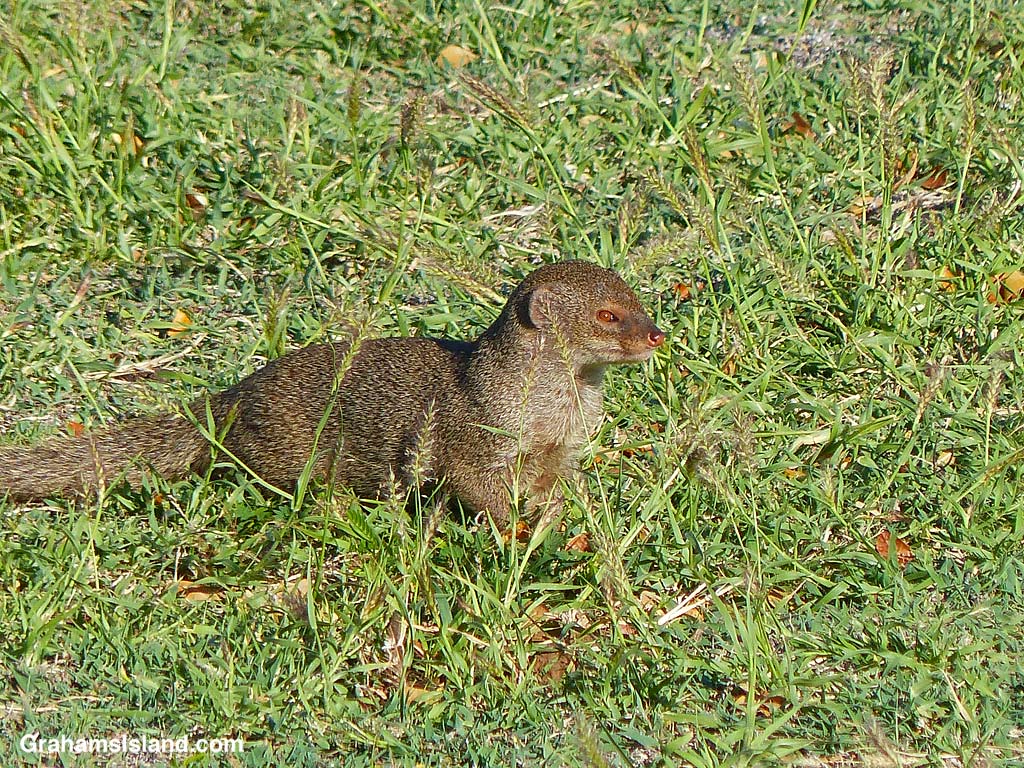
A Small Indian Mongoose (Herpestes javanicus) surveys its surroundings. Easily distinguished by its short legs, long body and tail, and beady red eyes, this mongoose is the poster child for bad ideas in Hawaii. It was deliberately introduced to get rid of rats, which it didn’t do. Instead, it has decimated native bird populations on all the islands except Kaua’i, where it is still, officially, absent.

When I pulled in to the parking lot of a local beach park, a flock of mynas was gathered around something on the ground. By time I opened the car door, the mynas were hopping around in a huff because this mongoose had moved in to snatch their spoil.
I suspect the focus of the dispute was rice left over from someone’s lunch, which had been dumped in the lot in the sure and certain knowledge it wouldn’t be there long.

I thought, for a brief exciting moment, that these two mongooses might come to blows. The look given by the farther mongoose suggested as much. I was ready with my camera for the encounter, but it didn’t happen. Instead the two of them seemed quite content in each other’s company and spent their time scavenging in the grass for scraps of food.

A small Asian mongoose suns itself on rocks along the shoreline. The mongoose can be found in most places on the island with the exception of the higher elevations.
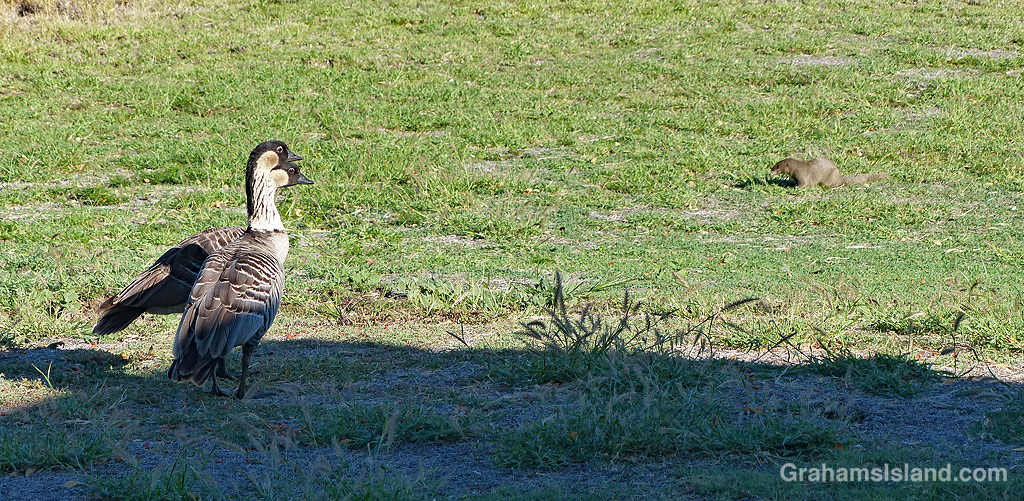
 This pair of nene (Hawaiian goose) were grazing when they noticed the mongoose (above). A mongoose isn’t a real threat to an adult nene, but it’s a real menace to a nene’s eggs and chicks. Though these birds weren’t nesting in this area and didn’t have chicks with them, Their protective instincts kicked in and one of the birds chased the mongoose away (second photo).
The mongoose scurried off into the tall grass, then reappeared on the edge and took stock of the scene (third photo). But when it ventured out (bottom), the nene’s attitude hadn’t mellowed and another charge ensued.
 This scenario was repeated a few times before the mongoose lost interest and wandered off. Mongooses are very quick and will use this tactic of feints and retreats to wear out their intended victim. In this case, like the nene, it appeared to be more going through the motions in preparation for the next time it encounters a nene nest or chicks.

 Graham's Island