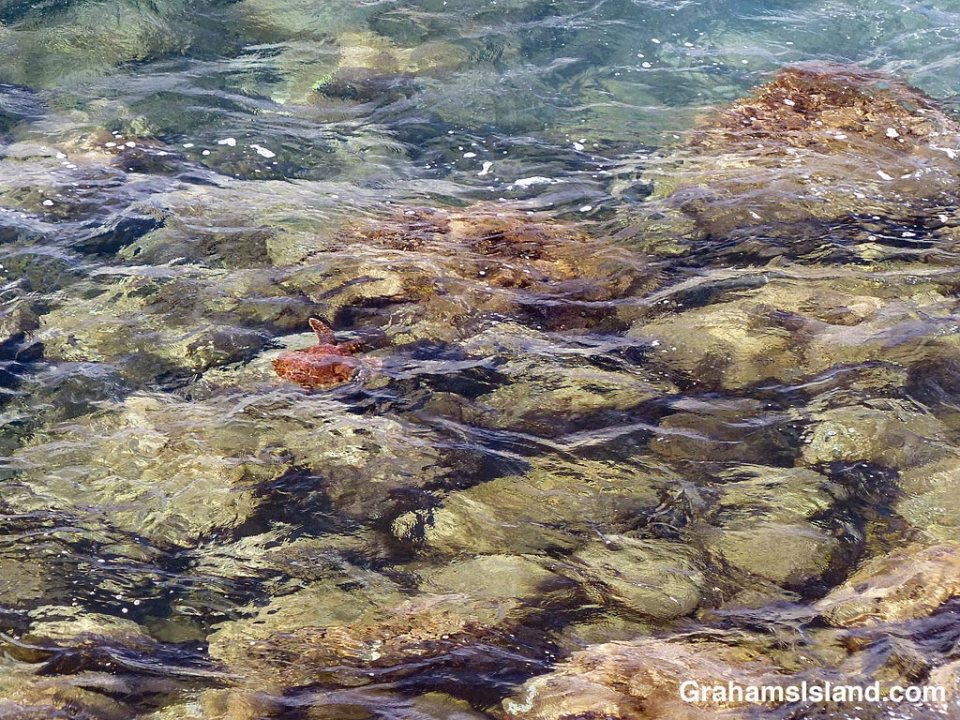
A Hawaiian green turtle swims over a field of large boulders, looking a bit like a boulder itself.

A Hawaiian green turtle swims over a field of large boulders, looking a bit like a boulder itself.

Padina japonica is a kind of seaweed which is found in tide pools. I love it’s creamy curled shape.

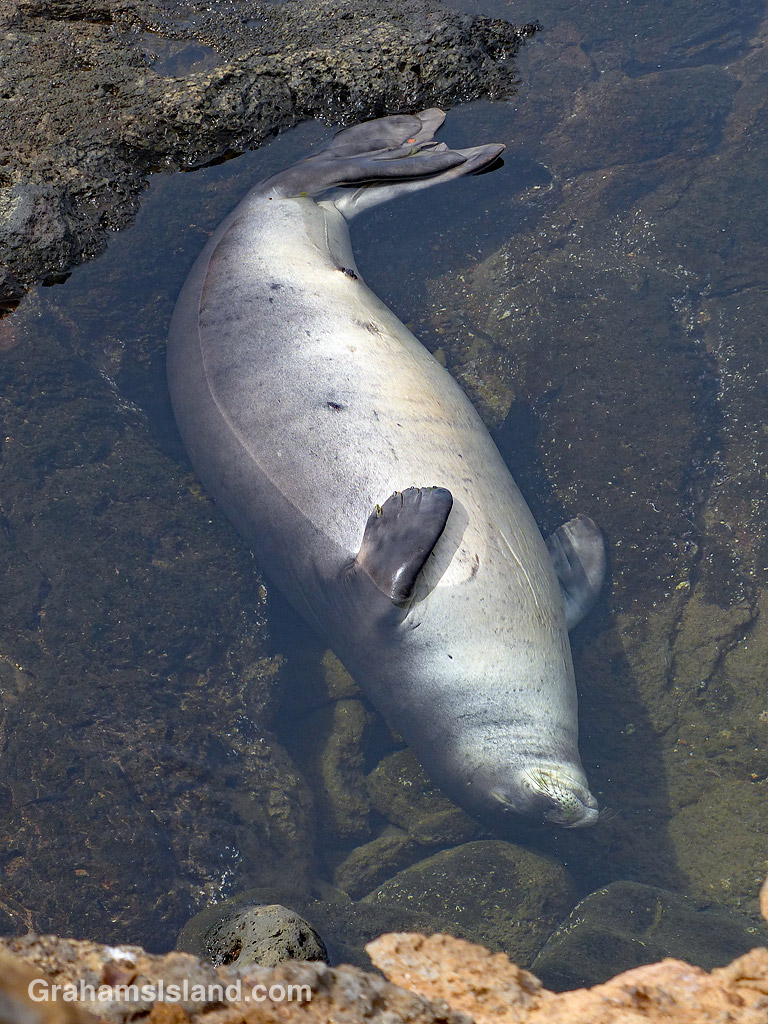 Monk seals are endangered and only a handful regularly live in the waters around the Big Island. The seal in these photos is one of these and I’m lucky enough to see him on a regular if not always frequent basis. When I do see him, it’s not unusual for him to be submerged in a tide pool as he was on this day.
Sometimes, when there’s been rain, the tide pool will be brown with runoff and all I see is this body with its head submerged. When I first saw this, I wondered if the seal had drowned, but since a monk seal can hold it’s breath for 20 minutes or more I know that’s not what’s going on.
What I like on this occasion, was the little fish (seen above) swimming around the seal’s head and through his whiskers. I like to think it was wondering what the heck this giant lump was that had suddenly taken up most of the space in its pool.
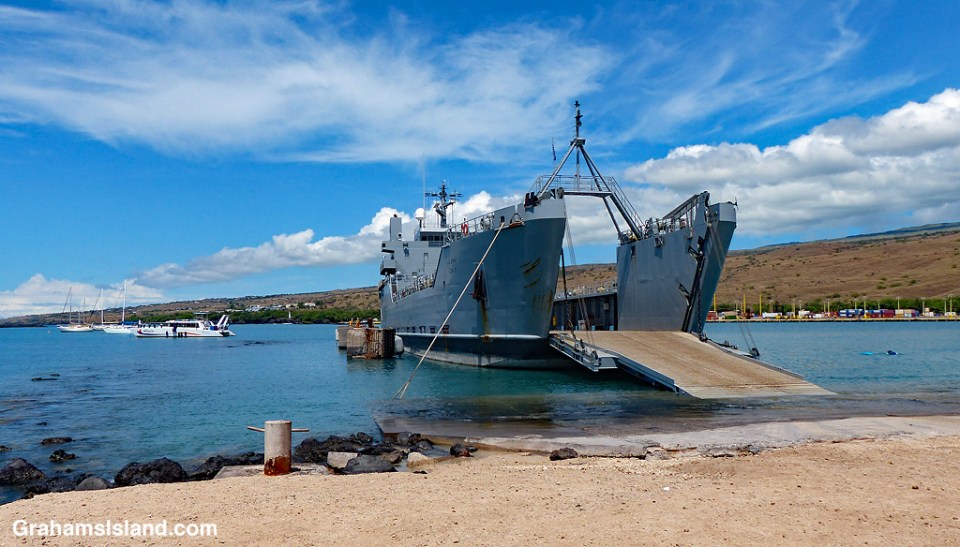
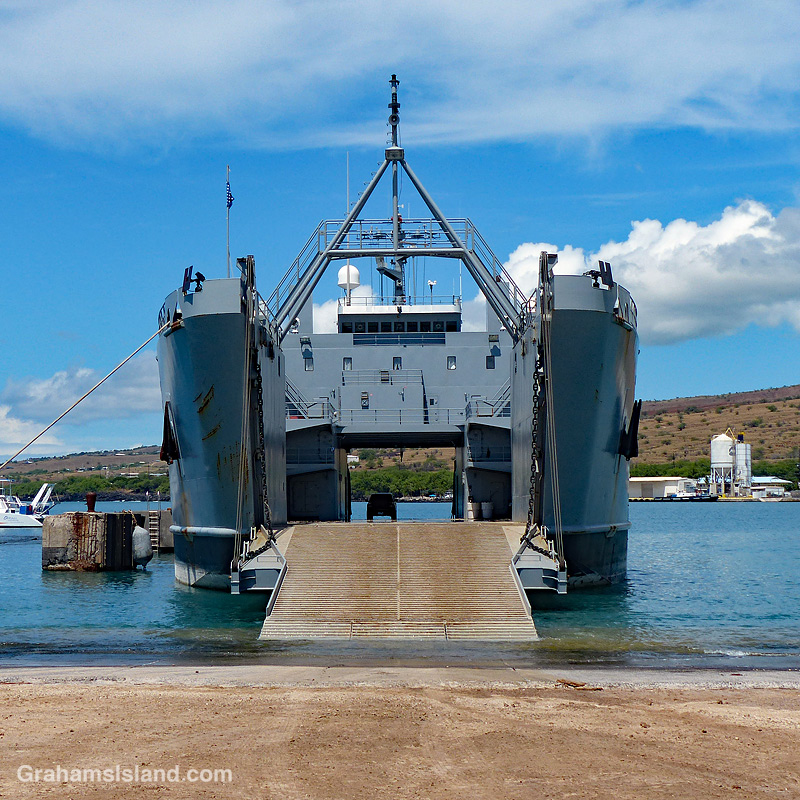 This is the ship that brings military troops and supplies from Oahu to Kawaihae Harbor en route to Pōhakuloa Training Area (PTA). I often see the ship going back and forth off the Big Island and had always assumed it to be a Navy vessel because, well, it’s a ship. But no, this is an Army LSV (Landing Ship, Vehicle) where they drop the ramp and roll the vehicles on or off.
These activities coexist with commercial shipping, pleasure craft, and locals enjoying the splendid beach and calm waters of the harbor, where I understand the snorkeling is pretty good. Got to try it out sometime soon.
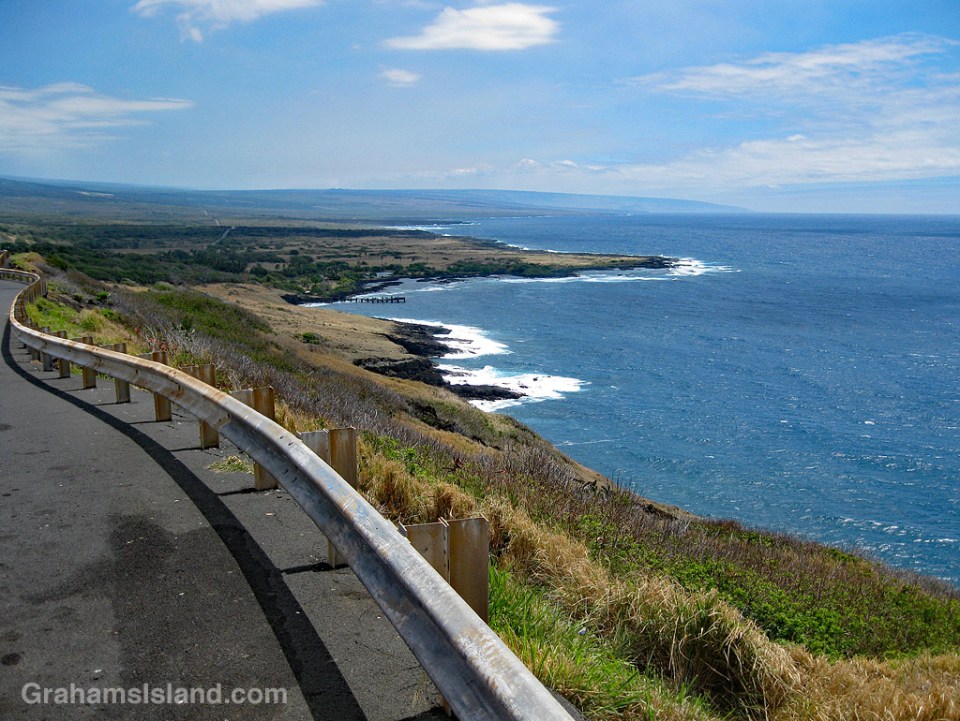
A view of the Kau coastline, not far from the southern tip of the island, where the road snakes down from Naalehu toward Whittington Beach County Park, where the pilings jut into the ocean.
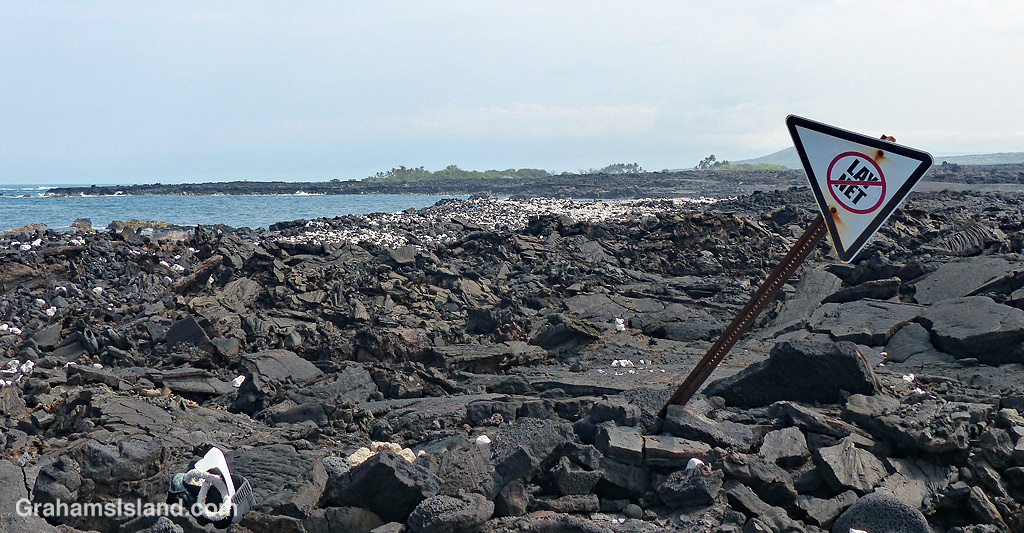
Lay nets are also known as gill nets. They can be hundreds of feet long and many feet deep with floats on the top edge and weights on the bottom. The problem with them is that, rather than targeting specific food fish, they can catch anything swimming by including turtles and monk seals. Because of this, they’re banned in certain areas, though not everywhere in Hawaii.
To me, this photo represents how the ban works. This section of the Kona coast is one of those areas where lay nets are banned. Someone has gone so far as to erect a sign in the lava near the coast. But that’s about it. In due course, the sign will fall down. It probably won’t be replaced. In the meantime, enforcement of the ban is spotty at best. Even when a violation is called in, chances are no one will be out to check on the situation until long after the net has been hauled and the netters gone home.

This week’s Sunday Stills challenge theme is ‘Autumn,’ (more responses here) which poses a bit of a challenge. In Hawaii, we don’t have leaves turning color or a certain crispness in the air. But what we do have at this time of year is migratory birds coming to the islands.
One of the more impressive of these travelers is the Pacific golden plover. These birds spend the summer, their breeding season, in the Arctic tundra from western Alaska to northern Asia. At the end of the season they make an epic migration south to places as far away as Australia, Southeast Asia, and northeast Africa.
Hawaii is a stopover on their way to Australia, New Zealand, and other Pacific islands, but some of the birds spend their winters in Hawaii. This is a non-stop journey of more than 2,500 miles and takes the birds three to four days. How they do this is not fully understood. There are no landmarks or stopping points en route and no room for errors in navigation. But year after year, Pacific golden plovers return precisely to the same sites. Not only that, but new born plovers are able to make the journey independently despite never having flown the route before.
Then there’s the small matter of how this little bird fuels itself for such a long flight. There’s a fine balance between the amount of fuel it must carry and the need to fly fast. But even if it gets this right, the fact is an individual plover still wouldn’t be able to go that far. The secret lies in the birds flying in a V-formation which saves enough energy for the birds to make the whole distance with a little bit to spare to cover adverse conditions. It’s a remarkably precise balance which the birds manage successfully year after year.
This plover was foraging (successfully in the top photo) in tide pools along the Kona coast.
For more information about the Pacific golden plover’s migration to Hawaii, go to https://phys.org/news/2011-06-plovers-tracked-pacific.html.


This is an aerial view of Kohala Ranch on the left and Kohala Estates on the right. The main road, Akoni Pule Highway, runs across the photo just above the coastline. The dark strip running across near the top of the land is Kohala Mountain Road, the darkness being the trees which line much of the road.
Kohala Ranch is a gated community which spans the space between these two roads. Near the bottom, houses are built on lots of one to three acres. Midway up the hill are five acre lots, and toward the top are bigger lots of 10 and 20 acres. The community has access to both roads. The top of the community gets more rainfall, and more wind, than the lower sections. Kohala Estates connects only to the bottom road.
Communities such as these are fairly common on the Big Island. Some are gated, some not, but most cater to people moving to the island from elsewhere since the property prices tend toward the upper end of the market.
 Graham's Island