
I was out on one of my usual coast walks when I heard the thrumming of engines. I looked up to see a pair of military helicopters heading west. I see a lot of helicopters on my walks, sometimes military ones, but more often those on tours.
I kept walking but, as they sometimes do, the helicopters turned and came in to land at Upolu Airport. This wasn’t unusual. Military aircraft often land at the lightly used airstrip. I’d have carried on, but the two aircraft had come to rest a little way above where I was walking. All I could see of them was their rotors turning, though I could hear plenty; helicopters are loud.
Anyway, I thought the situation had some photographic potential so I edged toward the airport fence and took some shots – not too interesting as it turned out. Still, I knew that when military craft touch down here, they only tend to stick around for a few minutes before taking off again. I thought these large helicopters rising above the vegetation might be interesting, so I waited, punishing my ears in the process.
Five minutes passed, then 10. I started to get antsy. What were they up to? I waited another five minutes or so and then I saw one of the crewmen through a gap in the vegetation, walking on the runway from the second helicopter to the first. Now it was possible he was returning to his aircraft prior to takeoff and I just hadn’t noticed him going the other way, but I figured if the crew were wandering around on foot, chances were that nothing was going to happen any time soon. I put away my camera and started walking again.
At this point in the story, one might expect that both helicopters to take of and collide in a flash of flame, or a UFO comes down and lands between them, but no. I walked a bit and turned around in time to see the rotors on the second helicopter turning slower and slower on their way to stopping. Something was wrong.
I kept going and several minutes later there was a surge in noise and the first helicopter rose up, made a sharp curve through the air, and headed off toward Oahu. I didn’t get a photo of this in part because I was looking directly into the sun and in part because it was halfway to Honolulu before I reacted.
Instead, I finished my walk and saw that the second helicopter was still sitting forlornly at the far end of the runway (something of a hazard for anyone else wanting to land there). So I drove my truck down the road and parked opposite the helicopter. I didn’t see anyone in it, but the doors were open and I didn’t think it had been abandoned. I was tempted to yell across asking if they needed a gallon of gas, but restrained myself, aware that such a craft was probably bristling with machine guns. Instead, I took these photos and left.
Later that evening, not long after dark, I heard that thrumming again and next day the runway was empty so I assume that whatever had gone wrong had been fixed.
The helicopter is a Sikorsky CH-53E Super Stallion operated by the U.S. Marine Corps who have a base at Kaneohe Bay on Oahu. It’s used for heavy-lift transport and I think it was a couple of these craft that were stationed in Hilo recently in case people needed to be evacuated from the region threatened by the current lava flow in Puna.


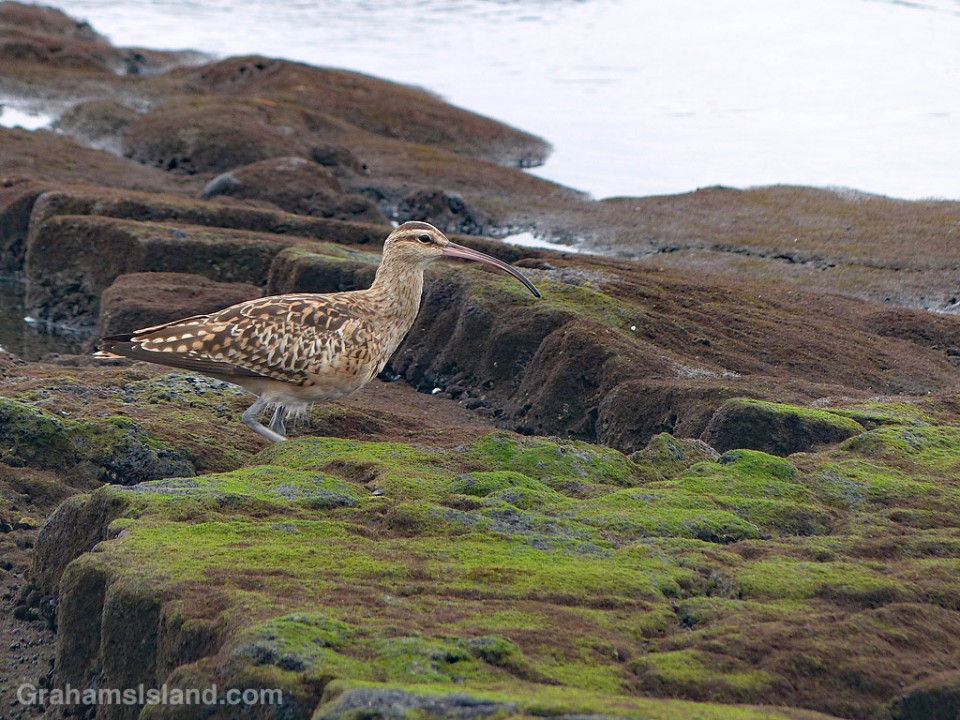
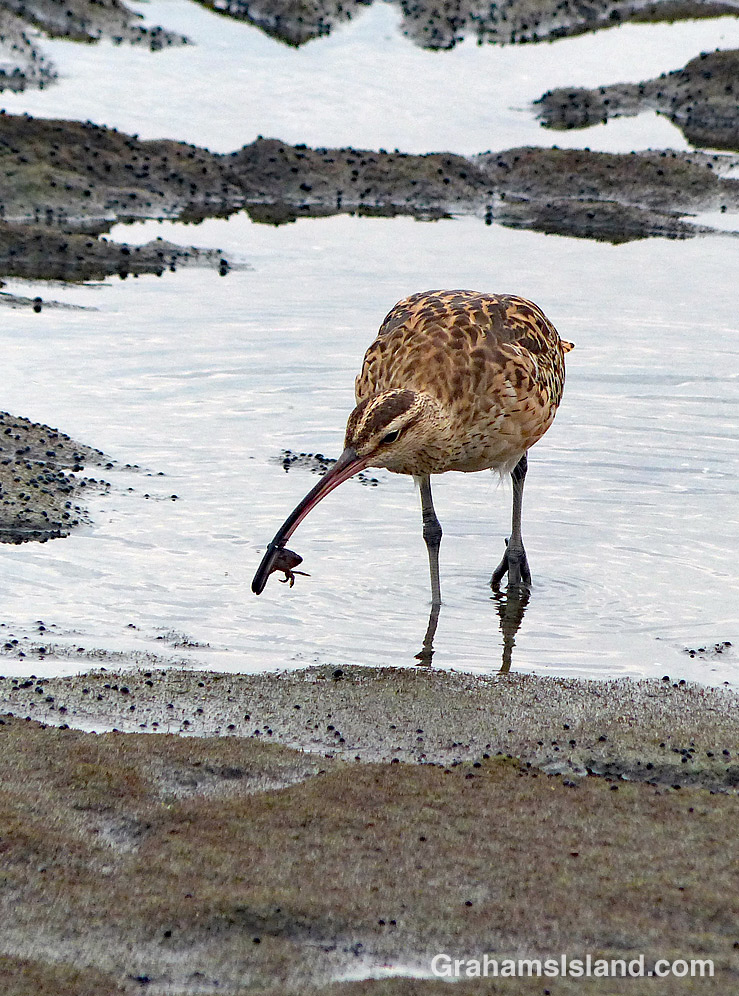 A bristle-thighed curlew making its way along the shoreline at Kiholo while searching for food. The middle photo shows it with a small crab that it plucked from one of the tide pools.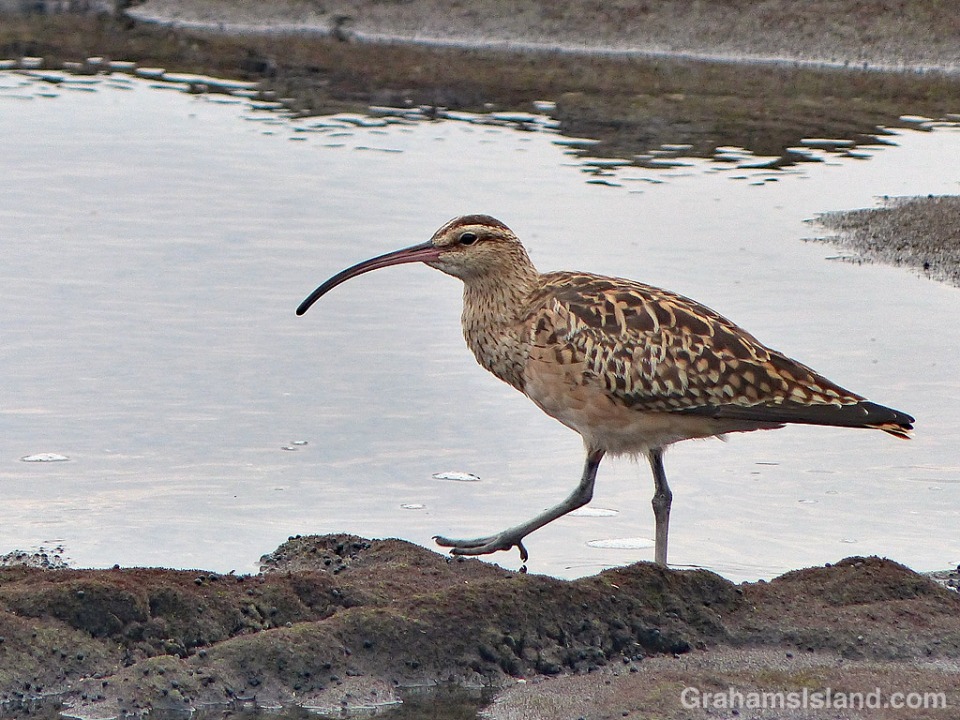

 These are older photos, but still interesting to me. I spotted this monk seal one day, not too far from a second seal that is a regular around the Big Island.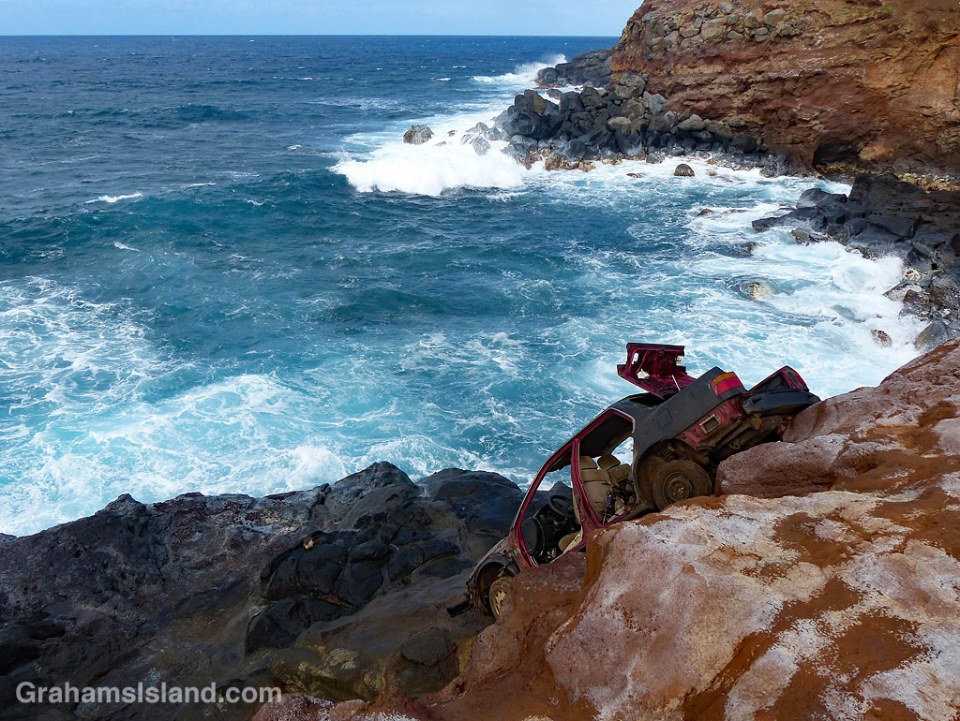
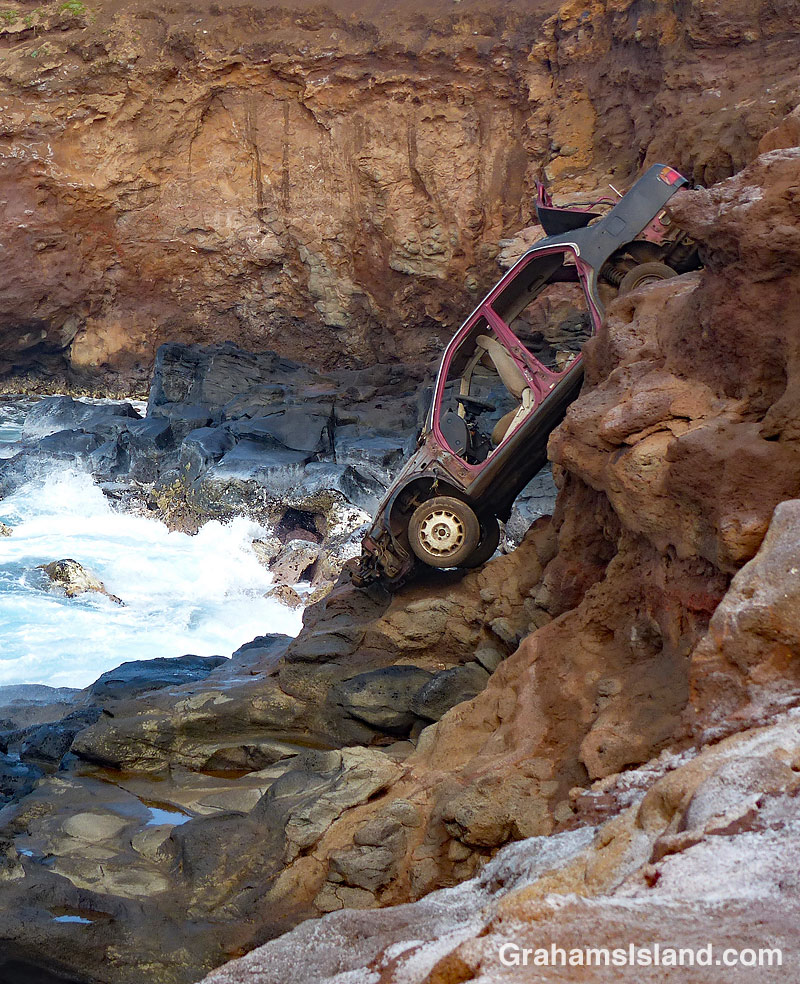 One of the Big Island’s scenic attractions is its sprinkling of abandoned vehicles. One doesn’t have to drive too far to spot a car being swallowed by weeds or a wreck languishing just off the highway. Usually the person dumping the vehicle has stripped it of all the identifying information or never registered it and so can’t be traced.
 Graham's Island