Tag Archives: On The Coast

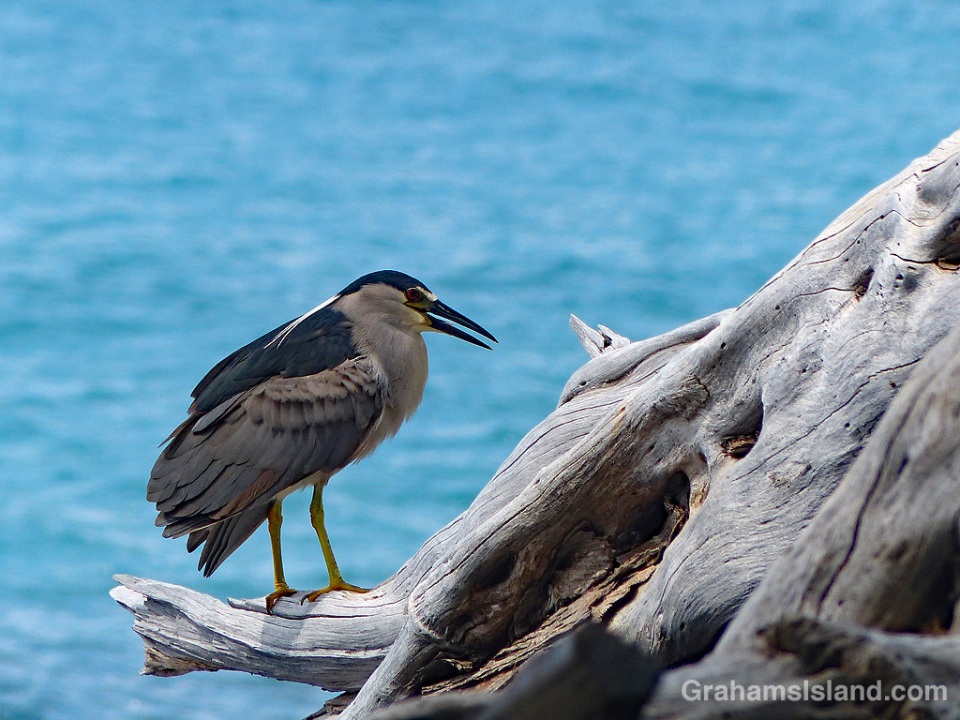
Adult black-crowned night heron

Black crowned Night Heron on old tree

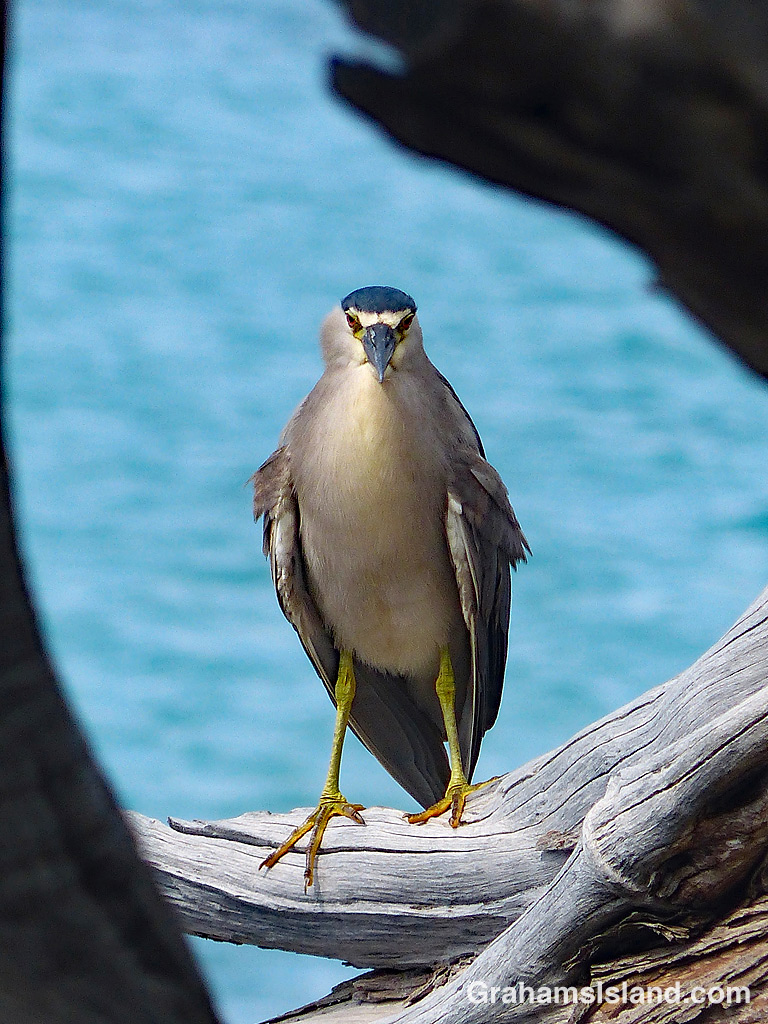
Black crowned Night HeronAnother response to the last edition of the WordPress photo challenge with a theme of ‘All time favorites.’

I’ve run photos of black-crowned night herons a few times before, notably here and here. Both those posts could qualify as favorites, but they showed juvenile herons and one feature of the juveniles is that they don’t have a black crown.

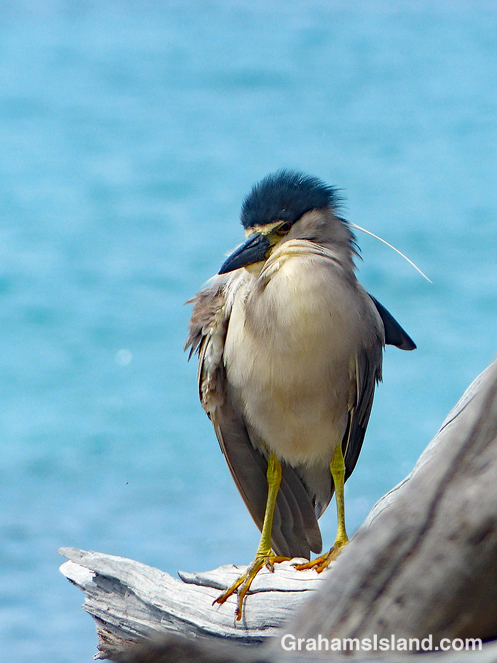
These photos are of an adult bird and make it fairly obvious why they have their name. Another feature of this breeding adult is the long white head plume. And finally, all I can say about the bottom photo is, “I love what you’ve done with your hair.”

Black-crowned Night Heron with fuzzy head

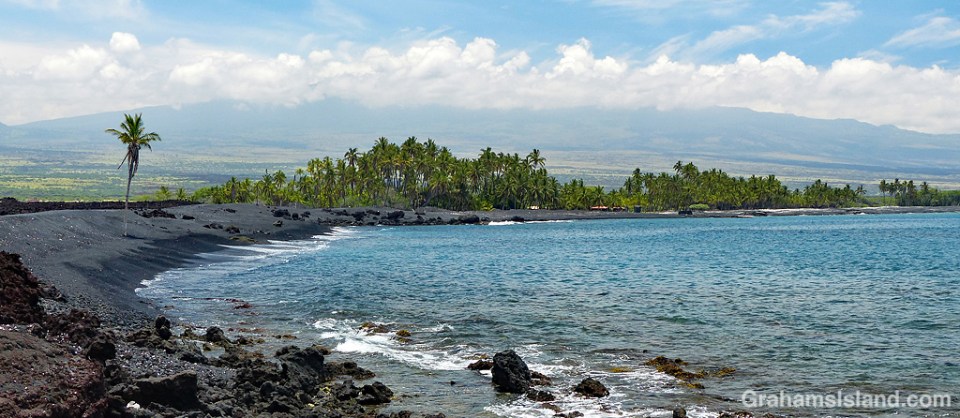
Keawaiki beach

Keawaiki Beach

I’m not a person who goes and spends a day at the beach, but I have been drawn to water and the ocean all my life. Possibly that’s why I’ve ended up in Hawaii, where the place is surrounded by it. And who wouldn’t be drawn to the water here?

This is Keawaiki Beach on the South Kohala coast. It’s a steep, black beach where sometimes the surf can roll in. But on a day like this one, it would be a fine place to swim. And on this particular day, not a soul was there, just me and my camera.

Posted in response to this week’s WordPress Photo Challenge ‘Place in the world.’


Better Days: Dead blenny

Better Days-Dead Blenny

Exploring tide pools one day, I found this unfortunate floating blenny. It was quite large, for a blenny, and in a small pool. The weather had been calm for a few days, without much ocean swell. I think the fish was trapped in the pool and, without fresh seawater reaching it, the pool had become stale and oxygen starved.

The macabre essence of the scene contrasted with its painterly quality, enhanced by the blenny’s coloration and the delicate creamy shells in the pool.

Updated 6-20-18

I’ve since learned that the ‘delicate creamy shells’ in the pool are actually a type of seaweed, Padina japonica. I’m also not sure about my oxygen starvation theory either since blennies are notoriously adept as jumping from pool to pool. Two things are unchanged however: the blenny is still dead and I still like the painterly quality.

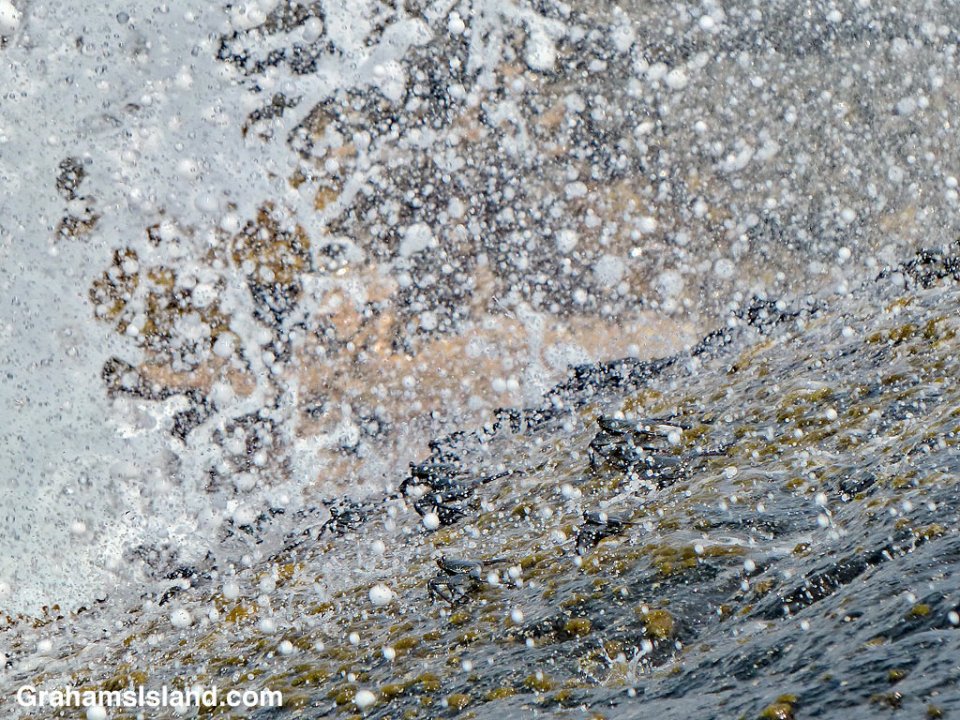
Abstracts: A’ama crabs and sea spray

Abstracts-A'ama crabs and sea spray

One of the first things anyone visiting a rocky seashore here will see is lots of little black shapes skittering away. Those shapes are a’ama crabs.

On this day, I had, as usual, spooked the crabs into motion, but after putting a little distance between me and them, they settled down again. Where they settled was on this sloping rock next to a blowhole. Moments later, water shot out of the blowhole creating this scene.

Where I would have been squealing and running from the sudden deluge, the a’ama crabs remained. I guess, living on these rocky shores, they are well used to this sort of thing.

Monk seal pup update

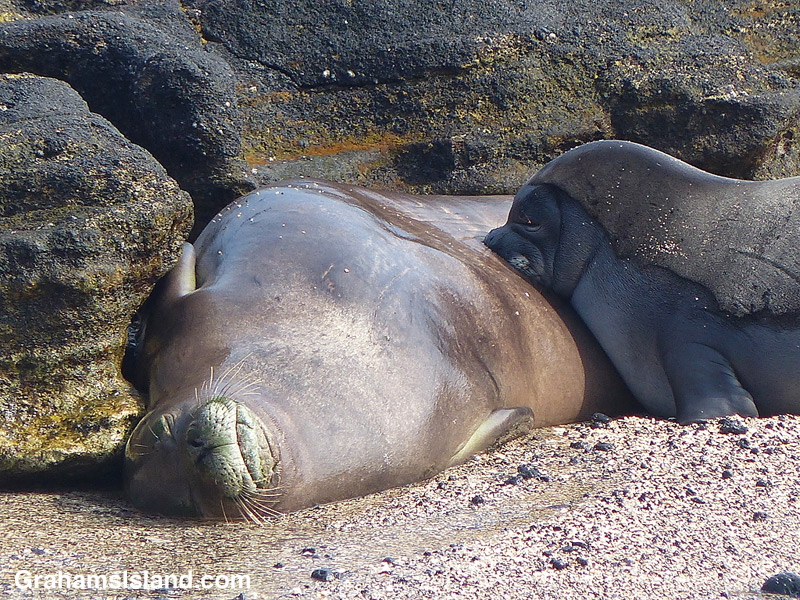
Monk seal and pup

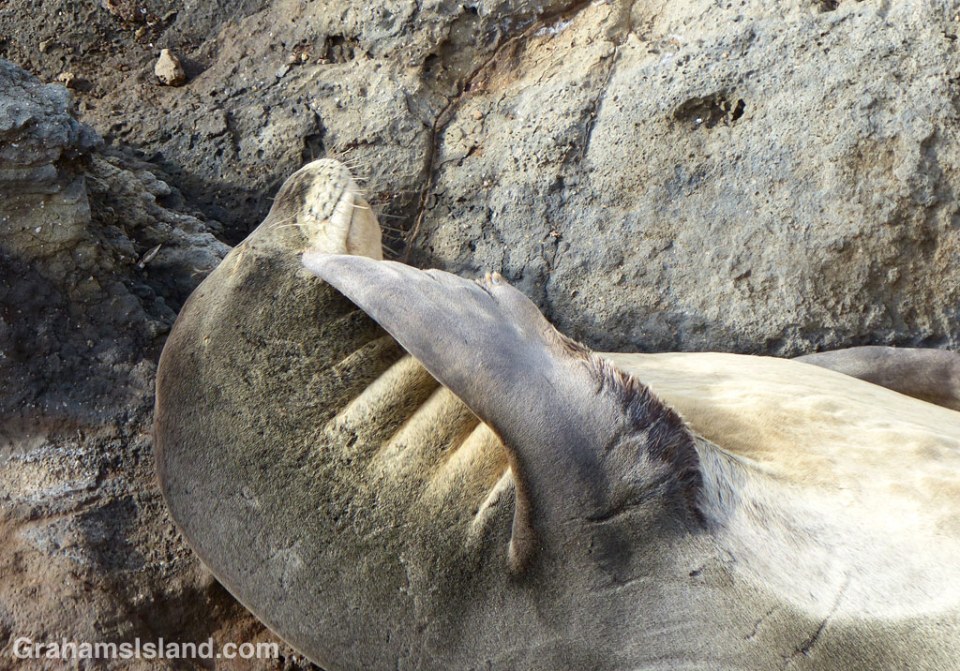
Monk seal pup feedingI visited the Big Island’s newest monk seal pup again, a couple of days ago, and I’m happy to report that mother and pup continue to do well. Since my last post about the pup, it’s clearly been packing on the pounds. Equally obvious is the mother’s loss of weight. Also, since that post, the pup has also been identified as female and given a name, Manu’iwa, which is a reference to the great frigatebird.

In these photos the pup is exactly 6 weeks old, so sometime very soon the mother will leave the pup to fend for herself. The top photo shows the two of them, the pup having shed her black baby coat for the more usual monk seal look. In the second photo, Manu’iwa has a feed. She was lying in the water which is why her lower half looks smooth while the dry upper part is raised and lighter. Below, mom heads for the water leaving Manu’iwa barking that she’s still hungry. Bottom, mom leads Manu’iwa out into the water for a swim, part of her ongoing education of the pup so that it will be able to fend for itself.

I should mention that these photos, as with those in the previous post, are taken with a telephoto lens. The area where the seals spend their time is cordoned off with volunteers monitoring the area and providing information to visitors. The volunteers work to minimize human interactions with the seals. If the pup gets used to humans it may seek them out and, at some point, is likely to have an interaction that ends badly – not necessarily for the pup, but for the person involved. This could be a bite or something more serious. If the pup, or any seal, has such encounters, it will likely have to be captured and relocated to the northwest Hawaii islands, which are uninhabited. This would be hard on the seal, faced with new territory and greater competition, and also be a blow to the goal of raising the number of monk seals living permanently around the main Hawaii islands.

Monk seal and pup enter the waterMonk seal and pup swimming

Kealia beach

Kealia Beach

I’d rather be at the beach, though I’m not one for stretching out on the sand and slowly broiling. I much prefer a beach like Kealia, north of Ho’okena, where the mix of sand and lava attracts tide pool dwellers and the birds that feed on them.

It was here, also, that I first saw butterflies, such as the large orange sulphur (Phoebis agarithe) below, drinking from the sand. I subsequently learned that butterflies can’t drink from open water, but get moisture from dew on plants, wet sand, earth and mud. In addition, drinking from these sources allows butterflies to obtain needed salts and minerals.

I learn something new every day. Now, if only I could remember these things.

Posted in response to this week’s WordPress Photo Challenge, ‘I’d rather be…

Large Orange Sulphur Butterfly on sand