Tag Archives: On The Coast

Abstracts: A’ama crabs and sea spray

Abstracts-A'ama crabs and sea spray

One of the first things anyone visiting a rocky seashore here will see is lots of little black shapes skittering away. Those shapes are a’ama crabs.

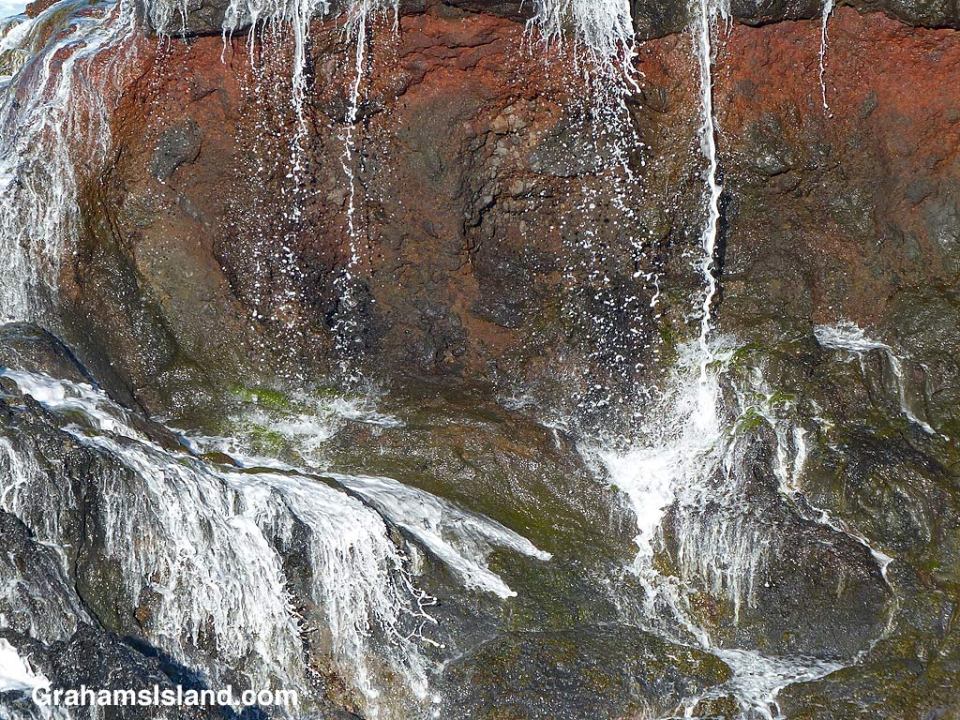
On this day, I had, as usual, spooked the crabs into motion, but after putting a little distance between me and them, they settled down again. Where they settled was on this sloping rock next to a blowhole. Moments later, water shot out of the blowhole creating this scene.

Where I would have been squealing and running from the sudden deluge, the a’ama crabs remained. I guess, living on these rocky shores, they are well used to this sort of thing.

Monk seal pup update

Monk seal and pup

Monk seal pup feedingI visited the Big Island’s newest monk seal pup again, a couple of days ago, and I’m happy to report that mother and pup continue to do well. Since my last post about the pup, it’s clearly been packing on the pounds. Equally obvious is the mother’s loss of weight. Also, since that post, the pup has also been identified as female and given a name, Manu’iwa, which is a reference to the great frigatebird.

In these photos the pup is exactly 6 weeks old, so sometime very soon the mother will leave the pup to fend for herself. The top photo shows the two of them, the pup having shed her black baby coat for the more usual monk seal look. In the second photo, Manu’iwa has a feed. She was lying in the water which is why her lower half looks smooth while the dry upper part is raised and lighter. Below, mom heads for the water leaving Manu’iwa barking that she’s still hungry. Bottom, mom leads Manu’iwa out into the water for a swim, part of her ongoing education of the pup so that it will be able to fend for itself.

I should mention that these photos, as with those in the previous post, are taken with a telephoto lens. The area where the seals spend their time is cordoned off with volunteers monitoring the area and providing information to visitors. The volunteers work to minimize human interactions with the seals. If the pup gets used to humans it may seek them out and, at some point, is likely to have an interaction that ends badly – not necessarily for the pup, but for the person involved. This could be a bite or something more serious. If the pup, or any seal, has such encounters, it will likely have to be captured and relocated to the northwest Hawaii islands, which are uninhabited. This would be hard on the seal, faced with new territory and greater competition, and also be a blow to the goal of raising the number of monk seals living permanently around the main Hawaii islands.

Monk seal and pup enter the waterMonk seal and pup swimming

Kealia beach

Kealia Beach

I’d rather be at the beach, though I’m not one for stretching out on the sand and slowly broiling. I much prefer a beach like Kealia, north of Ho’okena, where the mix of sand and lava attracts tide pool dwellers and the birds that feed on them.

It was here, also, that I first saw butterflies, such as the large orange sulphur (Phoebis agarithe) below, drinking from the sand. I subsequently learned that butterflies can’t drink from open water, but get moisture from dew on plants, wet sand, earth and mud. In addition, drinking from these sources allows butterflies to obtain needed salts and minerals.

I learn something new every day. Now, if only I could remember these things.

Posted in response to this week’s WordPress Photo Challenge, ‘I’d rather be…

Large Orange Sulphur Butterfly on sand

Abstracts: Birdman

Abstracts-Birdman

I’d rather be out exploring, which is how I found conclusive evidence of the existence of this previously unknown creature – half man, half bird. I bet it spends a good deal of its time going around in circles.

Posted in response to this week’s WordPress Photo Challenge, ‘I’d rather be…

Hawaiian monk seal and her new pup

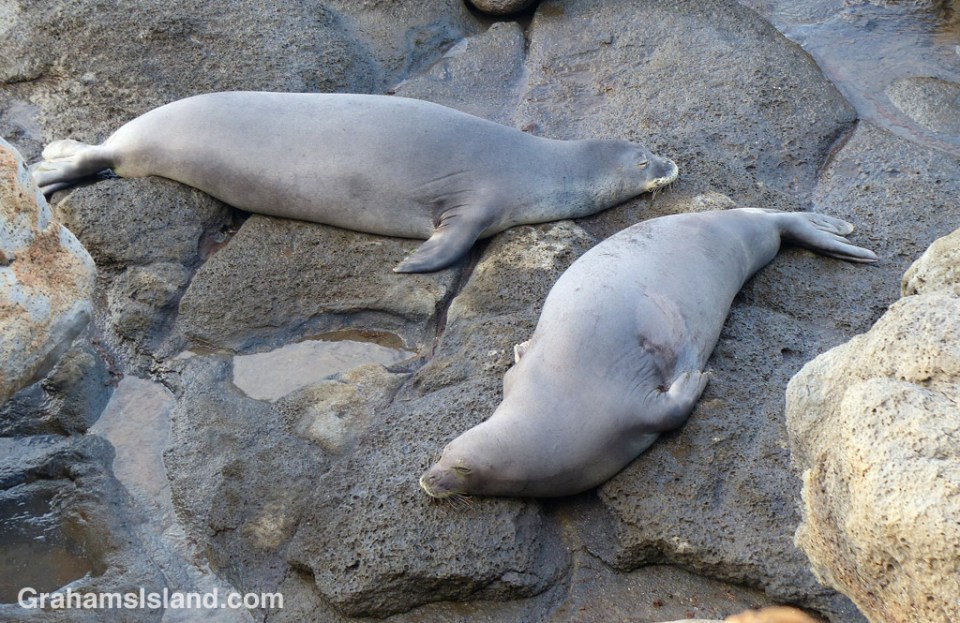
There’s a new monk seal pup on the Big Island and, happily, both mother and pup are doing well. The pup is just over a month old now and its mother will stay with it for another two weeks or so. At that point, she’ll head out to feed, having not eaten since giving birth, and the pup will be left to fend for itself.

I’ve been to see them three times and the pup’s growth has been dramatic as seen in the third and fifth photos. In the top one, the pup is 11 days old and below, exactly a month old.

For more information about Hawaiian monk seals, go to www.pifsc.noaa.gov/hawaiian_
monk_seal/ or www.marinemammalcenter.
org/hawaii
.

Posted in response to this week’s WordPress Photo Challenge to be a visual storyteller.