Fang blennies get their name because they have two defensive fangs on their lower jaws. If a predator gets one in its mouth, the fang blenny will bite its attacker’s mouth. This usually results in them being spit out to freedom.

Fang blennies get their name because they have two defensive fangs on their lower jaws. If a predator gets one in its mouth, the fang blenny will bite its attacker’s mouth. This usually results in them being spit out to freedom.

The idea of The Numbers Game is to enter a number into the search bar of your computer and then post a selection of the photos that turn up. This week’s number is 163. Captions are on the photos. You can see more responses here.


I hadn’t been snorkeling for a couple of weeks, having been under the weather. So last week, I was happy to get back in the water, and even happier when a pod of Spinner Dolphins showed up.
I first became aware of them when two snuck up from behind and zipped by just a few feet away. This happened to me once before, not long after moving to Hawaii, and I nearly had a heart attack. These days, I’m more used to expecting the unexpected in the water.
A few went back and forth around me, and I thought they might stick around for a bit, but they continued on their way south, albeit at a less-hurried pace than they often maintain. But it’s always a treat to see them and I was happy that a few photos turned out OK. My last encounter with dolphins, a few weeks ago, resulted in zero usable photos. I think my camera was having some issues, at least that’s my excuse.


I saw this small Whitemouth Moray Eel sticking out from a gap in the rocks. With its mouth open, it’s easy to identify.
So why is this posted for Becky’s Squares: Seven (see more responses here)? Well, this eel sports 2,408 visible white spots, which is seven to the power of four plus seven. OK, you counters out there – over to you!

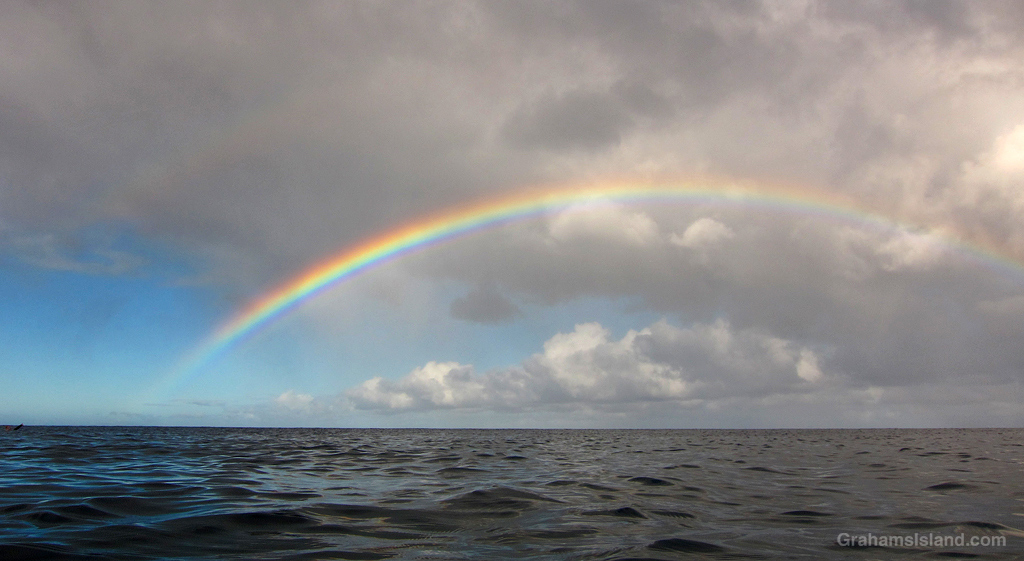
When Becky’s announced her theme for this month’s Squares as Seven (See more responses here), rainbows were one of the first things I thought of. So here’s two for the price of one. Sadly, that’s not a pot of gold between the ends of them. It’s just a rock.

The Seven-eleven Crab (Carpilius maculatus), is easier to identify than it is to see. That’s because it’s mostly active at night. This one was probably on its way to its daytime resting spot when I saw it. It gets its name from the prominent red spots on its shell, two behind each eye and three on the back, with the other four generally less visible along the rear, though two of those are clear in this photo.
Posted for Becky’s Squares: Seven. See more responses here.


Yesterday, in the water, I saw these three Spotted Eagle Rays heading my way. They were on the smaller side, but all in excellent condition, except for the slightly larger one that had lost much of its tail. The three made several languid loops around my wife and I before they finally eased away into shallower water.
The second photo gives a good view of the ray’s spiracles. They have one on each side, just above and behind the eye. These openings allow them to pass water through to the gills, even when they are digging for prey and churning up a lot of sand.


A Giant Porcupinefish waits patiently while a Hawaiian Cleaner Wrasse gets to work. Cleaner wrasses remove dead tissue, parasites and mucus from fish of all sizes that visit their cleaning stations. Watch out for those spines!