Tag Archives: Wordpress Photo Challenge

Moon landing

These skydivers appear head for the moon.These skydivers appear to have just missed the moon.

When I saw these skydivers I thought of Kurt Vonnegut’s satirical essay “Excelsior! We’re Going to the Moon! Excelsior!” The connection was really nothing more than the title.

In this case, I imagined the captions as “Coming in for landing,” “Whoa, just missed,” and “Let’s go round again.” I bet this is along the lines of how the moon landings were faked!

The reality is these were part of Upolu Airport’s newest/only economic enterprise, B.I.G Skydiving. On this outing, a couple of solo skydivers had already landed. These two were on a tandem skydive, where a paying customer has the much-needed security of being attached to an experienced skydiver.

For more information about B. I. G. Skydiving go to skydivebig.com.

These skydivers appear to be leaving the moon.

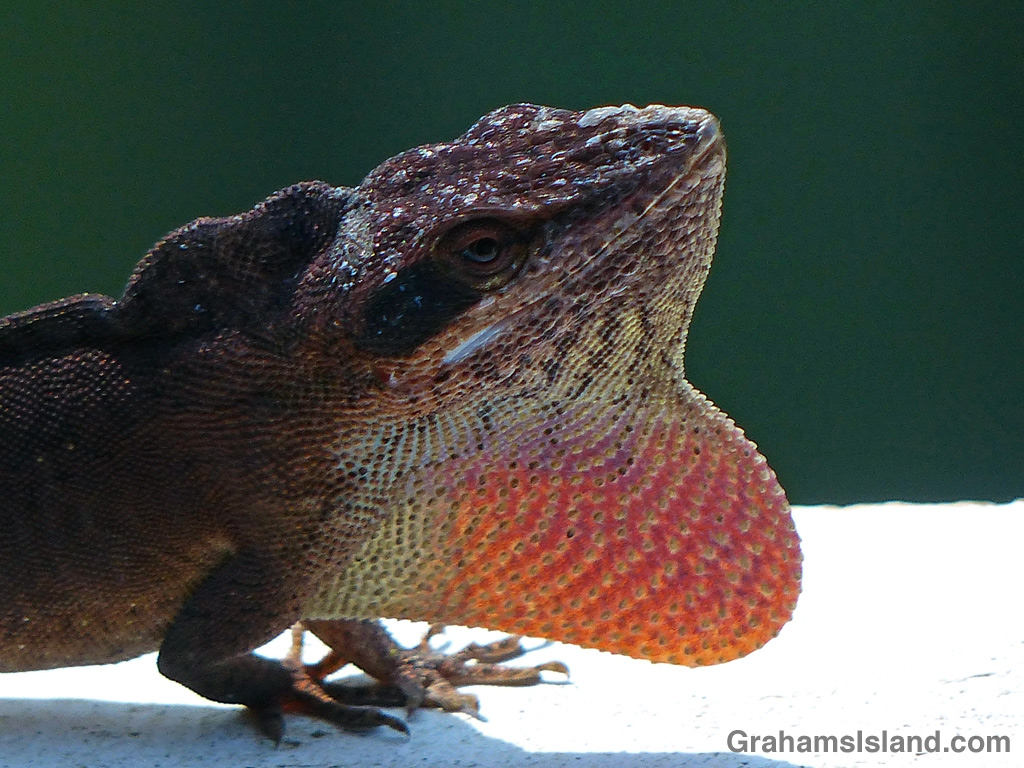
Green anole with raised ridge

A green anole puffs out its dewlap and raises the ridge on its neck in a display or aggression.
I saw this anole on the lanai one day and thought at first it was something new to me. It was a very deep brown with pronounced markings and it had a raised ridge on the back of its neck that I’d never seen before. It was already pretty agitated, but my taking photos riled it even more, causing it to strut around and puff out its dewlap.

After watching it for a while, I thought it had a lot in common with the green anoles I see around here, and sure enough, its color started to fade and then shift to green.

I suspect what was happening is that it was trying to stake out a new territory and was moving in with the most impressive display it could muster. I’ve found out since that the raised ridge is one such display technique that green anoles have. I didn’t see it again. Probably it decided that it didn’t need a territory already crawling with paparazzi.

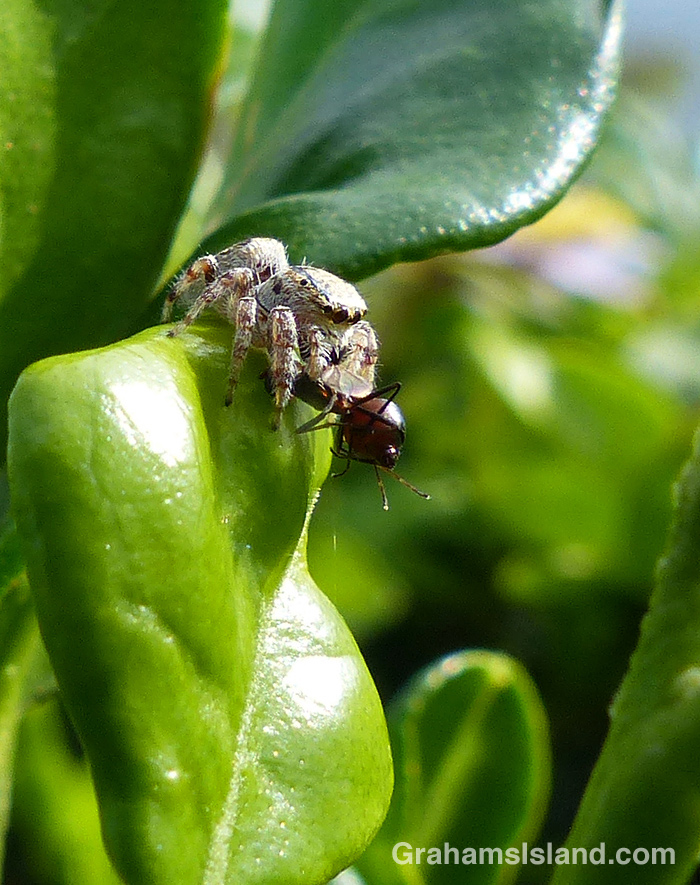
A jumping spider snags a meal

A jumping spider catches a parasitic wasp.
I was watching some butterflies recently when my eye was caught by something tiny (we’re talking a quarter-inch long here) bouncing across the dirt in front of me. I peered down and snapped a couple of photos before it disappeared. I’d seen enough to recognize it as a spider and the photos, while not great, were good enough to enable me to identify it as a striped lynx spider, a kind of jumping spider.

Not long after that, I was again watching butterflies and other bugs inhabiting a mock orange hedge, when I saw this little creature. Again, no more than a quarter inch long, it’s movement caught my eye against the glossy green of the mock orange leaves. A different kind of jumping spider, it hung around, enabling me to get this photo, because it had latched on to what I think is a parasitic wasp. Jumping spider don’t make webs, they pounce on their prey.

Jumping spiders are in the family Salticidae, but there are numerous species within the family and I haven’t yet been able to identify which this is. A characteristic of these jumping spiders is the pair of large eyes in front. This gives them very good eyesight, useful in identifying prey.

Another thing I’ve found out is that they’re everywhere around here. Now that I’m aware of them, and looking out for them, I see them often where I had never noticed them before. Mine eyes have been opened to the glories of the jumping spider – or something like that.

A passion vine butterfly lays her eggs

A passion vine butterfly lays an egg.
I watched this passion vine butterfly flitting around on a hedge, laying eggs atop the leaves of, you guessed it, a passion vine growing in the hedge. Typically, she deposits a single egg on each leaf, but this butterfly laid two on this one.

The butterfly is selective about which leaves to use. She chooses ones that have no eggs on them yet, since this will reduce the competition for her offspring. On the leaf she’s using in the photo are some yellow spots. I thought these might be where eggs had been laid previously, but some passion vines produce these colored bumps to make it look like eggs are already there and thus discourage the butterfly.

Not that laying eggs on unoccupied leaves guarantees survival. I saw a number of small parasitic wasps checking out the yellow bumps on several leaves. I have no doubt they do the same with the real eggs. I also saw a very small passion vine butterfly caterpillar snacking on what looked suspiciously like a newly-laid egg. And there’s always the possibility that someone will come along and trim the hedge. Not sure what the vine or the butterfly can do about that.

Humpback whale breach

A humpback whales breaches off the Big Island
I could wish for the humpback whales to be around all year, but perhaps that would not be for the best. Aside from the minor detail that they would starve to death here, there’s also so the chance of becoming jaded. As it is, seeing a humpback breaching – raising its huge bulk out of the water and then crashing back in – continues to be a thrill every time I see it.

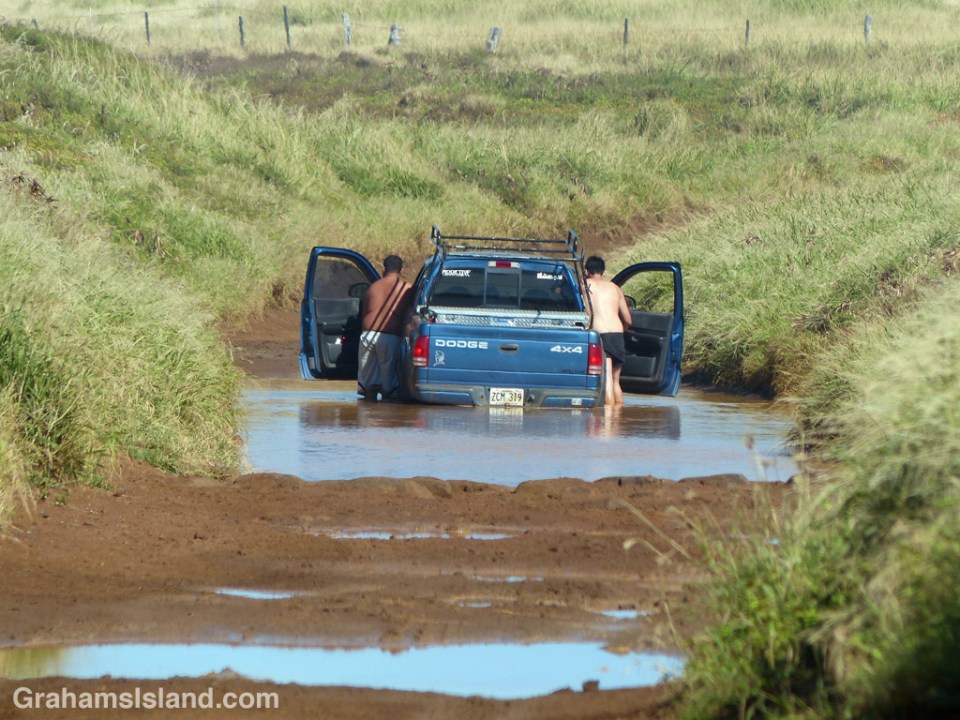
Truck stuck

A truck stuck in a muddy puddle on the Big Island of Hawaii
While I always prefer to take smaller, winding roads, such roads taken are not without pitfalls.

The last mile of the journey to Mo’okini Heiau in North Kohala is an uneven dirt road studded with rocks. When the road is dry it can be navigated by almost all vehicles (I saw a smart car there once!). However, care is needed, particularly regarding clearance. Almost every time I walk the road, I see fresh scrapes on the rocks. With rainy weather, the road becomes the territory of 4-wheel drives and jacked-up suspensions.

On this day, the puddles that often form on the road had become lakes. This truck had passed me earlier and when I saw it returning I ducked behind a bank to do a little whale watching and avoid the wave of spray that would surely accompany anything driving through the lake. A few minutes passed. I realized I hadn’t registered the truck passing. It had gone very quiet. So I wandered out to the road again and saw the truck marooned. They’d made it through on the way out, but weren’t so lucky on the way back.

The truck was a 4×4 but not with extra clearance. I think their problem was that the lake was deeper at the far end (in the photo). On the way out, they’d no doubt barreled into the water and their momentum had carried them to shallower waters and out. On the way back, the same approach would have propelled them toward the deep end. I suspect a bow wave built up, slowed them, and allowed water to penetrate parts of the truck that responded unfavorably.

The two young local men seemed quite cheerful. They waded through the muddy water, tried to coax life into the truck. One was on the phone (a miracle to have service there). After they insisted they had everything under control, I walked past on the high bank alongside the road, then turned and took this photo. When I returned a half hour or more later, the truck and its occupants were gone.

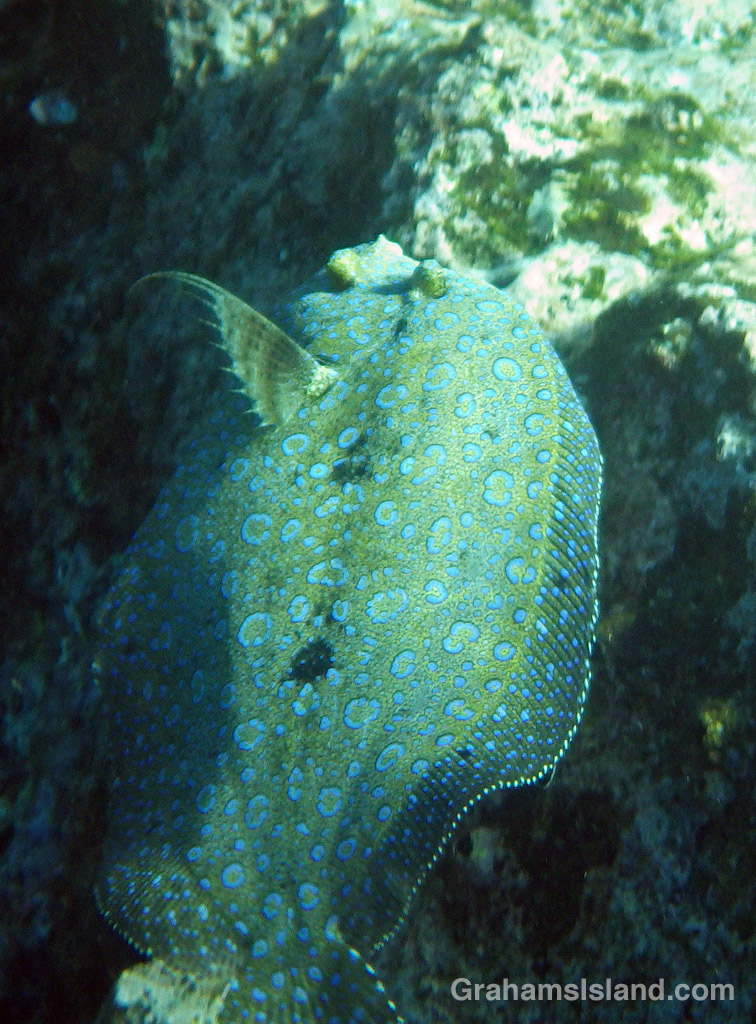
A flowery flounder vanishes

A flowery flounder disappears against a rock.A flowery flounder swimming
Camouflage is a creature making a good match with its surroundings. This serves to conceal it from both predators and prey. In the water, there are many exponents of this approach, from octopuses to scorpionfish.

Flatfish are masters of camouflage. It’s a fluke to see a stationary flatfish. It’s almost always necessary to see one on the move and to track it to where it settles down. Once it’s set though, it will usually stay put, making it one of the easier fish to observe and photograph.

I saw this flowery flounder on the move but once it plopped onto a rock (above) I would never have noticed it had I not known it was there.