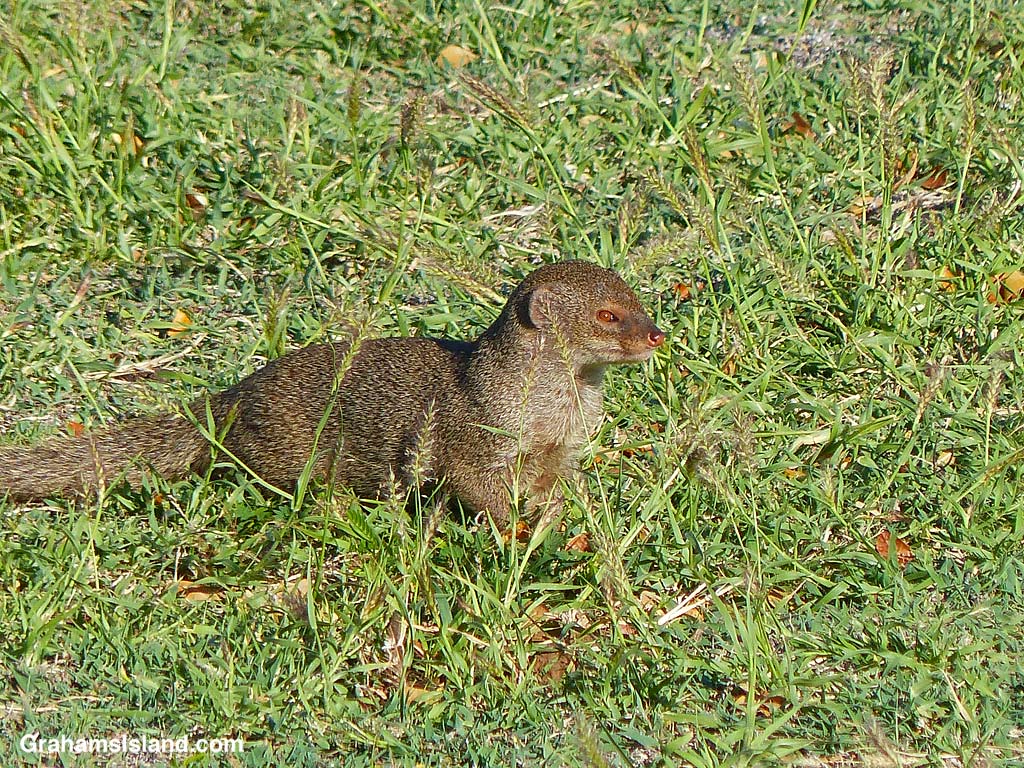
A Small Indian Mongoose (Herpestes javanicus) surveys its surroundings. Easily distinguished by its short legs, long body and tail, and beady red eyes, this mongoose is the poster child for bad ideas in Hawaii. It was deliberately introduced to get rid of rats, which it didn’t do. Instead, it has decimated native bird populations on all the islands except Kaua’i, where it is still, officially, absent.
This week’s Sunday Stills challenge theme is ‘Macro or Close-ups.’ See more responses here.
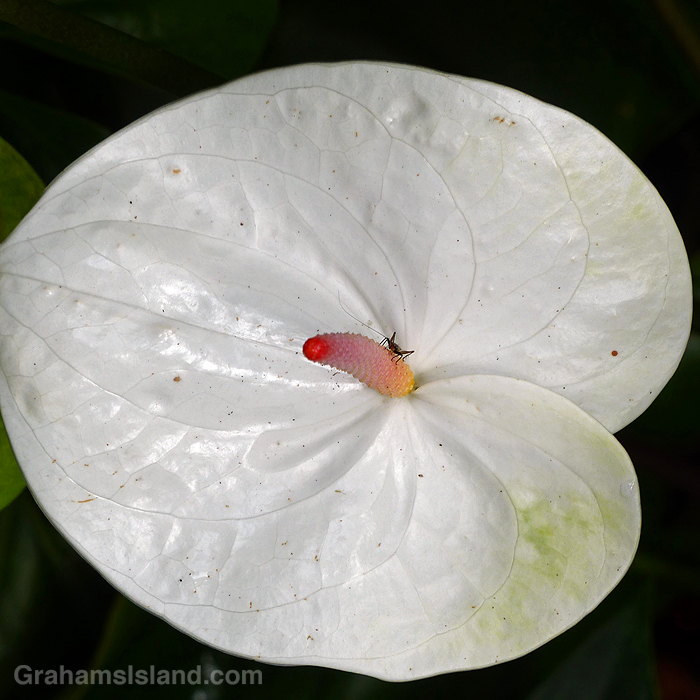
I saw this cricket climbing up the spadix of a white anthurium at Hawai’i Tropical Bioreserve & Garden. As it neared the top, I zoomed in for a close up. I haven’t been able to find out what kind of cricket it is (open to suggestions), but I was very taken by its extravagantly long antennae.
For more information about Hawai’i Tropical Bioreserve & Garden, go to htbg.com.
Updated 9-17-2022: Thanks to Forest and Kim Starr at Hawaii Insect ID for pointing out this is probably a cricket, though exactly which kind remains unknown.
Despite being brightly colored, Gold Dust Day Geckos can blend in when they’re on the right plants. I only noticed this one on a palm tree trunk because it was moving. I never tire of the look geckos give me when they realize they’ve been spotted.
For some reason, one of the pastures at Upolu has recently been occupied by this horse and a handful of cattle. I’m not sure why the horse is in there, but on this day, while the cattle were standing around looking bored, the horse was furiously rubbing itself against a fence post. Afterwards, it too stood around looking bored!
Lesser Brown Scorpions (Isometrus maculatus) are small, shy, and mostly active at night. This is why I’d only seen two here before. One was dead in a box, flattened by the items I was unpacking. The other was alive, but not well. It looked like it had been stepped on.
These photos are of my third encounter, which happened recently. I was getting rid of accumulated odds and ends in the office at work, when I opened up a large, yellow bag that had been stowed there for a year or so. When I looked in, I saw this very much alive and active scorpion.
I took the bag outside, grabbing my camera on the way, and then tried getting some photos, with the help of others in the crew. It was hard to get anything decent because the scorpion scurried around seeking cover. We decided to tip it out onto the tiles. This made the process a bit easier, though not because the scorpion settled down any. It was just as active and every time I looked in the viewfinder it seemed to be making a beeline for me!
After a while I ushered it off the tiles and it scurried away, under the lanai. And while it looks imposing in these photos, it was less than two inches long overall. I’ve read that the sting of these scorpions is similar to a bee sting and not dangerous unless a person is allergic to the toxins. I didn’t feel a need to find out for myself.
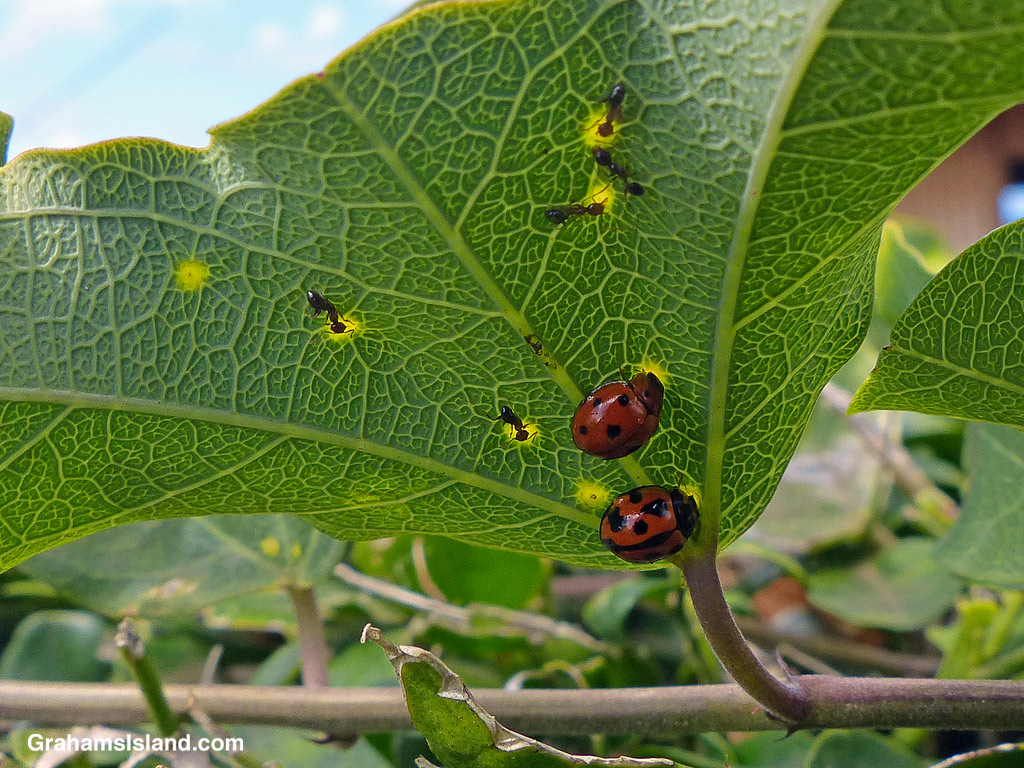
I spotted these two lady beetles on the underside of a passion vine leaf. The top one is a Seven-spotted Lady Beetle, the other a Variable Lady Beetle. But what got my attention was the fact that they appeared to be interested in the yellow spots on the leaf, as were several ants.
I knew that some passion vines produce these colored bumps to make it look like butterfly eggs are already there. Butterflies don’t like to lay eggs where another butterfly has already done so, though the leaf bumps aren’t foolproof in this regard (see here).
What I didn’t know was that the bumps produce nectar, which attracts ants, as was the case here. And the ants will defend this food source against caterpillars munching on the leaves. Isn’t nature fascinating!






 Graham's Island