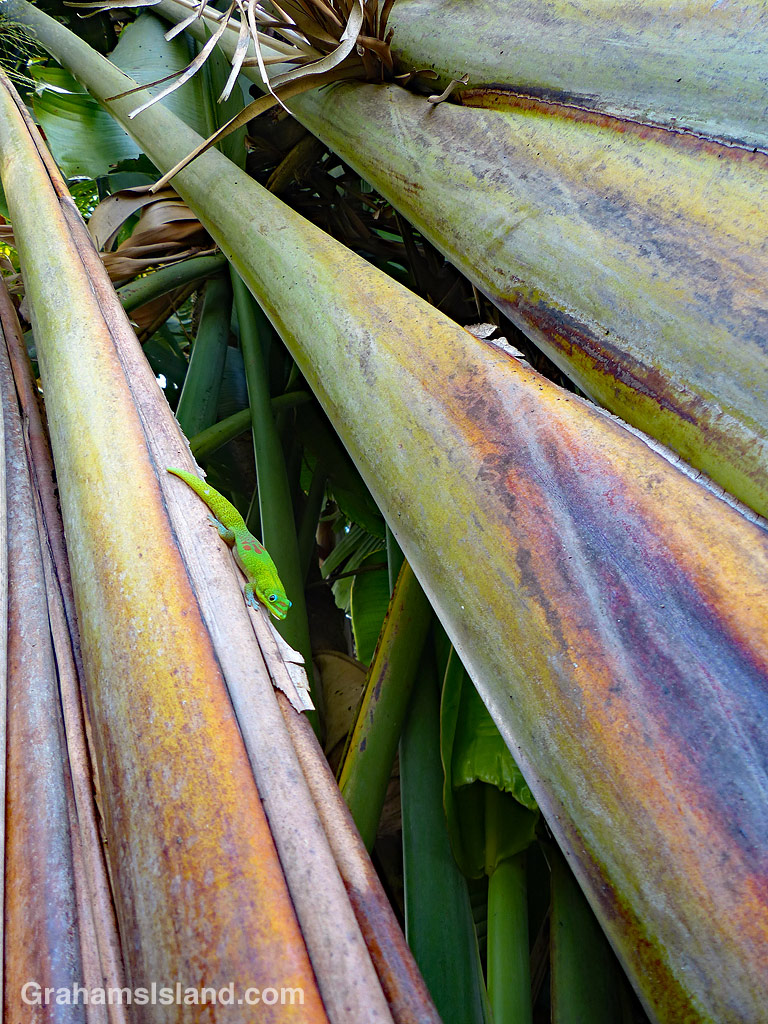
A gold dust day gecko scoots down the stem of a traveler’s palm.

A gold dust day gecko scoots down the stem of a traveler’s palm.
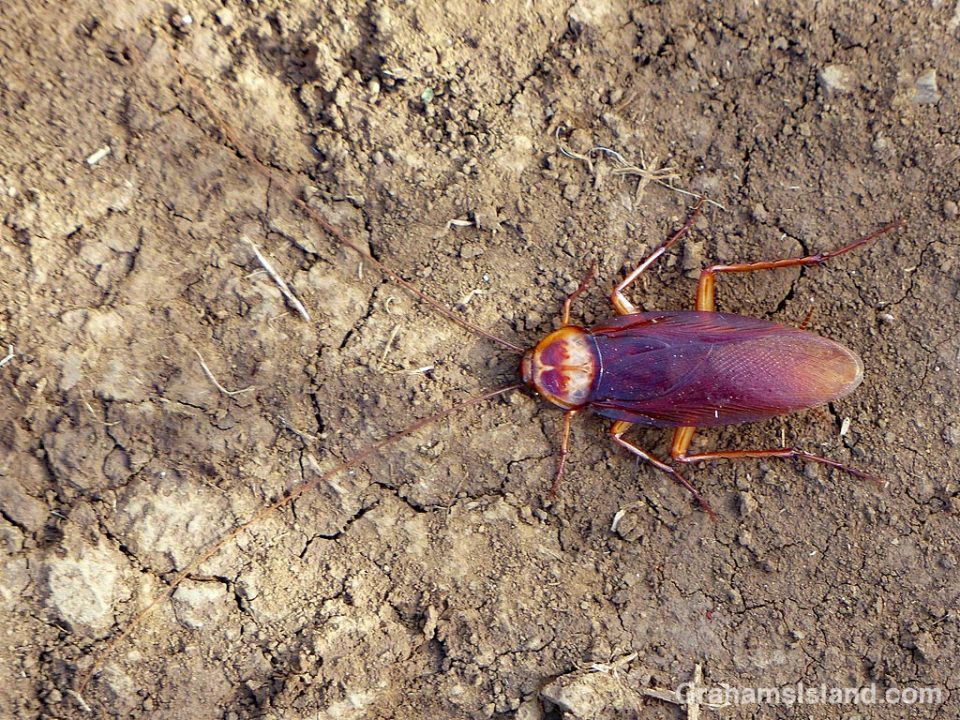
Most people think of Hawaii as a tropical paradise so, being something of a contrarian, I feel obligated every now and then to post something about the seamier side of the islands, and I think most would agree that today’s subject falls squarely into that category. Cockroaches are everywhere. Houses, shops, restaurants (eek), even the fanciest resorts have them. If you don’t see them, it’s because they’re out of sight, not because they’re not there.
Supposedly, Hawaii hosts 19 species of cockroach, of which three are most associated with human activity. These are the American cockroach (Periplaneta americana), German cockroach (Blattella germanica), and Surinam cockroach (Pycnoscelus surinamensis).
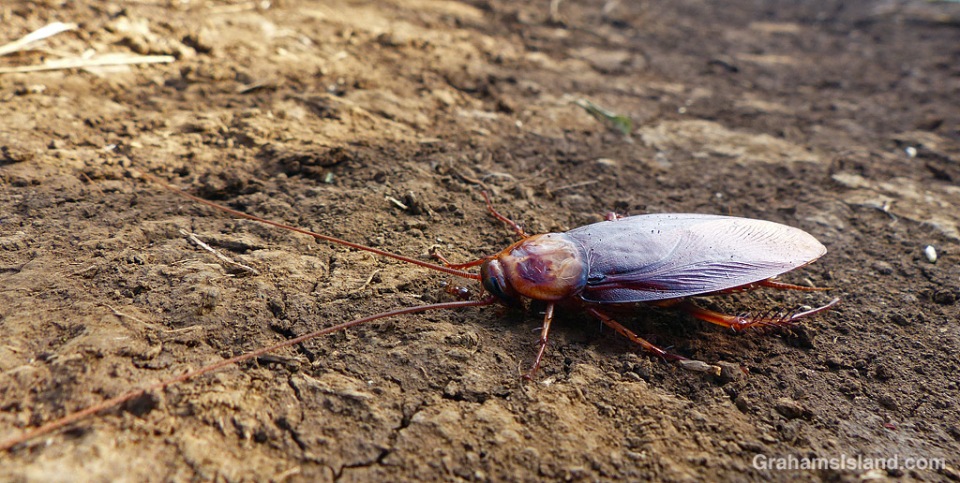
The beauty in these photos is an American cockroach. This one was around an inch-and-a-half long, not including its extremely long antennae; some are bigger. They’re a fearsome sight in the air, speedy on the ground, and loathsome in a sandwich. But living here, one has to get used to them, because they’re also survivors. Chances are that when humans are long gone, cockroaches will still be around, scampering across the rubble, skittering into semi-destroyed fast-food joints, and snacking on the still fresh-looking chicken nuggets.
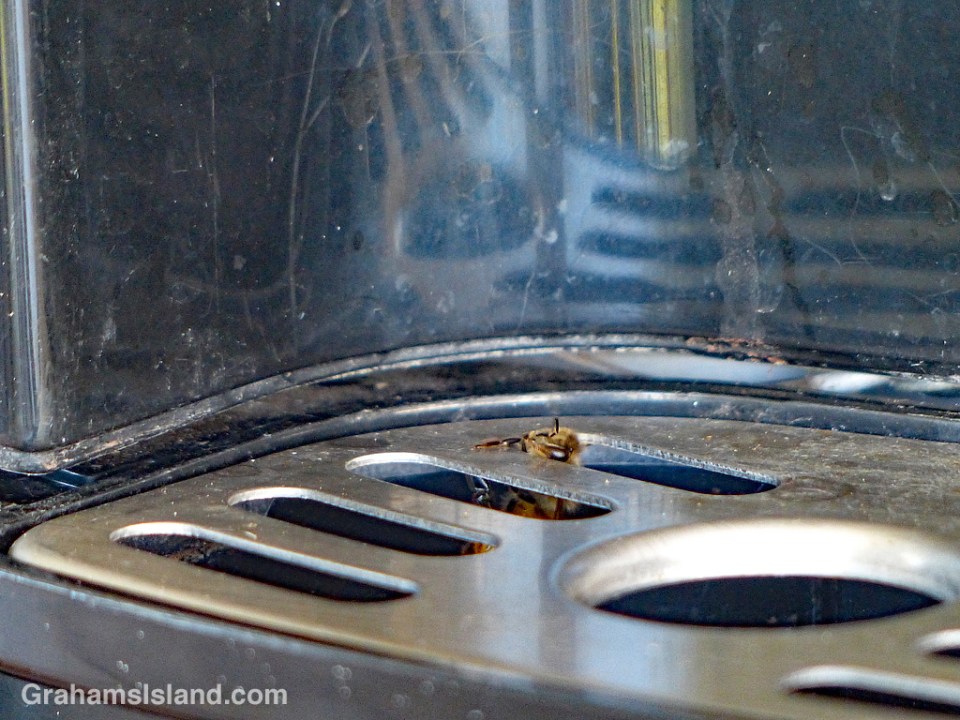
I noticed this bee one day, buzzing around this water cooler and then disappearing into the spill tray. Since then, I’ve seen it, or other similar bees, making the same journey to gather water from the tray and then, presumably, head back to the hive. Getting into the tray was the easy bit. Getting out tended to be more of a struggle.
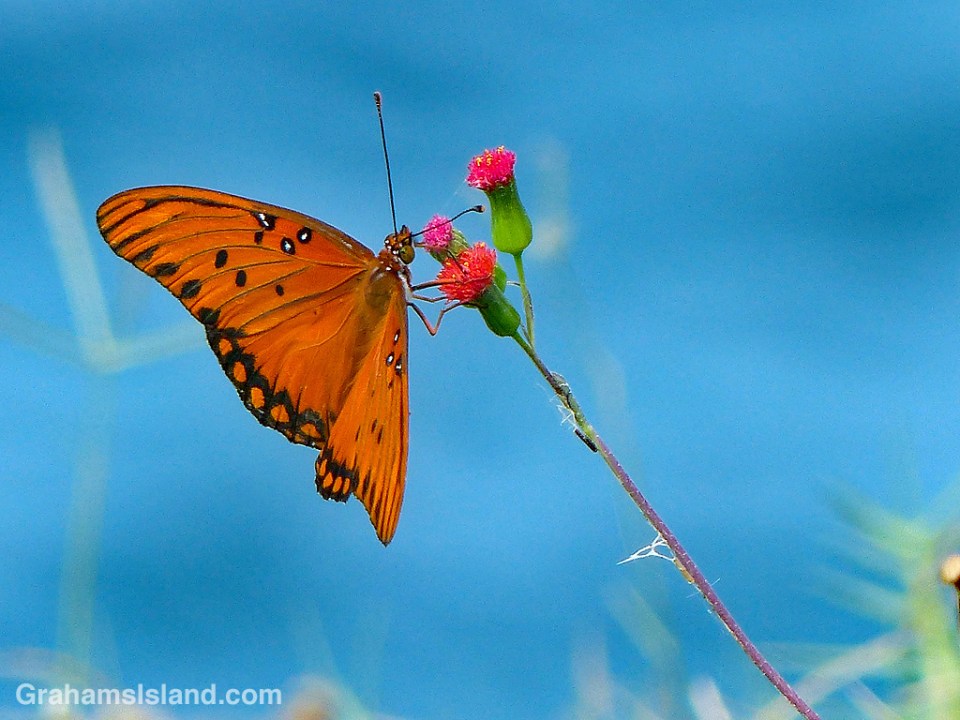
I already ran a post for this week’s Sunday Stills challenge on the theme of ‘Orange’ (here, and other responses here). But yesterday, while taking a walk, I came across this passion vine butterfly and thought it fit the theme too well to pass up. The butterfly was feeding on a tasselflower with the blue Pacific as a backdrop.
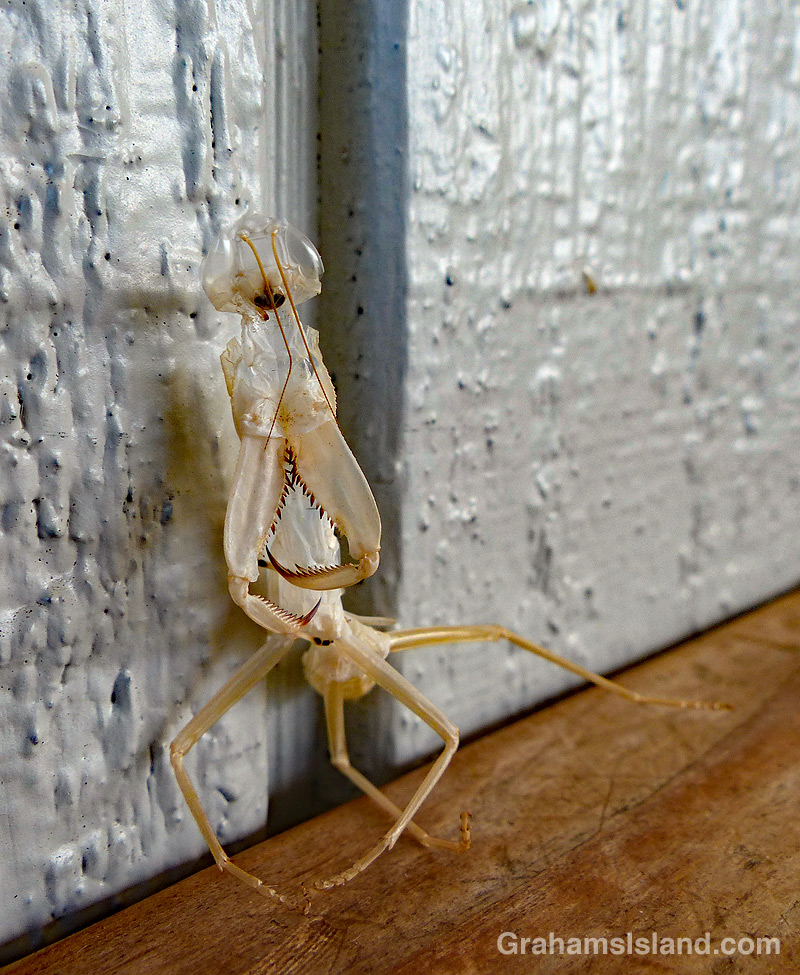
A few days ago, just in time for Halloween, I noticed this ghostly praying mantis, devoid of its innards. The work of some ghoulish fiend? Alas no, at least for Halloween fans. Rather, this is the result of a mantis molting, which it will do up to five times en route to adulthood. At least I hope that’s what it was.

A katydid rests on the round, spiny fruits of a castor bean (Ricinus communis) plant. These fruit capsules contain large bean-like seeds which are very poisonous. In the photo, it looks like the katydid is feeding, presumably not on the poisonous bits.

I posted a few weeks ago here about a large female Hawaiian garden spider which had spun a web in a place I often visit. A week or so later, that spider had disappeared.
Now, in that spot, three new webs have appeared, each occupied by female Hawaiian garden spiders. However, these new occupants are much smaller, about the same size as the average male of the species. I think it’s likely they’re the offspring of the first spider I saw there.
The smallness of the new spiders can be seen in the size of the prey this one had caught – a little ladybird.
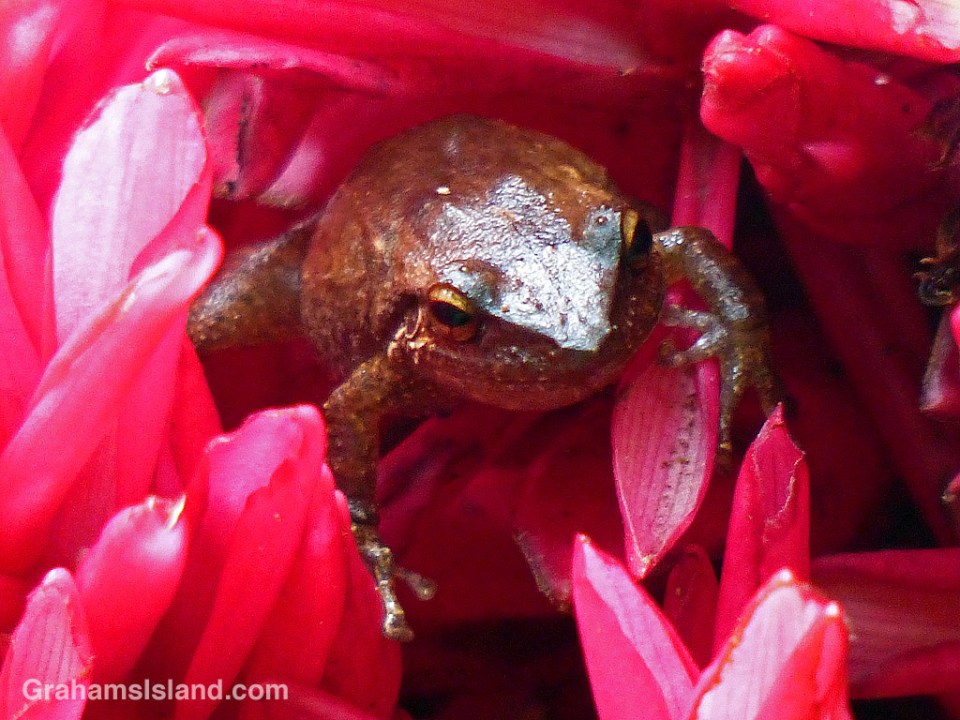
What is there to say about the coqui frog (Eleutherodactylus coqui)? How about KO-KEE, KO-KEE, KO-KEE, KO-KEE, KO-KEE, KO-KEE. And how about calling that out at around 100 decibels ALL NIGHT LONG.
Coquis came to the Big Island in the late 1980s, believed to be an accidental import on some plants. They hail from Puerto Rico where they’re a popular cultural symbol. But in Puerto Rico, the coqui has predators such as snakes and birds. In Hawaii, it has no predators and it’s thriving. Indeed, I recently read that supersized coquis have been found here, not the usual frogs the size of a quarter, but silver dollar sized – about 50% bigger. One theory for this is that the excellent conditions and lack of predators means the coquis live longer and thus eat more and grow bigger. Watch for ‘The Coqui That Stomped Hilo’ coming soon to a theater near you.
Suffice it to say that coquis are considered an unwanted invasive species here. Homeowners try to eradicate them because their noise is believed to lower property values. Even businesses are affected, with tourists considered less likely to want to stay in areas infested with coquis. (Ironically, while Hawaii tries to battle this mostly-loathed frog, in its native Puerto Rico this much-loved frog is threatened by a fungus called Batrachochytrium dendrobatidis and coqui numbers there are in decline.)
The east side of the island, with its greater rainfall and abundant vegetation, is prime coqui habitat. The northern part of the island, where I live, is considered coqui free. What that means is that the frog is not established here and coordinated efforts are made to find and eliminate those that are heard. It’s an uphill battle. I know I hear them at night. A few weeks ago it was just one, but now that one’s call is being answered by others.
And what about that call? Well, as usual, it’s the males making all the ruckus. The call is both a warning to other males (the KO part) and an alluring come hither to females (the KEE part). With the males, one will make the call to establish his territory and then another might respond to challenge this. They keep up this call and response until one gives up, a process that can last many minutes. The loser will move on while the winning male will start over until another challenger chimes in.
I’ve heard plenty of coquis, but the one above is the first I’ve actually seen. I was visiting Hawaii Tropical Botanical Gardens and taking photos of a gold dust day gecko that I saw on a red ginger (Alpinia purpurata). The gecko was poking its nose into the plant looking for moisture or nectar, when there was a sudden flurry. If you look at the photo below, the reason can be seen toward the top left corner, lurking deep in the bloom. The coqui hadn’t appreciated being disturbed and seemed to nip the gecko causing it to jump back. Then the frog came out a bit farther to check the coast was clear, before returning to its hideaway.
For more information about coqui frogs in Hawaii, go to https://www.ctahr.hawaii.edu/coqui/index.asp.

 Graham's Island