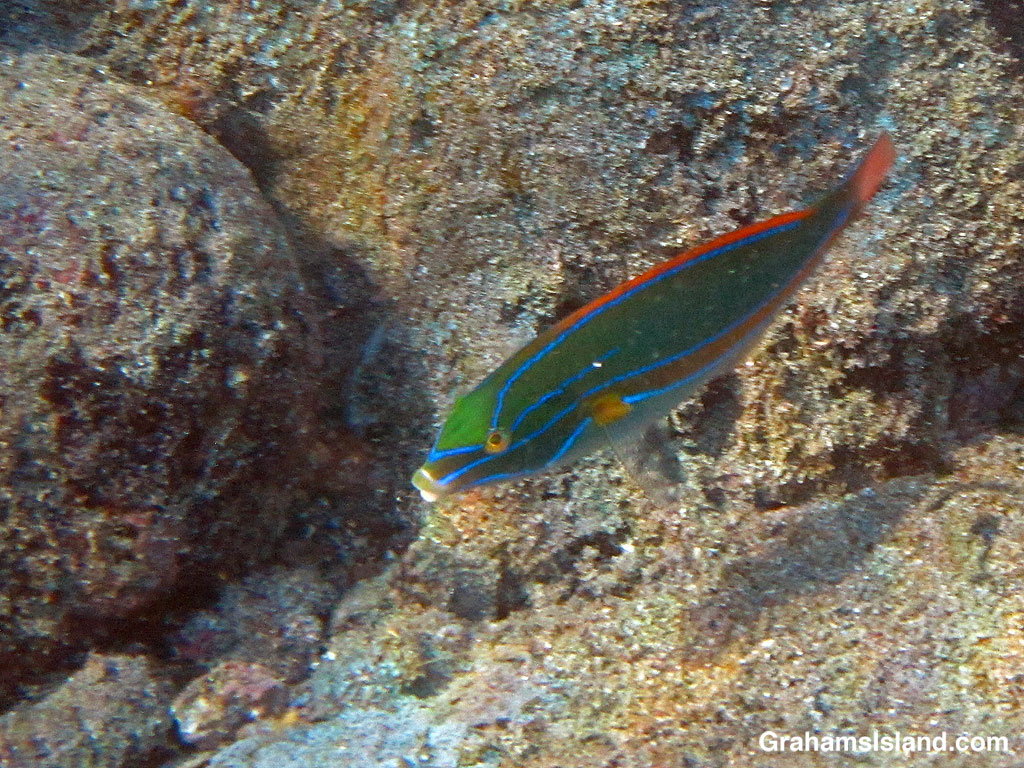
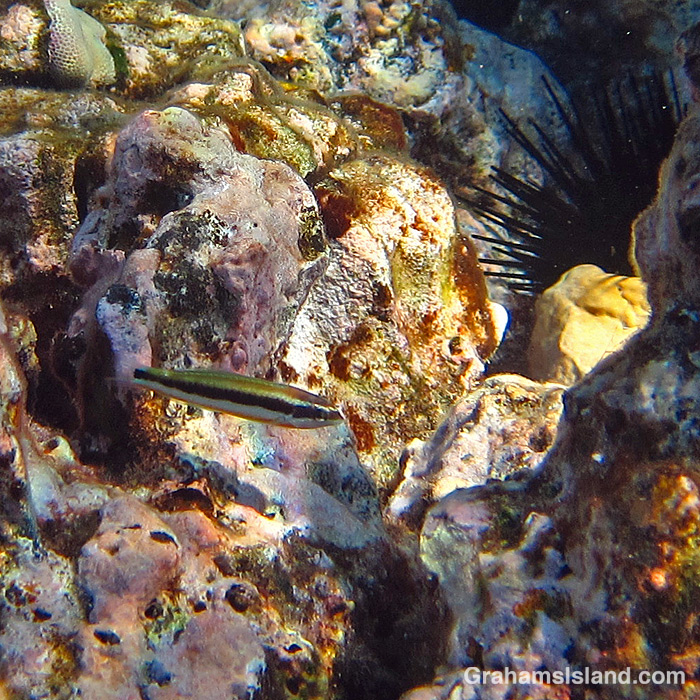
Belted Wrasses are endemic to Hawaii. This one is a supermale, and while it’s not the greatest photo, I like how the light illuminates its bright colors with the vibrant blue lines particularly emphasized.
Incidentally, I’ve decided to start capitalizing the creatures named in the blog. I think it helps when proper names contain words that can be mistaken for descriptions. Now all I have to do is remember this decision!
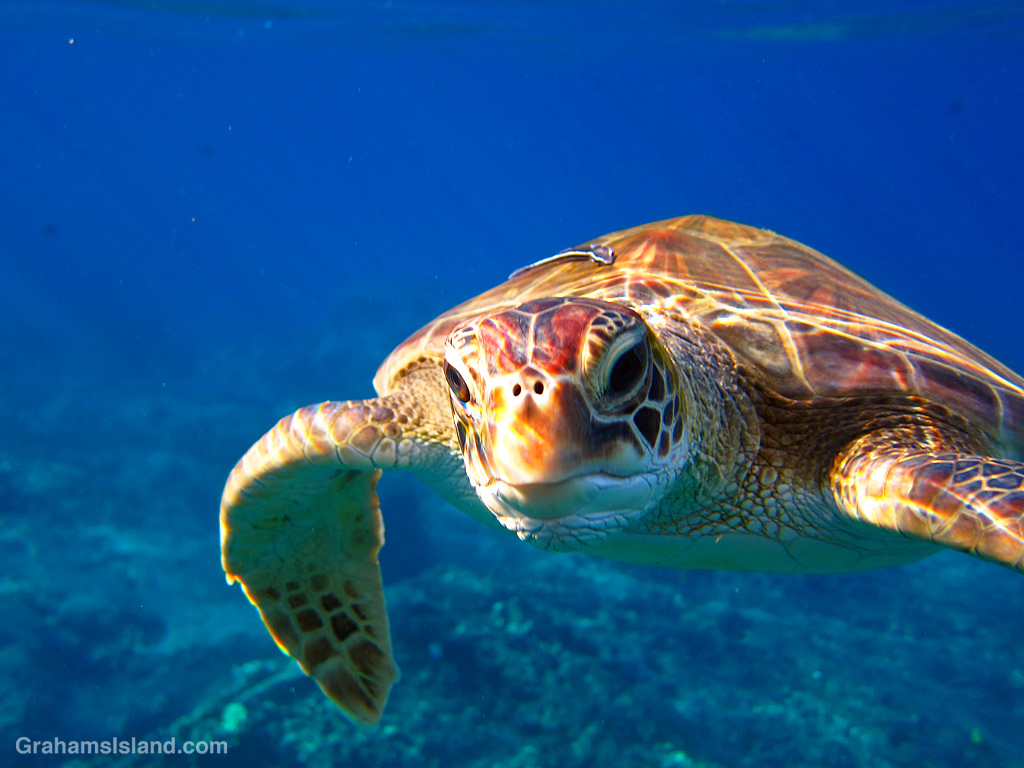
I was snorkeling yesterday, when I looked up and saw this green turtle coming towards me. It was near the surface and heading up so I thought it might be about to take a breath. Instead, the turtle, which was quite small, leveled off and kept coming my way.
Usually, in the water, I have a bit of zoom on my camera since that’s often needed. In this instance, I zoomed out and found myself leaning back to keep the turtle in the image. It came within a foot of me and I thought we were going to butt heads, but at the last moment it stopped, veered, then swooped down and away.
It wasn’t until I got home and processed my photos that I noticed the slender remora on the turtle’s shell, behind its head. Remoras, which don’t harm their hosts, attach themselves by means of a sucker disk on their heads, so what can be seen on this turtle is the underside of the fish.
I don’t change my desktop image often, but the top photo makes me so happy I popped it up immediately, so I’m posting it in response to Clare’s monthly Share Your Desktop challenge (see more responses here).
Fish tend to have their territories, so that when I swim, I often see the same kind of fish in the same place. This stretch of water is a place where pyramid butterflyfish can usually be found.
This crocodile needlefish swam up to check me out one day when I was snorkeling. These are large fish and sometimes, when I see them, I mistake them for great barracudas. A somewhat disturbing fact about crocodile needlefish is that, if they become alarmed, particularly at night, they can turn on whoever has frightened them and drive their beak into that person. The wounds inflicted can be very serious and deaths have been recorded. Mostly though, when I’m snorkeling, they just cruise by and take a non-threatening look.
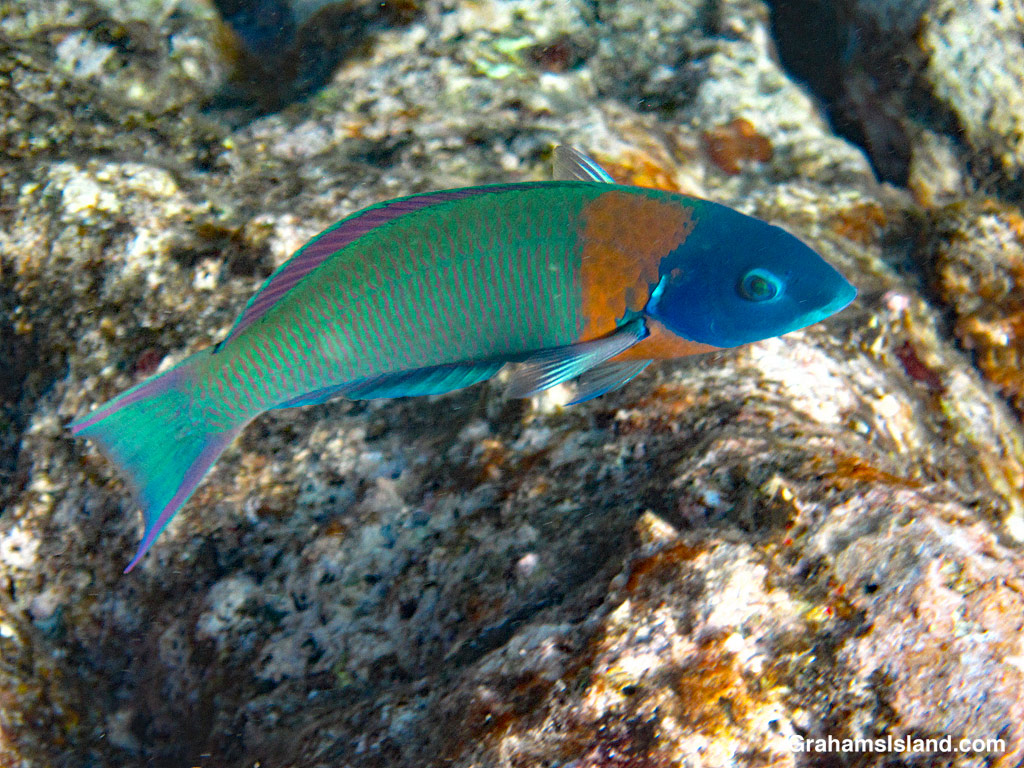
Saddle wrasses are one of those fish where the juvenile looks nothing like the adult. The top photo shows an adult supermale. The second one shows the very different look of a juvenile. These differences are one of the challenges of identifying fish. My fish book offers a wide variety of photos, but it can require careful attention to identify what I’ve captured with my camera.
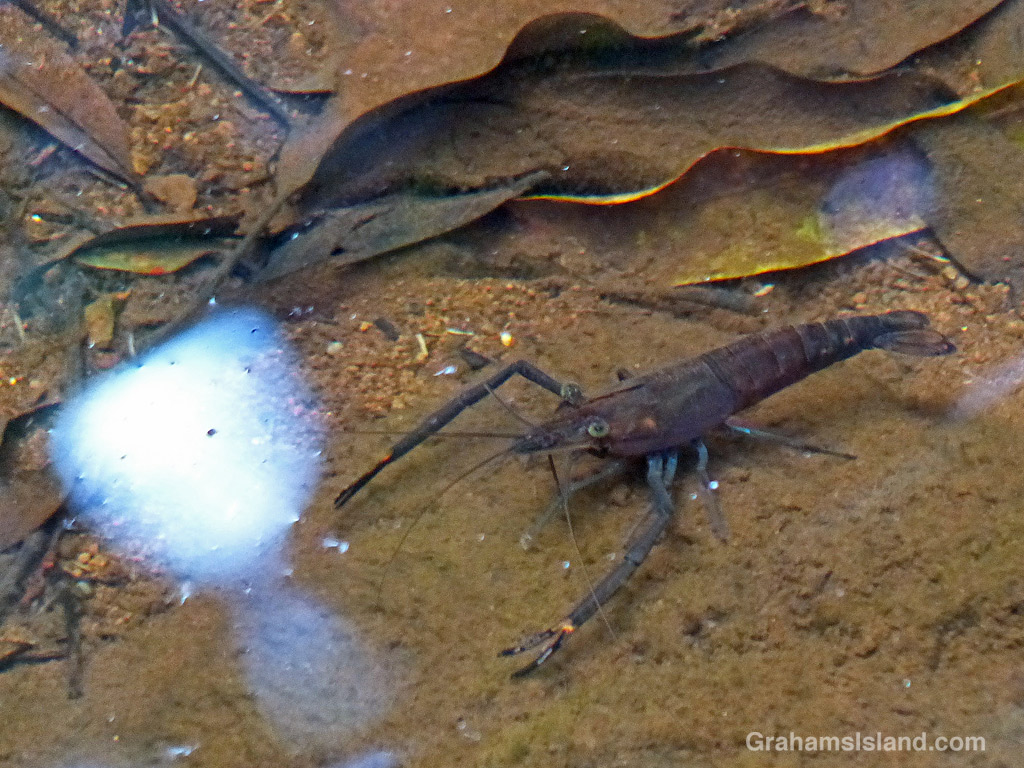
Tahitian prawns were introduced to Hawaii back in the 1950s and are now found on all the islands thanks, in part, to the fact that their life cycle includes a stage in the open ocean. The prawns have become a popular food here though, as with most introduced species, there’s a downside. They prey on native species in the streams they inhabit.
One such stream runs through Hawai’i Tropical Bioreserve & Garden, which is where I saw these Tahitian prawns. This stream is also one of several on the island where the prawns have been virtually wiped out on occasion. That’s because, while it’s legal to catch these prawns, it’s not legal to do so by dumping insecticide in the stream. Not only does this kill all the prawns, but it wipes out pretty much everything else that’s alive in there. And then there’s the small matter that these prawns are harvested for human consumption. Would you like insecticide with that?
Catching people in the act has proved difficult, but last year authorities did apprehend one man who had killed 6,200 prawns using this method. Earlier this year, he was fined $633,840 for his actions and the hope is that the big fine will discourage others. Mind you, the perpetrator looked like someone who would have trouble raising $840, let alone the other $633,000.
This is the first time I’ve seen signs like this one at Spencer Beach Park. I didn’t see any jellyfish on the beach so perhaps the signs were a warning for those getting in the water. There are often jellyfish in the water, but not in such numbers as to be a problem.
This park is popular with families with small kids so perhaps the authorities were being extra cautious with the signs.





 Graham's Island