Category Archives: Photo Challenges

Kauhola Point lighthouse

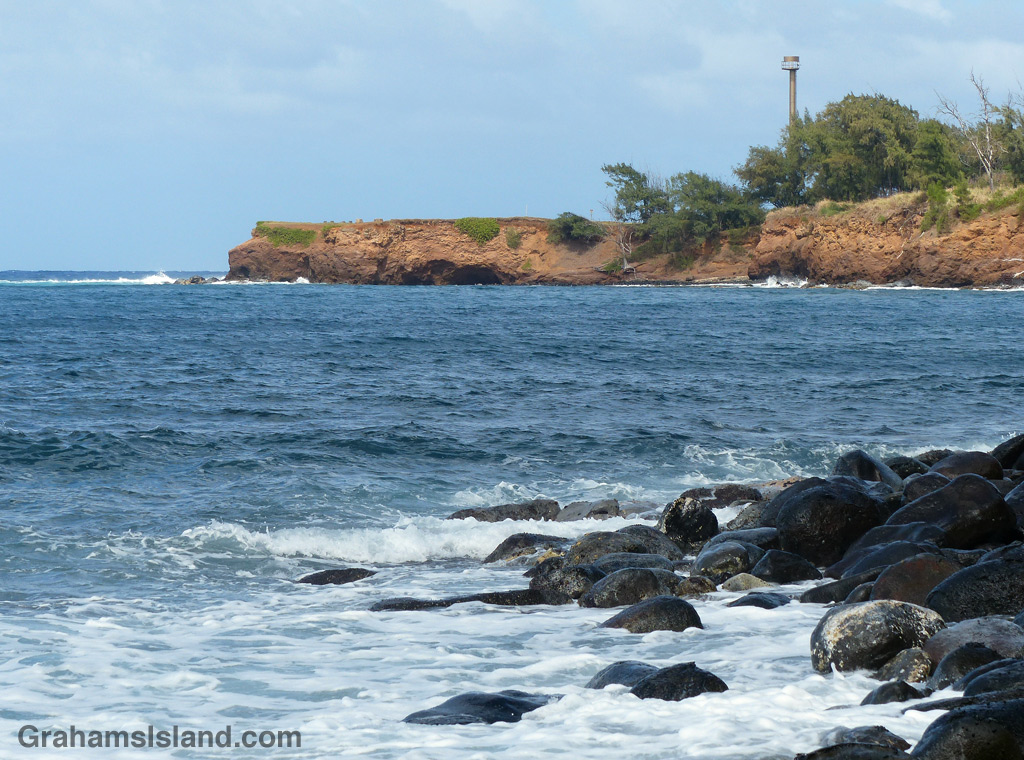
The new Kauhola Point Lighthouse on the north Kohala coast.

The Kauhola Point lighthouse is a modern affair, an automated light atop a tall metal pole. It replaced the previous, more traditional-looking lighthouse that was demolished in 2009. In the photo, the old base of that lighthouse can still be seen as several small block shapes toward the tip of the point. Therein lies the story.

The old lighthouse was demolished because erosion was eating away at the land near the base. The passing of time will surely remove even these remnants in the next few years.

In a way, this situation is a microcosm of the whole state. Many people think of the state of Hawaii as the eight main islands at the southeast end of the chain, but it encompasses hundreds of islands stretching away to the northwest for more than 1,500 miles. These small islands were formed over the same hotspot that fuels Kilauea Volcano today, but as the tectonic plate beneath the islands moved northwest, so the islands stopped growing and began to shrink under the forces of erosion. Over time, they too will disappear one by one.

Day octopus

A day octopus settles on a patch of coral off the Big Island of Hawaii.

A day octopus settles on a patch of coral. It will change its coloration from moment to moment depending on whether it wants to blend in or, perhaps, display an aggressive warning.

Spotting an octopus is a matter of chance. It helps if it’s on the move, but the presence of goatfish (in this photo, a manybar goatfish), is sometimes a tipoff.

Sausage tree

A sausage tree (Kigelia Africana) on the Big Island of HawaiiThe fruits of a sausage tree (Kigelia Africana) on the Big Island of Hawaii

The sausage tree (Kigelia Africana), as its botanical name suggests, is an import from Africa. It’s also one of the easiest trees to identify. Long stems hanging from the branches bear first the flowers, then the large, sausage-shaped fruits. These fruits can be as much as 2 feet long and weigh up to 15 pounds, though usually they’re somewhat smaller. Not the place for a picnic though.

The bottom photo shows stages in the transition from a flower beginning to bloom, to shedding petals, to fruit forming.

Flowers form and become fruit on a sausage tree (Kigelia Africana) on the Big Island of Hawaii

Abstracts: Floating branch

A branch floats in the water off the Big Island of Hawaii

The last of this week’s posts in response to the WordPress photo challenge on the theme of ‘transient.’

High winds resulted in a bump in the amount of debris in the water. This branch could be on its way back to shore or headed for somewhere across the Pacific, depending on how wind and currents move it.

Inter-island barge and Makali’i

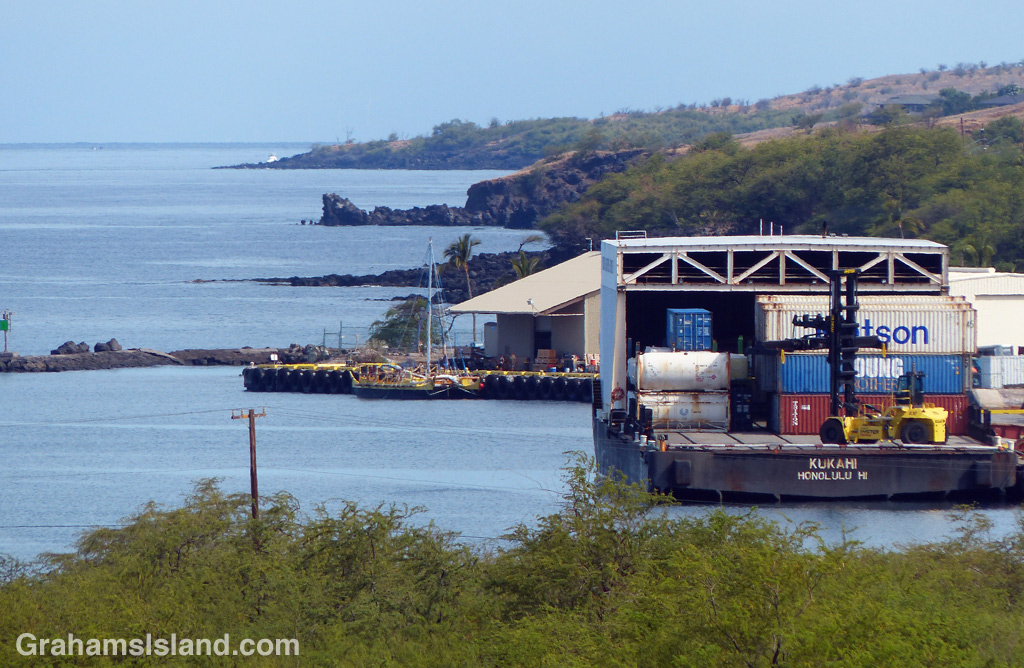
An inter-island barge and Hawaiian voyaging canoe Makali'i at Kawaihae harbor.

This week’s posts are in response to the WordPress photo challenge on the theme of ‘transient.’

There are two commercial ports on the Big Island, Hilo on the east side, and Kawaihae on the west. This is a view of Kawaihae harbor with the inter-island barge unloading at the dockside. In Hawaii, many goods are shipped to Oahu and then distributed to the other islands on barges.

Also at the dock, beyond the barge, is the Hawaiian voyaging canoe, Makali’i. This boat had just returned to the water after a long refit on the island. The following day, it set off to join other boats in Oahu, welcoming home the Hawaiian voyaging canoe, Hokuleʻa, from its 3-year Mālama Honua Worldwide Voyage.

Two wildly different vessels, but both engaged in the very transient business of crossing open waters.

For more information about Hokuleʻa and the Polynesian Voyaging Society, go to www.hokulea.com.

Jumping fish

Little fish leap from the water to avoid predators below.

This week’s posts are in response to the WordPress photo challenge on the theme of ‘transient.’

I watched these little fish roil the surface of the water and then jump clear, first in one area, then another, then elsewhere. Chances are that their performance was due to larger predatory fish below the surface, lured in to shallow water by the presence of food. The predators will move back to deeper waters once the feeding is over. The little fish will hope to survive long enough to eventually do the same.

Signs: Do not climb

A sign on a mimosa tree forbids climbing

This week’s posts are in response to the WordPress photo challenge on the theme of ‘transient.’

This sign is attached to one of two mimosa trees near King Kamehameha’s statue in Kapaau. The trees are huge with the kind of bumps and hollows that invite exploration. They’re believed to be more than 100 years old.

Not long after taking this photo, I was somewhat taken aback to see the trees almost devoid of foliage, the limbs hacked back. It turns out that one of the trees basically split in two, took out power and water lines, a chunk of the other tree, and blocked the road. It was, as they say in potboilers, rotten to the core. The cleanup is still in process, but will likely involve the removal of both trees, more than a century old, but transient in the larger scheme of things.


Fruit flies on a mango

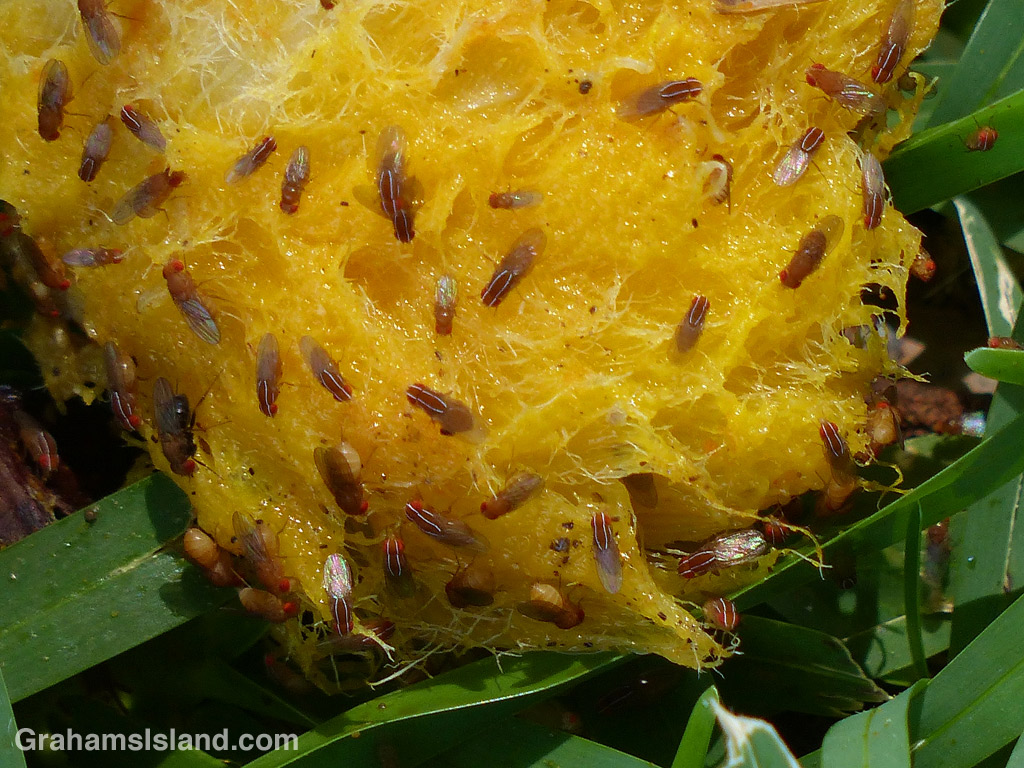
Fruit Flies feed on a mango

This week’s posts are in response to the WordPress photo challenge on the theme of ‘transient.’

This little scene could be considered transient on three counts. First is the fact that this is a mango that has fallen from the tree. In the life cycle of a mango, it’s a very short interval between ripening on the tree and rotting on the ground. Second, this mango has clearly been chewed over by one of the transient wild pigs that pass through from time to time, more so during mango season. And third, these fruit flies won’t be around long either, having a lifespan in the region of 30 days.

This fruit fly, also called the vinegar fly, is probably Zaprionus ghesquierei, an invasive species known to have reached Hawaii. Zaprionus indianus also looks like this, but hasn’t been seen in Hawaii yet, as far as I know.