Category Archives: Photo Challenges

A giant porcupinefish peeking

A giant porcupinefish peeks out from behind a rock

This would have been a good photo for a recent WordPress challenge, peek, but I took this after that was over. However, it also works for this week’s challenge of ‘experimental.’

My underwater photography setup is not a spiffy camera and a bank of lights, but a point-and-shoot Canon S 90 in a waterproof housing. It doesn’t have tremendous zoom capabilities so I’m constantly experimenting with ways to approach fish so I can get a decent close photo.

Taking photos in areas where fishing, spearfishing, and fish collection are banned makes things easier. Fish in those areas seem to know they have less to worry about, at least from humans, so they’re less inclined to dart off. Elsewhere it’s a different story. Often I can get reasonably close, but when I raise my camera toward them they tend to zip away, possibly thinking it’s a new type of spear gun.

The best approach I’ve found is to be as quiet as possible in the water and just drift toward something I want to photograph. In this instance, I was puttering around when I saw this giant porcupinefish headed my way. I like these fish with their big eyes and a body tapering from the huge head back toward the delicate tailfin.

This fish spotted me and dipped down behind a large lump of rock and coral. I waited, but it didn’t reappear. I eased forward, keeping the rock between me and the fish. Still no sign of my quarry, so I slid to one side and saw the tailfin fluttering. Ah ha! With my camera ready and a gentle flip of my flippers I moved to the other side where I found the fish peeking out and giving me this look. I snapped a photo and an instant later the porcupinefish pivoted and headed the other way at speed.

Despite their ungainly appearance, giant porcupinefish are good swimmers and it was soon a good distance away, but when I got home I was happy to find that I’d got this shot. I also like how the goldring surgeonfish in the photo looks suitably startled by the whole encounter.

Low clouds from Saddle Road

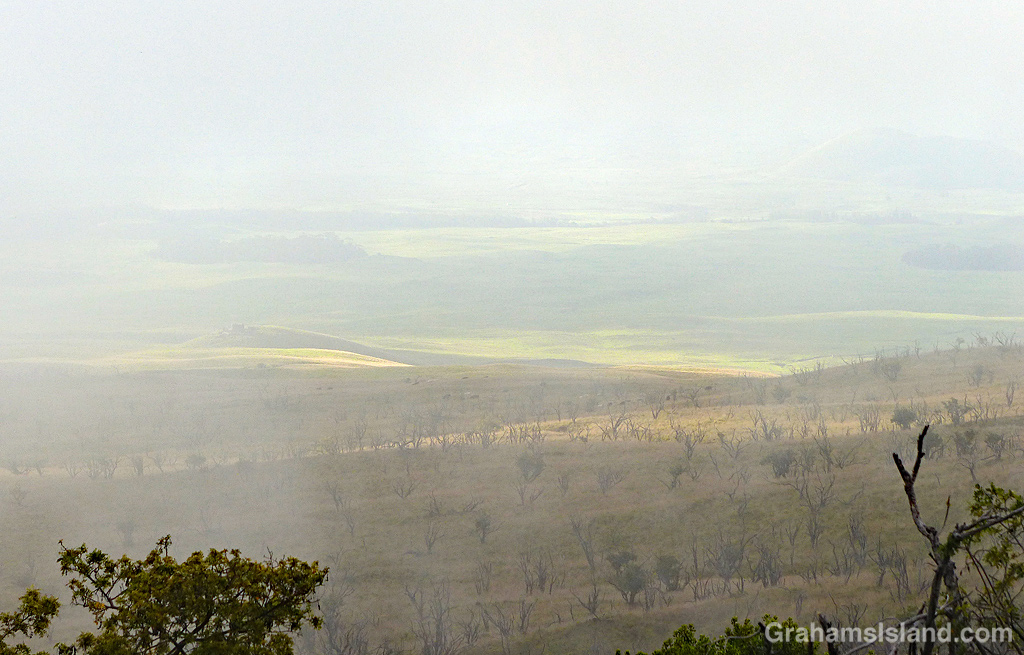
Low clouds blanket the lower slope of Mauna Kea.

Many times when I travel on Old Saddle Road, there comes a point where I’m exiting the clouds or disappearing into them. I like to take photos in this zone, experimenting as the level of the clouds comes and goes.

The top photo has that transition from clouds to clarity, but I also like the ethereal quality of the lower photo as patches of sun illuminate the pastures below.

Low clouds blanket the lower slope of Mauna Kea.

Temporary substation

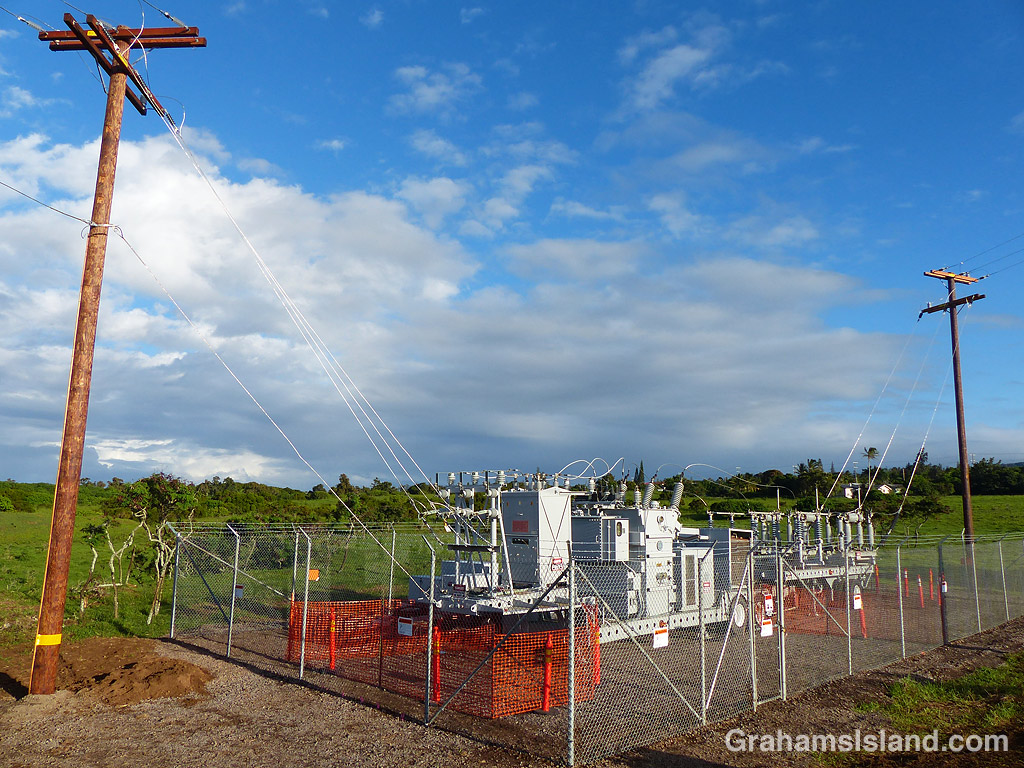
A temporary substation is installed while work is done on the Big Island of Hawaii

This little arrangement sprouted up in a cow pasture, beside the road to Upolu Airport, over the course of a week of so. It’s quite substantial with three new poles, fencing, and a gate having been put in, but the equipment itself is on wheels.

I was curious as to its purpose and finally happened by while workmen were there. As the title says, it’s a temporary substation. It’s been installed so that changes in the local distribution network can be achieved without power shutdowns. Supposedly, it will be in operation for two or three weeks, then the poles, fences, and equipment will be removed and the cows will get their pasture back.

Downpour

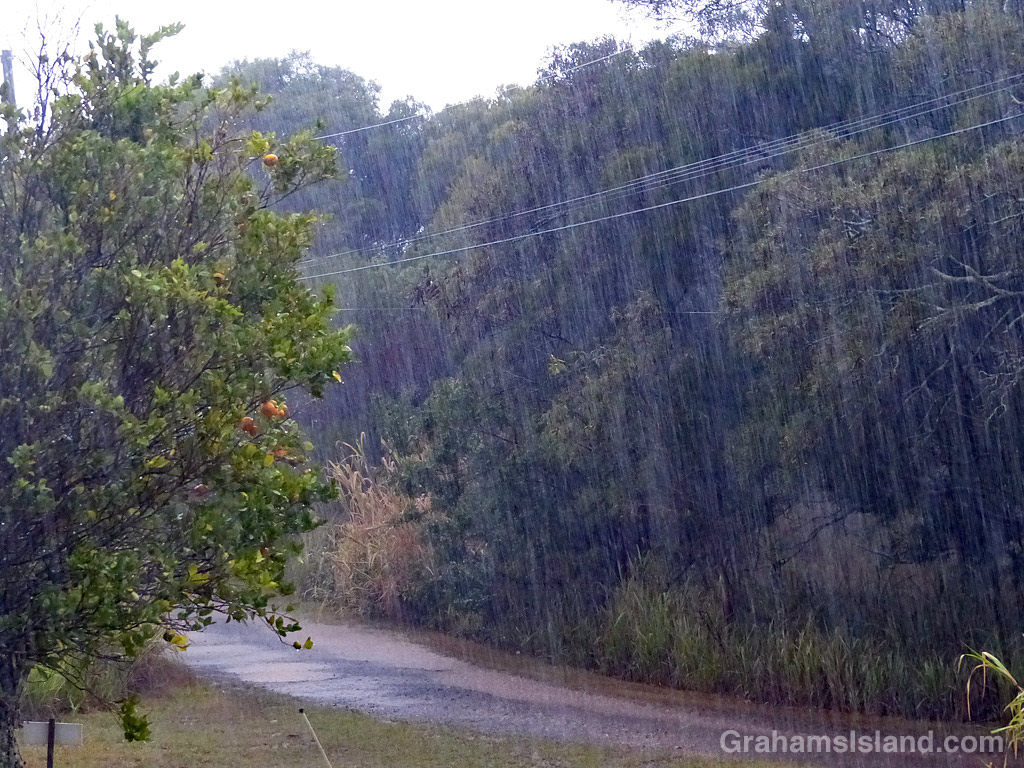
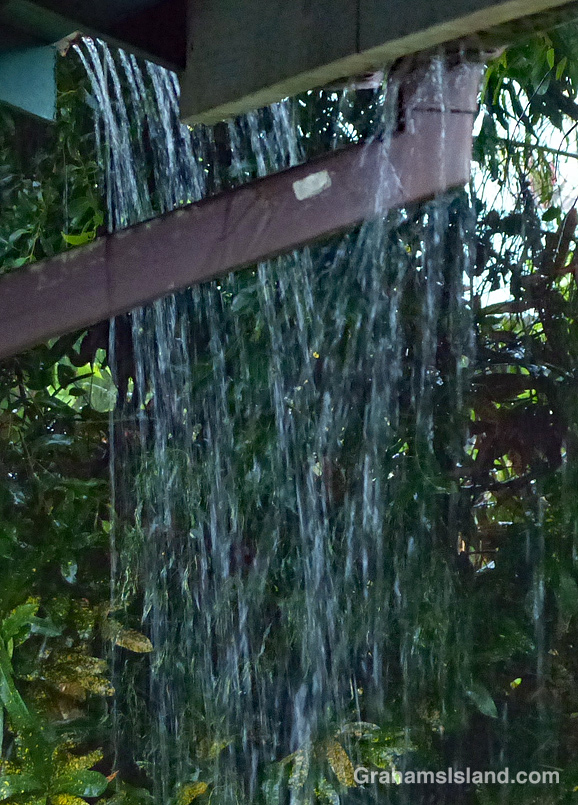
Heavy rain falls on the Big Island of Hawaii.Heavy rain falls on the Big Island of Hawaii.

The weather here is governed by the northeast trade winds. These bring abundant moisture to the windward side of Big Island, but the western side, in the lee of the volcanoes, is mostly hot and dry. There are local variations, and different times of the year can bring different winds. During the summer, Kona winds, blowing from the south or southwest, reverse the usual pattern.

Then there are weather systems which upset all the norms. Hurricanes are the most obvious. This year, in dramatic contrast to the Atlantic and Caribbean areas, there has been virtually no action in the Central Pacific. Only a couple of storms headed in this general direction and both petered out well before they reached the islands.

From time to time, an unstable air mass will pass over the state bringing with it unsettled weather and thunderstorms. One of the biggest dangers with such systems is when a storm cell settles over an area, dumping many inches of water, and sometimes generating flash floods. It’s interesting to follow these on the weather radar. The storm cells show up red, orange, and yellow. Sometimes they’re big enough to blanket an entire island.

One such system passed through the islands recently. Thunder had rumbled through the night, with distant lightning illuminating the sky. Next morning, I checked the radar and saw large areas of red and orange slowly working their way southeast, toward the Big Island. Then I noticed a little ball of orange appear and start to grow close to where I live. That online apparition was matched by an increase in the thunder’s volume and by the lightning becoming distinct strikes.

Very quickly, a cell built up that hung over this area for a couple of hours. It was quite the show. Three times the disturbance was so close overhead that I heard the crack of the lightning followed instantly by a clap of thunder that shook the house. Through it all, the rain hammered down, which I tried to capture in these photos.

Eventually, the large cell moving down from the northwest arrived, but instead of making things worse, it absorbed our local fireworks show and carried on to inundate areas to the southeast. An hour later, the sun broke through and our temporary weather maelstrom was over.

Bee on mock orange

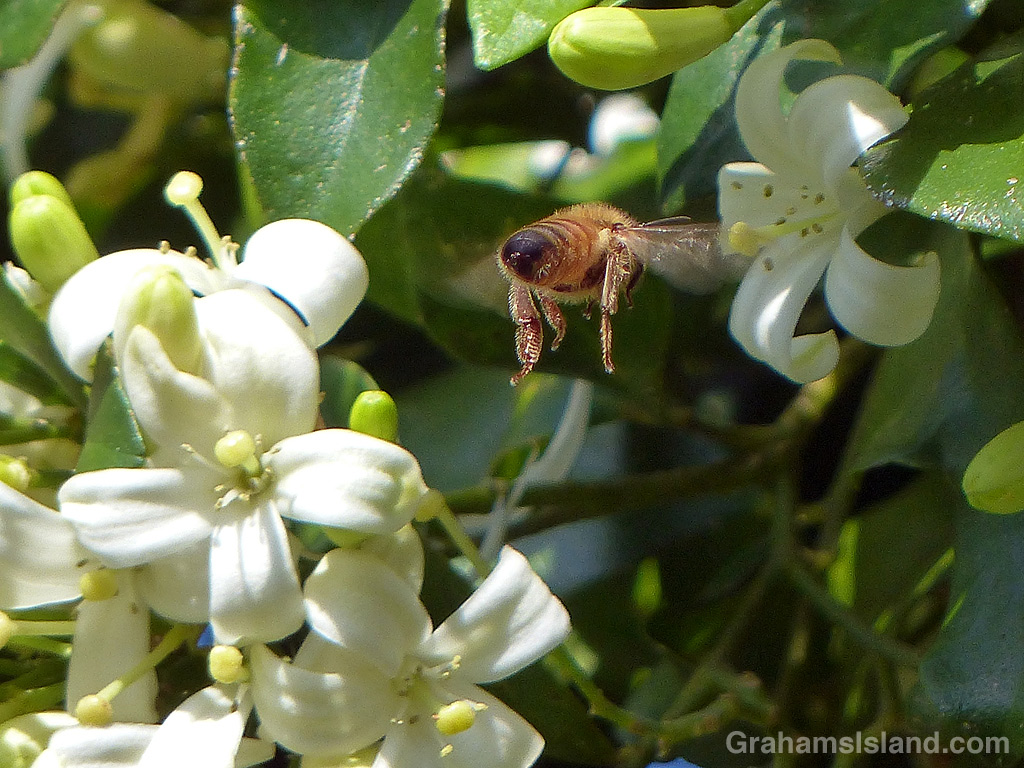
A bee approaches a mock orange flower.A bee on a mock orange flower.

There’s a large mock orange in the corner of the yard that blooms three or four times a year. Sometimes just a section produces flowers. Other times, the whole plant turns creamy white. I do notice the blossoms, but what usually alerts me to a new bloom is the scent. A breath of air in the right direction and the house fills with the aroma of mock orange.

The most recent bloom encompassed the whole plant and also highlighted another of the plant’s attention-getters. It hums. It’s not unusual to wake up and, once the din of roosters and cardinals and francolins have been weeded out, a steady background hum takes over. This is the bees working over the mock orange flowers.

The blooms last only a few days. When the wind blows, which it does often here, the white petals fall to the ground like snow. But while this latest bloom occurred during a calm spell, still the snow fell. When the flowers first began to fade, the bees continued to pile in and their busy harvesting knocked the petals off.

Now the plant is a quiet, glossy green again. The blooms are gone, the bees are gone, the scent is gone, this temporary frenzy over in a week. Until the next time.

Wild pig running

A wild pig runs off at Pu'u Wa'awa'a on the Big Island of Hawaii

Wild pigs are widespread on the Big Island. I saw this one on a hike up Pu’u Wa’awa’a. I’d been taking photos and when I turned around, the pig was ambling into some tall grass leading to a shallow gulley bordering the trail. It didn’t seem at all bothered by my presence which it must surely have registered.

A few moments later, I saw it still headed in the same direction, still taking its time. I hurried up the trail trying to make as little noise as possible, and keeping an eye out toward the area where I thought the pig must be. I hadn’t gone too far when I reached a place where I could see that the gulley ended and, assuming it hadn’t moved faster than I thought, the pig would have to emerge into view. I hoped then I could get a photo or two.

I saw and heard nothing so I edged around trying to see into the gulley. I caught a glimpse of movement, then nothing. There was no point going into the gulley myself. I’d lose my vantage point and the pig would surely disappear before I saw it. The alternative was, if it was a boar, it might charge me. So I held my ground, looking and waiting.

Nothing in my proximity or activity changed, but at some point the pig panicked. It’s previous sangfroid was temporarily replaced by the high-strung nervousness of a racehorse. It shot out of the grass, racing back the way it came. When it came to the metal gate I’d just passed through, it clanged into it, squeezed between two bars, and carried on as before. When it finally disappeared into some bushes, it was a good 200 yards away, and still traveling as though making the final turn at the Kentucky Derby.