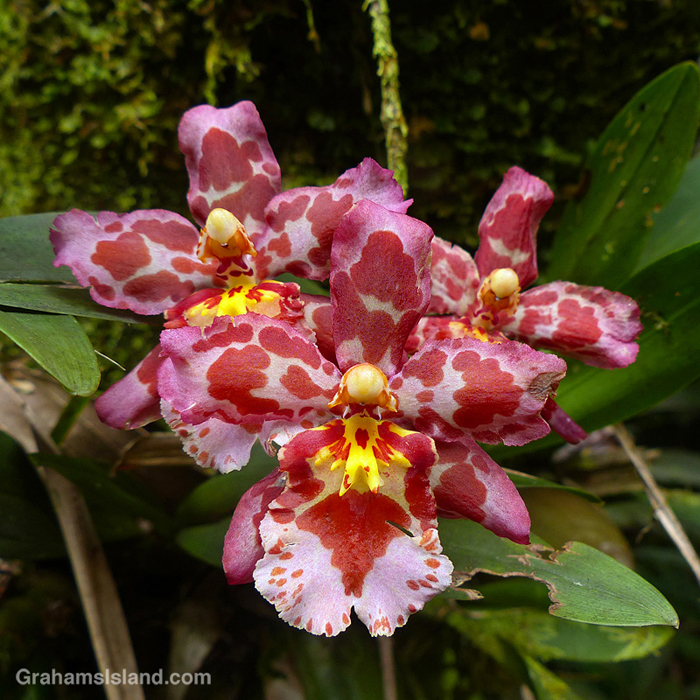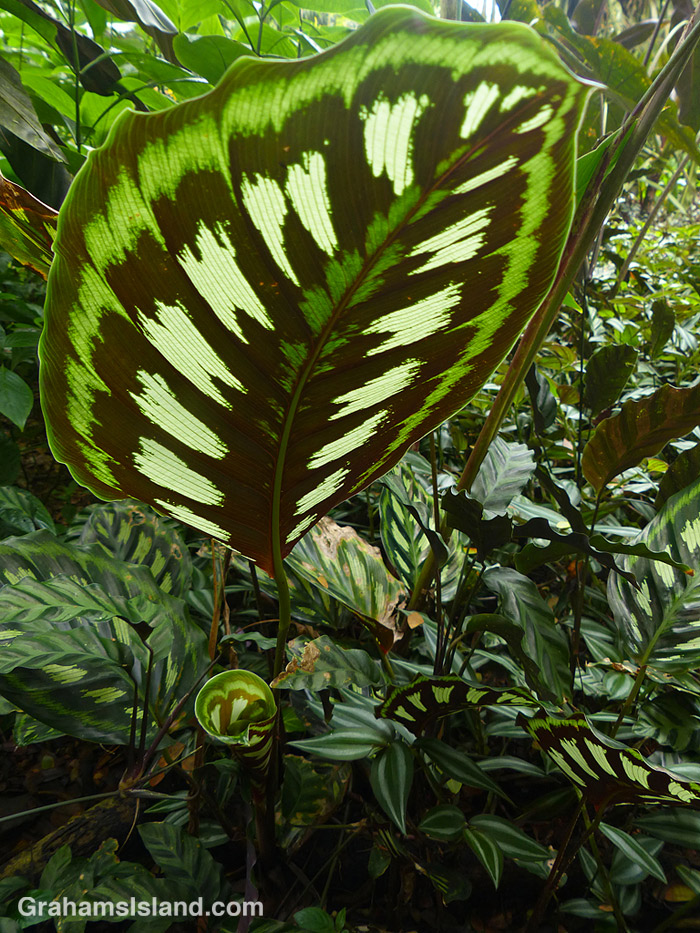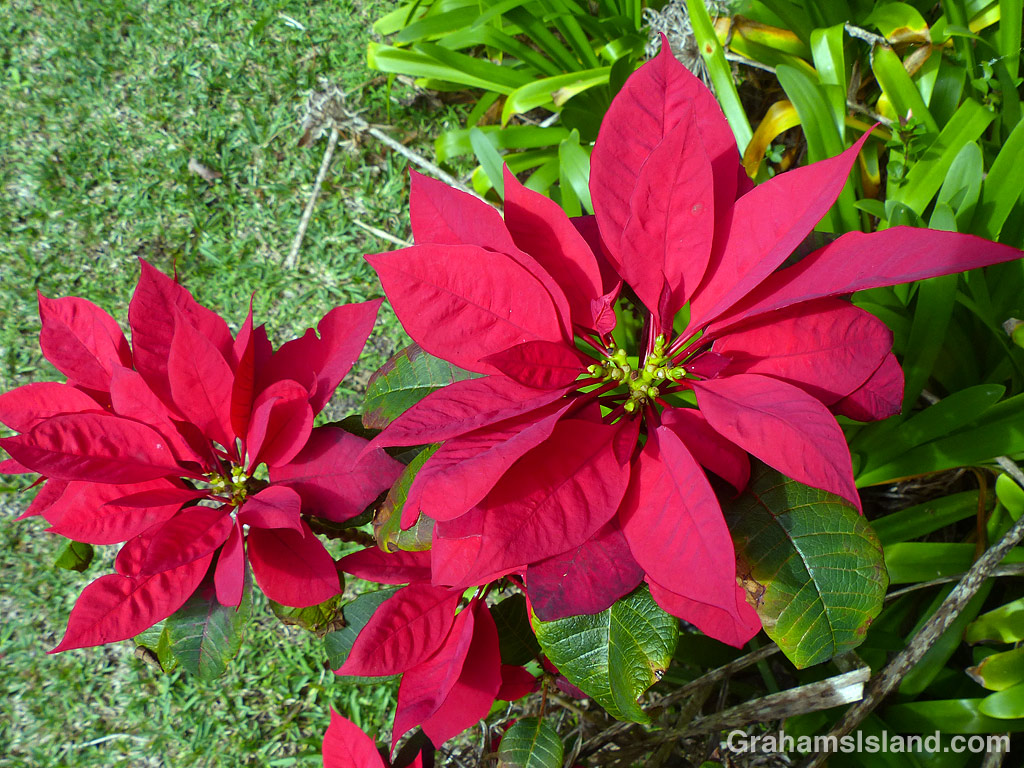
Leopard orchids (Grammatophyllum scriptum) come from the low-lying coastal areas of Southeast Asia. They produce abundant, showy flowers, but can grow to be quite large. Because of this growth habit, they’re most often seen in botanical gardens rather than domestic gardens.
This one was at Hawai’i Tropical Bioreserve & Garden. For more information about Hawai’i Tropical Bioreserve & Garden, go to htbg.com.
This week’s Friendly Friday challenge theme is ‘The Color Pink.’ See more responses here.
Pinkhead smartweed (Polygonum capitatum or Persicaria capitata) is a groundcover that hails from western China and the Himalayas. It’s variously known as pinkhead knotweed, pink knotweed, Japanese knotweed, pink-headed persicaria, or pink bubble persicaria. I use pinkhead smartweed for the very good reason that I like the name. It sounds like the name of someone pretentious, but slightly seedy, from the alleged upper crust of society.
In this bounty of names, a couple of elements stand out. One is ‘pink,’ the other is ‘weed.’ This is a very pink plant and, in Hawaii and elsewhere, an invasive weed. Drive eastbound over Saddle Road (officially Hawaii Route 200, the Daniel K. Inouye Highway) and, once you cross the saddle and begin your descent, this plant will become obvious very quickly. It lines the road on both sides for several miles with very little in the way of other plants competing for that space. This is because pinkhead smartweed will grow in poor ground and lava fields fit that description.
This is also a stretch of highway that, relatively recently, was converted from a narrow, winding road, that rental car companies routinely forbid their clients from driving on, to a wide, smooth thoroughfare, the only place on the island where you can legally go 60 mph, and where you can expect to receive a ticket if you go 80 mph like everybody else.
Redoing the road left verges of rock and gravel and very little else. Pinkhead smartweed was quick to move in and colonize this unpromising territory so that now the descent toward Hilo begins with pleasing pink borders.
The top photo shows the rugged kind of ground pinkhead smartweed can grow in. To the right, bees appreciate the flowers of this plant growing at an elevation over 5,000 feet. Below, the collapse of a lava tube has left a shady hole where pinkhead smartweed, an endemic amaumau fern, and an ohia tree have established a good foothold.
Pu’uanahulu is a small community midway between Kailua Kona and Waimea, on the upper road between those two communities. I don’t drive that highway much, except when I go to hike up Pu’u Wa’awa’a. Last time I did this, driving through Pu’uanahulu, I noticed that the jacaranda trees were in bloom alongside the road. What I hadn’t realized is just how many jacaranda trees there are in this area.
These photos are taken from the northern slopes of Pu’u Wa’awa’a. The bottom photo shows the general area with the purple jacaranda flowers of Pu’uanahulu clearly visible. The top photo shows a closer view of part of the community and the abundance of flowering jacaranda trees.
A bee on a passion flower as another bee approaches. What I like about this photo is the one bee’s leg up in the air. A friendly wave? Get away from me? Only the bees know for sure.
Last month, I posted (here) a photo of a gold dust day gecko drinking from a bird of paradise flower. This photo, taken last week, is from that same clump of plants. This flower is past its prime, but the gecko has not yet reached adulthood and has already had at least one narrow escape judging by its missing tail. It kept its eyes on me, probably wondering if I represented another threat.
Silk oaks (Grevillea robusta) come from Australia’s east coast, but are well established here. Rather too well actually. They’re fast growers and can outcompete native species, in particular ohia trees. In some places, silk oaks will have their trunks ringed to kill the tree in order to give those native species a better chance of survival.
At this time of year, silk oaks are blooming and their orange flowers put on a brilliant display. They look like giant toothbrushes, or rather groups of flowers look like that, for the toothbrushes are made up of many individual flowers. The flowers themselves are popular with birds, bees and other insects, but both the flowers and wood can cause allergic reactions so have to be handled with caution.
The long-tailed blue butterfly (Lampides boeticus) is believed to have been accidentally introduced to Hawaii in the 1880s. Accidental or not, it wasn’t a good thing. Its common name, bean butterfly, gives a clue as to the problem. It damages a wide variety of bean and pea plants, both domestic and commercial.
These photos were taken on the Puna Coast Trail in Hawaii Volcanoes National Park. The plant is Vigna marina or beach pea, an indigenous plant that grows well in the harsh, exposed coastal area that the trail passes through.