Category Archives: Flowers

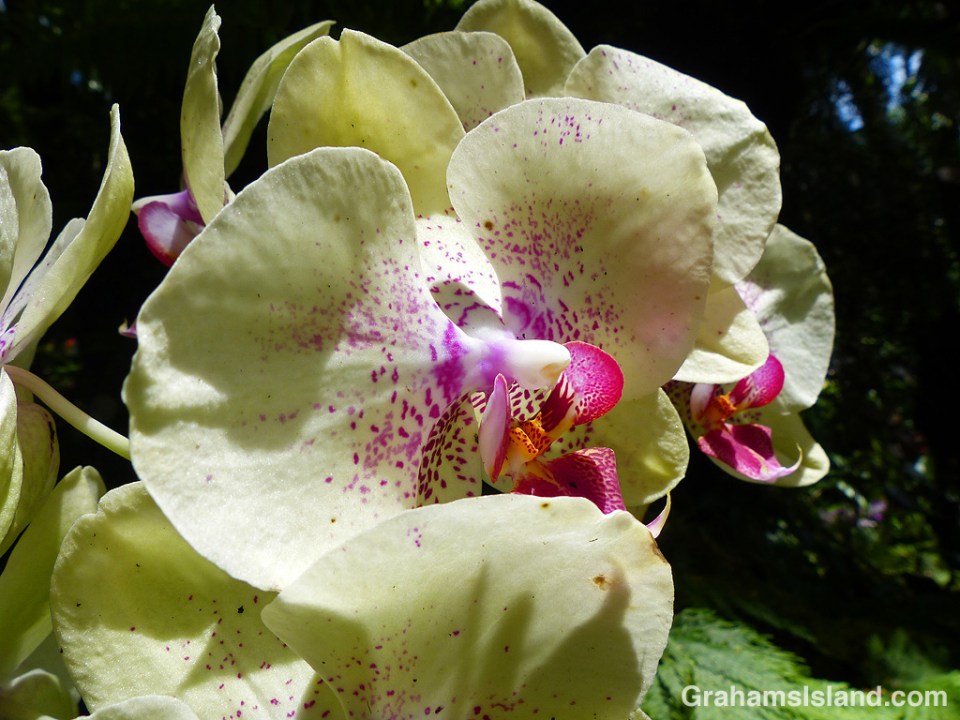
Phalaenopsis orchid hybrid

Phalaenopsis Orchid blooms

Phalaenopsis Orchid hybridPhalaenopsis orchids are also known as moth orchids because the flower shape resembles a moth in flight. They’re very popular with growers because they’re relatively easy to care for and bloom for a long time. This popularity has also resulted in growers producing numerous hybrids of this orchid.

These blooms were at Hawaii Tropical Botanical Garden, near Hilo. For more information about Hawaii Tropical Botanical Garden, go to htbg.com.

Passion vine butterfly

Passion vine butterfly

I already ran a post for this week’s Sunday Stills challenge on the theme of ‘Orange’ (here, and other responses here). But yesterday, while taking a walk, I came across this passion vine butterfly and thought it fit the theme too well to pass up. The butterfly was feeding on a tasselflower with the blue Pacific as a backdrop.

Orange

Dendrobium secundum flowers

Dendrobium secundum orchidThis week’s Sunday Stills theme is ‘Orange.’ (See more responses here.) Usually I pick one subject for these challenges, but I had two recent subjects that fit the bill and I couldn’t make up my mind, so I’m including both.

The flower photos are of a dendrobium secundum orchid, which is also known as a toothbrush orchid. The flower color can vary from pale pink to purple with an orange labellum at the tip. These flowers were soft and delicate looking, yet so lush.

The bottom photo is from the recent Ironman race on the island. I liked the pop of this cyclist’s outfit and how his water bottle matched his orange helmet.

Ironman cyclist and old shed

Coqui frog

Coqui frog

What is there to say about the coqui frog (Eleutherodactylus coqui)? How about KO-KEE, KO-KEE, KO-KEE, KO-KEE, KO-KEE, KO-KEE. And how about calling that out at around 100 decibels ALL NIGHT LONG.

Coquis came to the Big Island in the late 1980s, believed to be an accidental import on some plants. They hail from Puerto Rico where they’re a popular cultural symbol. But in Puerto Rico, the coqui has predators such as snakes and birds. In Hawaii, it has no predators and it’s thriving. Indeed, I recently read that supersized coquis have been found here, not the usual frogs the size of a quarter, but silver dollar sized – about 50% bigger. One theory for this is that the excellent conditions and lack of predators means the coquis live longer and thus eat more and grow bigger. Watch for ‘The Coqui That Stomped Hilo’ coming soon to a theater near you.

Suffice it to say that coquis are considered an unwanted invasive species here. Homeowners try to eradicate them because their noise is believed to lower property values. Even businesses are affected, with tourists considered less likely to want to stay in areas infested with coquis. (Ironically, while Hawaii tries to battle this mostly-loathed frog, in its native Puerto Rico this much-loved frog is threatened by a fungus called Batrachochytrium dendrobatidis and coqui numbers there are in decline.)

The east side of the island, with its greater rainfall and abundant vegetation, is prime coqui habitat. The northern part of the island, where I live, is considered coqui free. What that means is that the frog is not established here and coordinated efforts are made to find and eliminate those that are heard. It’s an uphill battle. I know I hear them at night. A few weeks ago it was just one, but now that one’s call is being answered by others.

And what about that call? Well, as usual, it’s the males making all the ruckus. The call is both a warning to other males (the KO part) and an alluring come hither to females (the KEE part). With the males, one will make the call to establish his territory and then another might respond to challenge this. They keep up this call and response until one gives up, a process that can last many minutes. The loser will move on while the winning male will start over until another challenger chimes in.

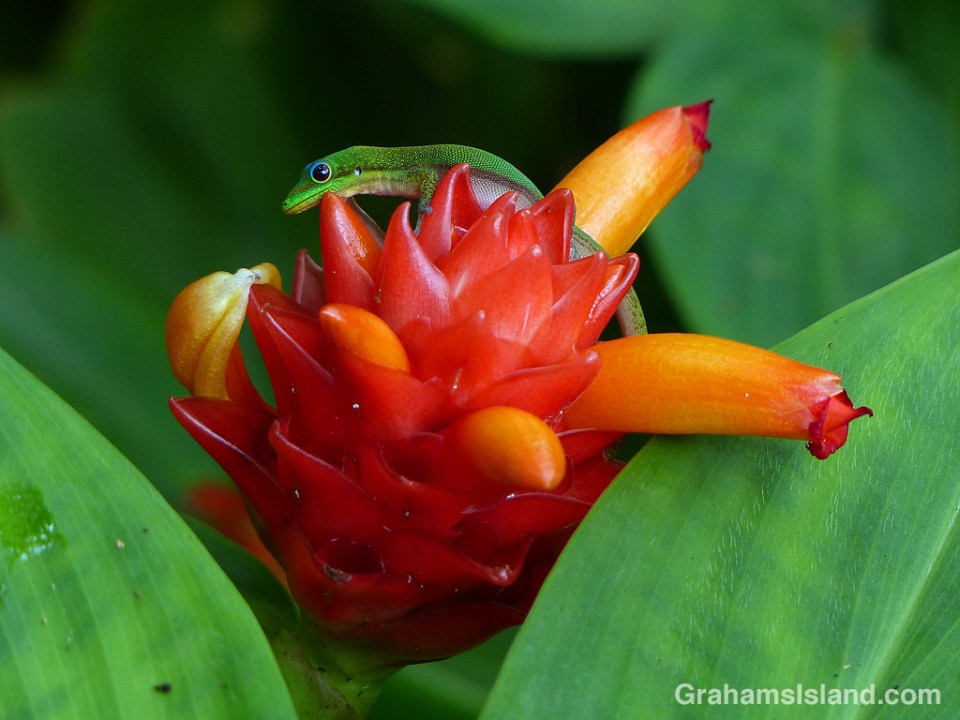
I’ve heard plenty of coquis, but the one above is the first I’ve actually seen. I was visiting Hawaii Tropical Botanical Gardens and taking photos of a gold dust day gecko that I saw on a red ginger (Alpinia purpurata). The gecko was poking its nose into the plant looking for moisture or nectar, when there was a sudden flurry. If you look at the photo below, the reason can be seen toward the top left corner, lurking deep in the bloom. The coqui hadn’t appreciated being disturbed and seemed to nip the gecko causing it to jump back. Then the frog came out a bit farther to check the coast was clear, before returning to its hideaway.

For more information about coqui frogs in Hawaii, go to https://www.ctahr.hawaii.edu/coqui/index.asp.

Coqui frog and gecko

Japanese aloe

Japanese Aloe

Japanese White-eye on Japanese aloe

I think this is a Japanese aloe with its long tubular flowers and spiky leaves, though it could be a different variety. The flower stalks are quite long and reach well beyond the leaves, which makes things a little easier for this Japanese white-eye to feed from the flowers.

Japanese Aloe leaves

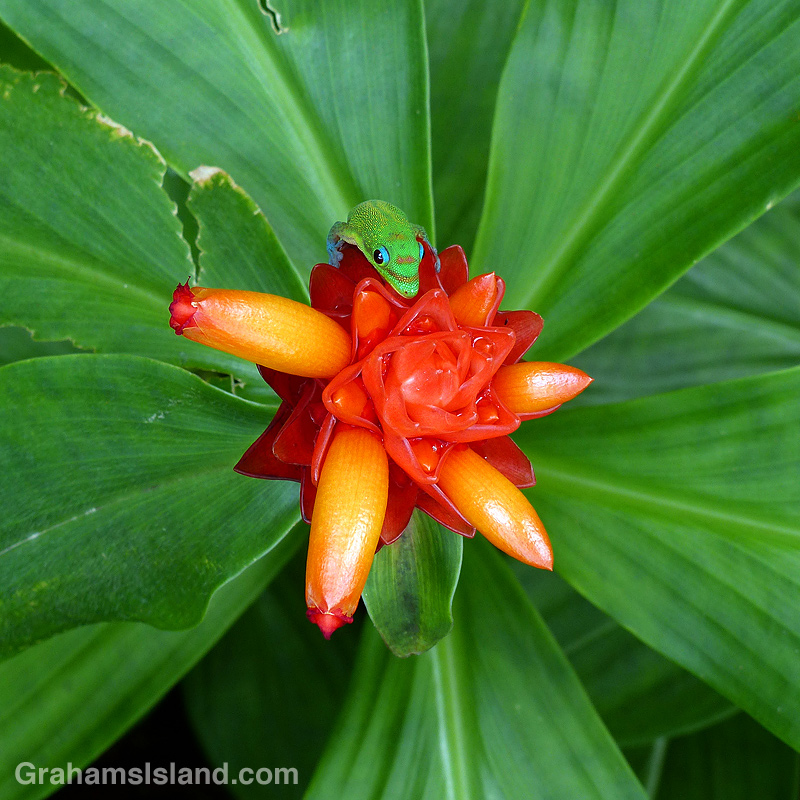
Gecko on torch ginger

Gecko on torch ginger

A gold dust day gecko drapes itself over a torch ginger (Etlingera elatior). This striking red form is not the flower but is known as an inflorescence. The red leaf-like parts are bracts and it is from between these that the yellow-edged red flowers will emerge.

Kou tree

Kou flower and bee

Kou flowersKou (Cordia subcordata) is an indigenous tree that was also brought over by Polynesian settlers. It was highly prized for its wood, which was used to make bowls and other containers.

The flowers are beautiful, too. Less than two inches across, they grow in clumps, which are sometimes hidden by the shiny green leaves. The flowers are followed by small, round green fruits (seen in the photos to the left and below) which harden to a dark brown and contain white seeds.

The flowers on this tree were popular with a variety of insects including a honey bee, above, and a paper wasp (Polistes exclamans), below.

Kou flower and paper wasp

Kou flower and wasp

Kou tree