
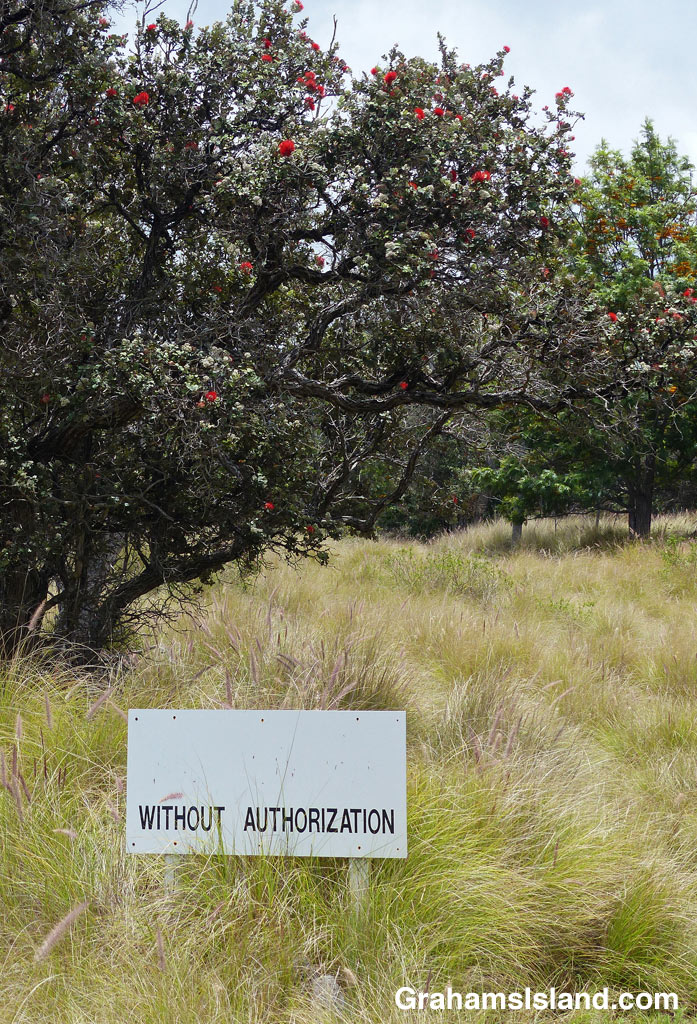
I assume this was once a no admittance sign, but I like this sign the way it is. Perhaps these are unauthorized ohia trees growing rogue.
Category Archives: Trees
Kiawes – a thorn in the foot
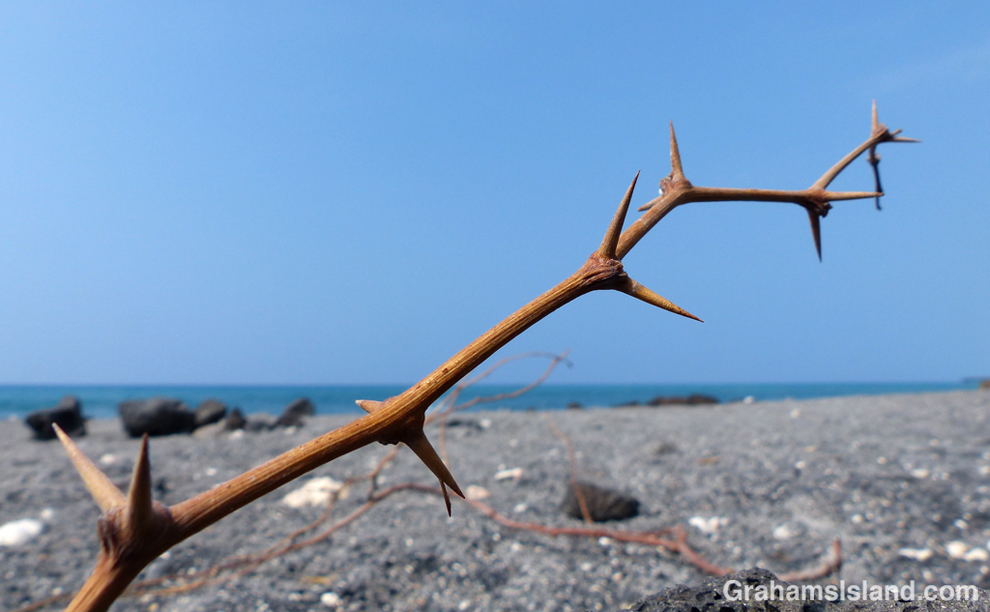
When twigs break off a kiawe, the thorns dry to hard, sharp spikes.
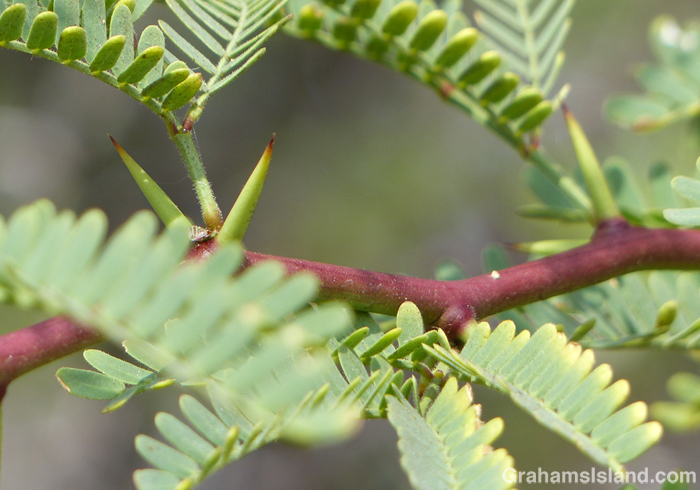
Kiawe thorns growing on the tree.
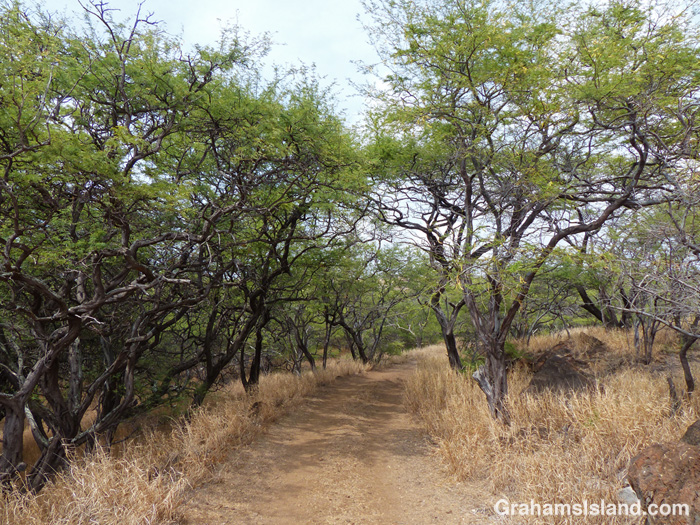
A stand of kiawe trees bordering a trail.
Hiking on the west side of the Big Island can be a hot and arid experience. The landscape is often barren lava or scrubby growth. If it’s scrubby growth, chances are that kiawe trees (Prosopis pallida) are prominent and if they are, it’s wise to tread carefully. That’s because kiawe trees produce long, tough thorns.
Hiking in slippahs (flip flops) is asking for trouble. A kiawe thorn will go through them like a knife through wet tissue. I’ve felt the jab of these thorns through my Tevas, which have robust soles of decent thickness. The first time I wore my new trail shoes, toward the end of the hike, crossing a kiawe-bordered beach, I felt a familiar prick in my foot. A thorn had buried itself in the ¾-inch thick sole and penetrated far enough to make itself felt. One of my routine tasks with my trail shoes, and the Tevas, is to examine the soles and extract any thorns with a pair of pliers. When a hike is over, it doesn’t mean the danger is past. Drive over one of these thorns and it can and does cause punctures.
But if all this makes it seem as if kiawes are reviled, that’s not the case. It’s widely used in smoking meats. The smell of burning kiawe is commonplace.
Kiawe isn’t a native tree; it originated in Peru. In fact, all Hawaii’s kiawes can trace their roots, as it were, back to a single seed planted by a priest in Honolulu in 1828.
Log yard

The Hamakua coast of the Big Island is the first landfall of the northeast trade winds and, consequently, gets a good deal of rainfall. Combined with warm tropical temperatures and good soil, the area is a prime growing area.
One of the crops is eucalyptus trees. The trees grow fast and straight. When they’re harvested they’re trucked to Kawaihae, the port on the west side of the island, to this log yard. They’re stored there until there are enough logs to ship to Asia, which seems to be about every couple of months at present.
I happened to be driving by late one afternoon and was struck by the light on the log ends. As can be seen from the hillside in the background, Kawaihae is one of the driest spots on the island, averaging around 10 inches of rainfall a year.
Kahuku hike
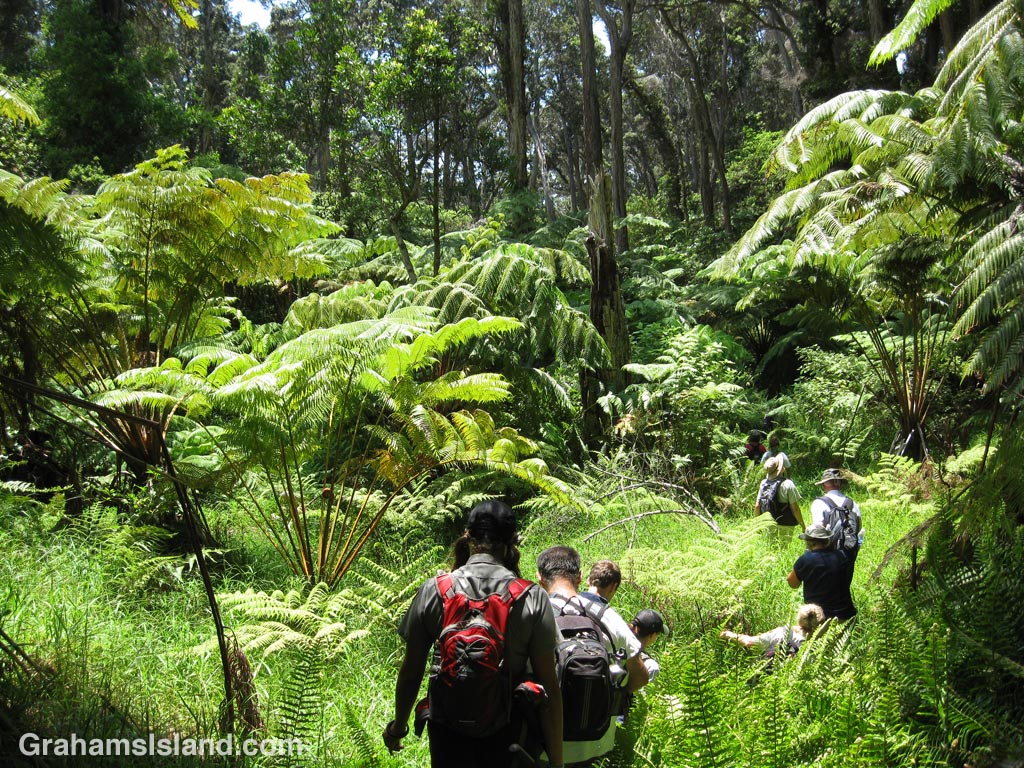

Kahuku is part of Hawaii Volcanoes National Park. Its 116,000 acres was added to the park in 2003, an estate purchase of former ranch land. This purchase almost doubled the size of the park.
Not far from the southern tip of the Big Island, the entrance to Kahuku is about an hour’s drive from the main park entrance, but the two areas are contiguous, joined at the summit of Mauna Loa.
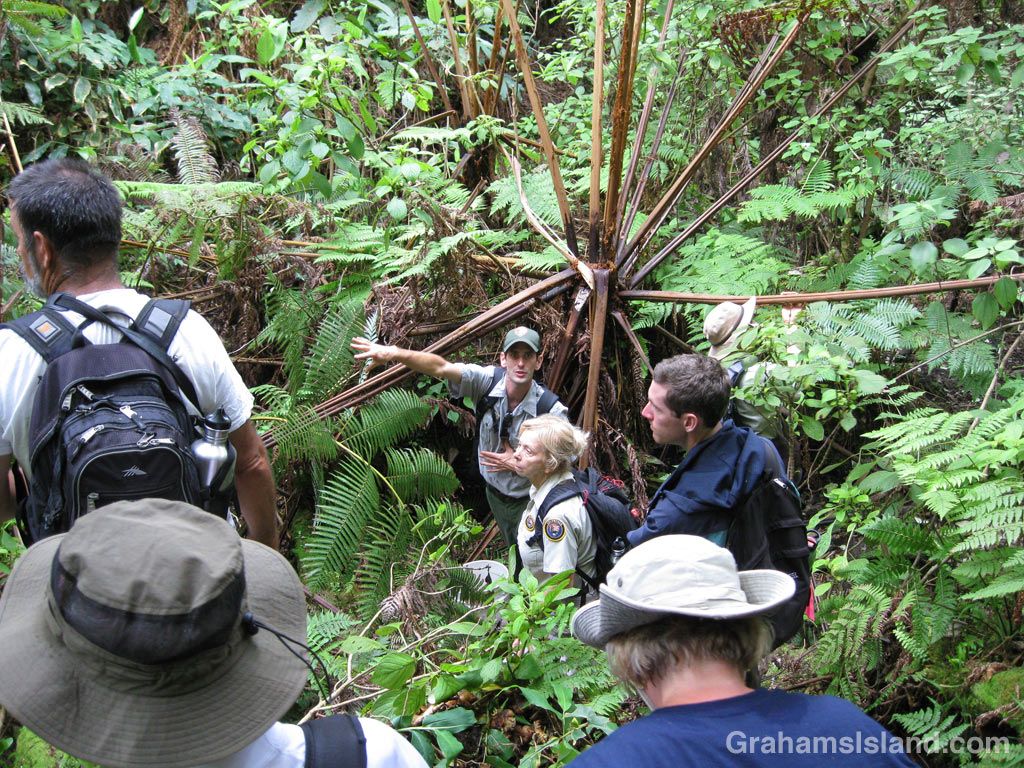
These photos are from a guided hike in Kahuku that I did a while back. The hike went through fairly dense old growth Hawaiian forest that had been spared because it was in a steep gully and thus not suitable for clearing for pasture. There was no real trail.
Currently this part of the park is closed because trees with Rapid ‘Ōhi’a Death (ROD) have been found in the lower part of the park and the goal is to prevent it spreading to other areas.
For more information on the Kahuku Unit of Hawaii Volcanoes National Park, go to nps.gov/havo/planyourvisit/kahuku-hikes.htm or bigislandhawaiitravelguide.com/places/puu-o-kahuku-at-hawaii-volcanoes-national-park.html
Fagraea berteriana


Fagraea berteriana is also known as perfume flower tree and pua keni keni. In Hawaiian, pua keni keni means “ten cent flower,” which used to be the price of a lei made from these flowers.
There’s a lot going on with these plants. The fragrant flowers start out white, then turn golden yellow. Later it will produce smooth green fruits that will become wrinkled and red.
A Bay to Keawaiki hike
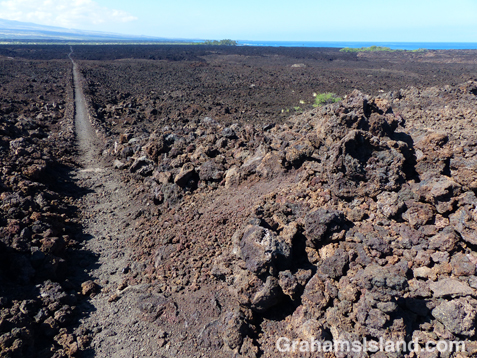
The Ala Loa Trail (King’s Trail) south of Waikoloa.

Keawaiki Beach with its lone palm tree and Hualalai volcano in the background.
This hike is a 7 mile loop directly north of the Keawaiki to Kiholo loop hike that I posted about here and here. One could combine the two, but it would make for a long, hot walk, though with several opportunities to take a cooling dip. I chose to start the loop at its northern end, heading south on the inland lava field before it got too hot. The return, along the coast, is still over lava, but usually features a cooling sea breeze.
A Bay is officially known as ʻAnaehoʻomalu Bay, but most people find A Bay easier to pronounce. There’s bathrooms and showers at the beach here so I find it a good place to start and finish.
From the parking area, head inland to pick up the old King’s Trail which is marked by a sign, though it’s obvious without it. The King’s Trail heads south in a ramrod straight line. Eventually, this trail intersects with a dirt road headed toward a cluster of palm trees on the coast. Follow this road down to the Brown estate, which is surrounded with barbed-wire. The trail goes down the side of this fence to Keawaiki Bay and its lone palm tree.

The Golden Pools of Keawaiki (though they’re actually inland of the next beach down the coast). The golden color is due to a unique algae.
Heading north again, the next bay is Pueo Bay and a small trail inland from this leads to the Golden Pools of Keawaiki. The color of these pools is due to a unique algae that grows here. There’s no swimming in these pools, but further up the coast, after passing Weliweli Point, another lone palm tree marks Akahu Kaimu Bay. Just inland from the palm is a large freshwater pool which is perfect for a cooling dip. When I visited, there was no one else there, or indeed within a mile of the spot.
Heading north along the coast again, the lava transitions to the kind of sandy beaches that Hawaii is renowned for. The southernmost beaches are usually sparsely populated or just plain empty. These beaches lead back to A Bay and its welcome facilities.
For more information about this, and other hikes on the Big Island, go to bigislandhikes.com. (This hike is listed as Keawaiki Bay to ʻAnaehoʻomalu Bay (A Bay), starting from the southern end.)

The freshwater pool behind Akahu Kaimu beach, marked by another lone palm tree. After a hot, dry walk, a dip in the pool was very refreshing.

A sandy beach straight out of the brochures at the south end of A Bay.
Zebra doves

I’ve been pruning a huge mock orange tree behind the house, a little concerned about how this would impact the birds that use it for food and shelter. However, this pair of zebra doves appeared to enjoy the late afternoon sunshine at a spot opened up by the pruning.
Grasshopper on a tree heliotrope
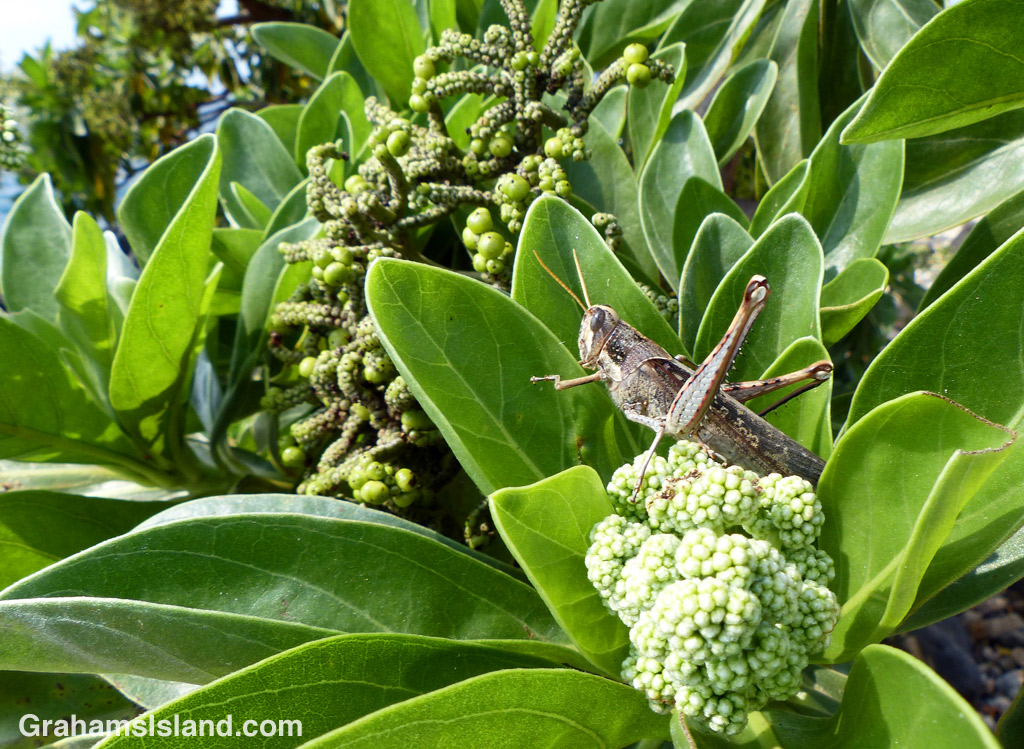
This grasshopper was tucked away in the foliage of a tree heliotrope on the North Kohala coast. I think it’s a Schistocerca nitens.
 Graham's Island