Category Archives: Places

Ring-necked ducks and lesser scaup

I saw a little group of ducks on a small reservoir near Hapuna. Most are ring-necked ducks, the bird on the right in the top photo being a male, and the two birds on the left below, being females. The odd one out is the bird on the left in the top photo and on the right below. That’s a female lesser scaup.

According to my bird book, a small number of lesser scaups migrate to Hawaii every year, but ring-necked ducks are considered uncommon visitors.

Thanks to birdforum.net for help with the identification of the female lesser scaup.

Abstracts: Dong Fang

There’s a skydiving business that operates out of Upolu Airport and they have a blue shipping container inside the airport fence where they store gear. One day when I went down there, I saw a second container had been installed next to the first, creating an L-shaped setup.

I liked the logo on the container and took a photo, which was just as well since the next day the container had been repainted to match the other one.

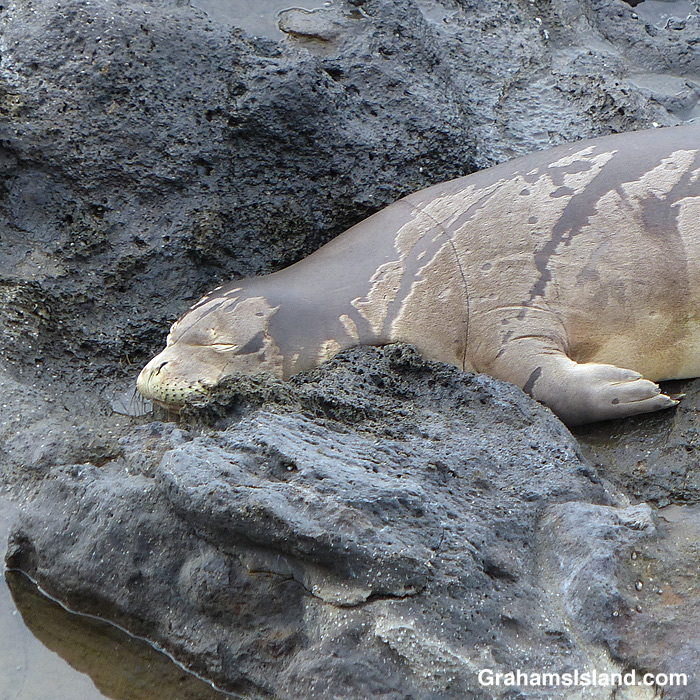
Monk seal resting

When I first saw this monk seal on the North Kohala coast a couple of days ago, I thought it was IO5. He’s the seal I see most often in this part of the island. But as I got closer, I saw this one was a female. I took photos, including some of the red ID tag. I wasn’t sure if, at that distance, I’d be able to read it, but luckily I could make out ‘A2’ in a couple of photos. There was space after the ‘2’ as if a number had rubbed off, so I wondered if this was RA20, the monk seal who raised pups on a Kona beach in 2018 (here and here) and 2019 (here and here).

I sent the photos to the Big Island Hawaiian monk seal response network, which tracks the movements and welfare of the monk seals. They confirmed this was RA20 and was the first sighting of her since she was released from Ke Kai Ola Hawaiian Monk Seal Hospital after suffering from a bacterial infection. The hospital’s veterinarians think RA20 recently lost a pregnancy and that the infection may have caused, or resulted from, the loss.

The good news is that she certainly appeared healthy and in good shape when I saw her.

For more information about Hawaiian monk seals and Ke Kai Ola Hawaiian Monk Seal Hospital, go to www.marinemammalcenter.org/hawaii.

Oncidium orchid ‘Tsuiki Margaruite’

The tag on this orchid read Onc. ‘Tsuiki Margaruite’ #1, but I see it mostly described as ‘Tsiku Marguerite,’ so take your pick. But it’s a delicate looking orchid with cream to apricot flowers that are highly fragrant.

This one was at Hawaii Tropical Botanical Garden. For more information about Hawaii Tropical Botanical Garden, go to htbg.com.

Better Days: Kona Village Resort

Looking across Kahuwai Bay toward the Kona Village Resort
The sign on the fence says it all.
Some of the damaged buildings lining the shore.

On March 11, 2011, the northeastern part of Japan was jolted by an earthquake registering 9.0 on the Richter scale. While the quake caused extensive damage, the resulting tsunami was even more destructive. Water surged up to six miles inland and flooded more than 200 square miles of land. Perhaps the best known result of this tsunami was the meltdown at the Fukushima Daiichi Nuclear Power Plant, after it was overrun by the surging waters.

Here in Hawaii, a few hours after the earthquake, tsunami waves washed up on shore. The waves were up to 10 feet high, but the damage was not as great as was feared. However, along the west coast of the Big Island, there was flooding and damage to coastal properties.

One of those properties was the Kona Village Resort, situated to the north of Hualalai Resort. Damage to the resort’s properties was sufficient to force its closure. The property then sank into the swamp that is insurance settlements and financial shenanigans. During this time, the buildings deteriorated.

Originally, the resort was supposed to reopen this summer, but that was pushed back a year, then more. Currently, sometime in 2022 is the planned reopening, but this being Hawaii, that date shouldn’t be taken too seriously. When I walked the beach past the site, work was going on, but I saw only a handful of workers and a couple of active machines. It didn’t appear to be a project going full-steam ahead.

The current work site, lots of orange netting but not much action.
At a casual glance things don’t look too bad, but the roof thatching is mostly gone, the buildings are open to the elements, and there’s other damage in and around the area.
It’s still a beautiful setting and the beach is enticing.

New moo and deadly cows

Two days ago, while driving home after my daily walk, I was thinking it must be almost a week since I actually took a photo (Never mind that when I got home I found that I’d taken a couple of photos earlier, during my walk!). Then I saw a patch of white in the grass beside the road, realized what it was, and thought that I should at least get a photo of that.

The nearest of the cows was some distance away, but this was the pasture of the local dairy and these cows are pretty mellow. I’ve seen other calves, seemingly abandoned, but actually just resting in a quiet spot while mom catches up with some grazing.

This was a marked contrast to my last cattle encounter, which was that almost-a-week-previous occasion of taking photos. I went for a hike up Pu’u Wa’awa’a. This is a public trail, but the land is also used for grazing so there can be cattle, horses, sheep, goats, and even a donkey or two sharing the area with hikers. Bear in mind that these cattle are being raised for beef so they’re big. Also, the cows among them are there to produce future beef cattle. They’re not giving milk to anyone other than their calves.

On this day, the first part of the trail, an old road, was littered with cattle of one kind or another, including several small calves. I grew up on a dairy farm and I’ve walked through many a field of cows and the occasional bull. I’m used to them, so this array of cattle didn’t bother me. As I walked up the trail, the herd thinned out. Soon all I saw in front of me were a couple of younger animals. These looked bigger and older than the calves lower down, perhaps yearlings. As I got closer I noticed a couple of full-grown animals grazing in a ditch on the other side of the road. They were mostly obscured by grass so I couldn’t see if they were cows or bulls. It seemed to make no difference as they appeared to ignore me as I passed.

I marched on up the road, and as I got closer to the two yearlings, I realized that one of the full-grown cattle (the large, black one in the photos below) had moved in my direction. This didn’t bother me. Often times cattle run towards me as I pass. Then they pull up and just look, or even turn and run away. I kept going. So did the large animal. I still couldn’t see whether it was male or female, but as it started snorting at me, I began to think female. I looked ahead to the two yearlings, then at the cow. She came closer, still snorting. I stopped. For the first time in my life, I thought I was probably going to get charged by a cow. This might seem silly, but people get killed by cows every year. A cow will charge, especially if someone comes between her and her calf.

By this time the cow was about 10 feet away. I decided this wasn’t the time to get a photo of a charging cow and instead clutched my metal water bottle with a view to swinging it at her snout. But the cow didn’t charge. Instead, she snorted one last time, glared at me as she stomped past, and headed up the road to what was clearly her calf. She was followed by the other large, brown cow.

Once the four were reunited, they just stood in the old roadway. I thought they might amble off, as cows will often do, but they stayed put. I didn’t feel like threading my way through them in case the two big ones were still riled up, so I marched into the scrubland to the side of the road and worked my way around them. The footing was uneven, but it wasn’t hard going and I soon came out on the other side. They’d watched my passage with more typically bovine expressions and once I regained the road surface they lost interest and meandered into the trees on the opposite side of the road.

I watched them go and figured I’d have a drink of water before continuing up the trail. I reached for my water bottle and pulled it out with a bloodstained hand … bloodstained hand? I couldn’t believe what I was seeing. Both hands were smeared with blood. My shorts had a giant patch of blood on one side. Just above my wrist, a small scratch continued to gush. Somewhere in my short trek through the underbrush I’d encountered something sharp without noticing, which is fairly typical for me.

I washed the blood off my hands and held a tissue to the cut. It quickly stopped flowing, so I carried on up the trail having rediscovered the wisdom of not getting between a mother and her offspring.

The top photo was my last of April and is posted in response to Bushboy’s Last on the Card photo challenge. See more responses here.
Also posted in response to this week’s Friendly Friday challenge theme of ‘Covid Discoveries.’ See more responses here.
And if those four cattle ever get together and release a record, perhaps Music To Moooove To, I think the bottom photo would make a great album cover for them.

The view from the top of Puʻu Mahana

Puʻu Mahana is an ancient cinder cone near the southern tip of the island. It is best known for Papakōlea beach, the green sand beach, which formed when the ocean cut into one side of the pu’u, creating the bay seen here. The sand’s green color is due to the presence of the mineral olivine. (More photos here.)

Posted in response to Becky’s April Squares challenge theme of ‘Top.’ See more responses here.