Category Archives: Volcanoes

Kilauea Iki Crater trail

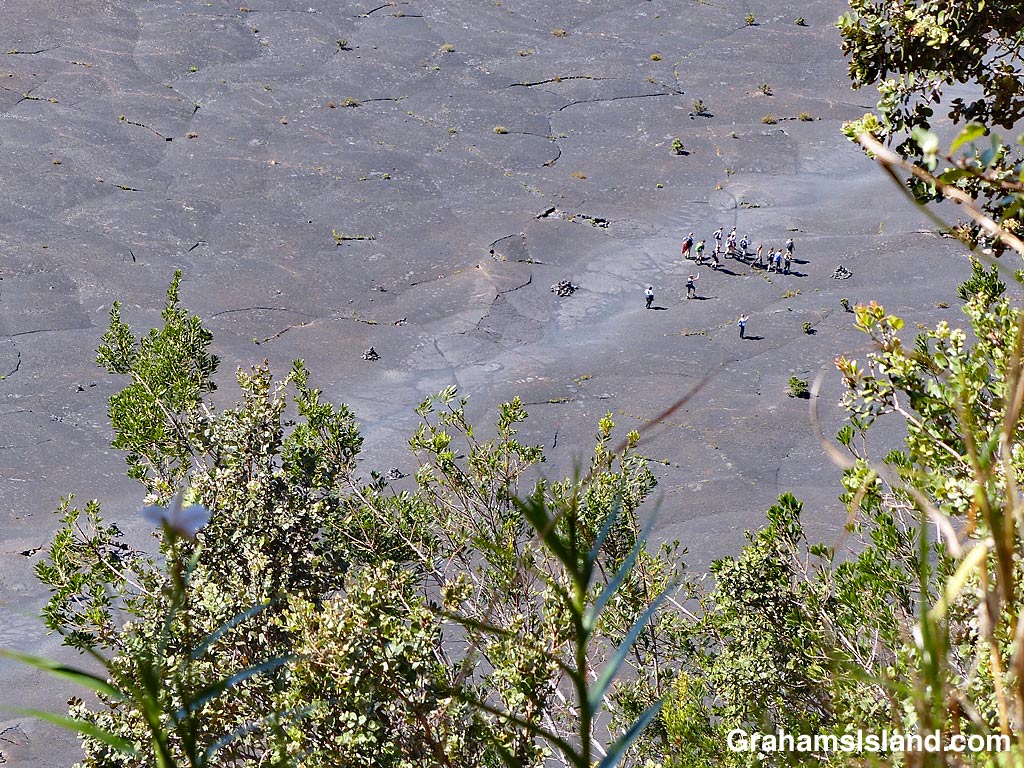
A group of people, looking very small, walk the trail across Kilauea Iki Craterfloor.A group of people, looking very small, walk the trail across Kilauea Iki Craterfloor.

These views of the trail across Kilauea Iki Crater, taken from the rim of the crater, give some idea of the scale of Kilauea Volcano.

Above, a group of people, looking very small, walk the trail across the crater floor.

To the left, smoke and gases from the active vent in Halema’uma’u Crater can be seen. Halema’uma’u Crater is part of the Kilauea Caldera which is much, much bigger than Kilauea Iki Crater. And, yes, that same group is still visible on the trail in this second photo, along with several others hiking the trail.

For more information about Hawaii Volcanoes National Park, go to nps.gov/havo/. For more information about Kilauea Volcano and it’s eruptions, go to hvo.wr.usgs.gov/kilauea/history/main.html.

Very Long Baseline Array on Mauna Kea

The very long baseline array on Mauna Kea is one of the ten radio telescopes that make up the Very Long Baseline Array (VLBA)Most of the telescopes on Mauna Kea are clustered together near the summit, but about halfway between the Mauna Kea Visitor Center and the summit is this lonely telescope. It’s one of the ten radio telescopes that make up the Very Long Baseline Array (VLBA), which began operating in 1993. Eight of the other telescopes are scattered around the U.S. mainland with the tenth at St. Croix in the Virgin Islands.

The Mauna Kea telescope, like the others, consists of a dish antenna 82 feet in diameter, and an unmanned control building. These ten telescopes are remotely operated from the Domenici Science Operations Center in Socorro, New Mexico.

For more information about the Very Long Baseline Array, go to https://public.lbo.us/.

Abstracts: James Clerk Maxwell Telescope mirror framework

Framing supports the mirror on the James Clerk Maxwell Telescope.

Last year, when I went on the Kama‘āina Observatory Experience, I visited a couple of telescopes. One of them was the James Clerk Maxwell Telescope, a single-dish telescope dedicated to detecting submillimetre radiation.

One of the things I liked about that telescope was the structure of the supporting framework. It reminded me of something found at Ikea, but on a giant scale. If I’d been involved in putting it together, at the end of the day, when congratulations were being bandied about, I’d have been the one saying, “Er, I’ve got a rod and three little hexagonal nuts left over. Where do they go?”

Kona lava tube

The lava tube north of Kailua Kona Airport.The lava tube north of Kailua Kona Airport.

Probably the most visited lava tube on the Big Island is Thurston Lava Tube in Hawaii Volcanoes National Park. However, the most easily accessible might be one just a couple of miles north of the airport at Kailua Kona.

Just off the main highway, it’s not unusual to see a line of vehicles pulled over and people scrambling over the lava. There’s a well worn path leading down to the entrance of the tube and enough headroom to make access easy. However, it’s worth noting that there are piles of rock strewn around from ceiling collapses and the whole area looks crumbly. I certainly wouldn’t want to be down there during an earthquake. Enter at your own risk!

Mauna Kea shadow

The shadow of Mauna Kea stretches out above the clouds.

Seen from the top of Mauna Kea, what is this shape we’re looking at, stretched out over the clouds, with that crisp corner at the top? It is, of course, the shadow of the volcano itself.

I like this image a lot, I think because it’s something I never thought about until I saw it. Then, I was immediately struck by how it illustrates the size of Mauna Kea and what a classic volcano it is.

Mauna Kea telescopes

Mauna Kea telescopes as sunset nears.

Waiting for sunset at the top of Mauna Kea, there are many distractions – shiny telescopes, other sunset watchers, pillowed clouds, and plummeting temperatures. By the time I returned to the car I was ready to turn up the heat, a rare opportunity in Hawaii.

The telescopes are from left: Suburu Telescope, The two telescopes of the W. M. Keck Observatory, and NASA Infrared Telescope Facility.