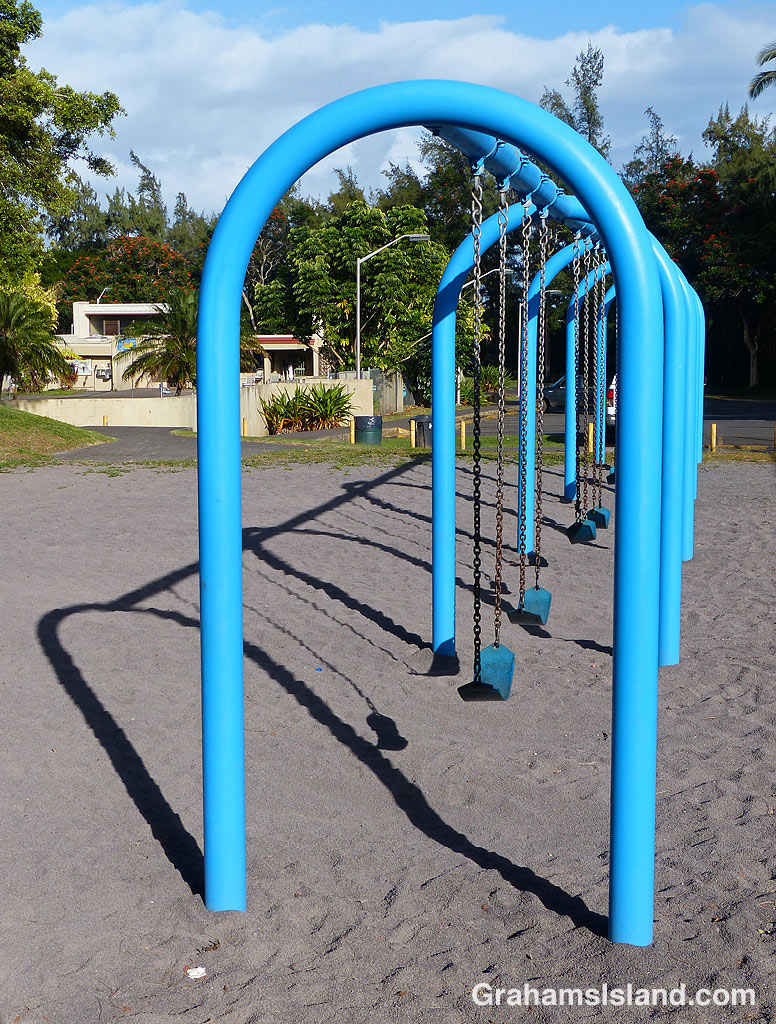
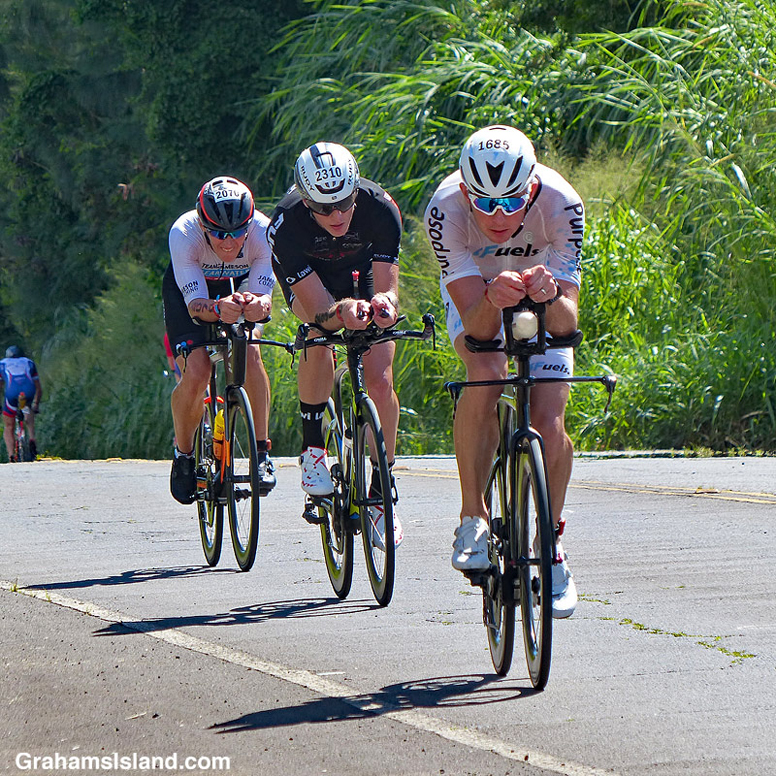
This week’s Sunday Stills challenge theme is ‘Shadows.’ See more offerings here.
The top photo is a row of colorful playground swings at Kamehameha Park in Kapaau. Below are three cyclists in line, heading out of Hawi during an Ironman World Championship race.
Also posted as a second offering for this week’s Friendly Friday challenge theme of ‘All in a Row.’ (See more responses here.) My first post for this theme is here.
This week’s Sunday Stills challenge theme is ‘Gray.’ See more offerings here.
This photo shows a pueo, the native Hawaiian short-eared owl, gliding over a gray road beneath a gray sky. This is a stretch of Old Saddle Road, which is one of the best places to see pueos as they hunt in the pastures on either side of the road or rest on fence posts alongside the road.
Earlier this month, I got up in the wee hours to view the Quadrantids meteor shower, with the idea of taking photos. My camera isn’t the greatest for this, but in the event, it didn’t matter. I caught a peripheral glimpse of one meteor and that was it.
Still, the effort wasn’t without its rewards. The sky was clear and starry, and I liked this scene of the illuminated building, the large kiawe tree, and the dark, starlit sky.
This is my third post on this week’s Sunday Stills challenge theme of ‘Yin-Yang.’ See more responses here.
This past week or so has been a bit bleak weather-wise. At one point we had a high wind warning, winter storm warning, flash flood warning, and a high surf warning. The warnings were justified. Winds blew at 40 to 50 knots with higher gusts. Rain bucketed down. Surf pounded the shorelines. It was an unfortunate week to be vacationing here.
Meanwhile, up on Mauna Kea and Mauna Loa, the winter storm warning produced a decent snowfall giving those peaks a Christmassy look, albeit a few weeks too late.
Yesterday, in certain parts of the island, the wind was honking. 20 miles south, there was a fresh breeze, but up around Kawaihae it blew a steady 40 knots with many higher gusts. Walking into the wind I had to lean forward at the kind of jaunty angle that would have seen me fall on my face on a calm day.
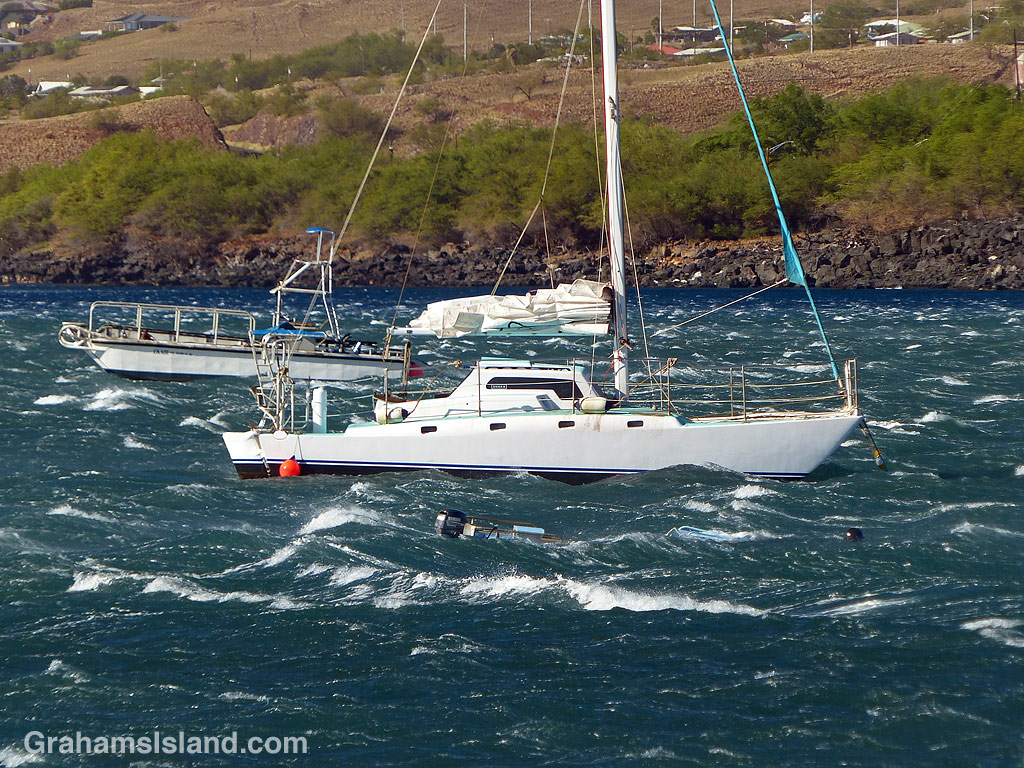
In the late afternoon, I made my way to Kawaihae harbor to see the waves and get a free skin treatment in the form of sandblasting. The very sheltered harbor was roiled with whitecaps from the whipping offshore wind. Most of the boats were bouncing up and down on the choppy waves, but I noticed something amiss. One of the boats wasn’t bouncing because it was mostly underwater. The outboard engine was the most prominent part to be seen.
I suspect that when the wind drops, the boat will still be barely afloat. But it should be able to be salvaged, pumped out, and ready to go again in fairly short order, so long as it doesn’t get taken out on a day like yesterday.
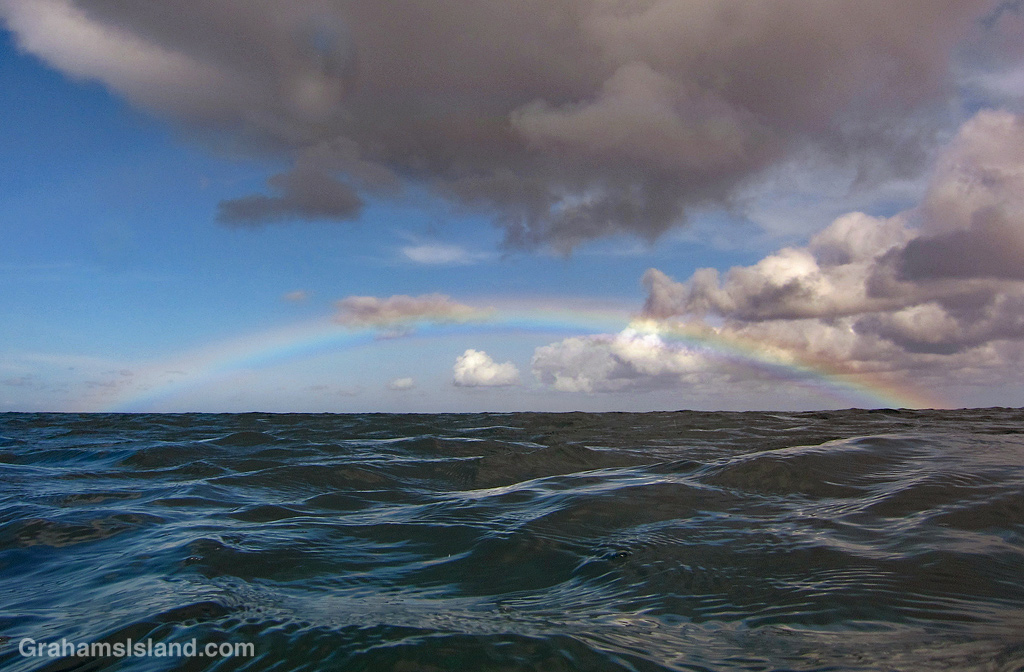
Today marks the start of this blog’s fifth year and to mark the occasion I’m posting a rainbow photo, as I did for the first blog post and for last year’s anniversary.
This rainbow occurred while I was snorkeling in somewhat lumpy water with clumps of clouds above.
On a recent foray into Hawi to get photos for last week’s Sunday Stills challenge (here), I took these photos of the Kohala Welcome Center. This is the place to get information about North Kohala for visitors en route to Kapaau and Pololu, which marks the end of the highway.
On this particular evening, the welcome center was illuminated by its Christmas display and a full moon, which also highlighted the palm trees that tower over that location.