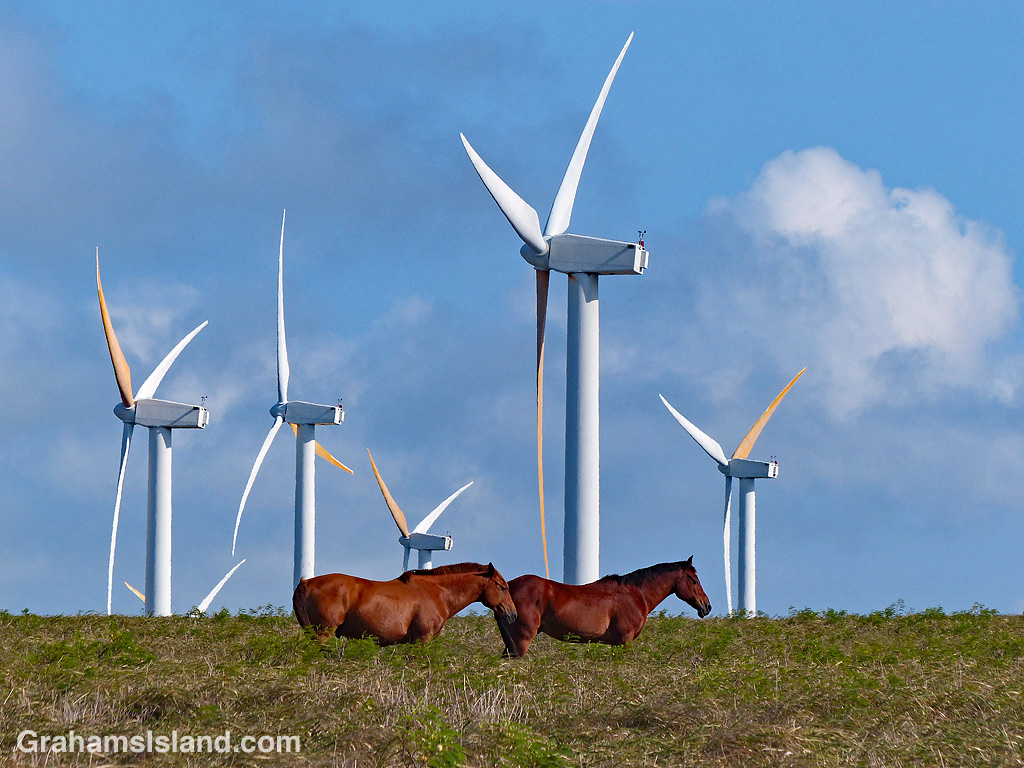
This pair of horses stood motionless for a long time while the turbines of Hawi Wind Farm whirled in the background. Don’t know what they were waiting for.

This pair of horses stood motionless for a long time while the turbines of Hawi Wind Farm whirled in the background. Don’t know what they were waiting for.

Coconut palms stretch upward to the blue Hawaiian sky.

Hualalai volcano has an elevation of 8,271 feet (2,521 m). Only the top of the volcano was poking through the clouds on a recent visit to the top of Mauna Kea.
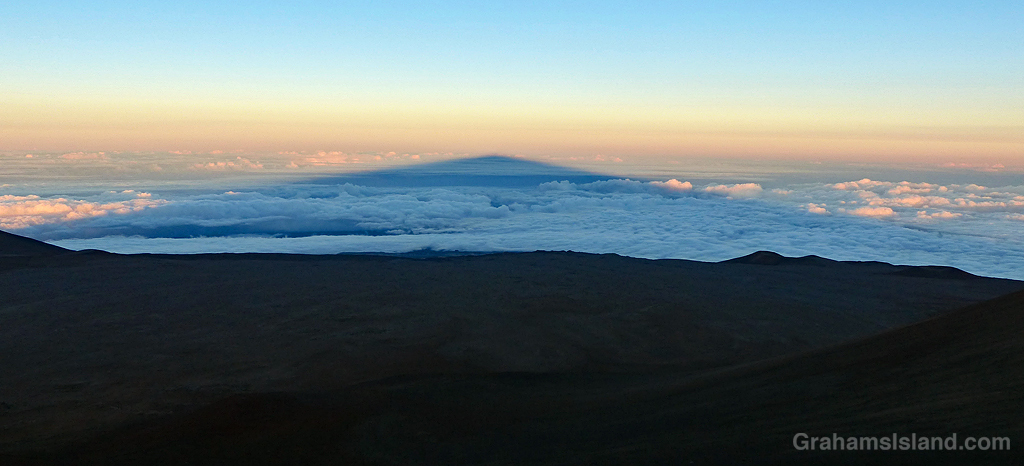
Seen from the top of Mauna Kea, what is this shape we’re looking at, stretched out over the clouds, with that crisp corner at the top? It is, of course, the shadow of the volcano itself.
I like this image a lot, I think because it’s something I never thought about until I saw it. Then, I was immediately struck by how it illustrates the size of Mauna Kea and what a classic volcano it is.

In keeping with my rigorous commitment to staying abreast of current events, it was only on the day before the event that I realized this week’s eclipse of the sun would be visible in Hawaii. Despite it being only be a partial eclipse here, I thought I should make the effort to check it out.
The first issue I had was that I had neither proper viewing glasses, nor the correct filters for my camera. But I thought that, since the eclipse would already be underway at sunrise, I might be able to get a decent photo or two at that moment.
I set my alarm and, when it went off at 5:15 on the big day, I got up and headed out. It was a promising, clear sky morning as I drove to Upolu Point, the northernmost tip of the Big Island. I parked my car and walked up a grassy slope to the headland which I thought would be a good spot for photos. That’s where I saw a band of clouds on the horizon. Maybe it would break up. Maybe it would blow over. Maybe a gap in the clouds would magically appear.
None of those things happened. This was the scene right around sunrise. The sun was eclipsed by the moon, but they were both eclipsed by the clouds. A while later the sun broke free, but by then it was too late for me, with my gear, to get an image. Still, it was a beautiful morning for a walk and not too late to head home for coffee.

Waiting for sunset at the top of Mauna Kea, there are many distractions – shiny telescopes, other sunset watchers, pillowed clouds, and plummeting temperatures. By the time I returned to the car I was ready to turn up the heat, a rare opportunity in Hawaii.
The telescopes are from left: Suburu Telescope, The two telescopes of the W. M. Keck Observatory, and NASA Infrared Telescope Facility.

There are two big contributors to lush, tropical growth – warmth and moisture. That combination helps these banana plants thrive in South Kona.

Mauna Kea is a mecca for astronomers because it boasts clear skies more than 300 days a year. That doesn’t mean Mauna Kea doesn’t get rain, just that it falls more on the lower slopes.
This photo shows the access road, a little way below the summit, socked in with clouds and steady rain. It was a little better at the top, but still very cloudy and not a day for seeing stars.

