
Not sure what kind of bromeliad this is. I had it labeled as a Dwarf Pineapple, but the more I looked at it, the less that seemed right. Not that it matters since it’s the colors and shapes that I was looking at.

Not sure what kind of bromeliad this is. I had it labeled as a Dwarf Pineapple, but the more I looked at it, the less that seemed right. Not that it matters since it’s the colors and shapes that I was looking at.

This endemic damselfish is mostly black or brown with a mottled distribution of light and dark scales, but it’s easily identified by its yellow eyes. It eats filamentous algae and is said to ‘farm’ the algae in its territory, which it defends vigorously against other algae-eaters after its crop.

I like this bench on the steep entry path at Hawai’i Tropical Bioreserve & Garden, for its simplicity and practicality.
For more information about Hawai’i Tropical Bioreserve & Garden, go to htbg.com.


Lesser Brown Scorpions (Isometrus maculatus) are small, shy, and mostly active at night. This is why I’d only seen two here before. One was dead in a box, flattened by the items I was unpacking. The other was alive, but not well. It looked like it had been stepped on.
These photos are of my third encounter, which happened recently. I was getting rid of accumulated odds and ends in the office at work, when I opened up a large, yellow bag that had been stowed there for a year or so. When I looked in, I saw this very much alive and active scorpion.
I took the bag outside, grabbing my camera on the way, and then tried getting some photos, with the help of others in the crew. It was hard to get anything decent because the scorpion scurried around seeking cover. We decided to tip it out onto the tiles. This made the process a bit easier, though not because the scorpion settled down any. It was just as active and every time I looked in the viewfinder it seemed to be making a beeline for me!
After a while I ushered it off the tiles and it scurried away, under the lanai. And while it looks imposing in these photos, it was less than two inches long overall. I’ve read that the sting of these scorpions is similar to a bee sting and not dangerous unless a person is allergic to the toxins. I didn’t feel a need to find out for myself.
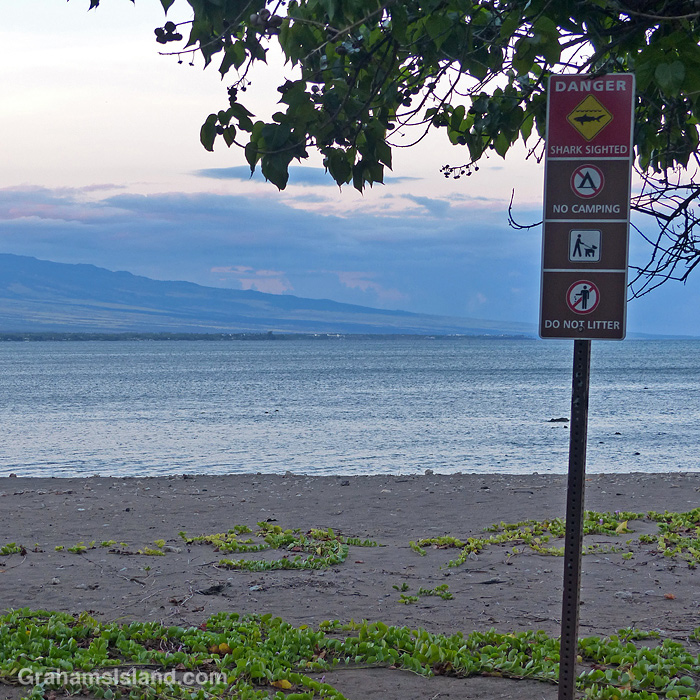
This sign stands behind the little beach below Puʻukoholā Heiau at Kawaihae. Typically, When a shark is sighted, a temporary warning sign is put up, then removed after a few days. This sign is permanent. The reason for this is that beyond this beach is Pelekane Bay and that’s the site of an underwater heiau dedicated to sharks.
This heiau, called Hale o Kapuni, was built by a chief for whom sharks were considered carriers of the spirits of his ancestors. Human sacrifices were carried out on the beach and afterwards, the bodies were believed to have been placed at the heiau for the sharks. Those days are long gone, but the bay and surrounding area is still home to a large population of sharks, hence the sign.
For more information, go to https://www.nps.gov/puhe/index.htm

When I returned to my car after a visit to the post office, this young myna bird landed nearby. It started out on two legs, then one, then plunked down to wait. I think it was looking for its parents to deliver food. They were probably waiting for me to depart. This might be a young bird, but it’s clearly mastered the myna bird scowl.


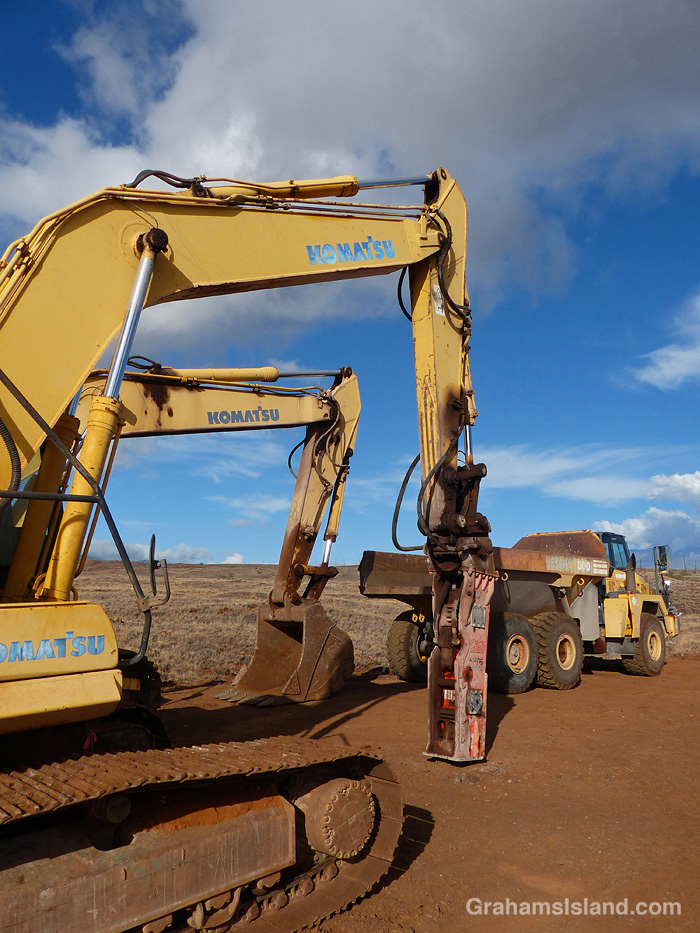
This week’s Sunday Stills color challenge is ‘Mustard.’ See more responses here.
Giant earth moving equipment reminds me of alien robots in space adventure movies. These mustard-colored aliens were resting after a day of destroying the earth, or at least rearranging its contours a bit.


I just liked the way the light illuminated this red ginger in the tangle of tropical foliage.
 Graham's Island